If you've ever received that polite but firm "rejected" from an ICA officer at Kallang Road, you know the feeling. A missing stamp description. A name that doesn't exactly match your passport. A faint seal that wasn't translated. Any one of these can derail your entire application.
Welcome to Singapore's document submission reality, where "close enough" doesn't exist.
Here's what catches most applicants off guard:
- Singapore's Immigration and Checkpoints Authority (ICA)
- Ministry of Manpower (MOM)
- Accounting and Corporate Regulatory Authority (ACRA)
- The Land Transport Authority (LTA)
They operate on zero-tolerance standards. A single mistranslated date or omitted government seal triggers immediate rejection, adding weeks or months to your timeline.
I've seen a PR applicant's Chinese birth certificate rejected because the translator didn't describe a barely visible red seal. Three months lost. An IT professional's Tamil degree was rejected because his name format didn't match his passport exactly. Six weeks' delay, missed job start date.
This guide transforms your approach from "I need a translation" to "I need a zero-rejection submission package." Whether you're translating Mandarin documents in Chinatown, Tamil certificates in Little India, or Vietnamese credentials anywhere in Singapore, the same unforgiving standards apply.
Let's master them together.
What Documents Commonly Require Certified Translation for Singapore Government Agencies?
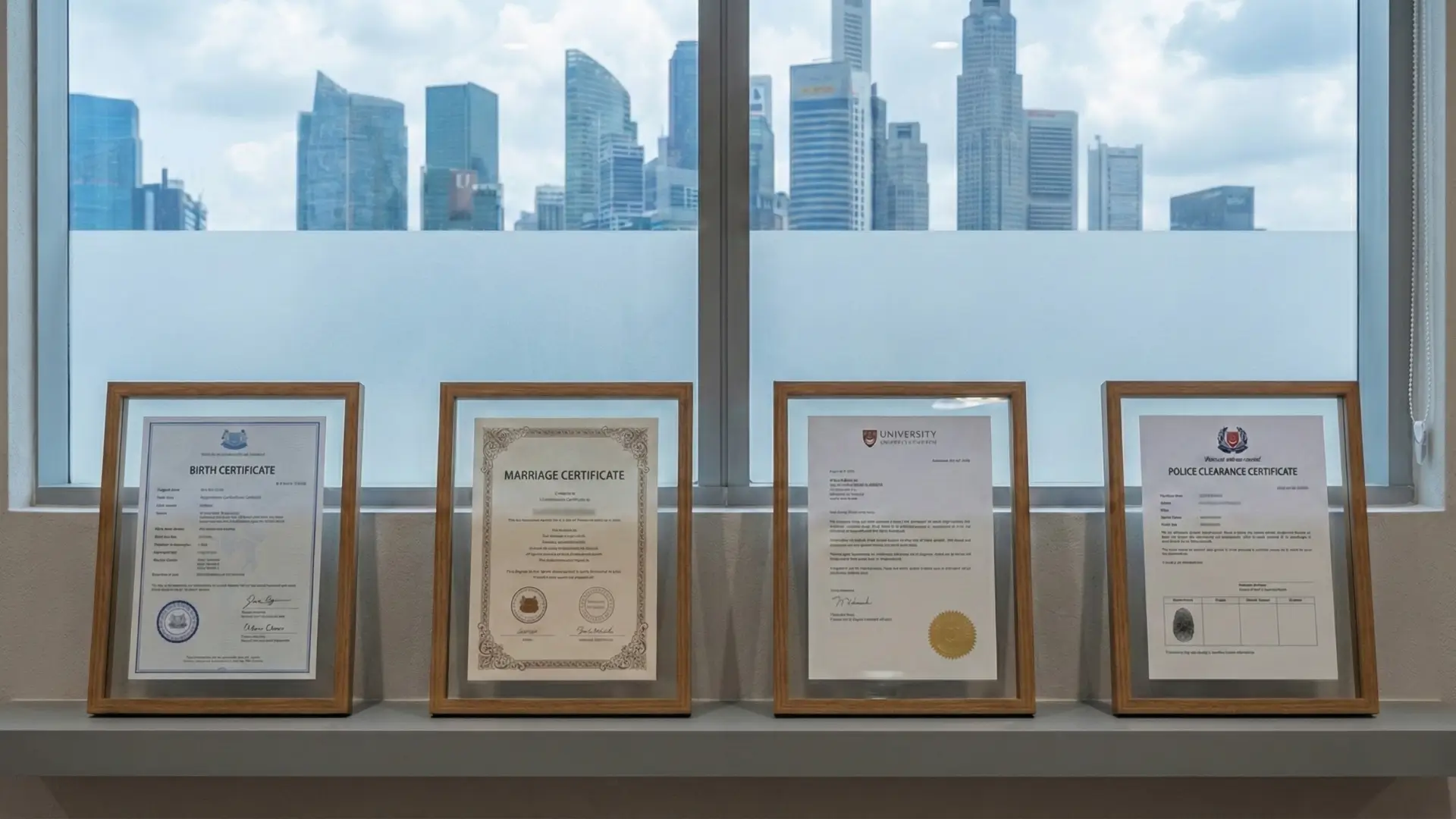
Most applicants know the basics: if you were born, married, or divorced, the government needs to see the paper trail. But Singapore agencies often require specific supporting documents that catch applicants off guard.
Here is what you actually need to prepare, categorized by how likely you are to forget them.
The Core Vital Records (The Obvious Ones)
These are standard for almost every ICA application (PR, Citizenship, LTVP).
- Birth Certificates: Must show full names and parental details.
- Marriage/Divorce Certificates: Crucial for dependent passes.
- Death Certificates: Required if you are updating family status or estate matters.
The "Identity Bridges" (Crucial for Consistency)
This is where many applications fail. If your name has changed over time, or if your family structure is complex, you need documents to "bridge the gap" between your past and present identity.
- Deed Polls / Name Change Certificates: If your degree says "Jane Smith" but your passport says "Jane Doe," this document is mandatory.
- Deed Polls / Name Change Certificates: If your degree says "Jane Smith" but your passport says "Jane Doe," this document is mandatory.
- Household Registers: Common oversight If you are from China (Hukou), Japan (Koseki), or Korea, ICA often requires your family register to verify multi-generational links.
Career & Education (For MOM & Employment Passes)
When verifying your professional value, MOM looks at the details.
- Transcripts & Diplomas: Not just the degree scroll, they often want the transcript showing the modules taken.
- Professional Licenses: If you are a nurse, engineer, or lawyer, your home country license needs translation.
- Employment History: In specific cases, MOM may ask for translated contracts or salary slips to prove your declared salary history.
Legal and Security Clearances
For long-term stays, Singapore needs to know you are in good standing globally.
- Police Clearances: Usually required from any country where you have lived for more than 6 months.
- Court Documents: If you have any litigation history relevant to your employment or character, these must be fully translated.
Travel and Residence Documentation
- Foreign IDs & Permits: Occasionally, ICA will ask to see your National ID card from home or old residency permits to verify your timeline of residence abroad.
Phase 1: The Pre-Translation Audit (Avoiding "Source" Failures)
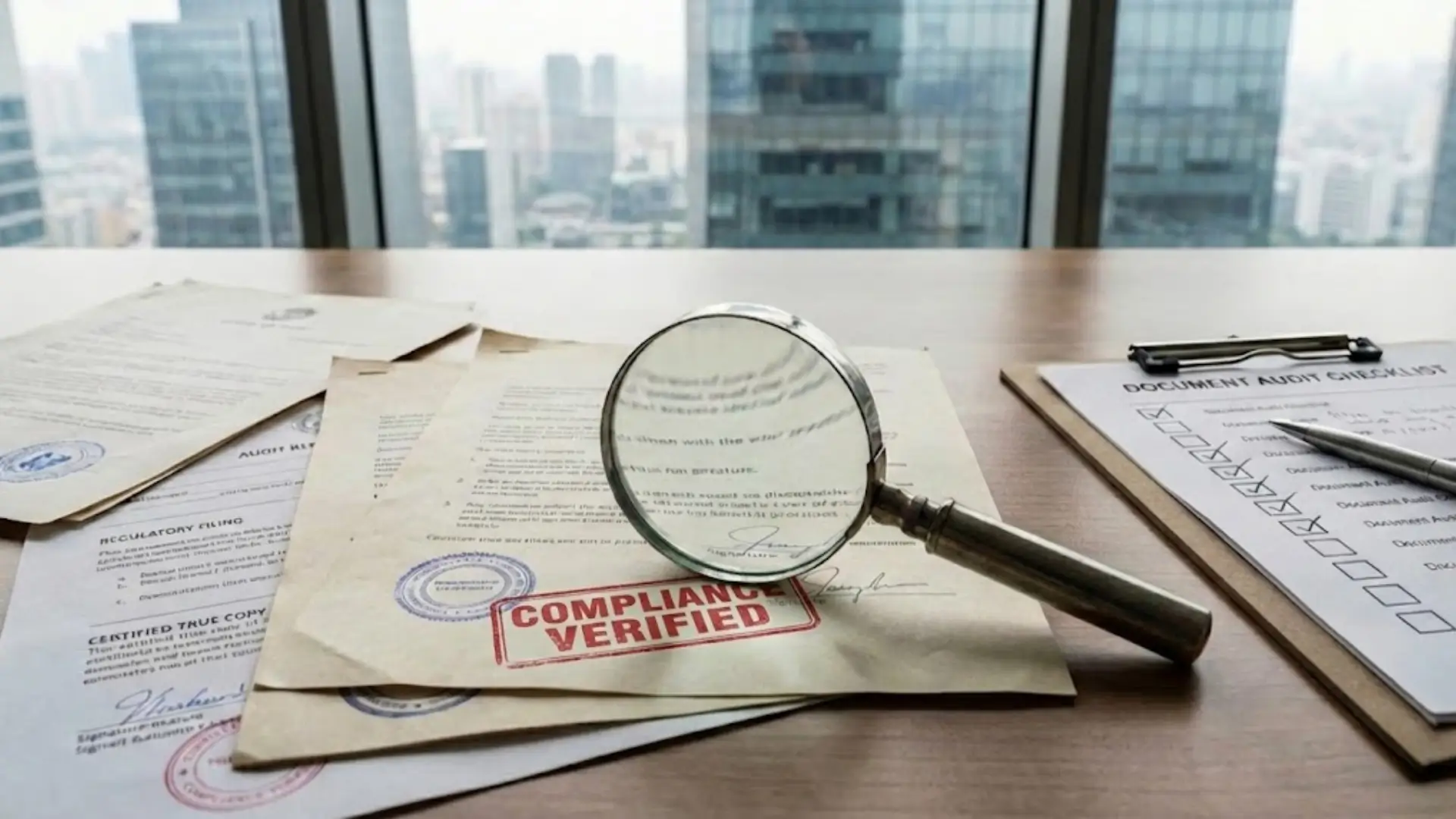
Before you even engage a translation service, conducting a thorough audit of your source documents can save you weeks of delays and hundreds of dollars in re-translation fees.
The Zero-Omission Rule: Capturing Every Visual Element
Singapore government agencies operate on a zero-omission policy. Every visual element on your original document must appear in the translated version, either translated or described. This includes:
- Marginal notes and stamps in the document borders
- Back-page endorsements (marriage certificates often have amendment stamps on the reverse)
- Faint watermarks that establish document authenticity
- Government seals in red, blue, or embossed formats, even if partially visible
I recently worked with a client whose Vietnamese marriage certificate had a barely visible circular seal in the top-right corner. The translator initially missed it because it was so faint.
When we caught this during our quality review, we added a translator's note: "[Circular government seal in red ink, partially faded, bearing the text 'People's Committee of District 1']." That description satisfied ICA's authentication requirements.
The Legibility Standard: When to Obtain Fresh Copies
Handwritten annotations, faded ink, or physical damage to source documents create translation challenges. If your translator must use bracketed tags like "[illegible]" or "[unclear]" in the final version, your submission is likely to face rejection.
When to request fresh document copies:
- Birth or marriage certificates more than 10 years old with visible fading
- Documents with water damage, tears, or staining affecting text areas
- Handwritten sections in cursive or calligraphic scripts that are difficult to decipher
- Certificates with coffee stains, folding damage, or sun-faded sections
Contact your issuing authority for certified fresh copies rather than attempting to translate compromised documents. The $20-50 you spend on a new certificate far outweighs the cost of rejected applications.
Document Integrity: The Lamination Prohibition
Here's a requirement that catches many applicants off guard: do not laminate original documents you intend to notarize.
The Singapore Academy of Law (SAL) authentication process requires notaries to examine original documents for security features, watermarks, and paper quality. Lamination obscures these features and typically results in automatic rejection of authentication requests.
If you've already laminated critical documents, contact the issuing authority for unlaminated certified copies before proceeding with translation.
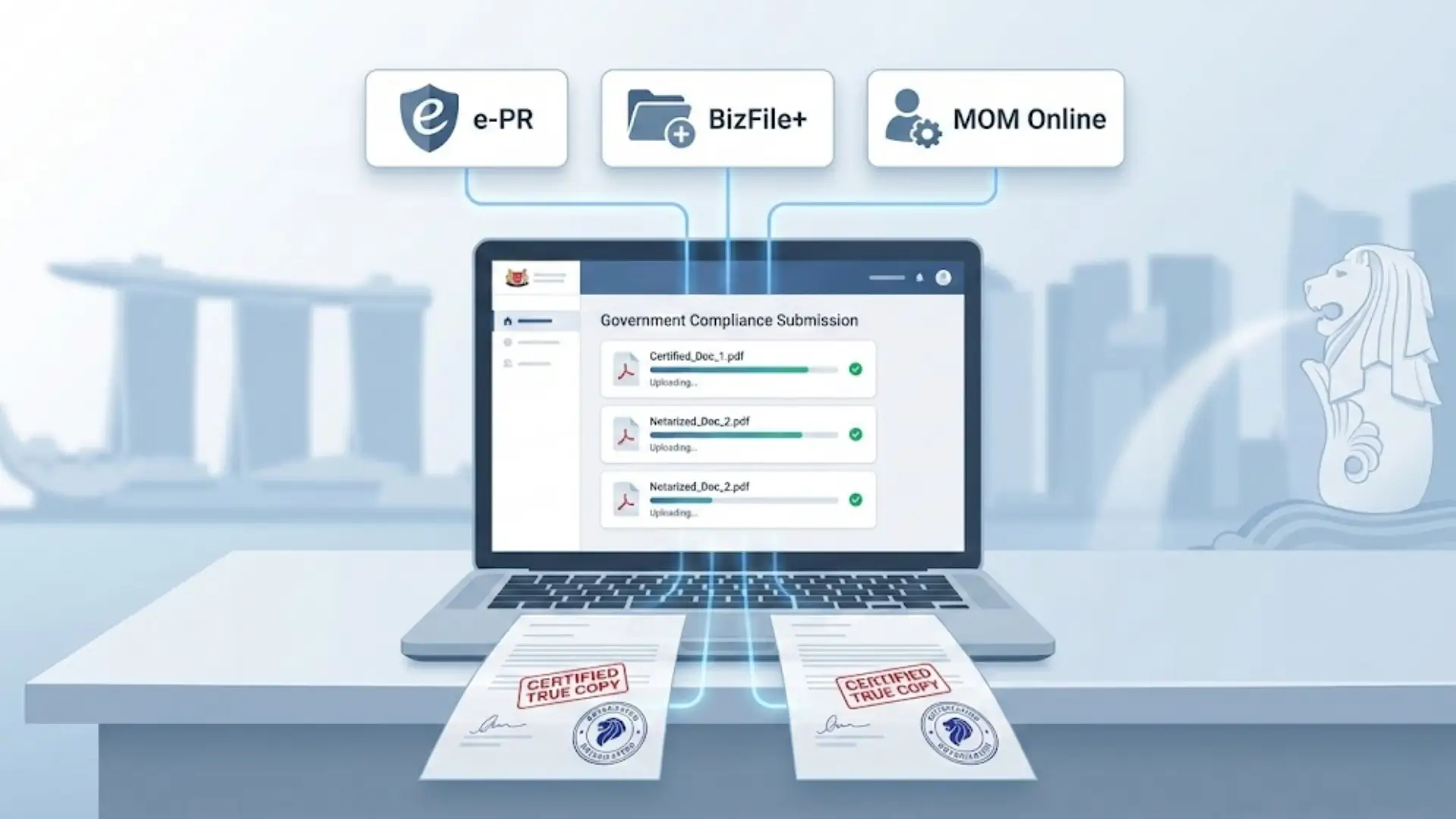
Phase 2: Technical Standards for Digital Portals (e-PR, BizFile+, and MOM Online)
Singapore's government agencies have transitioned to predominantly digital submissions through platforms like e-PR (for permanent residency), BizFile+ (for business registration), and MOM's online employment pass portal. Each platform has specific technical requirements that your translated documents must meet.
Scanning Specifications That Pass Automated Security Checks
Government portals employ automated security scanning to detect document manipulation and verify authenticity. Your scanned documents must meet these specifications:
- Resolution requirements: Minimum 300 DPI (dots per inch) ensures that text remains sharp and government seals display sufficient detail for verification. At 150 DPI or lower, fine text becomes blurry, and micro-text in security features becomes illegible.
- File format standards: PDF or JPEG formats are universally accepted. The e-PR portal specifically enforces a 2.0 MB maximum file size per document.
- Color mode is mandatory: Scans must be in full color, not grayscale or black-and-white. Government agencies need to differentiate official ink colors, red company chops, blue certification stamps, and multi-color security features. I've seen applications flagged as potentially fraudulent simply because black-and-white scanning obscured a red seal that should have been prominently visible.
The Scanner You Use Matters: Why Professional Scanning Beats Mobile Apps
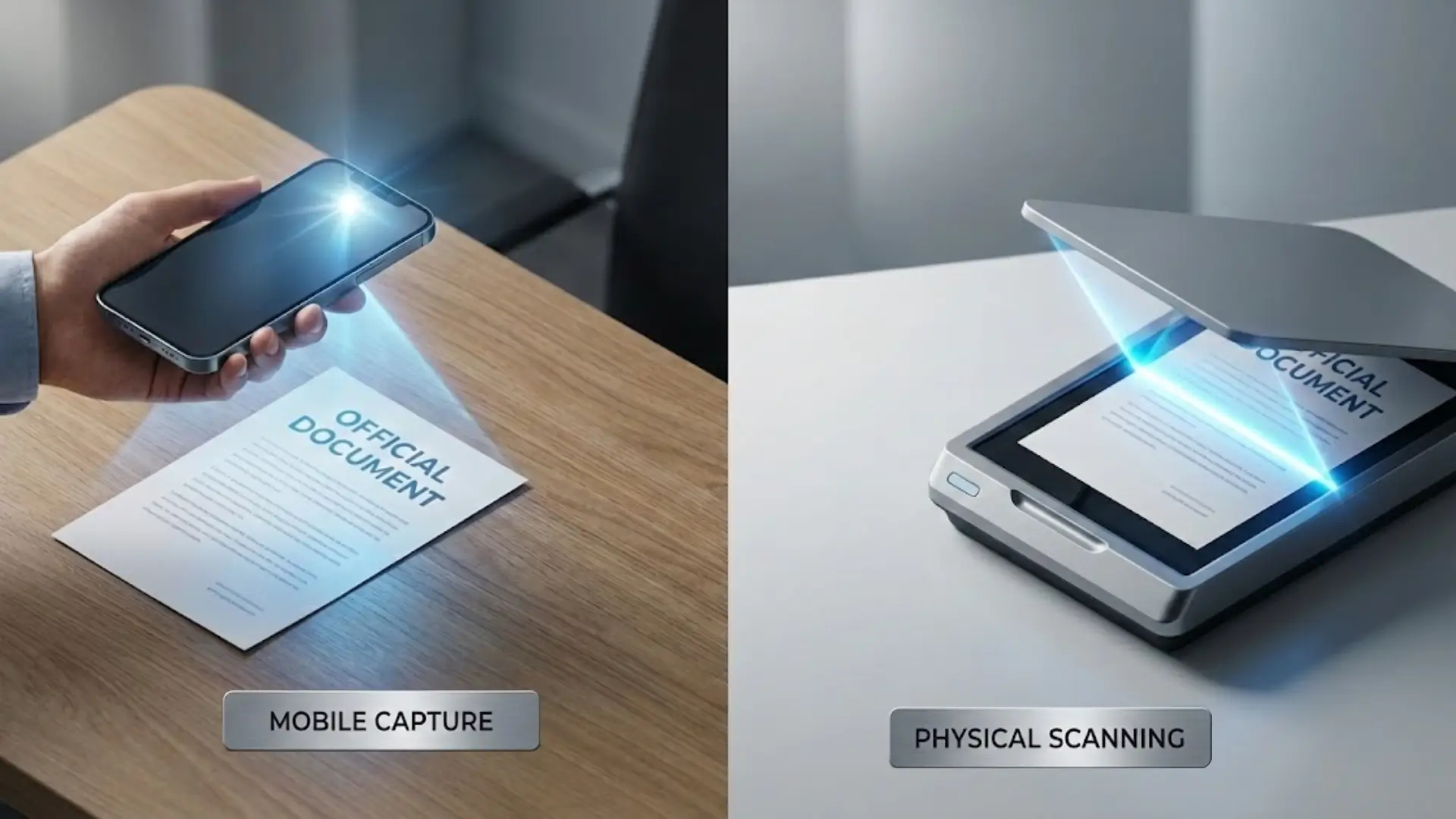
When it comes to official documents, whether for translation, compliance, or government verification the quality of your scan can make or break the process.
The Problem with Mobile Scanning Apps
Sure, mobile apps are convenient. But they often introduce:
- Perspective distortion (angled shots that warp text)
- Uneven lighting (shadows or bright spots across the page)
- Reflective glares (especially on laminated IDs or glossy paper)
These flaws aren’t just cosmetic. They can trigger security flags in automated document verification systems, leading to unnecessary delays or outright rejection.
The Best Practice: Flatbed Scanning
For critical documents, always choose a flatbed scanner at a:
- Professional print shop
- Certified translation agency
- Local government service center
By placing your document flat against the glass, you eliminate shadows and guarantee edge-to-edge capture, the standard required for compliance and verification.
Phase 3: The "Exact Match" Naming Convention
Our agency statistics show that name discrepancies represent 25% of all application rejections across Singapore government agencies.
The fundamental rule: character-for-character matching between your translation and your passport.
The Passport as Your Single Source of Truth
Your passport establishes your legal identity in Singapore's administrative systems. When translators convert your name from Vietnamese, Chinese, Arabic, Tamil, or any other script into English, the result must match your passport exactly:
- Name order: Some cultures place family names first (Wang Xiaoming), while passports may invert this to Western order (Xiaoming Wang). Your translation must mirror the passport sequence.
- Special characters: Hyphens (Jean-Pierre), apostrophes (O'Connor), and spaces within given names must appear identically.
- Spelling variations: "Muhammad" versus "Mohammed," "Sergey" versus "Sergei," or "Xiao Ming" versus "Xiaoming" (spaced versus combined) use exactly what appears in your passport.
Content Bridging: When Names Don't Match Across Documents
You might encounter situations where your birth certificate shows one name format, your degree shows another, and your passport shows a third. This commonly occurs with:
- Married women whose birth certificates show maiden names
- Individuals who've legally changed names but hold older academic credentials
- People from cultures using different naming conventions in various contexts (formal name versus commonly used name)
The solution: Documentation bridges
- Letter of Explanation: A signed, notarized letter explaining the name variation and confirming that all names refer to the same individual. For example: "I, Sarah Michelle Johnson (as per passport AB1234567), was born as Sarah Michelle Tan (as per birth certificate). I changed my surname upon marriage on March 15, 2015."
- Deed Poll or name change certificate: Obtain this from your home country's registry if you've legally changed your name. This document formally links your previous and current names.
- Self-introduction letter: Used primarily in Chinese cultural contexts, this notarized document confirms that multiple name variations (e.g., a Chinese name and an English adopted name) belong to the same person.
Phase 4: Navigating Agency-Specific Translation Requirements
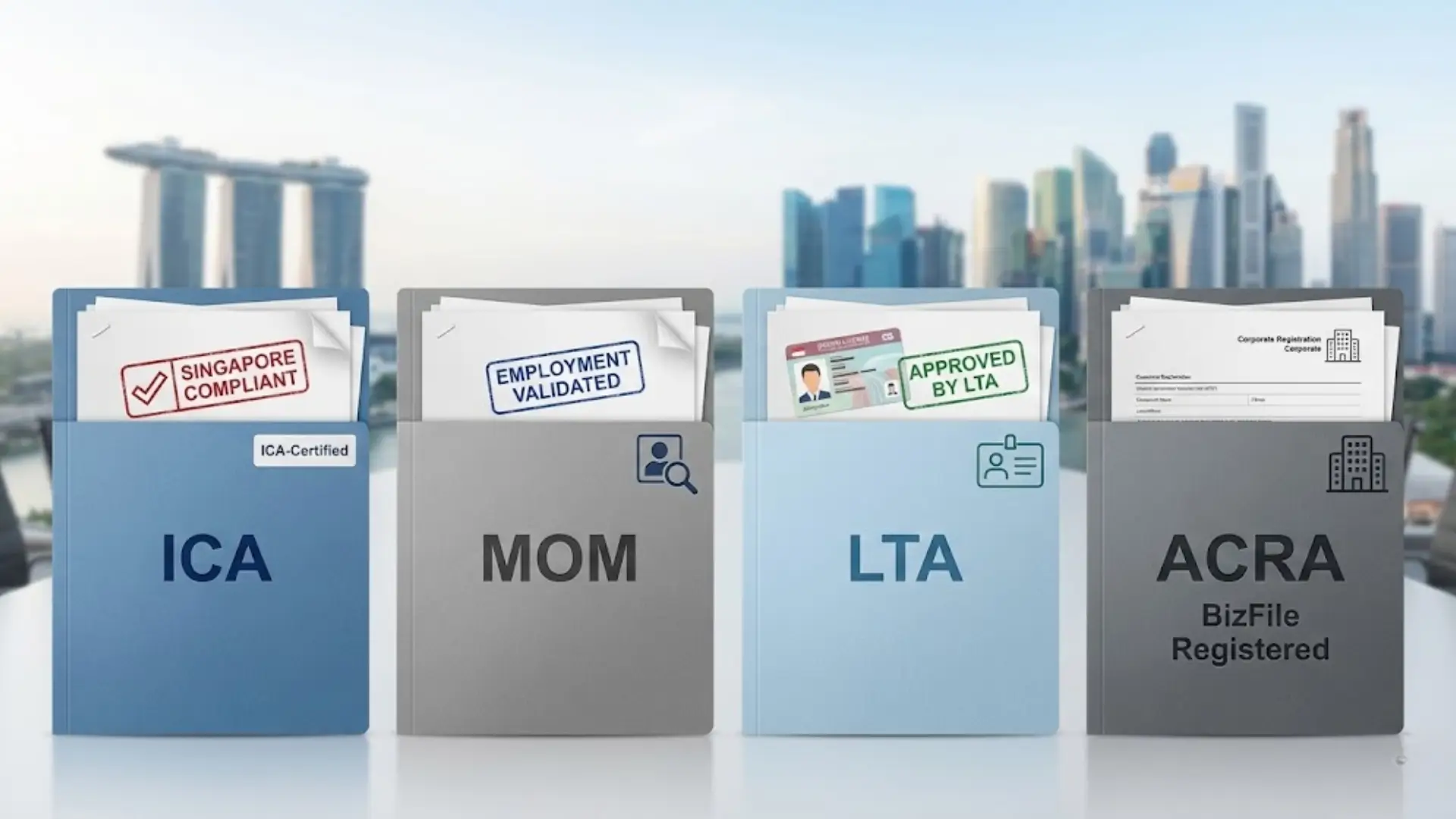
Each Singapore government agency enforces distinct translation and authentication standards based on its regulatory mandate. Understanding these variations prevents the costly mistake of preparing documents for the wrong standard.
ICA (Immigration & Checkpoints Authority): The "Certified + Notarized" Combo
ICA applications for permanent residency, citizenship, and dependent passes require the highest level of document authentication in Singapore.
The requirement: A certified translation alone is insufficient. You must have:
- A professional translation with the translator's certification statement
- Notarization by a Singapore Notary Public who witnesses your declaration that the translation is accurate
- Authentication by the Singapore Academy of Law (SAL) confirming the notary's credentials
This three-tier process creates an unbroken chain of accountability. A simple agency stamp or translator's declaration won't satisfy ICA's requirements for life-changing decisions like permanent residency.
Processing time consideration: Budget 5-7 business days for the complete notarization and SAL authentication process, separate from translation time.
MOM (Ministry of Manpower): Education Verification Focus
Employment pass applications prioritize educational credential verification. Beyond translation, MOM frequently requires:
Third-party verification: For degrees from certain countries or institutions, MOM requires verification from approved background screening companies like Verifile or Credentials Solutions. These companies contact your university directly to confirm your degree's authenticity.
Document combination: MOM's portal requires the original foreign-language document and English translation merged into a single PDF file. Place the translation immediately after the corresponding original page.
Translation certification format: MOM accepts translations from registered companies, but doesn't always require notarization unless the document relates to family or dependent matters.
LTA/Traffic Police: License Conversion Requirements
Foreign driver's licence conversions have unique requirements regarding both the provider and the format of the translation.
The "Hard Copy" Mandatory Requirement
Unlike many digital submissions, the LTA requires a physical certified translation for driver's licence conversions. A soft copy (PDF) alone is not sufficient.
Who Can Translate?
LTA generally requires translations to be certified by the Embassy of the issuing country or a
Singapore-registered translation company. A standalone translation from a freelance translator
without a company UEN or notarization is rarely accepted.
The LetterCrafts Timeline for LTA Translations: To ensure you meet the hard copy requirement, our process is structured as follows:
- Translation Start: Work begins immediately once the quotation is confirmed.
- Soft Copy: Emailed to you within 24-36 hours for verification.
- Hard Copy: The physical document is couriered via SingPost, arriving within 3-5 working days.
Why this matters: Plan your trip to the Traffic Police headquarters only after you have received the physical hard copy of your translation.
ACRA (Accounting and Corporate Regulatory Authority): Business Document Standards
When registering foreign companies or submitting foreign-language financial statements:
Parallel filing: ACRA requires both the original foreign-language document and the certified English translation to be filed together in the BizFile+ system.
Constitution and governance documents: Foreign company constitutions must be translated by a qualified legal translator familiar with corporate terminology in both source and target languages.
Financial statements: Particularly for companies from China, Japan, or Korea, ensure your translator understands accounting terminology specific to your jurisdiction's accounting standards (e.g., PRC GAAP versus Singapore FRS).
Phase 5: The Legalization Chain (Step-by-Step Process)
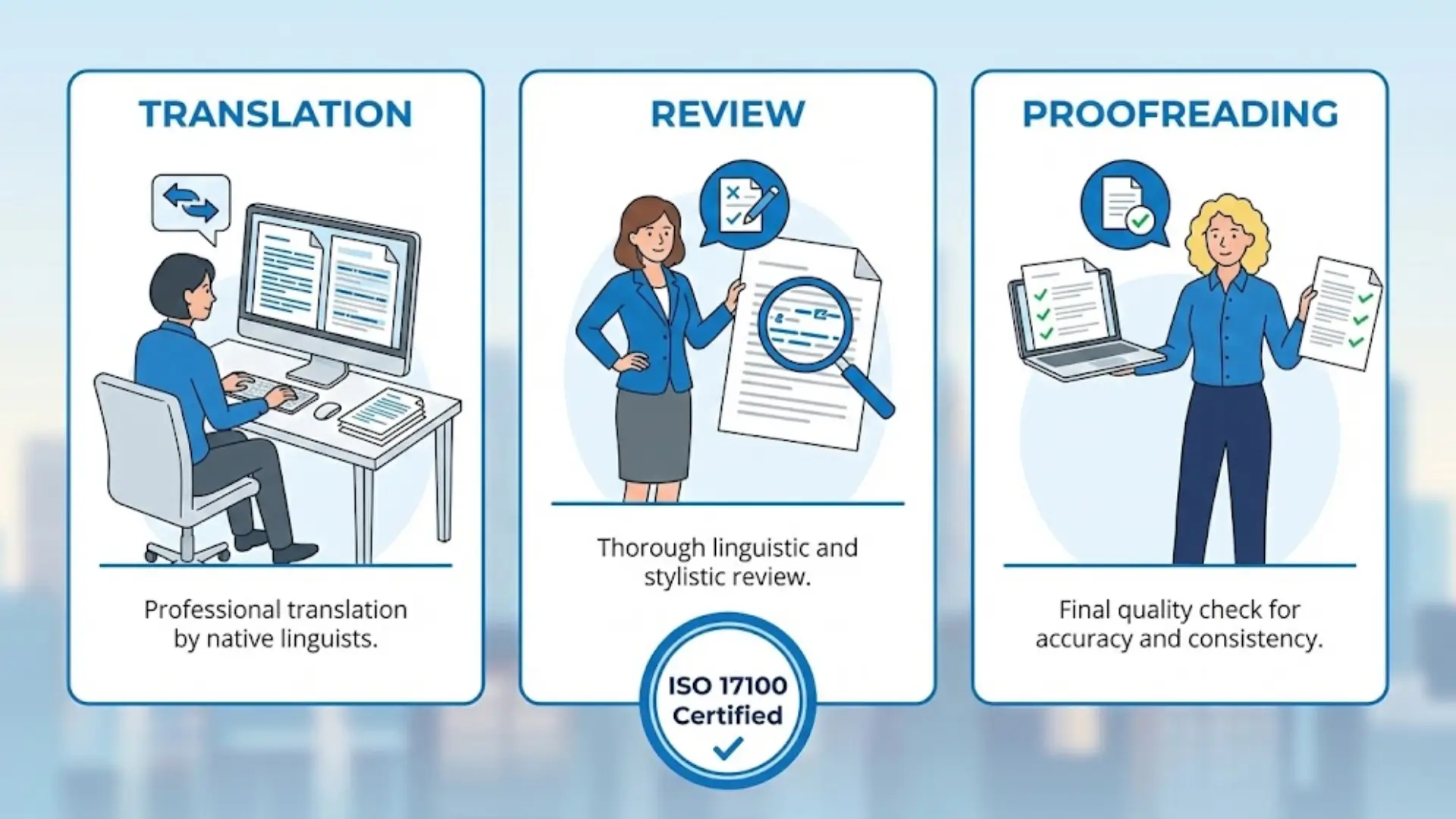
Understanding the complete legalization chain prevents confusion about which services you actually need for your specific situation.
Step 1: Professional Translation (ISO 17100 Standard)
Your translation must come from a qualified professional translator or translation company. The ISO 17100 standard ensures:
- Translation by a qualified linguist with verified competence in both languages
- Review by a second linguist for quality assurance
- Final proofreading by a subject matter expert when technical terminology is involved
The certification statement should include:
- Translator's full name and credentials
- Statement confirming the accuracy and completeness of the translation
- Translation company's stamp and registration details
- Date of translation
- Contact information for verification purposes
Step 2: Notarization (Binding with Red Ribbon and Seal)
A Singapore Notary Public performs two distinct functions in document legalization:
Witnessing your signature: You sign a declaration stating that you understand the translation and believe it to be accurate. The notary witnesses this signature and verifies your identity using your passport or national ID.
Certifying the translation: Some notaries also directly certify translations as true copies or accurate translations. This involves the notary examining both documents and attesting to their correspondence.
The physical result: The notary binds the original document and translation together with a red ribbon, affixes a wax seal or notarial seal, and issues a notarial certificate. This creates a tamper-evident package.
Cost considerations (2026 rates):
- Notarial certificate: $75.00 (regulated fixed fee)
- Witnessing first signature: $40.00
- Each additional signature: $20.00
Step 3: SAL Authentication (Mandatory Since 2019)
The Singapore Academy of Law authentication service verifies that the notary public who prepared your document is registered and authorized to practice in Singapore.
The process:
- Submit your notarized document to SAL either in person at their office or through their e-authentication portal
- SAL verifies the notary's signature and seal against their database
- SAL affixes its authentication certificate to your document
- SAL returns the authenticated document (typically within 2-3 business days)
Current fee: $87.20 including GST (as of January 2026)
Why this matters: Since 2019, ICA and other agencies have rejected notarized documents that lack SAL authentication. This requirement prevents fraudulent notarizations and establishes a verified chain of authenticity.
Step 4: The Apostille (For International Use Only)
The Apostille is relevant only when you're sending Singapore-issued documents to Hague Convention countries outside Singapore, or when you need to authenticate foreign documents for use in Singapore that come from Hague Convention countries.
When you need an Apostille:
- You're using a Singapore-issued document (e.g., a Singapore degree) for immigration to another country
- You're authenticating a document from a Hague Convention country for use in Singapore (though Singapore authorities increasingly accept direct submissions)
When you don't need an Apostille:
- For documents used within Singapore only (ICA, MOM, LTA submissions)
- For documents from non-Hague Convention countries (these require consular legalization instead)
The LetterCrafts Process: Your "Zero-Rejection" Submission Partner
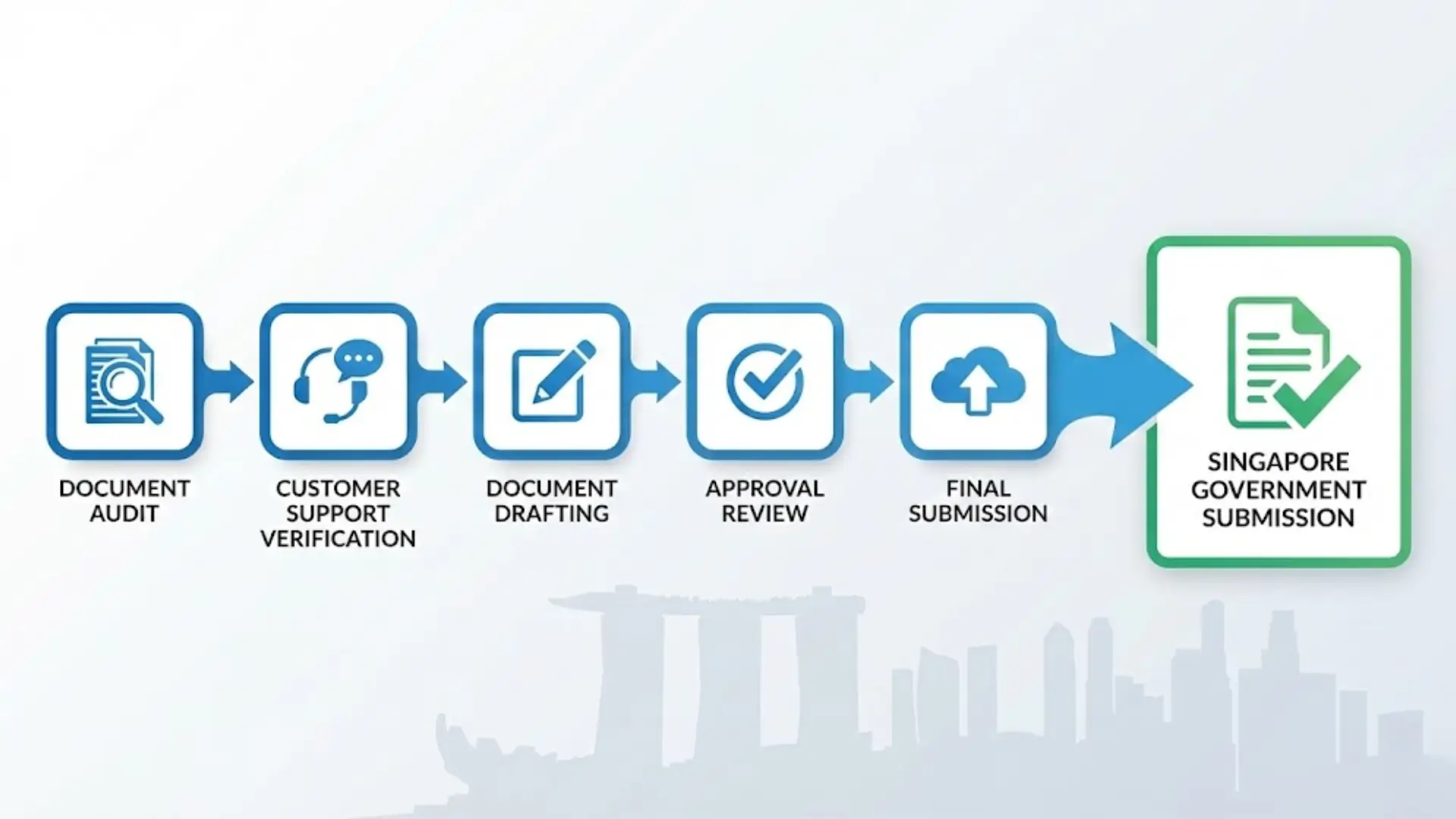
At LetterCrafts, we've developed a systematic approach specifically engineered for Singapore government submission requirements. Our process addresses every common rejection point before your documents reach government agencies.
Our Five-Stage Quality Assurance System
Stage 1: Document Audit
Before translation begins, our compliance specialists examine your source documents for:
- Missing pages or back-page content
- Faded seals or illegible sections requiring fresh copies
- Lamination issues that would prevent notarization
- Name variations that need bridging documentation
We contact you immediately if we identify issues, often saving 2-3 weeks by catching problems before translation.
Stage 2: Qualified Translator Assignment
We match your documents with translators who have:
- Native fluency in your source language
- Minimum 5 years' experience with Singapore government submissions
- Subject matter expertise (legal translators for court documents, educational specialists for academic credentials)
- Proven track record with your specific agency (ICA, MOM, LTA, or ACRA)
Stage 3: Translation with Zero-Omission Protocol
Our translators follow strict protocols:
- Every seal, stamp, and marginal note is translated or described
- Content structure maintains logical flow and traceability, with tables, sections, and data fields clearly organized for official review
- Translator's notes explain ambiguous elements
- Technical terminology matches agency-accepted standards.
Stage 4: Multi-Layer Review
- Second translator reviews for accuracy and completeness
- Compliance specialist verifies against agency-specific requirements
- Name-matching algorithm confirms passport alignment
- The technical specification check ensures scanning standards
Stage 5: Notarization and SAL Authentication Coordination
For ICA submissions requiring notarization, we:
- Schedule appointments with our network of notaries public
- Prepare all declaration statements in advance
- Submit to SAL for authentication
- Deliver your complete, submission-ready package
The Outcome: First-Attempt Approval
Our zero-rejection commitment means that if your document is rejected due to translation quality, formatting, or omissions, we will retranslate it at no additional charge. In practice, our pre-submission quality assurance achieves a 99.2% first-attempt acceptance rate across all Singapore government agencies.
Your Final "Zero-Rejection" Submission Checklist
Use this checklist for each document before submission to ensure compliance with Singapore government agency standards.
Document Completeness Review
- [ ] All pages present: Have I included the front and back of every page, even if the back appears blank?
- [ ] Supplementary pages: For multi-page documents, are all continuation sheets included?
- [ ] Attachments: If the original has stapled addenda or annexures, are these translated too?
Visual Fidelity Standards
- [ ] Structural Clarity: Are tables, headings, and paragraphs logically represented so they can be easily traced back to the source document?
- [ ] Seal descriptions: Are all seal descriptions included with clear references to their approximate location on the original document?
- [ ] Professional presentation: Does the formatting maintain appropriate formality and readability for official submission?
Zero-Omission Verification
- [ ] All stamps translated: Have I verified that every stamp (date stamps, office stamps, security stamps) is either translated or described?
- [ ] Seal descriptions complete: Do I have descriptions of red seals, blue seals, embossed seals, and watermarks?
- [ ] Handwritten notes: Are all margin notes, endorsements, and handwritten additions translated?
- [ ] Back-page content: Have I checked the reverse side for stamps or amendments?
Naming Convention Accuracy
- [ ] Passport comparison: Does the translated name match my passport exactly, character-for-character?
- [ ] Name order correct: Is the sequence (given name/surname) identical to my passport?
- [ ] Special characters: Are hyphens, apostrophes, and spaces exactly as shown in my passport?
- [ ] Bridging documentation: If names vary across documents, have I prepared explanatory letters or deed poll certificates?
Technical Specifications
- [ ] Scan quality: Is the document scanned at a minimum 300 DPI resolution?
- [ ] Color mode: Is the scan in full color, showing red/blue official inks?
- [ ] File size: Is each file under the portal's limit (typically 2-5 MB)?
- [ ] File format: Have I saved documents as PDF or JPEG as required?
- [ ] Clarity check: When zooming to 200%, is all text sharp and readable?
Legalization Chain Completion
- [ ] ICA submissions: Do I have a notary public seal AND SAL authentication certificate?
- [ ] Notary binding: Are the original and translation bound together with red ribbon and wax seal?
- [ ] Translator certification: Does the translation include a certification statement with the translator's credentials?
- [ ] LTA hard copy requirement: For driver's licence conversions, have I received the physical certified translation (not just the PDF)? Does it include the translator's company UEN on the certification statement?
Platform-Specific Preparation
- [ ] MOM combined files: Have I merged the original and translation into a single PDF with correct page ordering?
- [ ] ACRA parallel filing: Do I have both the foreign-language original and translation ready for simultaneous upload?
- [ ] File naming convention: Are files named clearly (e.g., "Birth_Certificate_Original.pdf" and "Birth_Certificate_Translation_EN.pdf")?
Conclusion: Secure Your Future in Singapore with Compliant Documentation
You've invested time, money, and hope in your Singapore application, whether it's building a new life through PR, advancing your career through an employment pass, or expanding your business through ACRA registration. Your documents deserve the same level of precision that Singapore's system demands.
LetterCrafts specializes in creating submission-ready documentation packages that pass government scrutiny on the first attempt. Our translators understand that they're not just converting words between languages; they're creating legal documents that government officers will examine with zero tolerance for errors.
Get your free 30-minute consultation: We'll review your specific documents, identify potential compliance issues, and provide a detailed quotation with no obligation. Our compliance specialists will explain exactly what your application requires and how we ensure every element meets ICA, MOM, LTA, or ACRA standards.
Contact LetterCrafts today: Don't let preventable document failures delay your Singapore future. Let us handle the technical complexity while you focus on what matters, preparing for your new chapter in Singapore.