Executive Summary: Technology Translation Compliance in Singapore (2026)
If you're launching a technology product in Singapore this year, here's what you need to know before anything else.
- Legal Requirement: Under Singapore's Strategic Goods (Control) Act, English translations of trade records must be provided to Singapore Customs within 14 days of a request. Non-compliance is a legal offence, not an administrative oversight.
- Primary Business Risk: Mistranslated UI content and technically inaccurate documentation are among the most common causes of HSA submission rejections, MAS audit failures, and post-deployment product recalls in Singapore's tech sector.
- Data Law Obligation: Any translation provider handling your proprietary technical data, source code documentation, or engineering records is classified as a Data Intermediary under Singapore's PDPA. This requires AES-256 encryption, access controls, and documented data retention and deletion schedules.
- The Real Success Factor: The companies that succeed in Singapore don't just translate, they localise with domain intelligence. That means engineering-aware content adaptation, regulatory vocabulary alignment, and Southeast Asian UX considerations built in from the start.
The Problem Most Tech Companies Don't See Coming
If you are entering Singapore's technology market in 2026, you will face a specific kind of tension. On one hand, Singapore is an advanced, English-proficient execution hub for fintech, biotech, hardware, and enterprise software. Its regulatory frameworks are sophisticated. Its professional workforce is internationally oriented. English is an official language.
On the other hand, Singapore is the gateway to a region of 680 million people who speak Thai, Bahasa Indonesia, Vietnamese, Tagalog, and dozens of sub-dialects markets where your product's commercial success depends entirely on how well its technical documentation, interfaces, and communications translate beyond English, in which it was built.
Here is the problem: most technology companies treat translation as a downstream task, something to arrange after the product is finished. In Singapore, that approach creates compounding risk regulatory exposure, engineering rework, and the subtler erosion of credibility in markets that can tell the difference between a product built for them and one adapted for them as an afterthought.
What Are Expert Technology Translation Services in Singapore?
Expert technology translation services are specialised language solutions that convert technical documentation, software interfaces, regulatory submissions, and engineering records into Singapore's required languages and the target languages of Southeast Asian expansion markets while preserving technical precision, regulatory compliance, and cultural appropriateness.
This definition matters because it is fundamentally different from what a general translation service provides. General translation addresses language. Expert technology translation addresses risk
The Difference Between General Translation and Expert Tech Localisation
This distinction is critical because general translation addresses language, while expert technology translation addresses risk. In Singapore's tech sector, a mistranslated API reference or an ambiguous "Instructions for Use" document doesn't just produce a linguistic error. It produces a regulatory Request for Information (RFI) from the HSA, a failed MAS compliance audit, a product liability claim, or a software deployment failure.
To prevent these outcomes, a genuinely expert localisation partner must operate across three layers simultaneously:
- Technical Domain Fluency: Your translation team must know the difference between "error" and "fault," or "encryption" and "hashing", even in languages where no direct equivalent exists. Getting the technically correct term requires understanding the underlying engineering concept, not just looking at a dictionary.
- Regulatory Vocabulary Alignment: Regulators like the HSA, MAS, and Singapore Customs use exact, controlled vocabularies. They do not accept approximate terminology. Submissions using non-standard language, even if technically accurate, generate clarification requests that can delay your launch by months.
- IP and Data Protection: Every document containing proprietary architecture, clinical algorithms, or source code must be treated as sensitive IP governed by Singapore's PDPA. This is a strict legal obligation for translation providers handling your content, not a "nice-to-have" preference.
The Real Cost Gap: Generalist vs. Expert Translation
The cost difference between expert and generalist translation is easy to spot on an initial quote. The actual cost difference only becomes visible much later, usually at the worst possible moment.
| Stage | The Generalist Path (High Risk) | The Expert Path (Risk Managed) |
|---|---|---|
| Stage 1 | Literal translation completed quickly and cheaply. | Domain-validated technical localisation. |
| Stage 2 | Regulatory RFI or Customs non-compliance notice. | First-pass regulatory approval. |
| Stage 3 | 3–6 month launch delay | Immediate market entry |
| Stage 4 | Emergency engineering rework for UI and docs. | Scalable, reusable documentation infrastructure. |
| Final Cost | Initial savings eliminated; massive additional spend. | Higher upfront cost; zero rework required. |
The bottom line: The generalist path is cheaper to start, but vastly more expensive to finish.
Types of Expert Technology Translation Services in Singapore
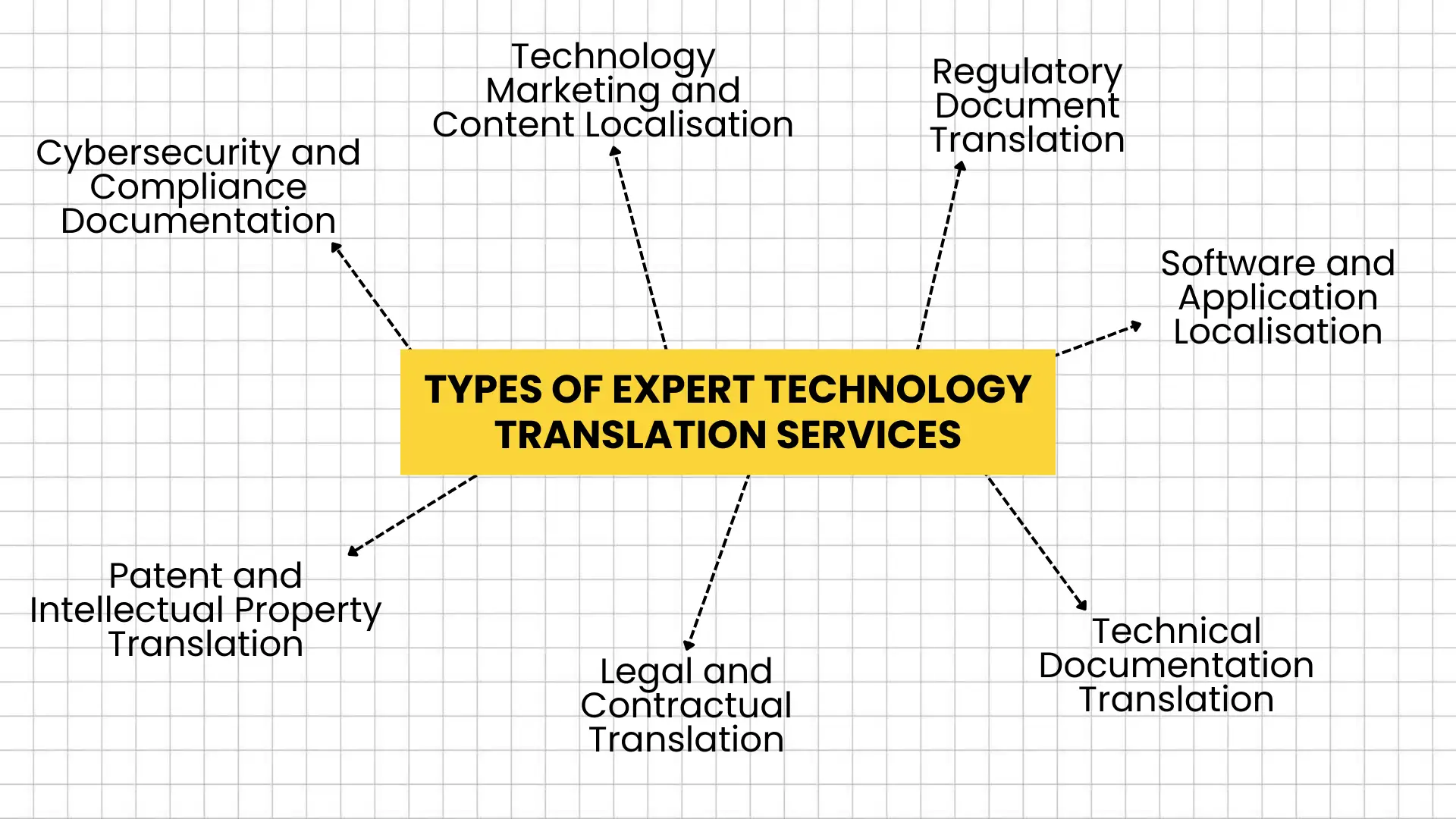
Technology translation is not a single service. It spans seven distinct categories, each with different technical requirements, regulatory implications, and consequences when done poorly. Understanding which category applies to your situation is the first step in building an effective localisation strategy.
Regulatory Document Translation
This covers HSA technical dossiers for medical technology, MAS compliance documentation for fintech platforms, and Strategic Goods permit records for hardware and semiconductor exporters. These translations are legally consequential; their quality directly determines your approval timeline and your clearance status with Singapore Customs.
A regulatory submission is not a marketing document. The language must map precisely to the vocabulary frameworks each regulator uses. One non-standard term in a Class C device dossier can trigger a Request for Information that adds three months to your launch timeline.
Software and Application Localisation
This adapts your full user interface menus, error messages, onboarding flows, tooltips, notifications, and in-app content for Southeast Asian languages and scripts. It is important to understand that this is not word substitution.
English text translated into Indonesian or Vietnamese typically expands by 200–300% in character count. A button that reads "Submit Payment" in English becomes a multi-line text block in Bahasa Indonesia if the UI was not engineered for text expansion. Thai script does not use spaces between words, which breaks standard line-breaking logic in most UI frameworks. Arabic and Jawi require a full right-to-left UI mirror, not just text direction reversal, but a reconfiguration of the entire layout hierarchy.
Software localisation must begin at the design stage, not after build.
Technical Documentation Translation
This handles engineering manuals, API documentation, system architecture specifications, white papers, and product datasheets. This category demands translators with genuine engineering domain knowledge, not linguists who are willing to look up technical terms.
A translator working on semiconductor fabrication process documentation needs to understand semiconductor fabrication. A translator working on fintech API documentation needs to understand API architecture. Fluency in the language is table stakes. Domain understanding is what produces accurate output.
Legal and Contractual Translation
Technology licensing agreements, SaaS terms and conditions, data processing agreements, NDAs, and IP transfer documents carry legally enforceable meaning. A translation error in this category does not just create misunderstanding; it can alter contractual obligations in ways that only surface during disputes.
Patent and Intellectual Property Translation
Patent translation is among the most precision-critical categories in technology. Patent claims are highly formalised, jurisdiction-specific, and strategically structured. A mistranslated claim boundary can affect the enforceable scope of IP protection across every country in your regional filing portfolio.
Cybersecurity and Compliance Documentation
Security policies, penetration testing reports, incident response procedures, and Data Protection Impact Assessments (DPIAs) sit at the intersection of legal, technical, and regulatory requirements. As Singapore's cybersecurity regulatory landscape evolves, particularly under MAS Technology Risk Management (TRM) guidelines and the Cybersecurity Agency of Singapore's frameworks, this category is growing rapidly in strategic importance.
Technology Marketing and Content Localisation
This adapts product launch content, developer documentation, technical marketing materials, and conference presentations for regional audiences. The challenge here is sustaining technical accuracy while achieving genuine cultural resonance and remaining compliant with Singapore's Health Products Act and MAS financial services advertising restrictions.
Quick Reference: Which Translation Service Does Your Company Need?
| Service Type | Best For | Critical Requirement |
|---|---|---|
| Regulatory Document Translation | HSA, MAS, Customs submissions | Controlled vocabulary; jurisdiction-specific formatting |
| Software & App Localisation | SaaS platforms, mobile apps, EMR systems | UI text expansion planning; script engineering; RTL |
| Technical Documentation | Manuals, API docs, datasheets | Domain expertise in the relevant engineering field |
| Legal & Contractual | Licensing, DPAs, SaaS T&Cs | Legally enforceable equivalence across jurisdictions |
| Patent & IP | Regional patent filings | Claim-level precision; IP law familiarity |
| Cybersecurity & Compliance | Security audits, DPIAs, and incident reports | MAS TRM and CSA framework alignment |
| Marketing & Content | Product launches, developer content | Technical accuracy + cultural adaptation |
How to Prioritise: Three Questions Worth Asking Before You Scope
Where are you in your product lifecycle?
Pre-market companies in Singapore's regulated tech sectors need regulatory translation and compliance documentation first. Companies already in the market and expanding regionally need software localisation and ongoing technical documentation as a priority.
What is your product's risk classification?
Medical technology devices classified as Class C or D under HSA require full technical dossier localisation. Fintech platforms subject to MAS licensing require precise regulatory translation throughout. Hardware exporters subject to Strategic Goods controls need standing documentation readiness, not reactive capacity.
Which markets are you targeting beyond Singapore?
Each Southeast Asian market, Indonesia, Vietnam, Thailand, Malaysia, and the Philippines, introduces distinct languages, scripts, and regulatory requirements. These differences need to be designed into your localisation strategy from the beginning. Retrofitting them is significantly more expensive.
The Real Challenges in Technology Translation
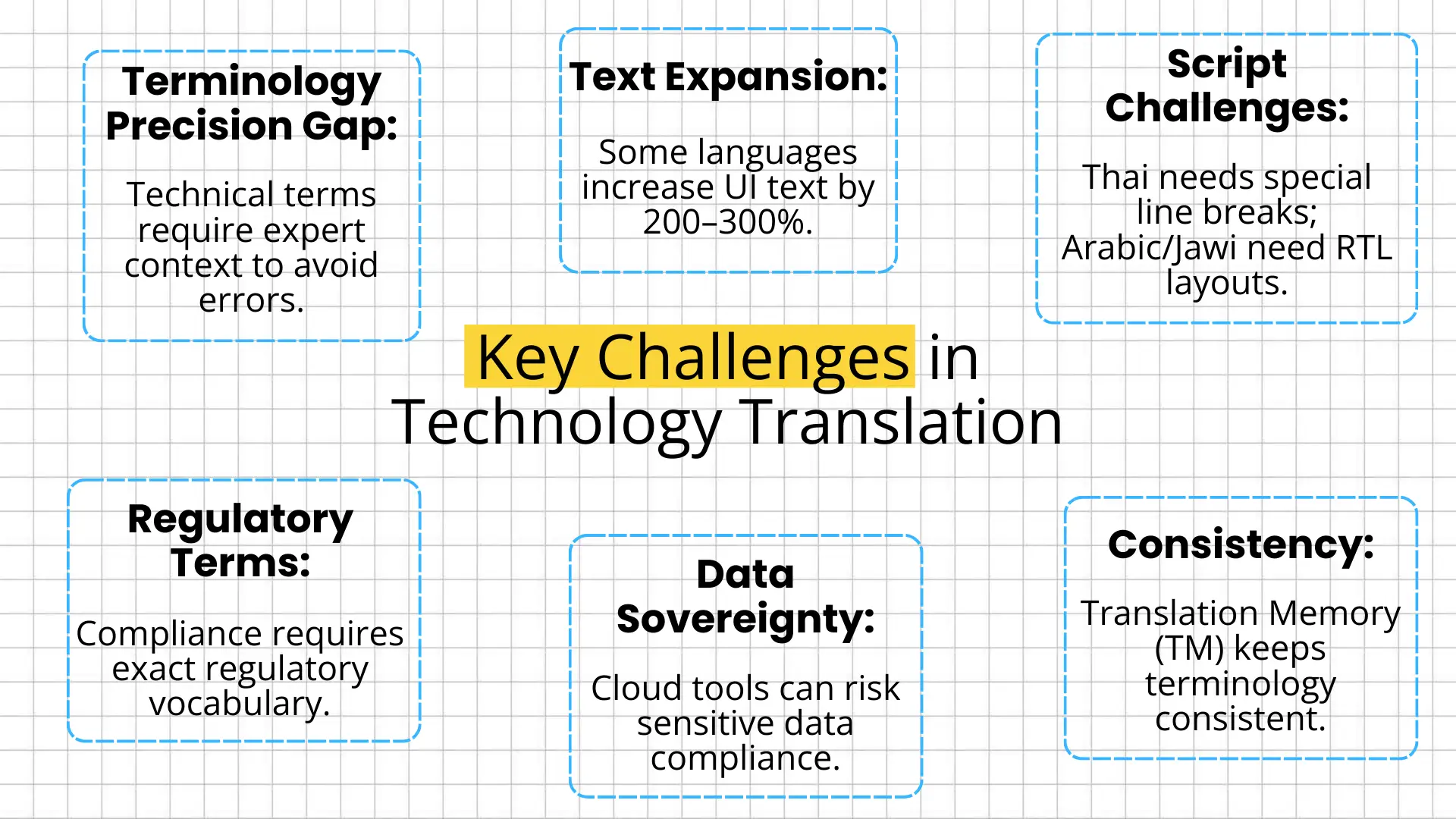
The Terminology Precision Gap: Technical English is full of terms that look similar but carry entirely different operational meanings. "Authentication" and "authorisation" are related but distinct. "Latency" and "lag" are not interchangeable in a network specification. In languages without direct equivalents for these terms, generalist translators make interpretive choices based on surface meaning. Domain-expert translators make choices based on the technical context. The difference is often invisible in the translated text but catastrophic in the resulting product behaviour.
The Text Expansion Engineering Problem: This challenge is structural, not linguistic, and it consistently catches tech teams off guard. When English UI content is translated into Indonesian, Vietnamese, or Thai, the text routinely expands by 200–300% in character count. A tooltip that fits neatly in a 120-pixel container in English may require 300 pixels in Bahasa Indonesia.
For modern SaaS and fintech products designed with compact interfaces, this causes engineering failures. The solution is not to shorten the translations; it is to design UI components with flexible containers from the start.
Script-Level Technical Challenges: Thai script has no spaces between words. Standard line-breaking algorithms, the code that determines where wrapped text starts a new line, will break Thai text mid-word, creating an illegible interface unless specifically engineered for it. Similarly, Arabic and Jawi (used for Malay in Malaysia and Brunei) require a full right-to-left (RTL) layout mirroring. This isn't just a simple CSS text-direction change; the entire navigation structure, icon directionality, and input logic must be re-architected.
Regulatory Vocabulary Specificity: Singapore's regulatory bodies operate within tightly defined vocabulary frameworks. A translation partner who is "generally competent" in life sciences is not the same as one who has successfully cleared HSA submissions for Class C medical devices. The former knows the terminology; the latter knows the exact vocabulary the HSA uses and expects to see.
Data Sovereignty and Cloud Translation Tools: Cloud-based translation platforms are fast and scalable, but they are a massive compliance liability if not configured correctly. Singapore's Healthcare Services Act and Malaysia's PDPA impose strict requirements on where sensitive data is processed. Pushing proprietary engineering data or financial system specs through a public cloud translation tool without verifying data sovereignty is a direct regulatory breach.
Maintaining Consistency Across a Living Documentation Set: Technology products are not static. They constantly generate new version releases, security updates, and API changelogs. If each update is handled as an isolated translation project without a centralized Translation Memory (TM), terminology drift occurs. The same technical term will eventually be translated three different ways across three different documents, creating invisible liabilities during a regulatory audit or liability dispute.
Why Expert Technology Translation Is Critical for Business Success in Singapore
Most companies discover the true weight of technology translation at exactly the wrong moment inside a compliance event, mid-submission, or facing a delayed product launch. Here is what drives that risk, and why it is entirely avoidable.
Regulatory Compliance: The Laws That Make Translation Non-Optional
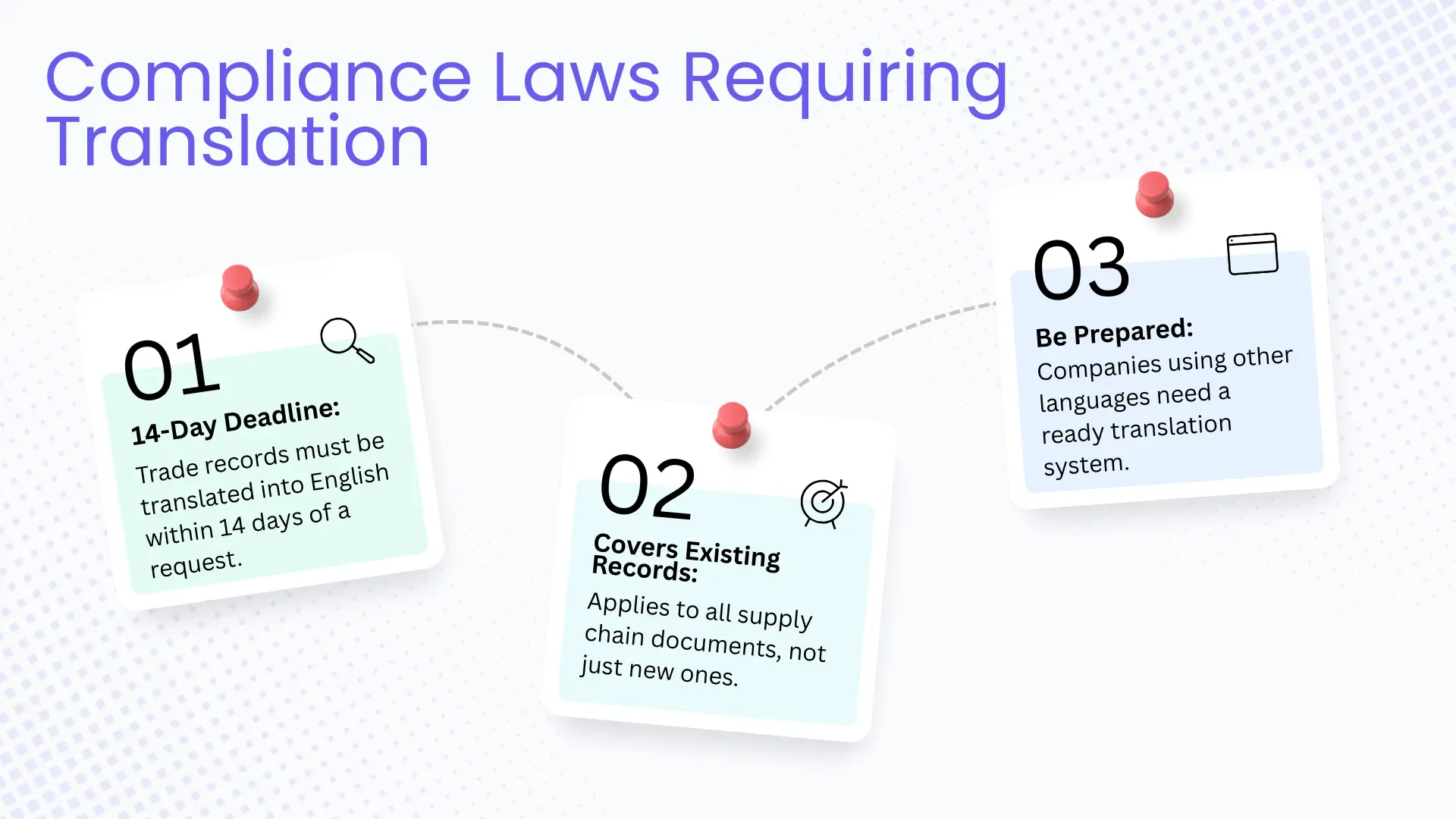
According to the Strategic Goods (Control) Act 14-day rule, Singapore's Strategic Goods (Control) Act applies to any company exporting controlled technology goods, hardware, semiconductors, encryption-capable software, or dual-use equipment.
What it requires:
- English translations of relevant trade records must be produced within 14 days of a Singapore Customs request
- This applies to ongoing supply chain documentation, not just records created after a request arrives
- Companies with trade documentation in Japanese, Korean, German, or Mandarin need a standing translation readiness system, not a reactive one
Scrambling to translate at the point of a Customs request is operationally difficult. More importantly, it is legally risky.
Product Performance Risk: When a Translation Error Becomes a Product Failure
In technology, a translation error is not just a communication problem. It has consequences downstream often traced back weeks or months later.
Real examples of what goes wrong:
- An ambiguous error message in a medical device interface triggers the wrong clinical response from a user
- A mistranslated conditional in a developer API document propagates implementation errors across dozens of client integrations
- A poorly localised cybersecurity policy creates compliance gaps that surface in an audit long after the translation vendor has left the project
On automated translation: Universal machine translation models without domain-specific fine-tuning produce a 30-40% accuracy degradation on technical content. In a regulated environment, that is not a marginal risk. The right approach is not to reject AI tools but to apply mandatory human domain-expert review at every point where accuracy carries real consequences.
Legal Liability: The PDPA Data Intermediary Obligation
If your translation project involves clinical algorithms, financial system architecture, or proprietary technical documentation, your translation provider is legally classified as a Data Intermediary under Singapore's Personal Data Protection Act (PDPA). That carries binding obligations for both parties.
The Protection Obligation requires:
- AES-256 encryption at rest and in transit
- Role-based access controls limiting data exposure to active project personnel only
- Full audit trails documenting access throughout the project
Full audit trails documenting access throughout the project
- Documented data deletion protocols with defined timelines
- A Certificate of Deletion for sensitive IP, confirming removal from vendor systems
The 2025-2026 shift: Singapore's PDPA is moving from implied to express consent for sensitive data processing. Your agreements with translation partners now need to explicitly state how documentation is stored, who can access it, and when it will be destroyed. Vague language here creates legal exposure that tends to surface at the least convenient time.
Verification standard: Your translation partner should hold ISO 27001 or SOC 2 Type II certification, with independently verified operational security, not a self-declared policy.
Competitive Advantage: Localisation Quality as a Market Signal
Singapore's technology sector is one of the most competitive in Asia-Pacific:
- 80,000+ tech companies operate in Singapore
- 4,000+ startups, with a growing deep-tech and advanced manufacturing cluster
- Technical parity between competing products is the norm cultural competence is still a differentiator
What separates products that earn sustained presence:
- Interfaces that embed genuine cultural intelligence, not just translated text
- Documentation that signals long-term market commitment to institutional and government buyers
- Localisation quality that regulators, regional partners, and end users can recognise
The products that get remembered in Singapore are the ones that feel built for the market. Not adapted for it the week before launch.
How to Choose a Technology Translation Partner in Singapore

Choosing a translation partner in the technology sector is not a vendor selection exercise. It is an extension of your regulatory infrastructure, your product quality system, and your intellectual property risk management strategy. And the way most companies approach it by comparing per-word rates across three quotes is precisely why so many of them end up repeating the work.
Here is a more useful framework.
Pillar 1: Regulatory Credibility Certifications That Actually Matter
Your provider's certifications are your first defence in a regulatory audit. But not all certifications are equally relevant to technology translation.
The Core Certifications to Require:
- ISO 17100: The professional standard for translation process quality
- ISO 9001: Evidence of a systematic, repeatable quality management system
- ISO 27001: The baseline requirement for any partner handling proprietary technical data
Beyond Certifications: Ask a direct question: "Have your translations successfully cleared HSA submissions or MAS compliance reviews for our specific technology category?" General claims of regulatory experience are not enough. Ask for documented examples. A provider who cannot cite specific submission outcomes is a provider who may not have direct regulatory experience, regardless of what their website says.
Pillar 2: Data Security and IP Protection
Technology translation routinely involves proprietary source code comments, unreleased product specifications, financial system architecture, and trade secrets. A data breach in this context is not a compliance event. It is a competitive intelligence exposure that may not be recoverable.
What to Verify:
- SOC 2 Type II or ISO 27001 certification (operational security, not just policy documentation)
- Translator NDA and vetting protocols for personnel handling classified technical content
- Network isolation capabilities for particularly sensitive projects
- Documented data destruction timeline and Certificate of Deletion provision
Do not accept vague assurances about data security. Ask for their specific protocols, in writing, before engagement begins.
Pillar 3: Domain Technical Expertise
This is the pillar that separates genuinely capable technology translation partners from generalist vendors who believe they can handle technical content.
The three-level test: A capable technology translation partner should demonstrate:
- Engineering or Domain Literacy: Translators can discuss the subject matter at a functional technical level. Ask them to explain the difference between authentication and authorisation, or to identify the distinction between two technical terms in your specific domain. Their answer tells you more than any certification.
- Regulatory Familiarity: Direct knowledge of HSA, MAS, Singapore Customs, and relevant international standards (IEC, IEEE, ISO). Not general awareness, but the ability to navigate these frameworks in practice.
- Cultural Intelligence for the Target Market: Understanding how technical content lands with different communities in Singapore and Southeast Asia. This is the dimension that determines whether your localised product achieves its communicative purpose or merely achieves formal translation.
Pillar 4: Quality Assurance The Multi-Stage Process
In technology translation, the first draft is not the product. It is the beginning of a quality process.
The Standard Requirement: A TEP (Translate → Edit → Proof) workflow conducted by separate practitioners at each stage. Translation and self-review by a single person is not a quality process. It is a single point of failure.
For Safety-Critical and Regulatory Content: Add Back-Translation, the independent re-translation of the output back into the source language by a separate translator who has not seen the original. This is the only reliable mechanism for verifying that the original technical intent has survived the translation process intact.
Terminology Asset Management: Ask specifically about Translation Memory (TM) and client-specific glossary management. A provider that does not maintain terminology assets for ongoing clients cannot guarantee consistency across your product documentation over time. Every update becomes an isolated project. Every isolated project introduces the possibility of terminology drift.
Pillar 5: Operational Performance Under Pressure
A translation vendor's performance under normal conditions tells you less than their performance under a regulatory deadline or a product launch timeline. The Strategic Goods Act's 14-day window. An urgent adverse event report. A product release that has been moved forward by three weeks.
Ask the specific operational questions:
- What is your average turnaround for Strategic Goods Act trade record translation requests?
- How do you handle urgent regulatory clarification requests during an active HSA submission?
- Can you provide a reference from a company in our specific device class or regulatory category?
- What is your process when the primary translator for our domain expertise area is unavailable?
If the answers are vague, the operational reality will be too.
The Decision Matrix: Removing Bias From Your Vendor Selection
Rate each shortlisted provider on a scale of 1–10 for each criterion below. Multiply by the assigned weight to produce a weighted score. This approach removes subjective impression from the procurement decision and creates auditable documentation for internal stakeholders and compliance records.
| Evaluation Criteria | Weight | Provider A | Provider B | Provider C |
|---|---|---|---|---|
| Regulatory Submission Success Rate (HSA, MAS, Customs documented examples) | 25% | /10 | /10 | /10 |
| Certifications (ISO 17100, 9001, 27001 verified, not self-declared) | 20% | /10 | /10 | /10 |
| Domain Technical Expertise (Specific to your technology category) | 15% | /10 | /10 | /10 |
| PDPA & IP Security (Documented protocols, not website claims) | 15% | /10 | /10 | /10 |
| Operational Velocity (Turnaround under deadline conditions) | 10% | /10 | /10 | /10 |
| Cost Efficiency (Value relative to risk reduction, not the cheapest quote) | 10% | /10 | /10 | /10 |
| Client References (Same technology category, verifiable) | 5% | /10 | /10 | /10 |
| Total Weighted Score | 100% |
If a provider cannot clearly explain their quality and security process, they do not have one. What they have is a workflow that they will explain after something goes wrong.
Why Lettercraft for Expert Technology Translation Services in Singapore
There is no shortage of translation vendors in Singapore. Finding one is not the challenge. Finding one that genuinely understands the intersection of technical domain knowledge, regulatory requirements, and IP protection that technology translation demands is the actual problem most companies are trying to solve.
Lettercraft was built around a specific premise: that technology translation is a risk management discipline, not a language service. That framing shapes everything about how the work is done.
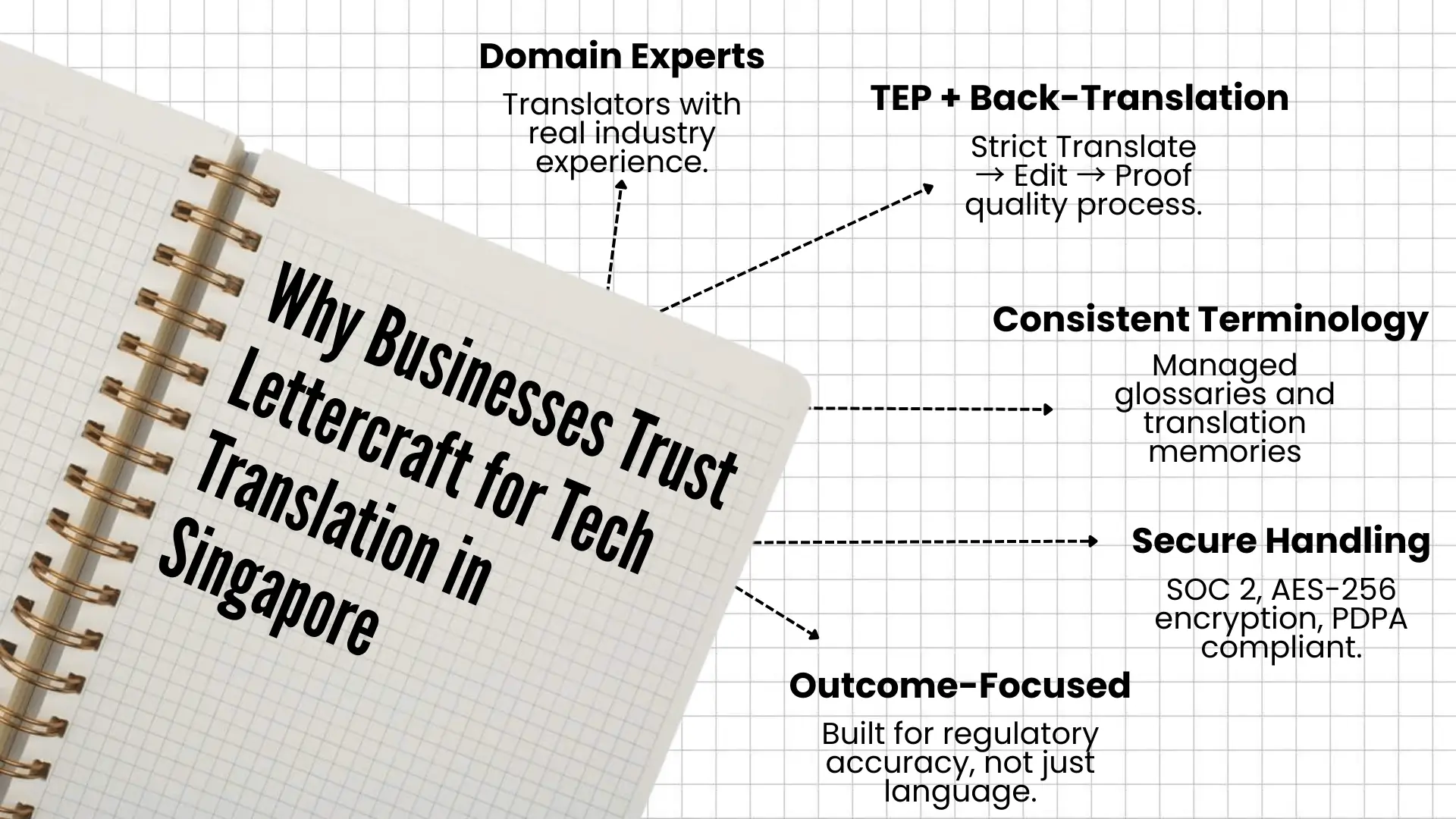
Domain-First Translator Assignment
Every Lettercraft project is assigned to translators with demonstrated expertise in the specific technology category, not generalist linguists with an interest in technology. For fintech compliance documentation, that means translators who understand MAS regulatory frameworks. For medical device dossiers, translators who have worked within HSA submission processes. For semiconductor export documentation, translators who understand the Strategic Goods framework at an operational level.
The TEP + Back-Translation Standard
Lettercraft applies a Translate → Edit → Proof workflow to every project as a minimum standard. For safety-critical documentation, regulatory submissions, and legally consequential content, Back-Translation is mandatory, not optional. This is how technical intent is verified, not assumed.
Living Terminology Infrastructure
Client-specific Translation Memories and technical glossaries are built and maintained throughout the engagement. Your technical vocabulary, your product-specific terminology, your regulatory filing language, these are captured, standardised, and applied consistently across every document, every update, and every submission. Documentation drift, where the same concept is described differently across different documents, is not a risk when terminology is actively managed.
Security That Matches the Sensitivity of Technical IP
Lettercraft operates with SOC 2 Type II certified data handling, AES-256 encryption, role-based access controls, and documented data destruction protocols. PDPA compliance, including express consent handling for sensitive data processing and Certificate of Deletion provision, is built into the workflow, not offered as an add-on.
The Core Distinction
Lettercraft is not a translation company that handles technology projects. It is a technology documentation specialist that works through language. The distinction is important because it changes what the output is optimised for. A translation company optimises for accurate language. A technology documentation specialist optimises for accurate outcomes, regulatory approval, product performance, legal enforceability, and consistent documentation across the product lifecycle.
Conclusion: Technology Translation as Long-Term Infrastructure
The companies that get technology translation right in Singapore do not think about it as a project. They think about it as infrastructure, the same way they think about their cloud architecture or their compliance management system. It requires upfront investment, specialist partners, and active management. And it compounds over time.
A well-maintained body of localised technical documentation grows more valuable with every update, every new market, and every regulatory submission it supports. It reduces the cost of subsequent translation work. It protects IP consistency. It gives regulators confidence in the quality of your submissions. It signals to regional partners and institutional customers that you are a serious long-term market participant.
The companies that treat translation as a last-mile task discover the cost of that decision at the most inconvenient moment: three weeks before a product launch, two days before a Customs deadline, or midway through an HSA review cycle.
The strategic question is not whether expert technology translation services are worth the investment. It is whether your current approach is building an asset or accumulating risk.
Contact Lettercrafts Translations for a consultation on your Singapore market entry translation requirements. We offer detailed project scoping, regulatory submission timeline assessment, and sample translations that demonstrate our quality standards at no cost and with no obligation.