Does ICA require notarization? Yes. ICA requires all non-English documents for PR and Citizenship applications to be professionally translated AND notarized by a Singapore Notary Public. Certified translation alone is not accepted.
At a Glance:
- Processing Time: 3-5 days
- Cost: Starting from S$250 for standard documents
- Success Rate: 100% acceptance of documents
Applying for Singapore Permanent Residency or Citizenship is a significant milestone, but a minor error in your document submission can derail months of preparation.
Here's something most PR applicants discover the hard way: that perfectly valid birth certificate from your home country? ICA won't accept it as-is. Not because there's anything wrong with it, but because it's not in English.
I've seen countless applications delayed by 2-3 months because applicants didn't realize ICA's translation requirements are different and far stricter than almost any other government agency in Singapore. What works for MOM or your child's school enrollment simply won't cut it for Permanent Residency or Citizenship applications.
Let me walk you through exactly what ICA requires, why the process exists, and how to navigate it without the costly mistakes most people make.
Does ICA Accept Certified Translation, or Do You Need Notarization?
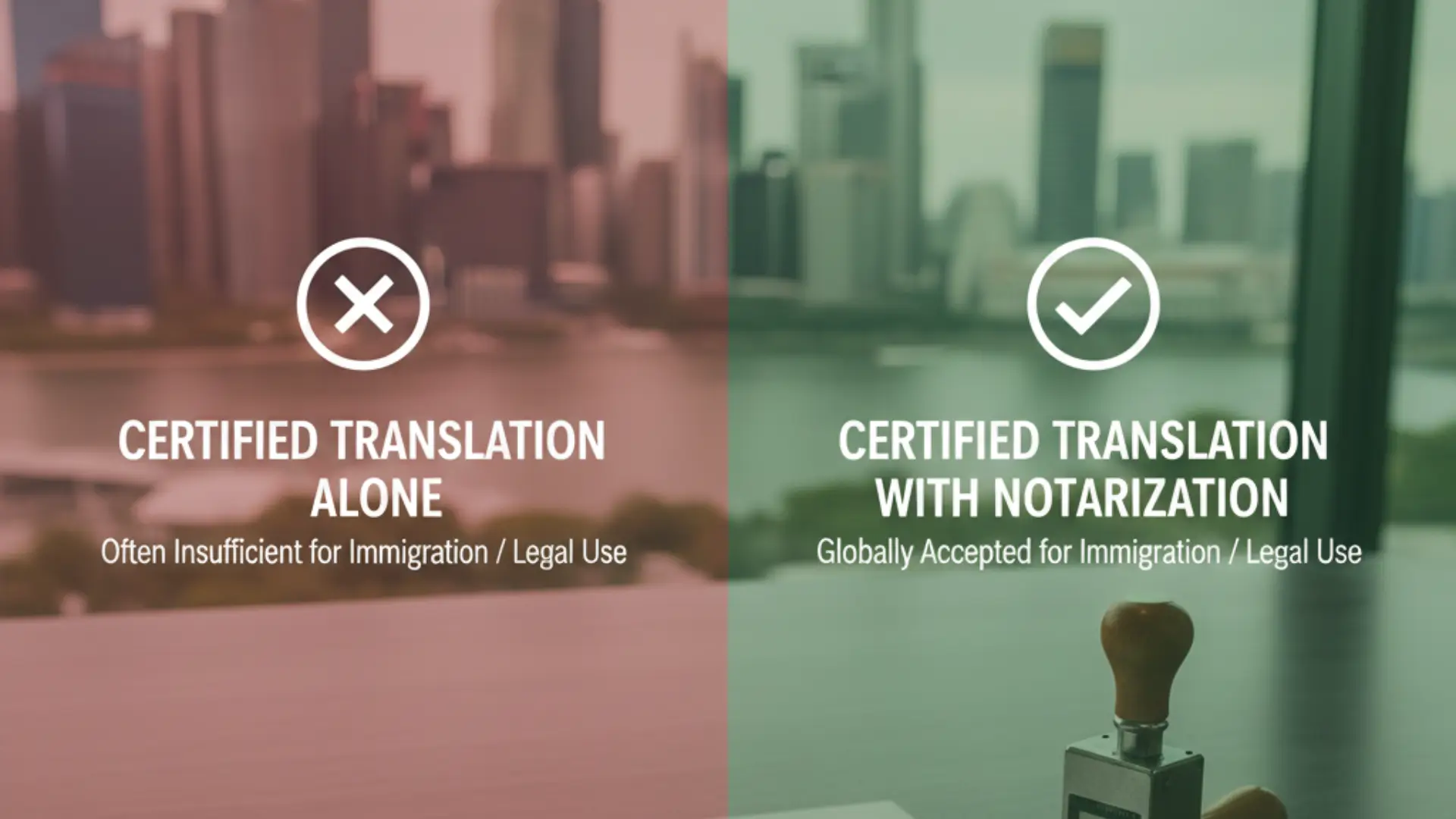
No, ICA doesn't accept certified translation by itself. You'll need both certified translation AND notarization for any non-English documents when submitting PR and Citizenship applications.
Just having a certified translation where the translator stamps and signs the document won't cut it. ICA wants an extra legal step: verification from a Singapore Notary Public. This is typically a lawyer who confirms, under oath, that your translator is qualified and the translation is legitimate.
- Certification proves the translation is accurate.
- Notarization proves the translator is legitimate.
- ICA needs both.
This catches people off guard because MOM (for Employment Passes), schools, and banks usually accept simple certified translations. But for ICA, they are granting you the right to live in Singapore permanently. The bar is higher.
What Are the Different Ways to Get ICA-Approved Translation?
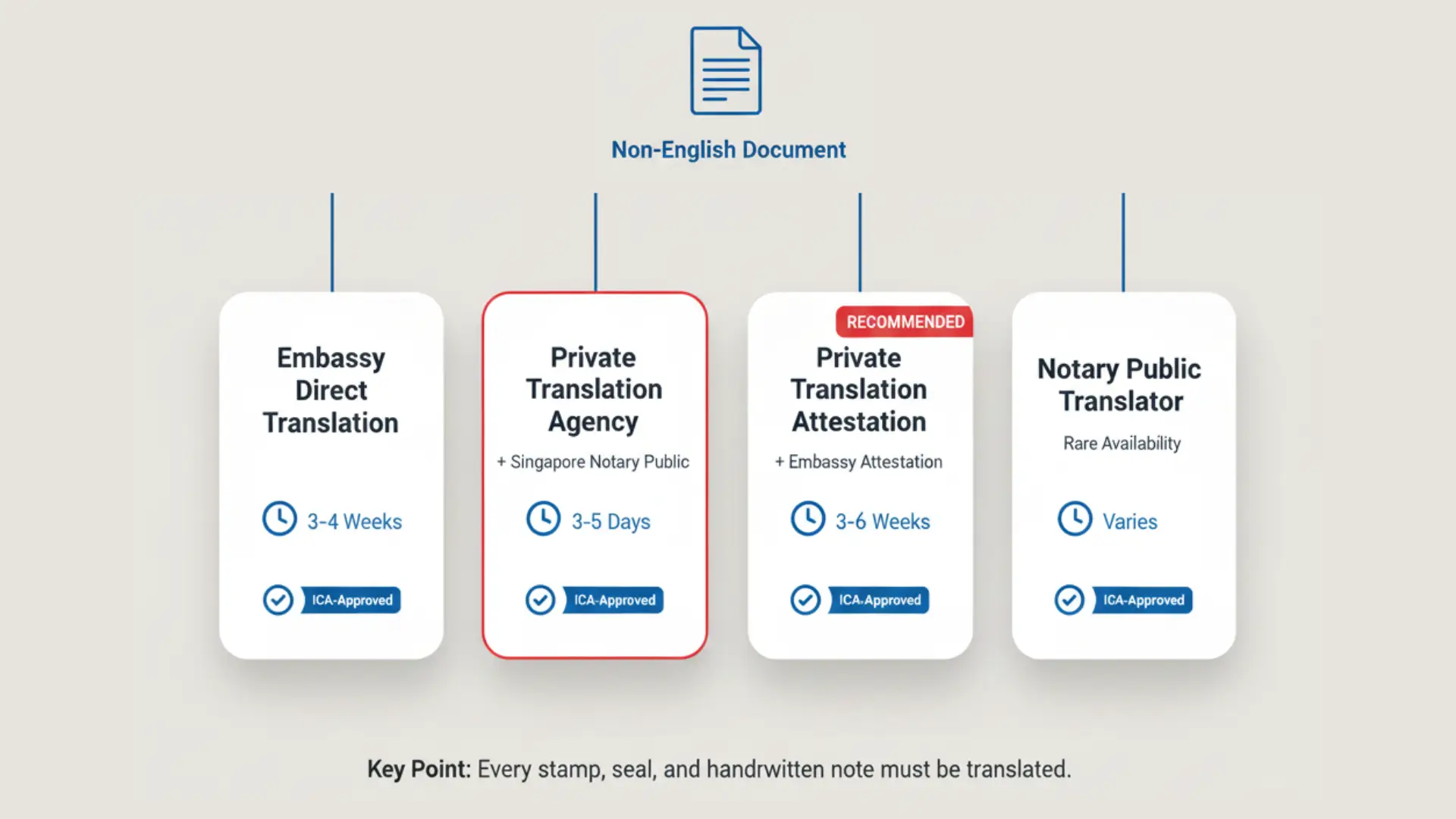
ICA accepts 4 authentication methods. Choosing the wrong one can cost you weeks: (1) Private agency + Notary Public, (2) Embassy direct translation, (3) Private translation + Embassy attestation, or (4) Notary translator who does both.
According to the Official ICA Guidelines there are only four recognized methods for authenticating translated documents.
The Golden Rule: Every stamp, seal, and handwritten note must be translated. Omissions are the #1 cause of rejection.
Comparison of Official Authentication Methods
| Method | Speed | Success Rate | Recommended For |
|---|---|---|---|
| Private Agency + Notary Public | Fast (3-5 Days) | High | Standard PR/Citizenship Apps |
| Embassy Direct | Slow (3-4 Weeks) | High | Specific gov documents |
| Private + Embassy Attestation | Very Slow | Medium | When the Notary is unavailable |
| Notary Translator | Varies | Low Availability | Niche languages |
Why 90% of Applicants Choose Option 1:
Most successful applicants use a private agency, such as LetterCrafts, in conjunction with a Singapore Notary Public. It is the only pathway that balances speed (under 5 days) with full ICA compliance.
The 4 Authentication Channels Explained
ICA accepts translations authenticated through these methods:
Can I Get My Embassy to Translate Documents Directly?
Your home country's embassy or consulate in Singapore can translate your document and issue it on official letterhead.
Reality check: Most embassies take 3-4 weeks for this service, charge premium rates, and only offer it for specific document types. I rarely recommend this route unless you have no other option.
Notary Public Translation (Rare)
A Singapore Notary Public who speaks your language fluently translates the document themselves and notarizes their own work.
The problem: Very few Notary Publics offer translation services. Most only notarize translations done by others. Finding someone who does both is like finding a unicorn.
Private Translation + Embassy Attestation
You hire a private translator, then bring the translation to your embassy for attestation.
Why this is painful: You need two separate appointments, potentially weeks apart. If your embassy finds any issue with the translation, you start over. Total timeline? Often 3-6 weeks.
Private Translation + Notary Public (The Standard Route)
A professional translation agency translates your documents, then coordinates with a Singapore Notary Public to notarize the translation.
Why it works: It's faster (3-5 days), reliable, and costs less than embassy routes. This is the industry standard for PR applications.
What's the Difference Between Certified and Notarized Translation?
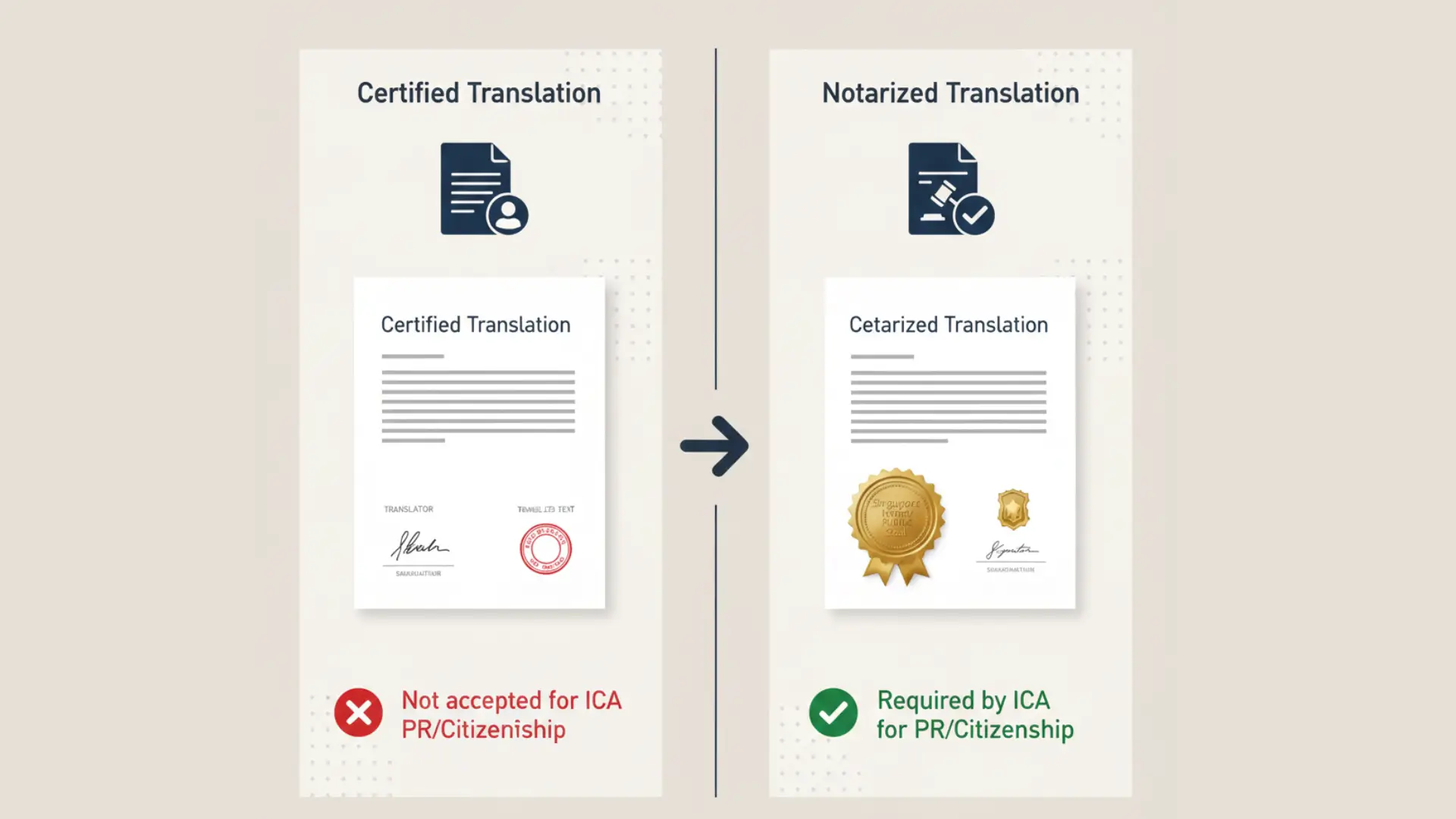
A certified translation comes with the translator's signature and stamp confirming it's accurate. A notarized translation takes it a step further, as it includes that certification plus verification from a Singapore Notary Public, who legally confirms the translator's credentials under oath.
When it comes to ICA PR and Citizenship applications, you'll need the notarized version; a certified one alone won't work.
Certified Translation: Translator Self-Declaration
A certified translation is a document where the translator or translation agency:
- Reviews their own translation work for accuracy
- Signs a declaration stating: "I certify this translation is accurate to the best of my knowledge and ability."
- Stamps it on the company letterhead
- Takes professional responsibility for the accuracy
Accepted by: Ministry of Manpower (MOM), schools, banks, and most commercial purposes.
Legal standing: Professional declaration with no third-party verification.
Notarized Translation: Legal Authentication
A notarized translation includes everything in a certified translation, PLUS:
- Verification by a Singapore Notary Public (a licensed legal officer)
- The Notary reviews the translator's credentials and qualifications
- The Notary adds their official seal and signature
- The Notary swears under oath that the translator is qualified and that the translation process was legitimate
Required by: Immigration & Checkpoints Authority (ICA) for PR and Citizenship applications, Singapore courts, and legal proceedings.
Legal standing: Sworn legal statement with independent third-party verification.
Why ICA Requires Notarization: Notarization adds an extra layer of legal verification. The Notary Public acts as a neutral third party, checking the translator's qualifications and confirming their work is genuine, all under oath. This legal safeguard is crucial for immigration decisions that determine whether someone gets permanent residency or citizenship rights.
Side-by-Side Comparison
| Feature | Certified Translation | Notarized Translation |
|---|---|---|
| Who Signs? | The Translator/Agency | A Notary Public (Officer of the Court) |
| What It Proves | Linguistic Accuracy | Legal Authenticity of the Translator |
| Legal Standing | Professional Declaration | Sworn Legal Statement |
| Required For | MOM, Schools, Banks | ICA (PR, Citizenship), Courts |
| Cost Factor | Lower ($30-50/page) | Higher ($110-170/doc + fees) |
| Processing Time | 1-2 days | 3-5 days (includes notary appt) |
How Do I Make Sure My Translation Won't Be Rejected by ICA?
ICA's document standards are unforgiving. Understanding these technical requirements before submission can save you months of delays.
The ICA Zero-Rejection Checklist:
- [ ] Visual Fidelity: Does the layout match the original?
- [ ] Stamps & Seals: Are all red/blue stamps translated?
- [ ] Annotations: Are handwritten margin notes included?
- [ ] Naming: Does the name match the passport exactly (Character-for-character)?
The "Zero-Omission" Policy: Why Missing a Single Stamp Means Rejection
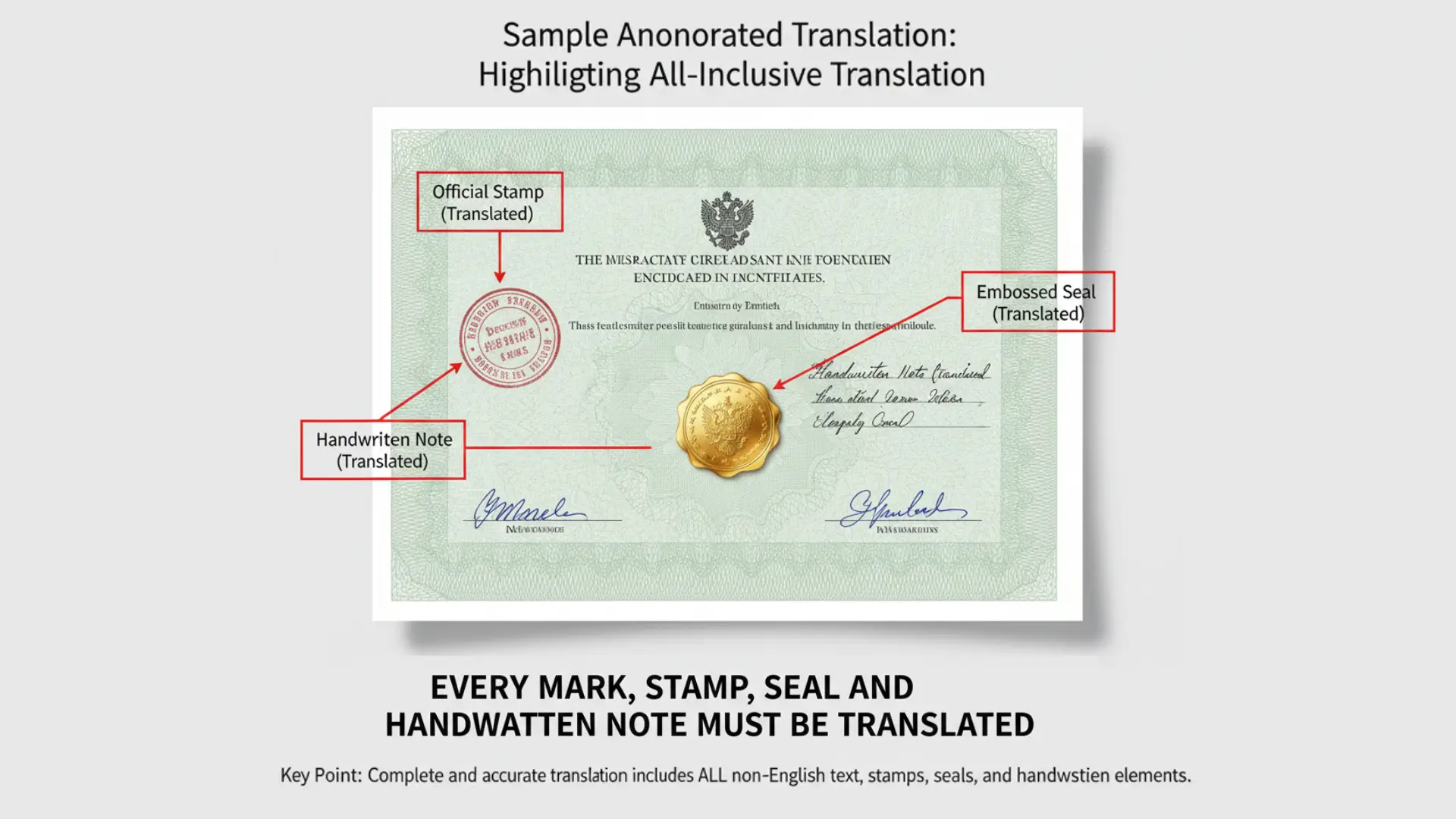
Every visual element on your original document must appear in the translation:
- Government seals and stamps: Including date stamps, authentication stamps, and issuing authority seals
- Handwritten annotations: Notes made by officials, corrections, or clarifications
-
Background watermarks: Even faint security features must be described - Multi-page elements: Continuation marks, page numbers, and binding stamps
I've seen rejections because someone's Chinese birth certificate had a "Re-issued" stamp from 2015 that wasn't mentioned in the translation. ICA sent it back with a request to resubmit, adding 6 weeks to the application timeline
Visual Fidelity: The Translation Must Mirror the Original
Your translation must mirror the original layout (tables, columns, spacing). Furthermore, names must match your passport exactly. This includes:
- Maintaining the same page structure and formatting
- Positioning translations of stamps and seals in corresponding locations
- Preserving table formats, columns, and spacing
- Using similar fonts and text sizing where appropriate
Example: If your birth certificate says "Wang Xiao Ming" but your passport says "Xiaoming Wang," the translation must use the passport format or be accompanied by an official explanation.
Naming Conventions: Exact Passport Matching
Names in your translated documents must match your passport exactly, character by character, including:
- Order of names (given name vs. surname)
- Spelling variations (e.g., "Mohammed" vs. "Muhammad")
- Special characters or diacritical marks
- No anglicized variations unless you provide legal proof of name change
This is where many Chinese, Indian, and Filipino applicants run into trouble.
Let's say your birth certificate shows your name as "Wang Xiao Ming," but your passport says "Xiaoming Wang." Or your Indian birth certificate says "Rahul Kumar," but your passport says "Rahul Kumar Singh."
These discrepancies need either:
- An explanation letter with your application, OR
- Supporting documents proving the name change or variation
The translation must use the exact name format from your passport. No variations, no "close enough," no assuming ICA will understand it's the same person.
Top 5 ICA Translation Rejection Reasons (And How to Avoid Them)
-
Missing stamp translations (40% of rejections)
- Solution: Use a translator experienced with ICA requirements
-
Name mismatch with passport (25% of rejections)
- Solution: Triple-check name spelling against passport
-
Certified but not notarized (20% of rejections)
- Solution: Always ensure the Notary Public seal is present
-
Poor scan quality (10% of rejections)
- Solution: Use 300+ DPI scans, not phone photos
-
Layout doesn't match original (5% of rejections)
- Solution: Choose a provider that replicates the visual structure
The Step-by-Step Process: How Translation and Notarization Actually Work
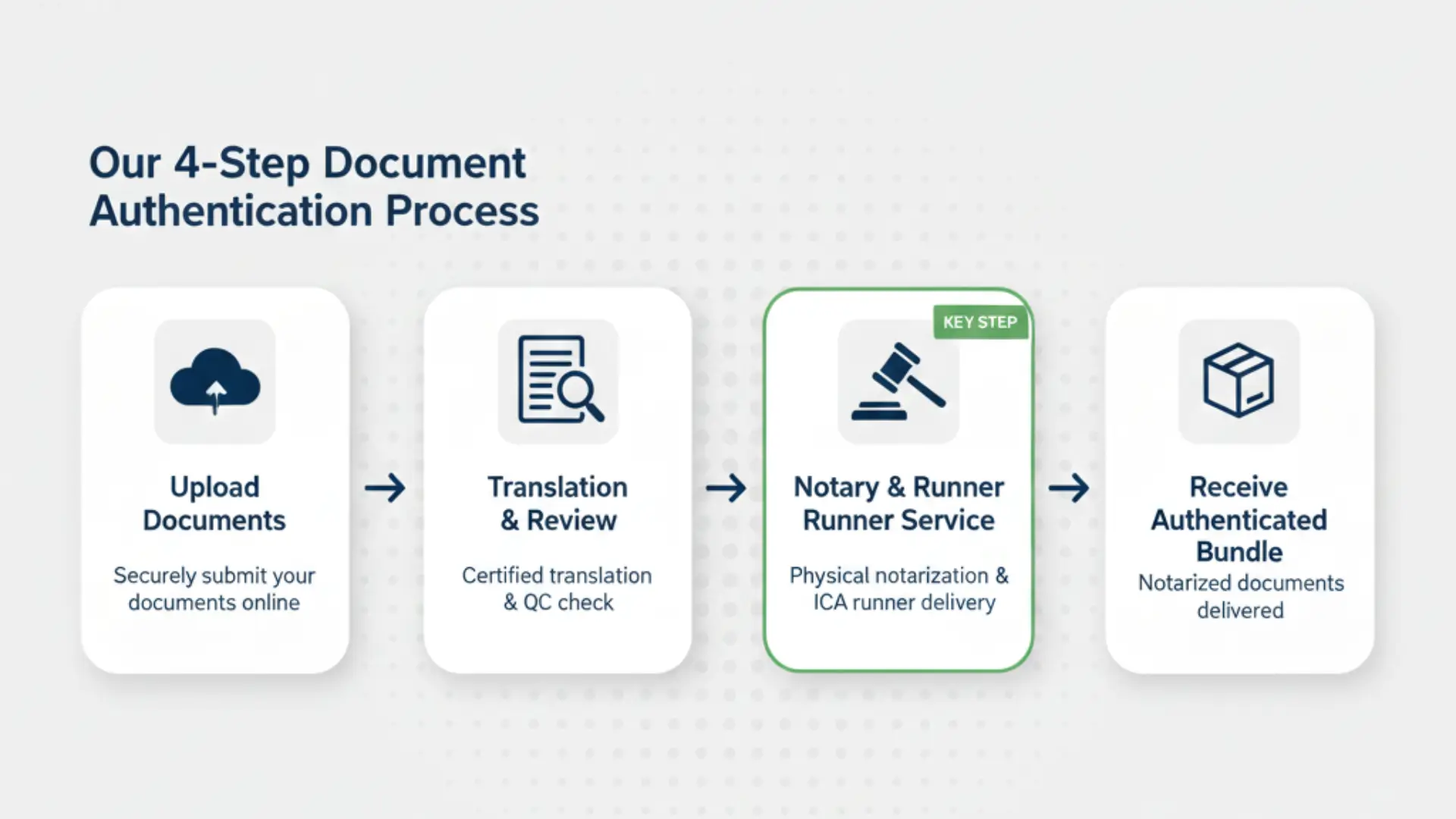
Let me break down what happens from the moment you decide to translate your documents until you upload them to ICA's portal. Understanding the complete workflow prevents costly mistakes and delays.
Here's the proven process used by successful PR and Citizenship applicants.
Step 1: Email Your Documents
Submit clear, legible scans of your original documents to info@lettercrafts.org.
Quality matters:
- Use a flatbed scanner when possible (300 DPI minimum)
- Avoid mobile scanning apps like CamScanner, which often compress images, making stamps illegible
- Photograph in good lighting if scanning isn't available, ensuring all text and stamps are sharp
- Scan both sides if your document has content or stamps on the back
Poor scan quality forces translators to make assumptions, increasing error risk.
Step 2: Get Your Quotation (Within 30 Minutes)
Receive your formal quotation within 30 minutes or less, based on page count and services needed. Translation begins immediately after payment confirmation.
Step 3: Translation Draft Review
Before any translation is finalized, a reputable service will share a draft. This is your moment to step in because once a document is notarized, every detail is locked. At LetterCrafts, we treat this stage as a safeguard, ensuring accuracy and protecting you from costly errors down the line.
Soft copies of translated documents will be emailed to you within 24-36 hours (actual timeline depends on document complexity). You review, approve, or request corrections; all corrections are made at no additional cost.
What to verify during your review:
- Dates: Verify birth, marriage, and issuance dates. Remember, formats vary across countries (DD/MM/YYYY vs. MM/DD/YYYY), so even small slips can cause big problems.
- Name spelling: Compare every character against your passport. A single misplaced accent or letter can invalidate the document.
- Stamps and seals: Count the stamps on your original and confirm the same number appears in the translation. Each seal carries legal weight.
- Technical terms: Make sure degree titles, occupations, and places of birth are translated with precision. These aren't just words; they're identifiers tied to your legal and professional identity.
How LetterCrafts Strengthens This Step
- We normalize formats and cross-check dates against official records.
- We ensure character-perfect fidelity to your passport and registry entries.
- We conduct a stamp-by-stamp reconciliation, so nothing is overlooked.
- We validate technical terms against jurisdiction-specific glossaries, ensuring compliance and credibility.
- We flag any ambiguity, whether it's a blurred seal or unusual phrasing, so you approve with confidence.
100% Post-Project Support Guarantee
If corrections are needed at any stage, LetterCrafts provides full post-project support at no additional cost. However, remember: corrections can only be made before notarization. Once the Notary seal is applied, the document is legally locked.
Once you've reviewed and approved the draft, LetterCrafts finalizes the translation and prepares it for notarization. It's not just a process, it's peace of mind.
Step 4: The Mandatory Physical Verification
This step is non-negotiable, and it often catches applicants off guard. The original physical documents must be presented to the Notary Public in person. Not scans. Not photocopies. Only the actual certificates will do.
Why? Because it's a legal requirement. The Notary must sight the originals before notarizing the translation.
Now, does that mean you personally have to trek to the Notary's office? Not necessarily. Either you or an authorized representative must present the originals in person.
Why This Matters
- Legal compliance: In Singapore, Notaries are required to sight originals before notarizing translations of vital records (birth, marriage, death, academic certificates).
- No digital shortcuts: ICA does not accept remotely notarized translations for these document types.
- Identity verification: The Notary may also request your NRIC or passport to confirm identity.
How LetterCrafts Makes It Easier
At LetterCrafts, we take this burden off your shoulders. If you're overseas, busy, or simply unable to attend, we provide a runner service. Our trained staff present your originals to the Notary Public on your behalf, with proper authorization.
That means:
- No time off work.
- No navigating to a law office in the CBD.
- No waiting room delays.
You hand over your originals to LetterCrafts, we manage the Notary appointment end-to-end, and return everything to you completed. It's seamless, compliant, and stress-free.
After your approval, documents proceed to notarization this requires one working day.
Step 5: Receive & Upload the Complete Bundle
After notarization, you'll receive:
- Your original document (returned to you)
- The translated document (on professional letterhead)
- The Notarial Certificate (the Notary's sworn statement and seal)
These three items together form your submission bundle. Scan this complete package at high resolution and upload to ICA's e-Service portal. Keep the physical originals in a safe place. ICA may request them during your PR or Citizenship interview.
Delivery Options:
You have four options:
- Email delivery: Final soft copies with stamp and signature (included)
- Standard post: Translation hard copy via SingPost (arrives in 3-5 working days, included)
- Express courier: Notarized hard copy via courier (S$25, arrives next business day)
- Self-collection: Pick up from HoH Law Corporation at 1 Coleman Street #B1-05, The Adelphi (S) 179803
Total Timeline: 4-8 working days from submission to receiving your complete, ICA-ready documents.
Cost & Timeline: What to Expect in Singapore
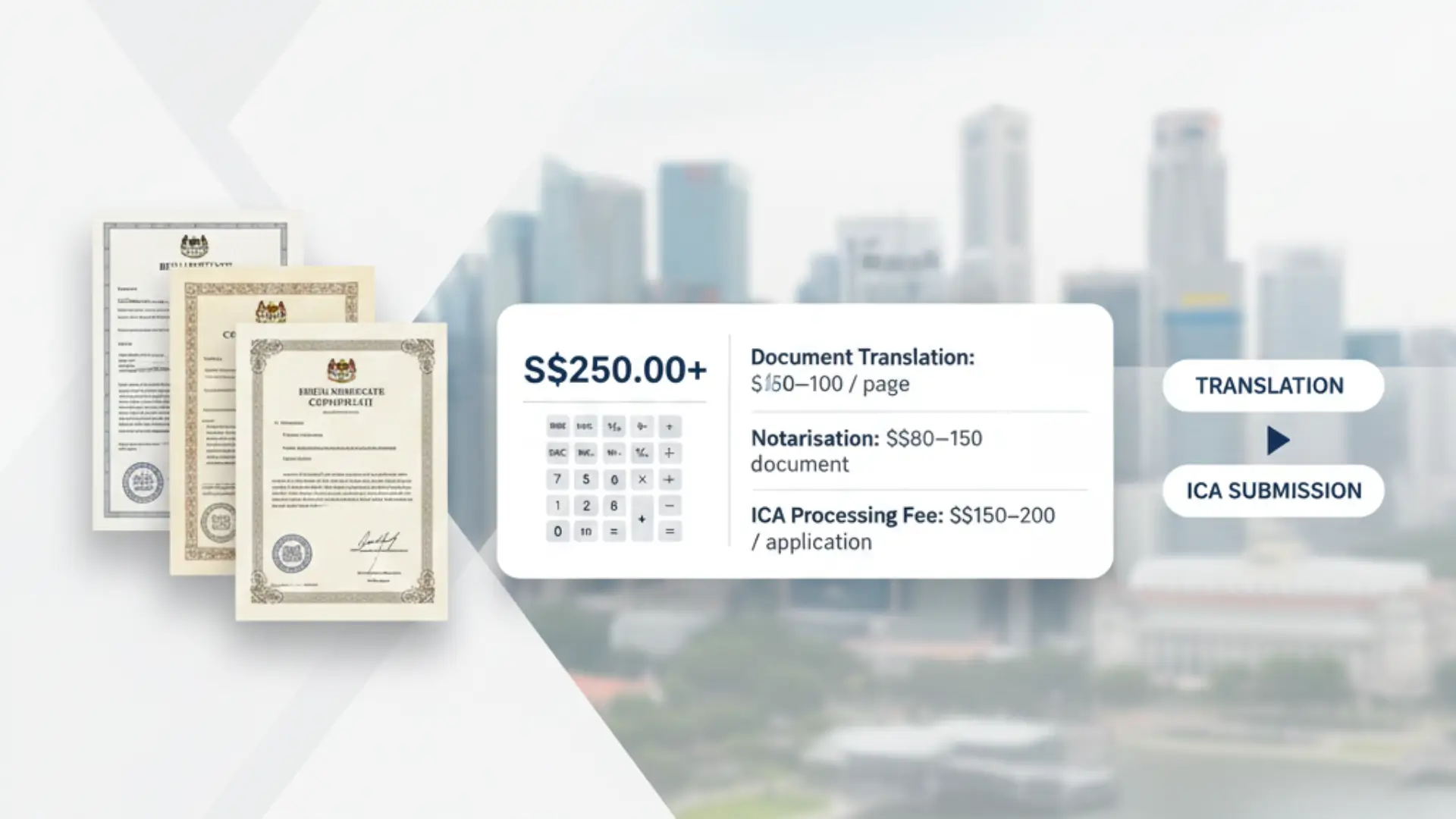
Transparency in pricing and timelines helps you plan your application budget and schedule.
Transparent Pricing at LetterCrafts (2025)
Translation Services
- Standard Rate: S$38 per page (no GST charges)
- Includes professional translation by experienced translators
- Covers all standard document types (birth certificates, marriage certificates, academic transcripts)
Notarization & SAL Authentication (Mandatory for PR Applications)
- Notary Certificate with SAL Authentication: S$215 per certificate
- Lawyer's Stamp: S$215 per certificate
- Important: Documents with different names cannot be bundled into one certificate (as per Notary Act requirements)
Express Courier Delivery
- Notary hard copy courier service: S$25
Complete Example:
- Birth certificate (2 pages): S$76 translation + S$215 notarization + S$10 lawyer stamps = S$301 total
- Add S$25 if you need courier delivery of the notarized hard copy
Included at No Extra Cost:
- Certificate of Translation/Assurance (free upon request)
- Draft review and approval process
- Email delivery of soft copies
- Standard SingPost delivery of the translation hard copy
- 100% post-project support for corrections (before notarization)
You'll know the exact cost before committing. Email your documents for a formal quotation. There's no obligation, and pricing is confirmed upfront based on your specific needs.
The Smart Solution: Using an Integrated Provider
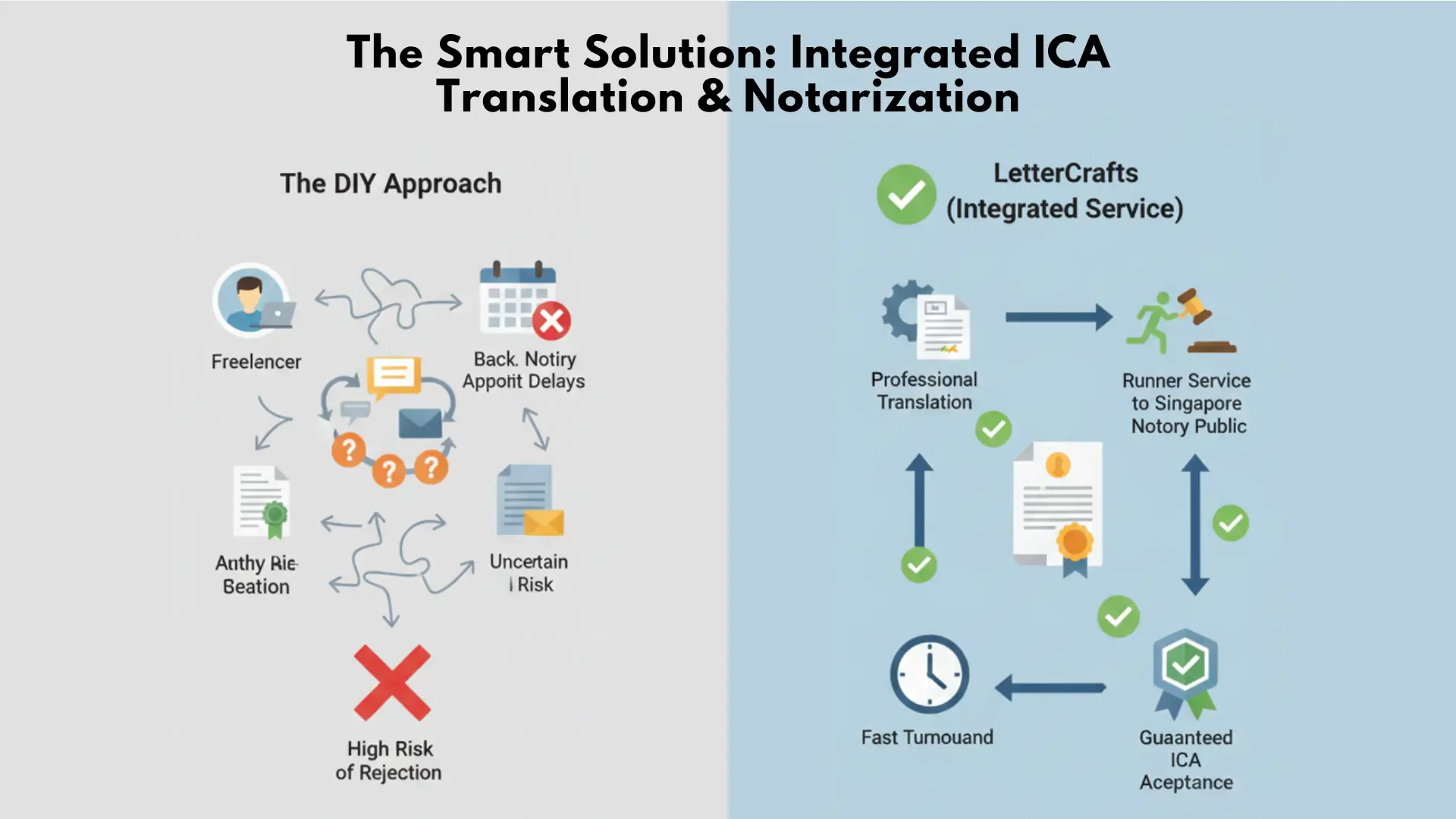
You could piece this together yourself: find a freelancer, book a Notary, and handle the logistics. Or you can use a purpose-built service.
Why LetterCrafts?
LetterCrafts has built its entire service model around Singapore's immigration requirements. Here's what sets them apart:
One-Stop Shop Efficiency
LetterCrafts handles the complete workflow:
- Professional translation by translators who know ICA's specific requirements
- Runner service to the Notary Public (you never need to attend)
- Coordination of the notarization appointment
- Secure return of your original documents plus the notarized translations
- Digital files are formatted and ready to upload to ICA's portal
You email documents once and receive the completed, notarized bundle.
Speed Without Compromise
- 24-36 hour translation turnaround (document complexity permitting)
- 1 working day notarization via established relationships with Notary Publics
- Quotation provided within 30 minutes
- Express courier options for urgent PR or Citizenship deadlines
The runner service is the secret weapon here. While you'd be waiting days for your own Notary appointment, LetterCrafts gets your documents in front of a Notary within 1 working day through their established relationship with HoH Law Corporation.
ICA-Specific Expertise (This Is Not Generic Translation)
LetterCrafts' translators specialize in Singapore immigration documents:
- Deep understanding of ICA's "zero-omission" policy
- Experience with all common source languages (Chinese, Malay, Tamil, Vietnamese, Thai, Tagalog, etc.)
- Knowledge of naming conventions across different cultures and Romanization systems
- Familiarity with Singapore's PR and Citizenship application process
Translated thousands of birth certificates, marriage certificates, academic transcripts, and other vital documents specifically for Singapore PR and Citizenship applications. This isn't theoretical knowledge, it's battle-tested experience.
Quality You Can Trust
- Top-rated translation service provider in Singapore (check our Google Reviews)
- 100% human translation, no machine shortcuts
- Registered translation company based in Singapore
- 100% post-project support on any corrections (before notarization)
Guaranteed Acceptance Promise
If ICA rejects your documents because of translation formatting, completeness, or any other translation-related issue, LetterCrafts will:
- Revise the translation to ICA's specifications at no additional cost
- Coordinate re-notarization if required
- Ensure your revised documents meet acceptance standards
You're not gambling $150-200 per document hoping it'll be accepted. You're paying for documents that will pass ICA's review.
That guarantee alone is worth the price difference compared to cheaper, generic translation services that disappear the moment ICA sends a rejection notice.
Why This Matters for Your PR or Citizenship Application
Your ICA application represents years of planning and significant financial investment in Singapore. The document translation step, while seemingly minor, can determine whether your application proceeds smoothly or faces months of delays.
LetterCrafts' integrated service model removes risk from this critical step, giving you confidence that your documents will meet ICA's exacting standards on the first submission.
Final Thoughts: Protecting Your ICA Application Investment
Your Singapore PR or Citizenship application represents a significant milestone in your life journey. The months of preparation, document gathering, and form completion deserve protection from avoidable errors in the translation and notarization process.
By understanding ICA's specific requirements, choosing the right authentication pathway, and working with specialists who understand Singapore's immigration system, you can eliminate this common source of application delays and rejections.
Ready to move forward? Get a free, no-obligation quote for your specific documents. Email your files to info@lettercrafts.org and the team will provide exact pricing and timelines within 30 minutes
Get Your Free Quote → Email: info@lettercrafts.org