Translation pricing shouldn’t feel like a negotiation exercise or a math puzzle. Yet many Singapore businesses overpay for large translation projects simply because pricing models haven’t evolved with how translation work is actually done.
At LetterCrafts Translations Singapore, we believe pricing should reflect effort, scale, and efficiency clearly and fairly. This article explains our pricing model in plain English, so anyone can understand why they’re paying what they’re paying.
The Hidden Tax Singapore Businesses Pay for Scale
Imagine this scenario:
- A one-page birth certificate for an ICA application
- A 50,000-word operations manual for regional expansion
Both quotes use nearly the same per-word rate.
Instinctively, this feels wrong, and it is.
Large projects benefit from translation memory, established terminology, and workflow efficiency. Yet most agencies price them the same way as one-off documents. This hidden inefficiency is what we refer to as the “Hidden Tax” on scale.
Traditional agencies use arbitrary pricing tiers. If your project crosses a threshold by even one word, your rate suddenly drops, or worse, doesn’t drop at all. At LetterCrafts Translations, we removed these pricing cliffs entirely.
Our Geometric Pricing Model reflects how work actually scales: the more you translate, the less effort each additional word requires, and the less you pay per word.
In simple terms, pricing behaves similarly to real work.
Certified Translation Services in Singapore – Flat S$38 Pricing
Not every translation needs a complex pricing model. Personal and HR-related documents require speed, precision, and guaranteed acceptance by authorities.
Our certified translations are accepted by:
- ICA (Immigration & Checkpoints Authority)
- MOM (Ministry of Manpower)
- LTA (Land Transport Authority)
- ACRA and the Singapore Courts
For these documents, simplicity matters.
Our rate is S$38 per page, all-inclusive:
- Professional native translators with legal expertise
- Official LetterCrafts certification stamp and signature
- Multi-stage quality checks
- No add-on certification or formatting fees
One price. No surprises.
Bulk Translation Rates Singapore – The Geometric Pricing Model
Once a project exceeds 10,000 words, translation economics change.
Instead of tiered pricing, we apply a smooth, declining curve. As volume increases, the effective price per word gradually decreases predictably and transparently.
Understanding Geometric Progression in Translation Pricing
Let me explain this visually, because seeing really is believing:
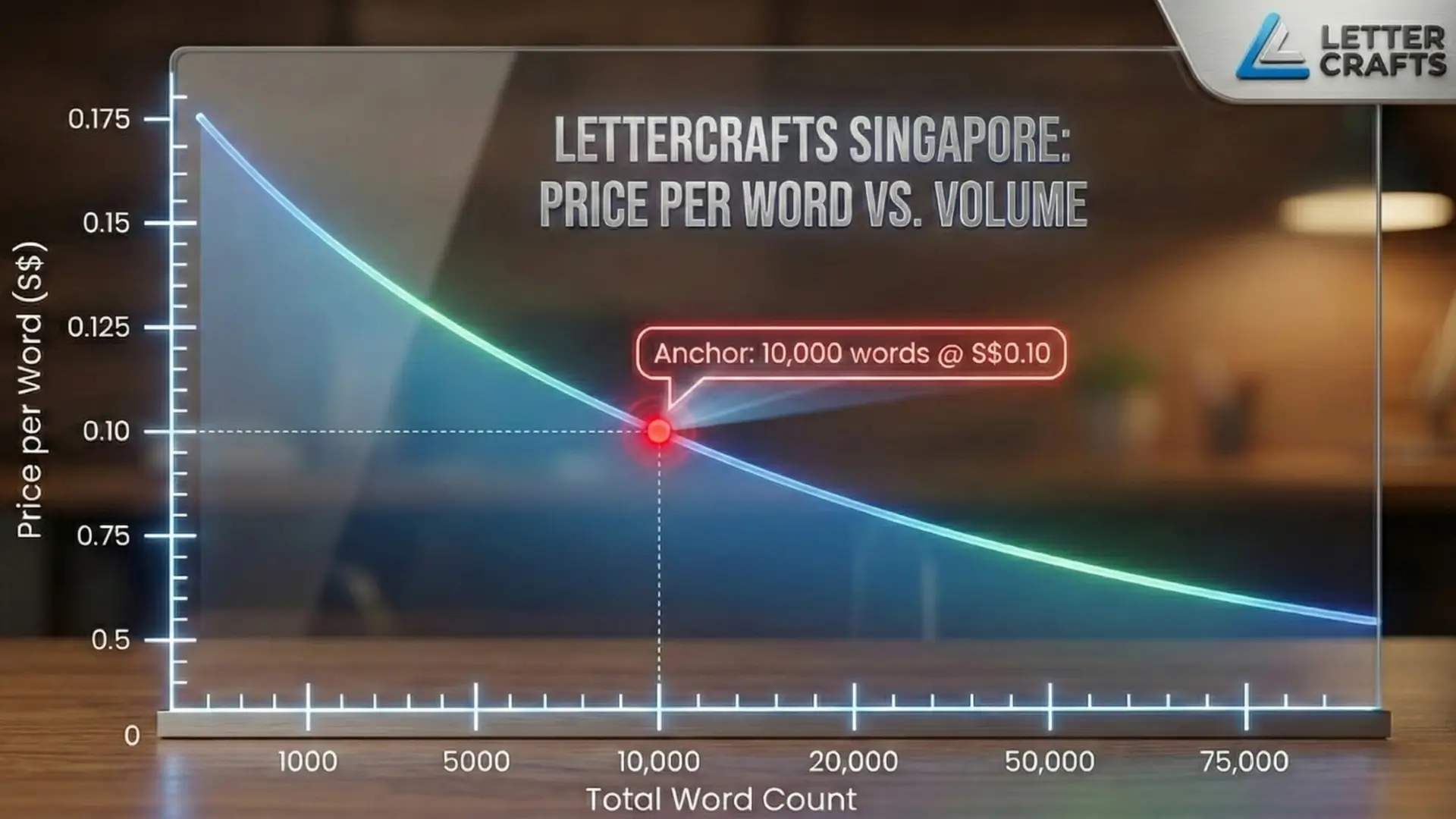
As word count increases from 10,000 to 50,000 words, the per-word rate eases down along a smooth curve. There are no sudden jumps, no arbitrary thresholds, and no renegotiations.
A simple comparison:
- 30,000-word document
- Traditional flat rate at S$0.12/word: S$3,600
- LetterCrafts Translations’ geometric pricing: ~S$2,550
Same quality. Same translators. Fairer Math.
The Science Behind the Fairness
If you’re not mathematically inclined, feel free to skip this section.
For procurement and finance teams, pricing follows a geometric progression:
an = a1*r(n-1)
Where:
- a1 = base rate at 10,000 words (S$0.10)
- r = discount ratio reflecting real efficiency gains
- an = effective per-word rate as volume increases
This ensures discounts are automatic, predictable, and defensible, not driven by negotiation tactics.
The Unique Word Advantage: Don't Pay for Repetition
Large documents repeat themselves. Most agencies charge for every repeated sentence.
We don’t.
Using CAT tools, we identify unique words and pass the savings back to you.
Example:
- 40,000-word technical manual
- 35% repetitive content
- Traditional cost: ~S$4,000
- LetterCrafts cost: ~S$2,600
You only pay for real work done.
Why This Matters to Singapore Businesses

Predictable Pricing, Faster Decisions
No RFP games. No negotiation fatigue. Quotes are instant, transparent, and easy to justify internally.
Quality Through Fair Compensation
When pricing is driven to the bottom, quality suffers. Our model ensures translators are compensated fairly, leading to better consistency, accuracy, and accountability, especially on large projects.
Designed for Singapore’s Multilingual Reality
English–Mandarin, English–Malay, English–Tamil, and ASEAN languages all benefit from the same predictable pricing logic, making budgeting realistic across markets.
Conclusion: Simple Math. Honest Pricing
Translation pricing doesn’t need to be complicated. Complexity often hides margins. We prefer clarity.
With LetterCrafts Translations Singapore, you get:
- Transparent, predictable costs
- Fair volume-based savings
- Consistent, professional quality
Math removes subjectivity and puts trust back into pricing.
Get an instant quote from LetterCrafts Translations Singapore and see how fair translation pricing should work.