Key Takeaway
- Singapore death certificates are issued in English and have been digital-only since 29 May 2022. Translation is rarely needed for local use.
- The translation runs one of two ways: a foreign certificate into English for use in Singapore, or a Singapore certificate translated abroad after an SAL apostille.
- Certified and notarised are not interchangeable. ICA and the Singapore courts require notarisation for vital records a plain certified translation gets bounced.
- SAL is the only apostille authority in Singapore. It requires original documents; laminated certificates are turned away.
- China (including Hong Kong and Macao), Indonesia, and Saudi Arabia have all joined the Hague Convention recently, removing the embassy step. Vietnam and Thailand are not yet in force. The UAE is not a member.
- Name romanisation mismatches across the certificate, passport, bank account, and will are one of the most common reasons a file stalls.
- Machine translation is accepted nowhere not by ICA, not by the courts, not by any bank.
Here's something that catches almost everyone off guard: a Singapore death certificate hardly ever needs translating. It's issued in English. The translation problem shows up at the edges instead of a parent who died in Guangzhou, an estate with a flat in Jakarta, or a bank in Tokyo that won't touch an English document until there's a Japanese version stapled to it.
We've handled enough of these files to know that the cost and delay rarely come from the translation itself. They come from getting the type of certification wrong: sending a plain certified translation where the court wanted a notarised one, or arriving at the Singapore Academy of Law with a laminated certificate that gets turned away at the counter. This guide walks through exactly when a death certificate translation is needed in Singapore, what "certified," "notarised," and "apostilled" actually mean here, and the small mistakes that quietly add weeks to probate, a CPF claim, or an account closure.
Quick answer
Death certificates in Singapore are issued in English and, since 29 May 2022, only in digital form. So a translation usually runs in one of two directions:
- Into English: a foreign-language death certificate translated for use in Singapore probate, CPF, bank, insurance, or ICA records.
- Out of English: a Singapore death certificate translated into another language for use abroad.
For the Singapore courts and for ICA, the translation generally has to be notarised. To use a Singapore certificate overseas, it's apostilled by the Singapore Academy of Law (SAL) first, then translated into the destination language.
How the Singapore death certificate works now
A few things have changed in recent years, and getting them straight saves a wasted trip across town.
A death in Singapore is now registered automatically the moment a doctor certifies it online. There's no counter registration, and the certificate is generated digitally. ICA stopped issuing physical death certificates on 29 May 2022. The next of kin downloads the digital (PDF) certificate from the My Legacy portal and prints it if they need a hard copy.
Death extracts went the same way: digital only since 27 March 2023. (An extract is the replacement you apply for when a certificate is lost or damaged.) ICA's Registry of Births and Deaths holds records of every death registered in Singapore since 1872, so even very old records can be retrieved.
For a death before 29 May 2022, where what you're holding is a paper certificate rather than a digital ICA document, a lawyer can certify it as a true copy, and that copy is what gets translated and, where needed, notarised.
One point that trips people up: ICA does not legalise or authenticate documents. Apostilles and legalisation are handled entirely by the Singapore Academy of Law, which took over that function from the Ministry of Foreign Affairs in 2021.
Because the certificate is already in English, a Singapore-issued death certificate generally needs translating only when it's heading to a non-English-speaking jurisdiction abroad.
When you actually need a death certificate translation
In practice, there are two realistic scenarios in Singapore
A foreign death certificate, used in Singapore. Someone dies overseas, in China, Indonesia, Japan, Korea, Thailand, Vietnam, the Gulf and the family has to settle matters here: report the death to ICA, apply for probate, close accounts, claim on a policy, or release CPF savings. If that certificate isn't in English, Singapore institutions will want a certified, and usually notarised, English translation.
A Singapore death certificate, used abroad. A Singapore resident dies but holds property, accounts, or a pension in a country that won't accept an English document. The Singapore certificate is apostilled by SAL, then translated into the local language.
| Scenario | What you typically need |
|---|---|
| Reporting an overseas death to ICA | Foreign death certificate + official English translation (ICA accepts translations done by a notary public in Singapore or in the issuing country) |
| Probate / Letters of Administration in Singapore | English certificate, or a notarised English translation of a foreign certificate |
| Closing bank accounts/conveyancing | Certified English translation; banks often require notarisation under their KYC checks |
| Releasing CPF savings (no nomination) | English documentation for the Public Trustee's Office |
| Life insurance claim | Certified English translation that matches the policy name exactly |
| Settling assets abroad (non-English country) | Singapore certificate apostilled by SAL, then translated into the local language |
Why translation matters for an inheritance
An estate stalls for one reason above all others: the body processing it can't read or can't trust the paperwork in front of it.
Probate: A Grant of Probate or Letters of Administration comes through the Family Justice Courts. A foreign-language death certificate has to be translated into English, and the courts generally expect that translation to be notarised.
CPF: Where CPF savings aren't covered by a nomination, they're distributed through the Public Trustee's Office, which needs verifiable proof of death before it acts.
Banks and property: Financial institutions and conveyancing firms need the death certificate for their know-your-customer and estate checks, and they won't act on an uncertified translation.
Insurance: Insurers cross-check the name and date of death before paying out. A mismatch between the translated certificate and the policy is enough to freeze a claim until it's resolved.
Apostille vs notarisation vs certified translation: what's the difference?
This is where most of the confusion and most of the wasted money happens. Here's the Singapore-specific version.
| Type | What it is | When Singapore needs it |
|---|---|---|
| Certified translation | A complete translation with a signed declaration of accuracy from the translator or agency. | Accepted by many banks, schools, MOM, and for general commercial uses. |
| Notarised translation | A certified translation that a Singapore Notary Public verifies after sighting the original. | Required by ICA (PR, citizenship, family-record updates) and by the Singapore courts for vital records like death certificates. |
| Apostille (SAL) | A certificate from the Singapore Academy of Law confirming that a Singapore public document is genuine. | When using a Singapore certificate in a Hague Apostille Convention country abroad. |
| Embassy / consular legalisation | Authentication through the destination country's embassy, after SAL. | When the destination is not a Hague member (e.g. the UAE). |
A few things worth pinning down:
- Singapore's accession to the Hague Apostille Convention took effect on 16 September 2021, and SAL is the sole authority that issues apostilles. ICA explicitly points people to SAL for legalisation.
- SAL requires original documents; apostille copies aren't accepted. If a document has been laminated, you'll need a certified true copy or extract from the issuing agency before SAL will touch it.
- For vital records, a Singapore notary has to see the original before notarising a translation. ICA does not accept remotely notarised translations of these documents.
- An apostille only works between Hague members. For a non-member destination such as the UAE, you go through SAL and then the relevant embassy.
Rule of thumb: Singapore court or ICA → notarised translation. Singapore certificate going abroad → apostille for a Hague country, or SAL plus embassy legalisation for a non-Hague country.
For a full breakdown of what ICA requires across all document types, see our complete ICA translation and notarisation guide
Reporting an overseas death to the ICA
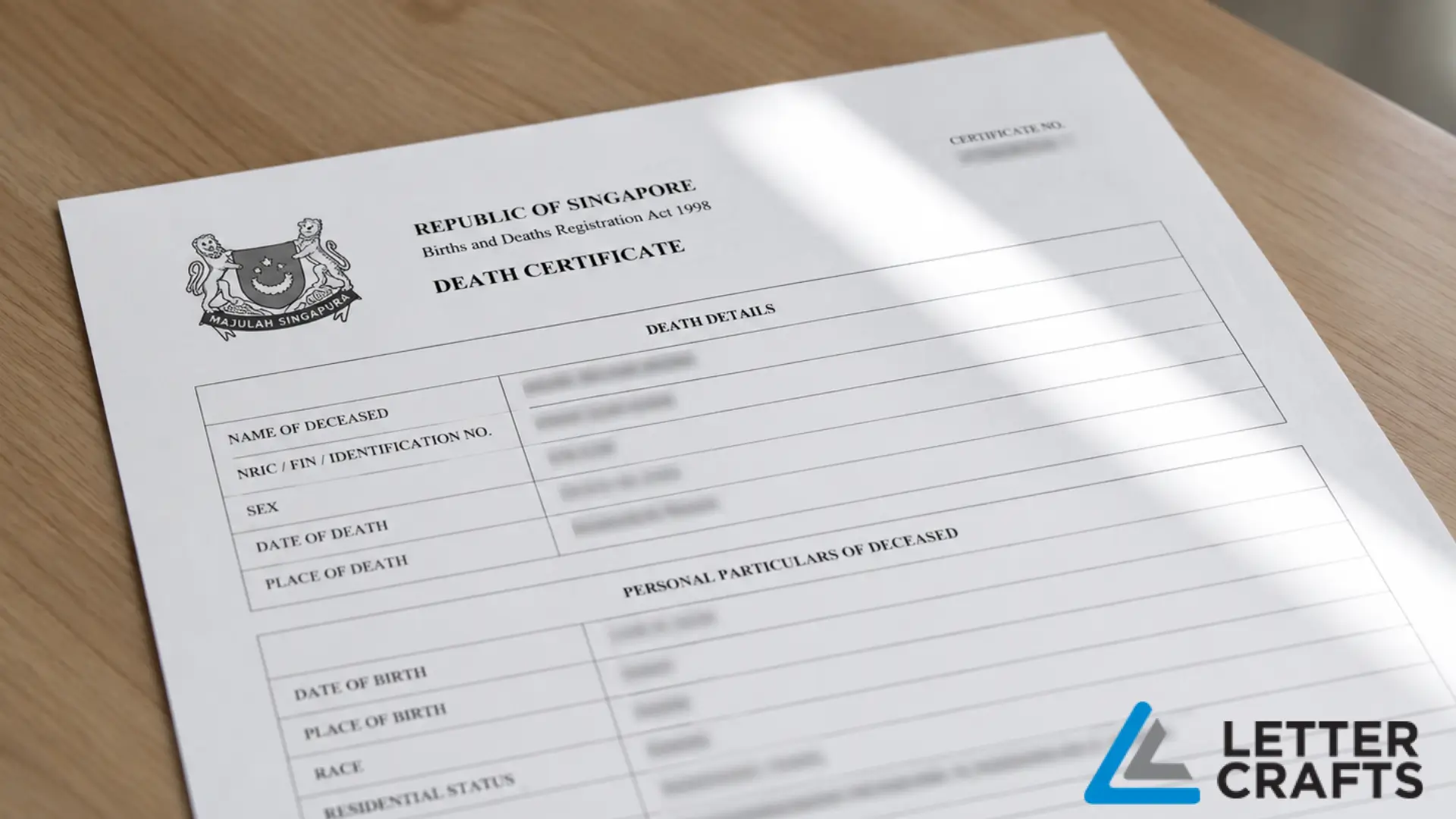
If a Singapore citizen, PR, or long-term pass holder dies abroad, the next of kin first registers the death with the foreign authority and collects the local death certificate, then reports it to ICA. There's no fee, and processing is generally within three working days once the documents check out.
The catch is the language. If the foreign certificate isn't in English, ICA requires an official translation. It will accept one produced by a notary public in Singapore or in the country that issued the certificate, and it doesn't endorse private translation companies as such. The safe route is a translation that's been properly certified and notarised, so it doesn't get bounced the moment you submit.
The apostille shortcut most people miss in 2026
This is the part of the older guidance that's quietly gone out of date, and it matters because it can save a family an entire embassy step.
When a foreign death certificate comes from a country that belongs to the Hague Apostille Convention, that country's own competent authority can apostille the certificate with one stamp, no embassy queue, and Singapore will recognise it. You then attach a certified (and, where required, notarised) English translation. When the country isn't a Hague member, you fall back to the older route: authentication followed by consular legalisation through the relevant embassy.
What's Changed: Countries That Have Recently Joined
The membership list has shifted, and several of the countries Singapore families deal with most have joined:
- China acceded on 7 November 2023, and that includes Hong Kong and Macao. Given that Chinese → English is by far the most common pair we see, this is the single biggest update a mainland, Hong Kong, or Macao certificate can now be apostilled rather than embassy-legalised.
- Indonesia joined on 4 June 2022, and Saudi Arabia on 7 December 2022.
- Japan and South Korea have been members for years.
Two Near-Misses Worth Flagging
The timing here is genuinely confusing, and assuming the wrong status is one of the costlier mistakes on this list.
- Vietnam has acceded, but the Convention only enters into force for it on 11 September 2026 so as of today, a Vietnamese certificate still takes the embassy-legalisation route.
- Thailand's cabinet approved accession in late 2025, but the instrument hadn't been deposited at time of writing, so Thai documents are also still on the embassy route.
- The UAE remains outside the Convention entirely; UAE-bound documents need SAL plus full embassy and MOFA attestation.
If you're not certain where your country sits, that's worth a quick check before you pay for anything. The wrong assumption here is one of the costlier mistakes on this list.
High-Demand Language Pairs for Death Certificate Translation in Singapore
For Singapore, the most requested pairs track where deaths and assets cross borders. The language needed and the certification that goes with it depends entirely on which direction the document is travelling.
Into English: Foreign Certificates Used in Singapore
Chinese (Simplified and Traditional) is far and away the most common, covering estates in mainland China, Taiwan, Hong Kong, and Macao. After that:
- Bahasa Indonesia and Malay for estates across the region
- Tamil for deaths registered in India
- Japanese and Korean for assets held in Northeast Asia
- Thai and Vietnamese for the wider Southeast Asian corridor
- Tagalog for Filipino nationals based in Singapore
- Arabic for deaths and estates across the Gulf
Out of English: Singapore Certificates Used Abroad
When a Singapore-issued death certificate needs to travel, it's apostilled by SAL first, then translated into the destination language. The most requested pairs going out are:
- English → Chinese for estates in mainland China, Hong Kong, Taiwan, and Macao
- English → Japanese and Korean for accounts and property in Northeast Asia
- English → Thai and Vietnamese for the Southeast Asian corridor
- English → Arabic for Gulf-based estates and pension claims
- English → major European languages for assets held in Europe
For non-Hague destinations, embassy legalisation follows the SAL apostille before the translated document is submitted.
The Recurring Trap: Name Romanisation
This is where files quietly break down across every language pair. Chinese, Arabic, and Tamil names can each be romanised several perfectly valid ways in English and a mismatch between the translated certificate, the bank account, and the will is enough on its own to freeze a file.
A careful translator doesn't quietly pick one spelling and hope. Every ambiguous name gets a bracketed note flagging the variation, so the receiving body whether it's ICA, a Singapore court, or a foreign bank can see exactly what was on the original and why the spelling was chosen. That single detail is often what decides whether a file moves forward or stalls.
What's on a death certificate, and why every line counts
Digital or foreign-issued, a death certificate carries closely cross-referenced data:
- Identity: full legal name and any aliases, sex, date of birth, identification number, address.
- Death details: date, place, and cause(s) of death.
- Family and authentication: informant or next of kin, registration number, date of registration, and the official seals or digital verification.
Courts, insurers, and lawyers check every one of these against wills, passports, and account records. A single inconsistency a date format, a romanised name, a place spelled differently can trigger a query or an outright rejection. A certified translator can't summarise or skip anything: every field, stamp, and annotation is rendered, and anything illegible or wrong gets a translator's note rather than a silent "fix."
Mistakes that stall an estate in Singapore
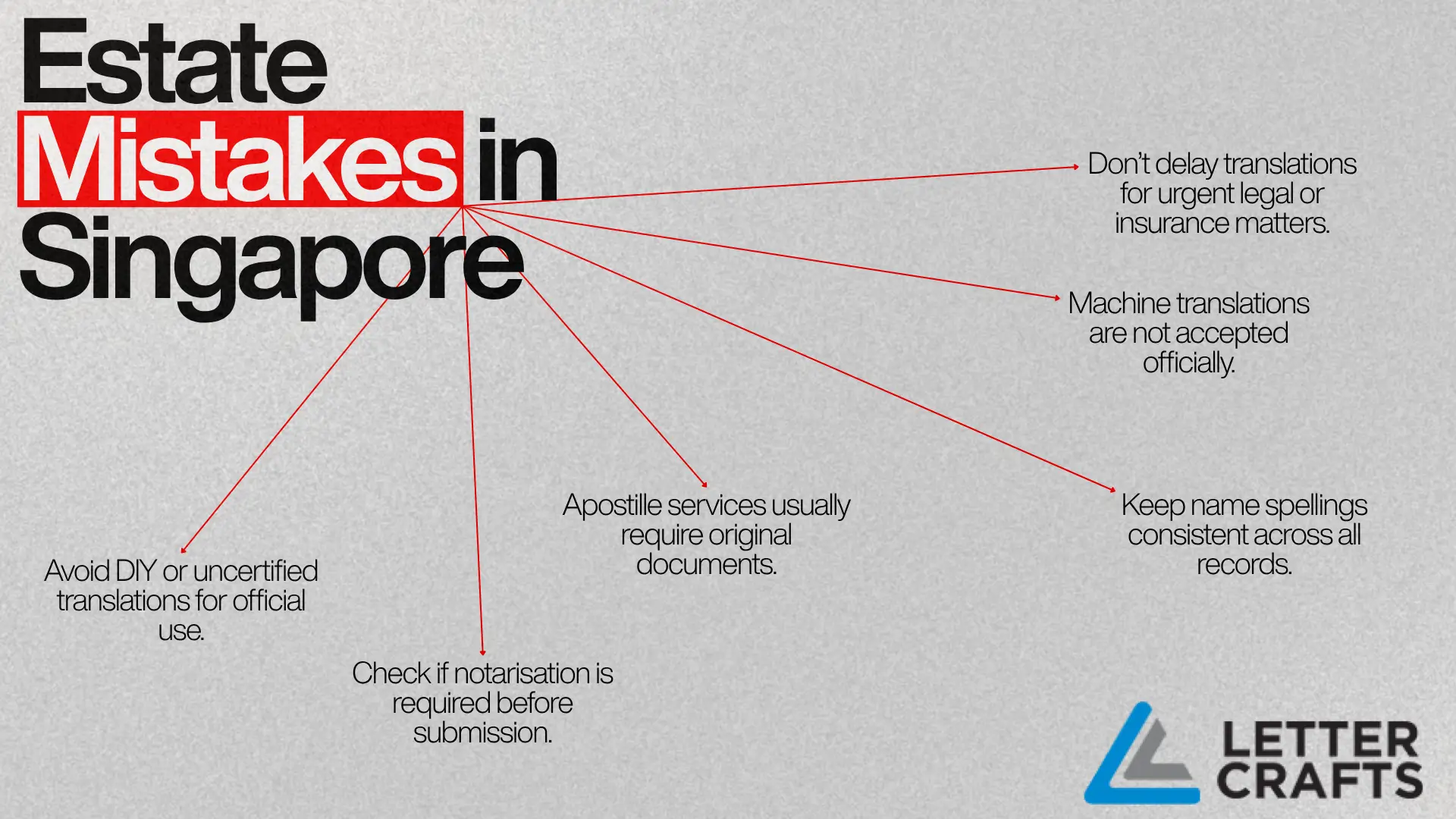
- Submitting a DIY or uncertified translation to ICA or the courts. These bodies require certified, and for vital records notarised, translations. A self-made version comes straight back.
- Skipping notarisation when it's needed. A plain certified translation is fine for some banks, but not for ICA PR/citizenship matters or court filings. Confirm the requirement before you order.
- Forgetting SAL's originals-only rule. Apostille needs the original. Bring a certified true copy if your original is laminated, or you'll be turned away.
- Inconsistent name spelling across documents. Romanised Chinese, Tamil, and Arabic names have to match across the certificate, IDs, accounts, and the will. Translate the whole bundle together so the spelling stays consistent
- Using machine translation. No court, bank, or government body in Singapore will accept a machine-translated death certificate.
- Leaving it too late. Probate, insurance, and overseas claims run on deadlines. A rejected or slow translation can cost a family time it doesn't have.
How these go wrong in practice (and how to avoid it)
These are common failure patterns rather than specific cases, but they map to the rejections we see most often:
- A certified translation sent where a notarised one was required bouncing an ICA or court submission and restarting the clock.
- A foreign certificate apostilled correctly abroad but translated by an uncertified provider, so the translation, not the original, becomes the weak link.
- Inconsistent romanisation between the certificate and a bank account, freezing the release of funds until a translator's note clears it up.
The fix in every case is the same: certified work, notarised where the receiving body requires it, and consistent name and date handling across the whole set of documents.
Why work with LetterCrafts
Settling an estate is stressful enough without chasing the wrong certification or resubmitting a rejected translation. Here's what we bring to the process and one honest note on what no provider can promise.
What We Handle
- Certified and notarised translations prepared to ICA and Singapore court standards.
- A notary runner service we present your originals to a Singapore Notary Public on your behalf, with proper authorisation, so you don't have to take time off or trek into the CBD.
- Apostille coordination with the Singapore Academy of Law for documents going abroad, plus embassy legalisation for non-Hague destinations.
- Wide language coverage including high-demand pairs like Chinese, Bahasa Indonesia, Malay, Tamil, Japanese, Korean, Thai, and Arabic.
- Careful name romanisation, with a translator's note wherever a spelling can go more than one way the detail that most often decides whether a bank or court accepts the file.
- Confidential handling of sensitive records, with digital and physical delivery.
One Honest Note on Expectations
No translation provider can guarantee acceptance. The final call always rests with ICA, the court, the bank, or the foreign authority and that's how it should be.
What a properly certified and notarised translation does is remove every avoidable reason for rejection. The paperwork arrives complete, correctly certified, and consistent across every field. What happens after that is the receiving body's call but there's nothing left on our end that should give them pause.
How the process works
- Send the document. Upload a clear scan or photo of the death certificate (and any apostille, if it's already done).
- Tell us the purpose and direction. Probate, ICA, CPF, insurance, property, or use abroad plus the language pair. That's what determines whether you need certification, notarisation, or apostille coordination.
- Get a quote. A line-item breakdown covering translation, notarisation, and any SAL or embassy coordination, with turnaround options.
- Translation and review. Field-by-field translation, an independent second read, then certification and notarisation where it's required (we arrange the notary).
- Delivery. A certified PDF by secure email, or a notarised hard copy.
Conclusion
The death certificate itself is rarely the obstacle. Singapore issues them in English, digitally, and the process works cleanly for deaths registered here. The complications appear at the edges a parent who passed away in Guangzhou, a flat in Jakarta that needs transferring, a bank in Tokyo that won't release funds until it sees a Japanese translation it can trust. That's where families lose weeks they don't have.
When translation is needed, two things decide the outcome: getting the certification level right and keeping every name, date, and detail consistent across the entire document bundle. Certified works for many banks and general purposes. ICA and the Singapore courts require notarisation for vital records. A Singapore certificate heading overseas needs an SAL apostille before anything else or embassy legalisation if the destination sits outside the Hague Convention.
Ready to get it right the first time?
Send us a scan of the death certificate and tell us what it's needed for probate, ICA, CPF, insurance, or use abroad. We'll come back with a clear assessment, the correct certification path, and a line-item quote with no guesswork.
Or email your document scans directly to begin. Most assessments come back the same working day.
LetterCrafts: trusted translations for life's most important documents.