TL;DR
ICA requires every non-English document submitted for PR or Citizenship to be translated into English, certified by an independent translator, notarised by a Singapore Notary Public, and authenticated by SAL via Apostille. Skip the notarisation step, and the file is rejected. End-to-end cost runs roughly S$200-S$500 per document; timeline runs 4-8 working days. The single most common rejection trigger is an untranslated stamp.
Key Takeaway
- For ICA Permanent Residency and Citizenship applications every non-English document needs a certified English translation plus notarisation by a Singapore Notary Public followed by Singapore Academy of Law (SAL) authentication. Certification alone will be rejected.
- For MOM work passes (EP, S Pass, Work Permit), a certified translation from a registered translation provider is usually sufficient; notarisation is not generally required.
- The SAL authentication fee is fixed at S$87.20 (inclusive of GST) and has been delivered via Apostille since 16 September 2021.
- End-to-end timeline for an ICA-ready bundle: 4-8 working days, or 2-3 working days with express handling.
- The single most common rejection trigger is an untranslated stamp, seal, or reverse-side notation, not a bad translation of the main text.
Quick rule of thumb: if your document is heading to ICA, ROM, or a Singapore court, assume notarisation is required. If it is heading to MOM, a bank, or a school, certified translation is usually enough.
Why this guide exists
If you're submitting to ICA for PR or Citizenship, a certified translation isn't enough on its own; it has to be notarised by a Singapore Notary Public and authenticated by SAL. Skip a step, and the file gets bounced.
If you are submitting a foreign-language document to the Immigration & Checkpoints Authority (ICA) the Ministry of Manpower (MOM), the Registry of Marriages (ROM), the Inland Revenue Authority of Singapore (IRAS), or a Singapore court, the rules around translation are stricter than most applicants expect.
A translated document isn't a certified one. A certified translation isn't a notarised one. The distinctions matter; get them wrong, and the file is returned. The wrong type of document, even when done by a competent translator, will be rejected at submission, and we routinely see this add two to three months to an applicant's timeline.
This guide explains, in plain language, what each level of authentication actually means in Singapore, when you need it, what the authorities require, and how to avoid the rejection reasons we see most often in practice.
Certified vs. Notarised vs. Apostilled vs. Legalised: The Four Levels
People throw these four terms around as if they mean the same thing. They don't, and the order matters.
| Authentication Level | What It Confirms | Issued By | Typical Use |
|---|---|---|---|
| Certified Translation | The linguistic accuracy of the translation | Translator or registered translation company | MOM work passes, schools, banks, HR files |
| Notarisation | The identity of the translator and the legitimacy of the certification | Notary Public (a senior lawyer appointed by SAL) | ICA (PR, Citizenship), Singapore courts, ROM marriage registration |
| SAL Authentication (Apostille) | The authenticity of the Notary's signature and seal | Singapore Academy of Law | Mandatory follow-up to all Singapore notarizations; also used for overseas submissions to Hague Apostille countries |
| Embassy Legalisation | The acceptance of the SAL-authenticated document by a non-Apostille country | The foreign embassy or consulate in Singapore | Documents intended for countries that have not joined the Hague Apostille Convention |
Here's the cleanest way to remember it:
- Certified = the translation is accurate.
- Notarised = the translator is verified.
- Apostilled = the Notary is verified.
- Legalised = the apostille is recognised abroad (only required for non-Apostille countries).
The Apostille Convention came into force in Singapore on 16 September 2021 (following accession on 18 January 2021), and SAL is Singapore's sole Competent Authority for issuing Apostilles. Since June 2025, SAL has been issuing e-Apostilles for ACRA documents (Business Profiles and Certificates of Incorporation) with plans announced to extend coverage to all notarised documents by the end of 2025 and expand to other categories over time.
What is Certified Translation in Singapore?
Certified translation is a translation accompanied by a signed declaration, usually called a Certificate of Accuracy confirming that the translation is a true and faithful rendering of the original document. The declaration is issued by the translator or the translation company, on official letterhead, with credentials, signature, company stamp, and date.
A certified translation is not a court-validated document. It is a professional declaration, and its strength rests on the credibility of the translator who issued it.
What a Certificate of Accuracy typically contains
- A statement that the translator is competent in both source and target languages
- A statement that the translation is complete and accurate
- The translator's or the company's name, address, and contact details
- The original document title, language pair, and page count
- Signature, company stamp, and date
- Often, a unique reference number for traceability
You can see a sample Certificate of Accuracy here
Who can issue a Certified Translation in Singapore?
Singapore does not maintain a state-run registry of "sworn translators" the way many civil-law jurisdictions (Spain, France, Germany, Brazil) do. In practice, a certified translation in Singapore is issued by:
- A registered translation company (ACRA-incorporated, verifiable on the BizFile portal)
- A professional translator with verifiable credentials
- The embassy or consulate of the country that issued the original document
For most everyday purposes involving work pass applications to MOM, such as school enrolment, opening a bank account, or updating employer HR records, a certified translation from a reputable provider is sufficient.
What is Notarisation, and Who can do it?
Notarisation is a formal legal act in which a senior practising lawyer appointed by the Singapore Academy of Law, who witnesses the signing of a document and attests to its authenticity through a Notarial Certificate.
For translated documents, the Notary verifies the identity of the translator (or sights the translator's signed declaration and credentials), then issues a Notarial Certificate that binds the translation to a recognised legal officer.
Worth pausing on, because most applicants get this wrong: the Notary isn't vouching for the translation's accuracy. The Notary attests that the translator is who they say they are, that the original document was sighted, and that the certification declaration was properly made. The accuracy of the translation remains the translator's professional responsibility.
What Happens at Notarisation
- The original document is presented to the Notary physically.
- The translator (or translation company representative) signs the Certificate of Accuracy in front of the Notary, or has previously signed a declaration that the Notary verifies.
- The Notary affixes a Notarial Certificate, official seal, and signature.
- The Notarial Certificate is then authenticated by the Singapore Academy of Law.
Under Rule 8(3)(c) of the Notaries Public Rules, a Notarial Certificate must be authenticated by SAL to be valid. The authentication fee is S$87.20 (inclusive of GST) and is payable at the Notary Public's office. Since 16 September 2021, this authentication is done by affixing an Apostille to the back of the Notarial Certificate; the same mechanism is used whether the document is intended for local or overseas use.
Why Authorities Request Notarisation
For high-stakes submissions like Permanent Residency, Citizenship, Court proceedings, Inheritance, and Property transactions, the receiving authority wants more than a translator's professional word. They want a chain of accountability that includes a regulated legal officer. Notarisation provides that chain: a Notary Public's name and licence number are on record with SAL, and any falsified notarisation can be verified and prosecuted.
When You Actually Need at Each Level? (Decision guide)
Use the matrix below to identify the authentication level your submission requires. When in doubt, confirm with the receiving authority before commissioning the work.
| Submitting to | Purpose | Need |
|---|---|---|
| ICA | Permanent Residency, Citizenship, Long-Term Visit Pass | Certified + Notarised + SAL Authenticated |
| MOM | Employment Pass, S Pass, Work Permit, Dependant Pass | Certified (notarisation rarely required) |
| Family Justice Courts | Probate, custody, foreign judgments | Certified + Notarised + SAL Authenticated |
| IRAS | Tax filings involving foreign-sourced income | Certified (notarisation may be requested) |
| Banks/insurers | Account opening, claims, and loans | Certified |
| Universities | Admissions, credential verification | Certified |
| Overseas authority (Apostille country) | Use of Singapore documents abroad | Certified + Notarised + SAL Apostille |
| Overseas authority (non-Apostille country) | Use of Singapore documents abroad | Certified + Notarised + SAL Apostille + Embassy Legalisation |
ICA-Ready Translation Checklist
Before submitting a translation to ICA, confirm every item below:
Translation produced by an independent third party (not the applicant, not a family member)
Every stamp, seal, watermark, and reverse-side mark translated with zero omissions
Layout mirrors the original document (table stays as table, certificate stays as certificate)
All names render exactly as on the applicant's passport, or a name-discrepancy declaration is included
Certificate of Accuracy on translator's letterhead, signed, stamped, dated
Notarisation by a Singapore Notary Public completed
SAL authentication (Apostille) affixed to the Notarial Certificate
Scan uploaded at 300 DPI or higher
Original physical bundle ready for the ICA interview
ICA's Specific Translation Requirements
ICA requires every non-English document submitted in support of an application to be accompanied by an official English translation. ICA publishes this requirement across its document checklists for PR, Citizenship, Long-Term Visit Pass, dependant passes, and student passes. See, for example, the official ICA explanatory notes for the spouse of SC/PR applications
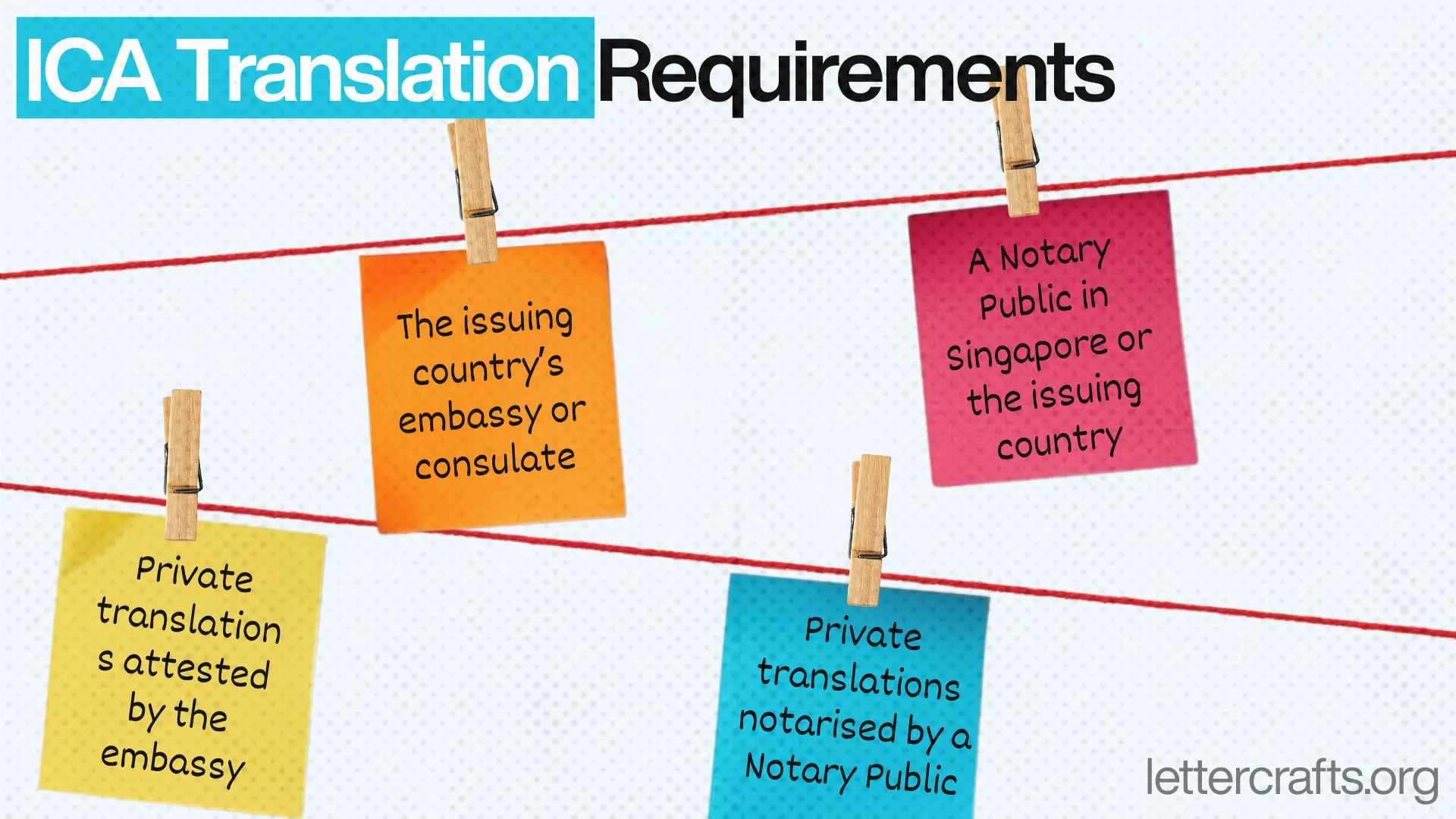
ICA's published guidance lists three official channels (one of which has two attestation routes):
- The embassy or consulate of the country that issued the original document
- A Notary Public in Singapore or in the country that issued the document
- Privately created translations subsequently attested by the embassy of the issuing country
- Privately created translations subsequently notarised by a Notary Public in Singapore or in the issuing country
ICA explicitly states that it does not endorse any private translation companies. The acceptance of a translation rests on the authentication channel, not the translation provider itself. This is why a certified translation alone, without notarisation or embassy attestation, will be rejected at submission.
ICA also reserves the right to request additional supporting documents and will not accept incomplete bundles. A PR application submitted with missing or improperly authenticated translations will require a fresh appointment to resubmit.
What must appear in the translation?
Every visible element on the original must appear in the translation:
- The main text body
- All stamps, seals, watermarks, and official marks
- Handwritten annotations, corrections, and marginal notes
- Reverse-side content
- The issuing authority's name and registration details
- Any prior apostilles or legalisation certificates already affixed
From the files we handle, missed stamps cause more ICA rejections than any other single issue. A "reissued" stamp on a Chinese birth certificate, a registrar's signature on a Filipino PSA-issued document, and an authentication serial on an Indian transcript each have caused returns we have had to clean up.
Names must match the passport, character for character
ICA matches names character-by-character against the applicant's passport. Differences in spelling, name order, or romanisation must either match the passport exactly in the translation, or be supported by a separate One-and-the-Same-Person Affidavit or name-discrepancy declaration.
Recurring patterns we see:
- Chinese applicants use different romanisation systems (Hanyu Pinyin, Wade-Giles, and Cantonese romanisation) across documents.
- Indian applicants' patronymics or village names are omitted on birth certificates but included on passports.
- Filipino applicants' middle names (mother's maiden name) are on the PSA certificate, but rendered differently on the passport.
- Married women's pre- and post-marriage surnames are not aligned across documents.
Common documents that require translation
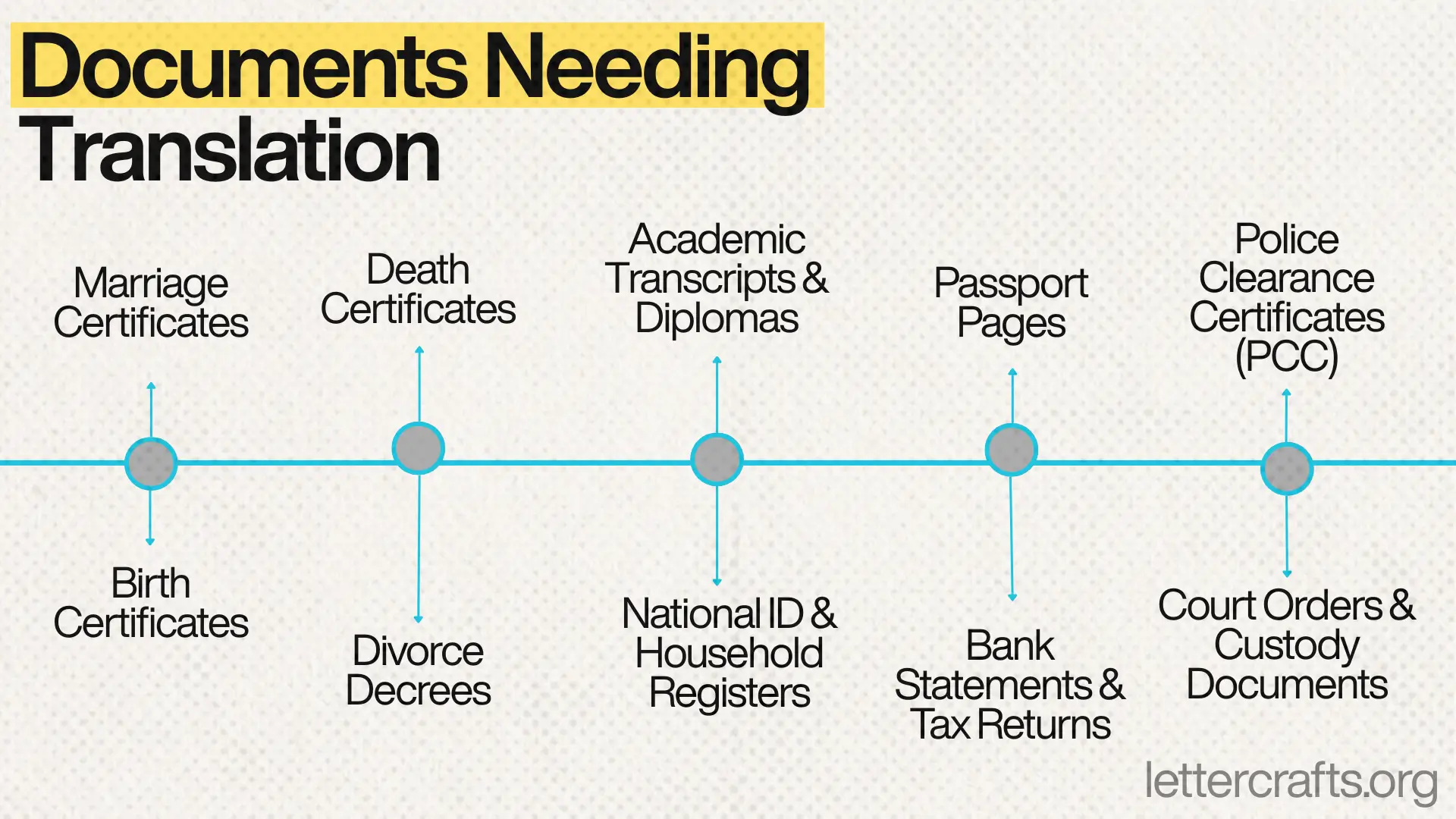
The documents below appear most often in ICA Permanent Residency, Citizenship, MOM work pass, ROM marriage registration, and court submissions. Each carries its own formatting conventions, authority-specific requirements, and rejection risks. A Chinese hukou booklet and a Filipino PSA birth certificate are both household-and-birth records, but they look nothing alike and fail at different points in the review process.
Birth Certificate Translation for ICA and Singapore PR Applications
Birth certificates are among the most common documents submitted to ICA and among the most frequently returned. The main body text is rarely the problem. Rejection almost always comes from a stamp, a seal, or a registrar's notation that the translator treated as background rather than translatable content.
Re-issuance marks, authentication stamps on the reverse side, and marginal annotations must all be translated in full. ICA's standard is zero omissions: a single overlooked stamp is enough.
Name-order conventions are the second major rejection trigger. A Chinese birth certificate records the surname first in characters, but the romanisation on the applicant's passport may follow a different system entirely. Where the rendered name in the translation does not match the passport character-for-character, a name-discrepancy declaration is required alongside the translation.
Authentication required for ICA: Certified translation + notarisation + SAL authentication.
Marriage Certificate Translation for Spousal PR and Dependant Pass Applications
Marriage certificates are required for spousal PR applications, dependent pass applications, and certain IRAS tax filings where marital status affects the assessment.
The complication is that marriage certificates are issued by very different registering authorities: a church-issued certificate in the Philippines, a civil registration document from an Indian state registry, a notarial act in France, a family book entry in Indonesia. Each carries its own stamp layout, witness signatures, officiating authority details, and registration number format. All must appear in the translation.
Dates and places of registration are cross-checked by ICA against other documents in the same bundle. Inconsistencies in how dates are rendered, different day-month-year conventions across a multi-document submission, are a common trigger for ICA requests for clarification, which add weeks to processing.
Authentication required for ICA: Certified translation + notarisation + SAL authentication. ROM has separate document validity windows to confirm the currency of the underlying certificate before commissioning translation.
Divorce Decree Translation for ROM Re-Marriage and PR Applications

Divorce decrees are required for remarriage at ROM and for PR applications where the applicant or spouse has a prior marriage on record. Omitting a prior marriage from an ICA application or submitting an improperly translated divorce decree is among the most serious documentation errors an applicant can make.
A divorce decree is a court-issued document. It carries a court seal, a judge's signature, a case reference number, and typically a series of numbered orders covering custody, maintenance, and property division. Every element must be translated, not summarised. A translation that renders the judgment in continuous prose rather than mirroring the numbered structure of the original will be returned.
Where the decree runs across multiple pages with separate exhibit stamps, every page requires translation, including exhibit notations. Where ancillary orders (custody, injunction) are attached as schedules, those schedules form part of the document and must be included. Our legal translation team handles court documents under affidavit standards.
Authentication required for ICA and ROM: Certified translation + notarisation + SAL authentication. Court-issued documents carry the highest formatting requirements layout must mirror the original.
Death Certificate Translation for Inheritance, Probate, and Insurance Claims in Singapore
Death certificates are required for inheritance and probate proceedings, insurance and pension claims, cancellation of a dependant pass following bereavement, and the updating of estate records. For probate matters filed with the Family Justice Courts of Singapore the translated death certificate must meet court-filing authentication standards.
Death certificates from different jurisdictions present very differently. Some are handwritten entries in a civil register, others are typewritten official forms, and some are digital printouts with QR-code verification panels. The cause-of-death field frequently contains medical terminology that requires a translator with specialist vocabulary; a general-language generalist is not adequate. Our medical translation team handles these.
Where a foreign death certificate already carries its own apostille, the apostille text must also be translated. This is a known omission point.
Authentication required for Family Justice Courts and ICA: Certified translation + notarisation + SAL authentication.
Academic Transcript and Diploma Translation for MOM and ICA
Academic transcripts and diplomas are submitted for MOM Employment Pass education verification, ICA dependant pass applications, and university enrolment. The translation covers the institution name, qualification title, subjects, and results, award date, and all institutional seals and signatures.
A critical distinction: grade conversion , converting a foreign grading scale into its Singapore or international equivalent, is not part of a certified translation. Grade conversion is a separate credential assessment performed by bodies such as credential evaluation by recognised bodies (e.g., Dataflow for MOM background checks, or institution-specific assessment offices) or a private credential evaluator. Conflating the two creates scope disputes mid-process.
Where MOM is the receiving authority for a standard Employment Pass, a certified translation is generally sufficient; notarisation is not typically required. Where ICA is the receiving authority (for a dependant pass under a PR application, or for Citizenship), notarisation is required. A translation prepared for MOM is not automatically accepted by ICA.
Applicants who anticipate a future PR application are well advised to commission the fully notarised version from the outset. Redoing the chain later costs more than doing it once correctly.
Authentication required: MOM-certified translation. ICA certified translation + notarisation + SAL authentication.
Police Clearance Certificate Translation for ICA PR and Citizenship Applications
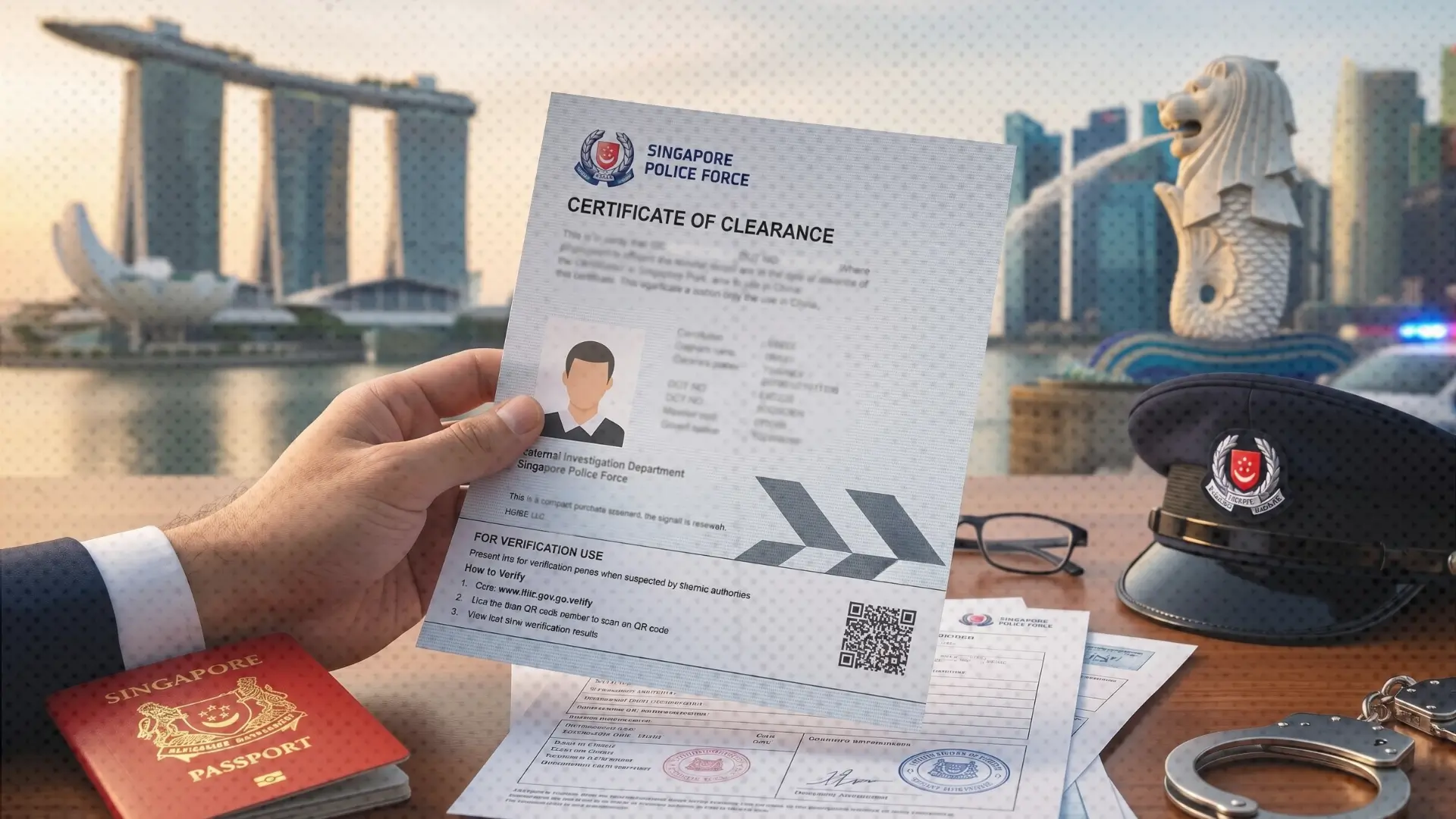
Police clearance certificates (PCCs) are increasingly requested by ICA for PR and Citizenship applications, particularly where the applicant has resided in multiple countries. Employers in regulated sectors also request them.
Many overseas PCCs, particularly those from India, China (Ministry of Public Security), the Philippines (NBI Clearance), and several ASEAN member states, arrive with their own apostille or authentication certificate already affixed. This creates a translation obligation that is consistently overlooked: the apostille text itself must be translated alongside the main body of the clearance certificate.
An apostille is itself a legal document. It contains the issuing authority's name, the document type, the date of issue, the signatory's name and capacity, the seal, and a verification reference number. Submitting a translation that covers the clearance certificate body but leaves the apostille panel untranslated is a known ICA rejection trigger.
Authentication required for ICA: Certified translation + notarisation + SAL authentication. Where the PCC carries an overseas apostille, translate the apostille panel as part of the same document.
National Identity Document and Household Register (Hukou) Translation
National identity documents and household registers are country-specific in their layout and, as a result, country-specific in the complications they produce. Chinese hukou booklets are the most common document of this type in Singapore PR applications.
A hukou booklet typically runs to multiple pages, one page per registered household member, and each page contains relationship designations, registration dates, address history, and administrative notations that must be translated in sequence. The cover page and administrative registration pages must also be translated, not only the page that names the applicant. Submitting a partial translation of a hukou covering only the applicant's page is a frequent rejection trigger.
Other national identity and household documents with equivalent complexity include the Indonesian Kartu Keluarga (KK) family card, the Vietnamese hộ khẩu household register (for documents issued before its abolition on 1 January 2023, Vietnam has since moved to a digital residence database tied to the Citizen Identity Card), the South Korean family relation certificate (가족관계증명서), the Indian ration card, and various national identity cards from Bangladesh, Myanmar, and Sri Lanka. For all of these, the entire document is the unit of translation, not only the page that names the applicant.
Authentication required for ICA: Certified translation + notarisation + SAL authentication.
Passport Translation for ICA Submissions
Full-page passport translations are required in specific circumstances, most commonly for the personal particulars page, but also for visa pages and entry or exit stamps where these are relevant to the applicant's immigration history or declared period of residence.
A passport translation is not a summary of the applicant's travel history. It is a page-by-page rendering of the specific pages ICA has requested. Where only specified pages are requested, the translation must clearly identify which pages are covered and which are excluded.
Visa stamps and entry or exit notations often contain abbreviated codes and authority-specific terminology. These must be rendered accurately, not paraphrased, because they are cross-checked against declared travel history and residency periods in the application.
Authentication required: Varies by submission purpose. Confirm with the receiving authority before commissioning.
Bank Statement and Tax Return Translation for IRAS and ICA
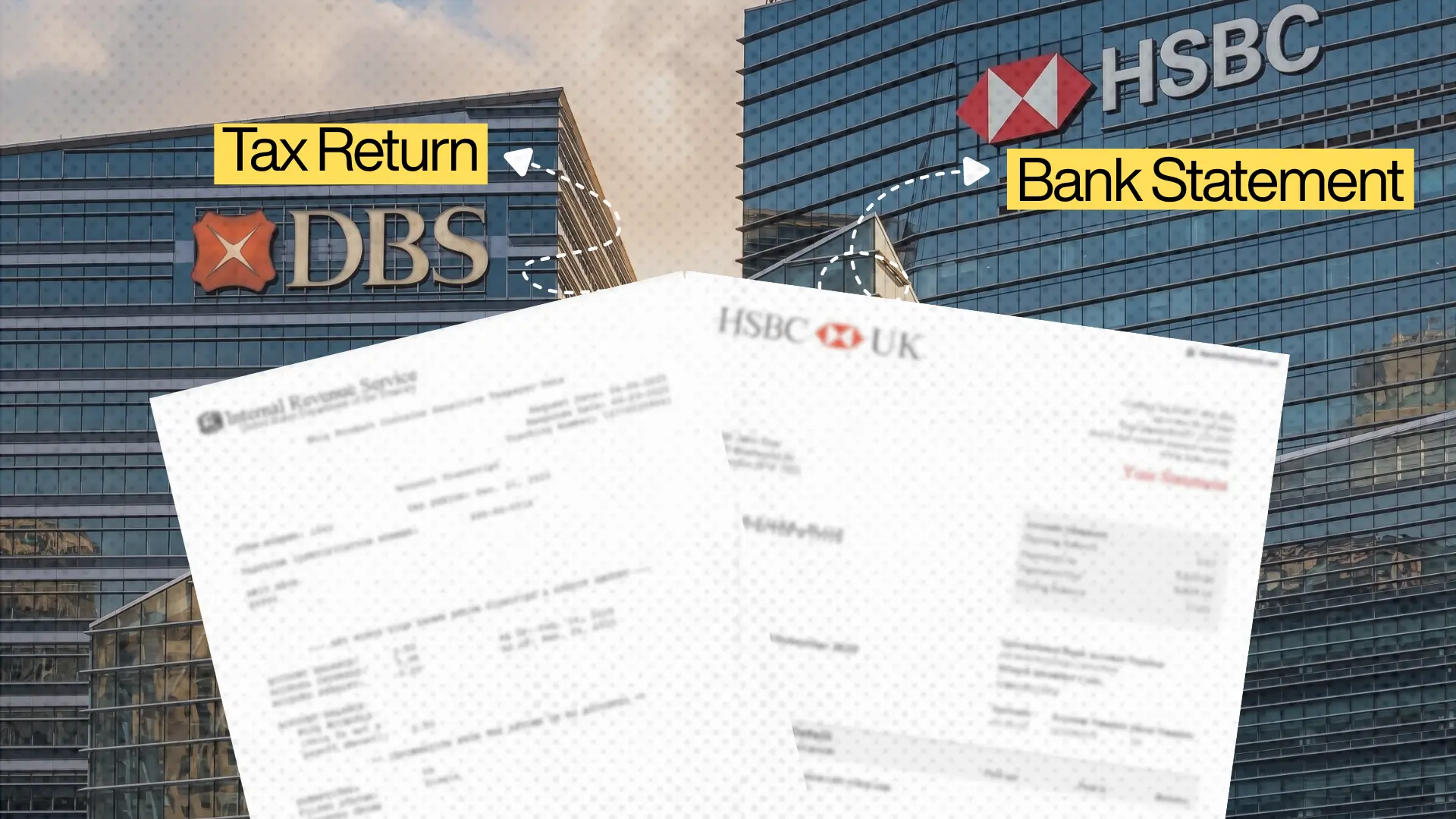
Bank statements and tax returns in foreign languages are submitted to IRAS for assessments involving foreign-sourced income, to financial institutions for loan and mortgage applications, and to ICA as supporting evidence of financial standing in certain PR and Citizenship applications.
The primary translation challenge here is consistency. Bank statements contain repeated terminology, such as account holder, transaction type, running balance, branch code, and SWIFT identifier, that must be rendered the same way throughout. Inconsistent terminology across pages of the same statement, or across statements from the same institution, creates ambiguity that reviewers will flag. Our business translation team handles financial documents with terminology memories that keep this consistent across long bundles.
Tax returns from civil-law jurisdictions often include schedules, supplementary declarations, and annexures running to many pages. The full document is the submission unit. Translating only the summary page while leaving schedules untranslated is not acceptable to IRAS or ICA.
Authentication required: IRAS and financial institutions typically accept certified translation. ICA may require notarisation where financial documents form part of a PR or Citizenship bundle.
Court Order, Custody Order, and Protection Order Translation
Court orders, including custody orders, maintenance orders, and personal protection orders originating from foreign jurisdictions, are required for family law proceedings in Singapore, for applications where an existing foreign order is relevant to proceedings before the Family Justice Courts, and for matters where a protection order issued abroad needs to be recognised or enforced.
Court documents sit at the top of the authentication chain. Notarisation and SAL authentication are standard. Depending on the originating jurisdiction, embassy attestation may be required in addition to, or as an alternative to, Singapore notarisation.
The structural integrity of the translation is as important as linguistic accuracy. Numbered clauses, defined terms, party designations, and recitals in the original must be rendered in a way that preserves the legal sense of the order, not merely its surface meaning. A poorly structured court order translation, even if linguistically accurate, can create ambiguity in enforcement proceedings that requires a separate legal opinion to resolve.
Where the order has been varied or amended by a subsequent court, the variation order must also be translated as part of the same bundle.
Authentication required for Family Justice Courts: Certified translation + notarisation + SAL authentication. The highest formatting and structural fidelity standard applies.
The 6-step ICA-compliant translation process
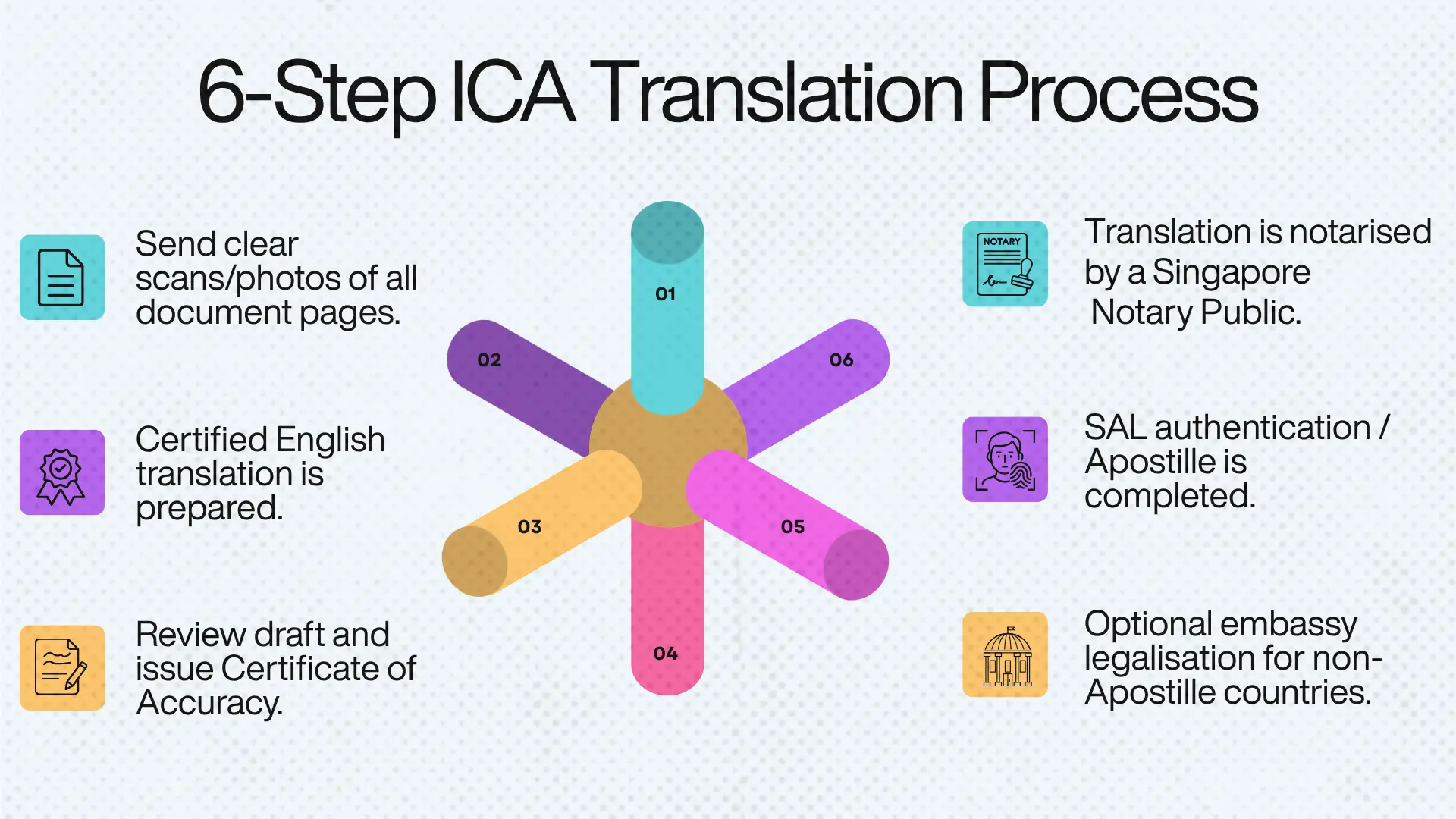
The process below reflects how a typical ICA-compliant translation and notarisation is handled end-to-end at LetterCrafts.
Step 1: Send your documents
Clear, high-resolution scans (300 DPI or better) of the original document, including the reverse side and any continuation pages. Phone photographs are acceptable only if every stamp, signature, and watermark is legible.
Step 2: Translation is completed
A qualified translator produces the English translation, preserving the original layout as closely as possible. Tables remain tables. Stamps are described and positioned in the corresponding location on the page. Handwritten annotations are noted.
Step 3: Draft review and Certificate of Accuracy issued
A draft is shared with the client before notarisation. This is the single most important step, because once a document is notarised, it cannot be amended without restarting the entire chain. The client checks names, dates, places, technical terms, and stamp translations.
Once approved, the translation company finalises the document, attaches the Certificate of Accuracy, and signs the declaration.
Step 4: The Notary Public notarises the translation
The original document and the certified translation are presented to a Notary Public in Singapore. The Notary sights the original, verifies the translator's declaration, and issues a Notarial Certificate. The Notary signs and seals the Notarial Certificate, and the SAL authentication fee (S$87.20) is paid at this stage.
Step 5: SAL authentication / Apostille
The notarised package is taken to the Singapore Academy of Law at 1 Coleman Street, #08-06, The Adelphi, Singapore 179803 for authentication. SAL affixes an Apostille to the back of the Notarial Certificate, completing the chain. Physical authentication typically takes one to three working days. available for ACRA documents today, with SAL announcing extension to all notarised documents by the end of 2025.
Step 6: Optional overseas legalisation
If the document is destined for use in a country that is not party to the Hague Apostille Convention, an additional step at the relevant embassy or consulate in Singapore is required. For Apostille Convention countries, the SAL Apostille is sufficient.
Four real-world scenarios

The same translation and notarisation process applies across very different submissions. Below are four scenarios that reflect the bulk of casework we handle.
Scenario 1: PR application for a Mainland Chinese family of three
A family applying for PR will typically need: the principal applicant's birth certificate, the spouse's birth certificate, the marriage certificate, the household register (hukou) for each adult, the academic certificates and transcripts of the principal applicant, and the birth certificate of the dependent child. Every document is in Chinese. The full chain translation, Certificate of Accuracy, notarisation, and SAL authentication run to roughly six to ten distinct documents.
Bundling efficiency matters: where names match across documents (parent and child sharing surnames), some notarisation cost-savings are possible, but documents with different names cannot be combined under a single Notarial Certificate.
Scenario 2: Marriage registration at ROM with a foreign fiancé(e)
A Singapore Citizen marrying a foreign national at the ROM will typically require the foreign partner's birth certificate, passport, and, where applicable, a divorce decree or death certificate of a prior spouse, plus a Certificate of No Marriage / Single Status declaration from the home country. ROM has specific document acceptance windows (CENOMAR equivalents, for instance, are typically valid for six months from issue). The translation and notarisation chain must be timed so the underlying document is still within ROM's validity window when the application is filed.
Scenario 3: Inheritance and Grant of Probate
When a Singapore-resident family member passes away, leaving assets abroad, or a foreign-resident relative passes away, leaving Singapore assets, the executor will typically need certified, notarised translations of the death certificate, the will (if any), and supporting identity documents. Singapore probate proceedings require these to be filed with the Family Justice Courts. For foreign assets, the translated and notarised package usually needs an additional SAL Apostille for use overseas, plus embassy legalisation if the receiving country is not party to the Apostille Convention.
Scenario 4: Employment Pass education verification
An Employment Pass applicant whose university degree is in a non-English language will typically face MOM's education verification through an accredited background screening company. MOM's standard is a certified English translation by a translation service provider; full notarisation is not generally required. However, if the same applicant later applies for PR through the same employer, that earlier MOM translation will need to be redone with notarisation for ICA. It is often more economical to anticipate the PR step from the outset and produce the fully notarised version once, even if MOM does not strictly require it.
Turnaround times and costs
Typical timelines
Timelines below assume a standard, single-document workflow. Multi-document bundles and rare-language pairs may take longer.
| Stage | Standard Timeline | Express Option |
|---|---|---|
| Translation (single document, common language) | 24-48 working hours | Same-day for short documents |
| Draft review and client approval | 1-2 working days | Same day |
| Notarisation appointment | 1 working day | Often available the next morning |
| SAL authentication (physical) | 1-3 working days | e-Apostille issued in minutes for eligible documents |
| Total end-to-end | 4-8 working days | 2-3 working days |
Plan around your ICA appointment date. A common mistake is leaving translation and notarisation to the final week before submission and discovering that a document needs correction after the SAL apostille has already been affixed, at which point the entire chain must be redone.
What it costs
Pricing in Singapore varies by document type, language pair, page count, and whether notarisation is included.
Translation costs are driven by:
- Source language (Mandarin, Malay, and Tamil are the most economical; rarer languages like Burmese, Khmer, or Sinhalese cost more)
- Number of pages and word density
- Document complexity (a one-page birth certificate vs a multi-page divorce decree)
- Urgency
Notarisation costs include the Notary's professional fee (regulated under the Notaries Public Rules) and the SAL authentication fee of S$87.20 (inclusive of GST), payable at the Notary Public's office. What varies between providers is the translation fee, runner-service fee, and any express handling charges.
LetterCrafts publishes translation pricing starting from S$38 per page with no additional GST, and our quotations itemise every line so there are no surprises.
Always get a written quotation that itemises:
- Translation fee per page
- Certificate of Accuracy (should be included as standard, never a premium add-on)
- Notarisation and SAL authentication
- Courier or delivery
- Express handling, if applicable
Avoid providers who quote a single round number without a breakdown, when corrections or extra pages surface mid-process, the lack of itemisation tends to cause disputes.
Validity, re-use, and digital submission
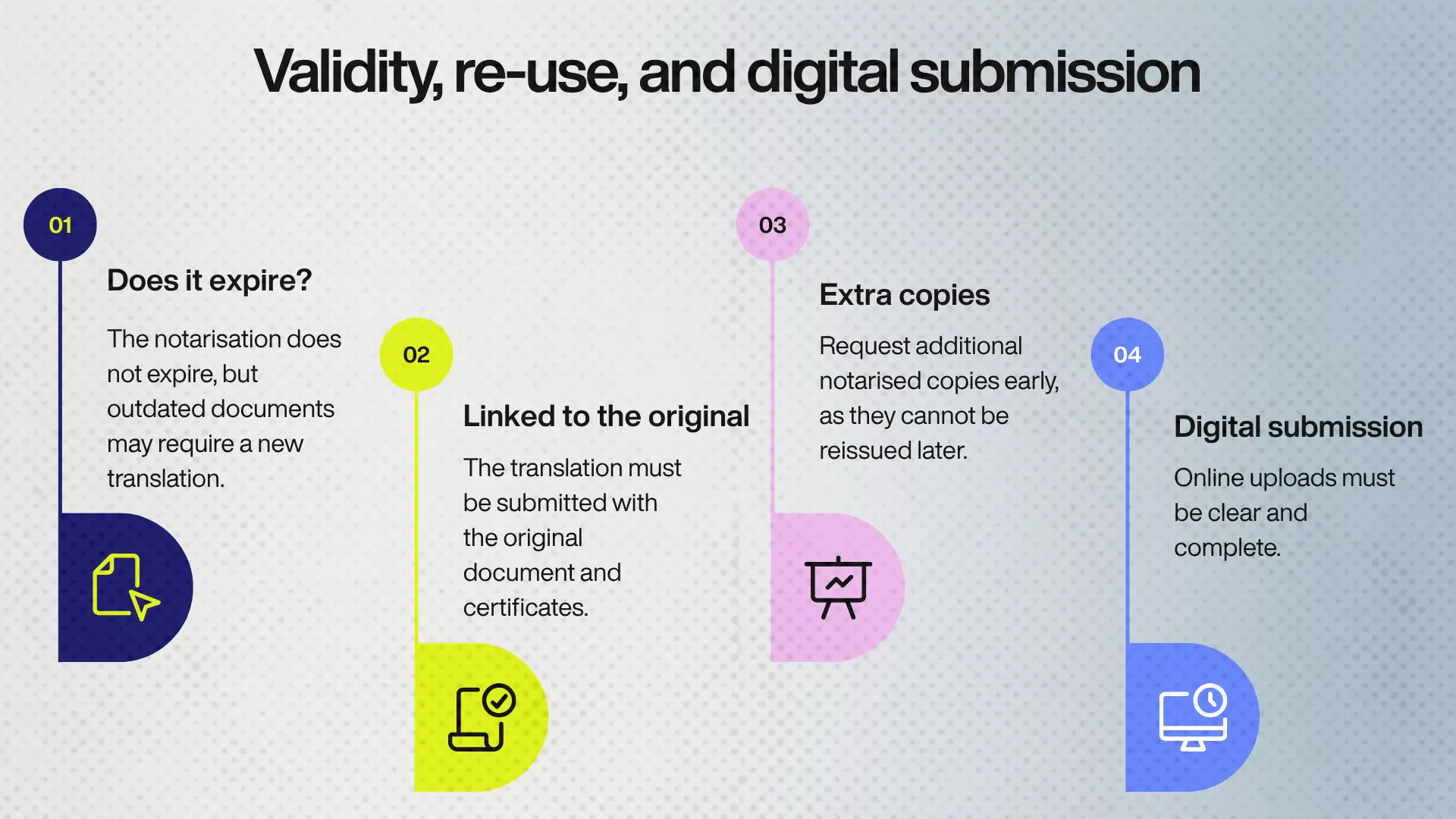
Does a notarised translation expire?
The Notarial Certificate itself does not have a built-in expiry. What expires is the underlying document and, by extension, the receiving authority's willingness to accept the translation.
A Certificate of No Marriage issued nine months ago may have been valid when first translated, but it is no longer valid for ROM submission today. A fresh issue of the underlying document requires a fresh translation and notarisation chain.
Translations are tied to a single original.
A notarised translation of a birth certificate cannot be detached and used with a different original. If ICA, MOM, or a bank requests the original alongside the translation, the entire bundle (original + translation + Notarial Certificate + SAL authentication) must be presented together.
Multiple copies vs. a single original
If you anticipate needing the same translated document for several authorities (ICA, then a bank, then a property transaction), discuss this with your provider at the outset. Multiple notarised hard copies prepared in a single appointment cost significantly less than redoing the chain later. Each Notarial Certificate is a unique legal document and cannot be photocopied or reprinted after the fact.
Digital submission standards
ICA, MOM, and most Singapore agencies accept document uploads through their respective e-Service portals. The quality of the upload matters as much as the quality of the underlying translation.
- File format: PDF is the universal standard. Avoid uploading JPEG photos of physical documents, as they are often too large and too low-resolution in the relevant areas.
- Resolution: Scan originals and translations at 300 DPI or higher. Stamps, seals, and signatures must be clearly legible. Some popular consumer scanning apps compress images aggressively and can render small seals illegible.
- Pagination and order: Upload the complete bundle as a single multi-page PDF: original document, then certified translation, then Notarial Certificate, then SAL authentication / Apostille.
- File naming: Use descriptive filenames (e.g., Birth-Certificate-Translation-Notarised-Wang-Xiao-Ming.pdf ), not camera-generated codes.
- Physical originals at interview: ICA may request original documents and the physical notarised packages at the PR or Citizenship interview. Carry the physical bundle even if the application was uploaded digitally.
The 7 most common reasons ICA rejects a translation
Returns happen for a small number of repeated reasons. Most are avoidable.
- Certified but not notarised. The translation is accurate, but submitted with only a translator's stamp. ICA returns it for notarisation.
- Missing stamp or seal translation. The translator focused on the main text and overlooked a stamp on the reverse side, a re-issuance mark, or a registrar's signature block. ICA's standard is zero omissions.
- Name mismatch with the passport. The translation faithfully renders what is on the original birth certificate, but the result does not match the romanisation on the applicant's passport. Without a name-discrepancy declaration, the application is returned.
- Layout not faithful to the original. The translation is presented as flowing prose when the original was structured as a form, table, or certificate. ICA expects the translation to mirror the original so each element can be cross-referenced.
- Poor scan quality submitted to ICA. Even a perfectly translated and notarised document can be returned if the scan uploaded to the ICA e-Service is blurred, cropped, or low-resolution.
- Translation done by an unrecognised party. Self-translation, translation by a family member, or translation by an unverified online service, ICA will not accept these, regardless of accuracy.
- Missing or invalid Notarial Certificate authentication. A notarised translation that does not carry SAL authentication (or the Apostille that replaces it under the current process) is incomplete.
How to choose a translation provider
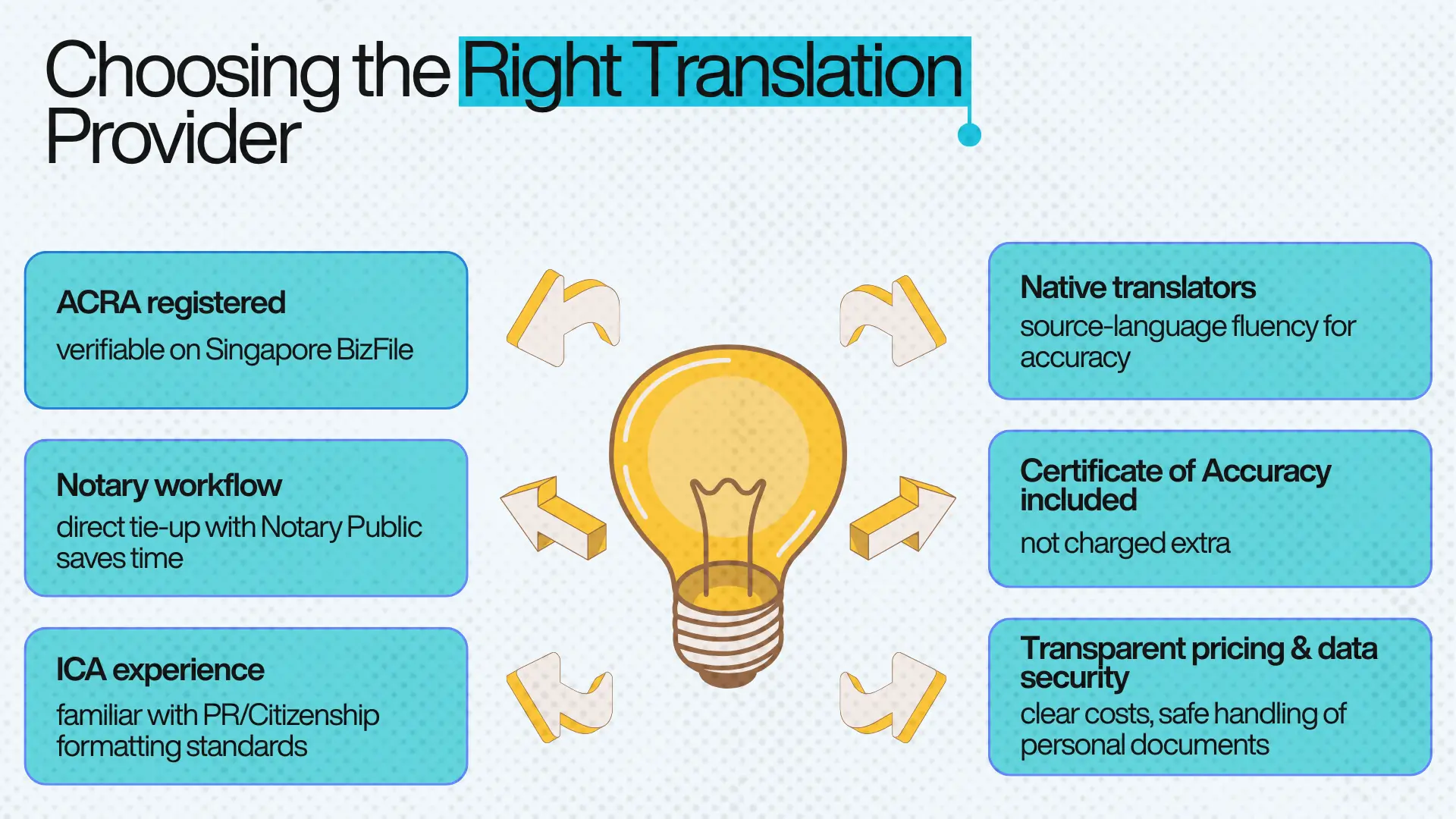
Translation providers in Singapore range from solo freelancers to large agencies. The markers worth checking before you commit:
- ACRA registration. A company registered with the Accounting and Corporate Regulatory Authority is accountable in Singapore and verifiable on the BizFile portal.
- Working relationships with practising Notaries Public. Providers with an established workflow with a Notary Public can complete the full chain in a single appointment; those that don't will ask you to arrange your own notary appointment, often adding a week.
- ICA-specific experience. ICA's requirements differ from MOM's and from court submissions. A provider that handles PR and Citizenship bundles regularly will know the formatting conventions ICA expects.
- Native-speaker translators. A birth certificate from Vietnam should be translated by someone whose first language is Vietnamese. Source-language fluency matters more than target-language polish for legal translation.
- Certificate of Accuracy as standard. Providers that charge extra for the Certificate of Accuracy are treating a legal declaration as a premium product. It should be included.
- Transparent, itemised pricing and confidential data handling are particularly important given that translated documents contain personal data.
Why clients choose LetterCrafts
LetterCrafts Translations is a Singapore-registered translation specialist (ACRA UEN: 201728634E) focused on documents submitted to Singapore authorities, ICA, MOM, ROM, IRAS, the courts, and law firms handling probate, family, and immigration matters.
Our service model:
- Translation by qualified translators, with source-language native speakers across the language pairs we see most often: Chinese, Malay, Indonesian, and 80+ others
- A standing relationship with a Singapore Notary Public so notarisation and SAL authentication happen within the same workflow.
- Original-document runner service for clients who cannot attend the notary appointment in person
- Draft review before notarisation, so corrections can be made while they are still cost-free
- Certificate of Accuracy issued as standard
- Itemised quotations so you see what you are paying for
ICA, MOM, and the courts grade on a pass/fail basis. Either the bundle is accepted, or it has to be redone. The work of a translation specialist is to make sure it is accepted on the first submission.
Send your documents to info@lettercrafts.org for a written, itemised quotation or request a quote online Pricing is confirmed before any work begins.
Conclusion
Certified translation and notarisation in Singapore is a structured process with strict authentication rules, but it is a predictable one. The most common cause of delay is the mismatch between what an applicant assumes is needed and what the receiving authority actually requires.
For ICA (PR, Citizenship, Long-Term Visit Pass), assume notarisation by a Singapore Notary Public is required. For MOM, certified translation is usually sufficient. For overseas submissions, factor in the SAL Apostille and, where the destination country is outside the Apostille Convention, embassy legalisation. For court matters, expect the highest tier of authentication.
Get it right the first time, every stamp translated, the right authentication channel, every name matched, and you save months. Get it wrong, and once the Notary's seal is on, the chain can't be repaired in pieces. You restart.
Need certified translation and notarisation for ICA, PR, marriage, or legal use in Singapore?
LetterCrafts prepares translation and notarisation bundles that meet the submission requirements of ICA, MOM, ROM, the courts, and overseas authorities. Send your documents for a written quotation and timeline pricing is itemised and confirmed before any work begins.
Glossary of key terms
A quick reference for the terminology used throughout this guide.
- Apostille: A standardised certificate issued under the 1961 Hague Apostille Convention that authenticates the origin of a public document for international use. In Singapore, issued exclusively by the Singapore Academy of Law.
- ACRA: Accounting and Corporate Regulatory Authority of Singapore. The national regulator of companies, a registered translation company, will have an ACRA Unique Entity Number (UEN).
- Attestation: A formal act by which an authority (often an embassy) confirms the authenticity of a signature or document.
- Certificate of Accuracy: The signed declaration attached to a certified translation, in which the translator affirms the translation's completeness and accuracy.
- Certified Translation: A translation accompanied by a Certificate of Accuracy issued by the translator or translation company.
- e-Apostille: A digital version of the Apostille certificate, issued by SAL through the Legalisation Portal. Rolled out from 2025 for eligible document types.
- ICA: Immigration & Checkpoints Authority of Singapore. Handles PR, Citizenship, Long-Term Visit Passes, and other immigration matters.
- Legalisation: The traditional multi-step authentication process for documents used in non-Apostille countries. Involves notarisation, SAL authentication, and embassy legalisation.
- MOM: Ministry of Manpower. Handles work passes (EP, S Pass, Work Permit) and employment-related matters.
- Notarial Certificate: The document issued by a Notary Public attesting to the authenticity of a signature or transaction. Must be authenticated by SAL to be valid.
- Notary Public: A senior practising lawyer appointed by the Singapore Academy of Law to perform notarial acts. Singapore has approximately 700 appointed Notaries Public.
- Notarisation: The formal act of a Notary Public attesting to a document or signature.
- ROM: Registry of Marriages, Singapore.
- SAL: Singapore Academy of Law. The statutory body that appoints Notaries Public, administers Apostille issuance, and operates the Legalisation Portal.
- Sworn Translation: A translation produced by a state-registered sworn translator. A formal concept in many civil-law jurisdictions; Singapore does not maintain a sworn-translator register and uses the notarisation chain instead.