Key Takeaway
- ICA does not accept self-translated or machine-translated birth certificates under any circumstances.
- Only four translation sources are valid: the issuing country's embassy, a Singapore notary public, a notary public in the issuing country, or a private translator's work that is then notarised or attested.
- Every stamp, seal, watermark, and handwritten note on the original must be translated or described; omissions are the leading cause of rejection.
- All notarised translations must be authenticated by the Singapore Academy of Law (SAL) since 1 October 2019.
- Names on the translated birth certificate must match the applicant's passport exactly.
- A complete certified translation typically costs SGD 30-100 per page, a notarised translation with SAL authentication usually totals SGD 200-320 per document.
- Standard turnaround is 1-3 working days for certified translation; allow 6 weeks before submission if notarisation is needed.
If your birth certificate isn't in English, the Immigration & Checkpoints Authority (ICA) of Singapore will not accept it as-is. That single line is responsible for more application delays than almost anything else immigration consultants deal with in Singapore. People assume a translation is a translation. ICA does not.
This guide walks through exactly what ICA requires in 2026, what it doesn't accept, the four authentication pathways that are actually allowed, the rejection traps most applicants fall into, and what your translated birth certificate must contain, down to the seal descriptions and name formatting, to clear ICA on the first try.
It's written for people applying for Permanent Residency, Citizenship, Long-Term Visit Pass, Dependant Pass, Student Pass, and overseas birth registrations, in which a non-English birth certificate is at the centre of the document set.
Quick Answer: Do You Need a Translated Birth Certificate for ICA?
Yes, if your original birth certificate is not in English, ICA requires a certified English translation produced through one of four approved channels. Self-translations, translations by AI systems, and translations by family members are not accepted, even if they are accurate. This applies to PR applications, citizenship, Dependant Pass, Long-Term Visit Pass, Student Pass, and overseas birth registrations submitted to ICA.
If your birth certificate is already in English (for example, certificates issued in Malaysia after a certain period, or modern bilingual certificates), no translation is required, but the document must still be a clean, complete, legible copy.
What ICA Actually Says About Translations
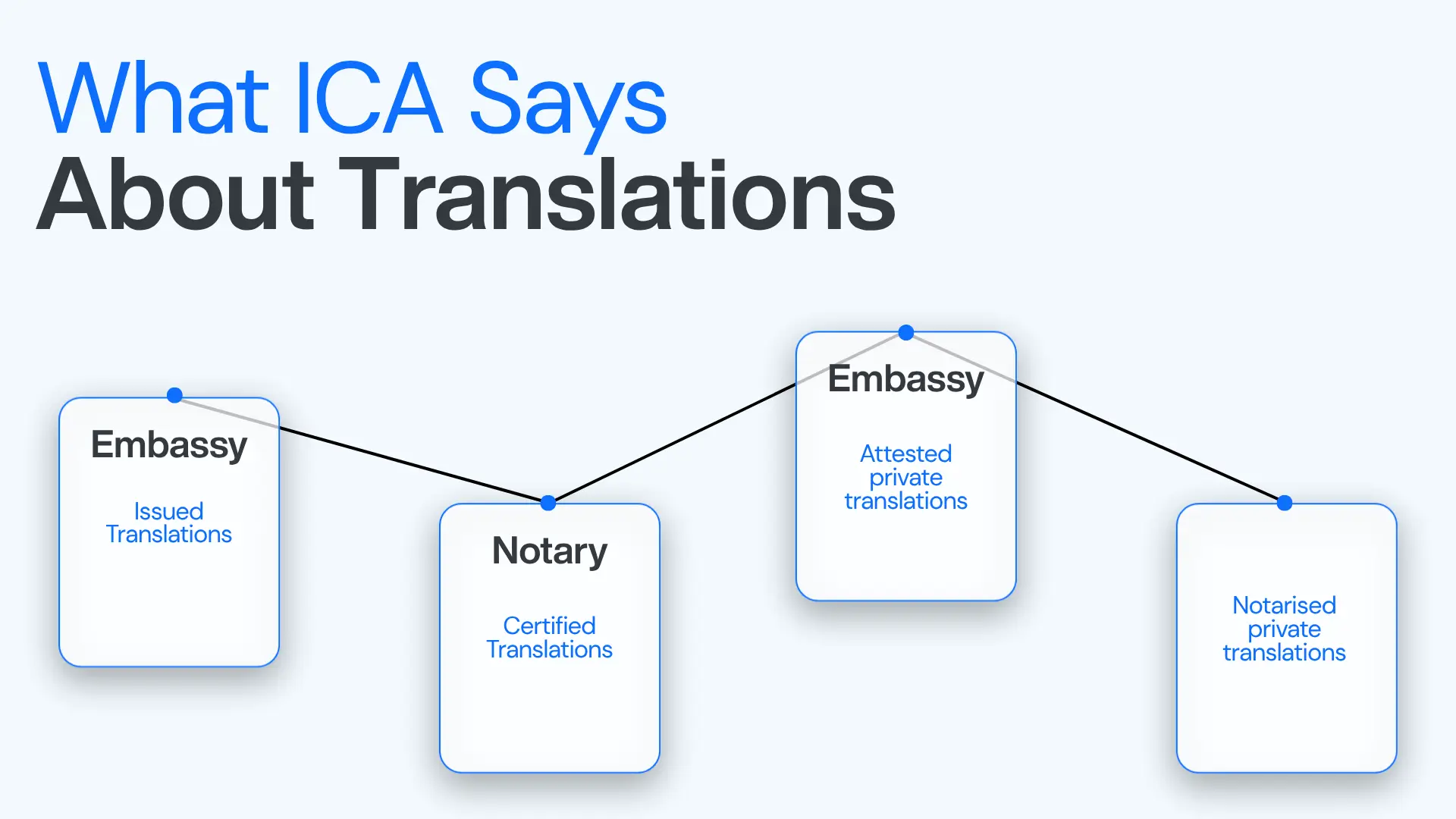
ICA's official position is short and unambiguous. For documents that are not in English, ICA accepts:
- Translations provided by the embassy of the country or place that issued the document.
- Translations produced by a notary public in Singapore or in the country/place that issued the document.
- Privately created translations attested by the embassy of the issuing country.
- Privately created translations notarised by a notary public in Singapore or the issuing country.
ICA explicitly does not endorse any private translation company. What it accepts is the certification mechanism not the brand. A translation from any agency, no matter how well-known, is not accepted on its own. It only becomes acceptable when it is notarised or embassy-attested using one of the four pathways above.
This is the single most misunderstood point in the entire process.
Why a Translated Birth Certificate Matters So Much
A birth certificate is the foundational identity document in almost every ICA application. It establishes:
- Legal name at birth (and any changes since)
- Date and place of birth
- Parentage and family relationships
- Nationality status at birth
That last point is often the deciding factor in family-linked applications. ICA cross-references the birth certificate against passports, marriage certificates, household registers, and parental documents to verify that everyone is who they claim to be and related as claimed. A small error in translation, a date format flipped, a name spelt slightly differently from the passport, and an unmentioned amendment stamp create a verification gap. ICA officers do not assume good faith on a missing detail. They send the application back.
Where Birth Certificate Translation Is Required
The same translation rules apply across multiple ICA processes, but each has its own document checklist. Here's a quick reference to where a translated birth certificate slots in.
| Application Type | Whose Birth Certificate? | Notes |
|---|---|---|
| Singapore PR (Permanent Residency) | Applicant + spouse + children | Required for all family members, including each child |
| Singapore Citizenship | Applicant + dependants | Highest level of scrutiny; expect close cross-checking against passports and other records |
| Long-Term Visit Pass (LTVP) | Sponsor's child or grandchild | Often paired with parents' birth certificates and household registers to prove the relationship |
| Dependant Pass (DP) | Children under 21 | Submitted via MOM, but the same translation rules apply |
| Student Pass (STP) | Student | Required if the certificate isn't in English |
| Overseas Birth Registration | The newborn child | If the foreign-issued birth certificate isn't in English, a translation is mandatory |
| Confirmation of Singapore Citizenship Status | Applicant | Required for verifying citizenship history |
| Re-entry Permit, name changes, and regularisation | Varies | Whenever an underlying birth record is referenced |
For Dependant Pass applications, MOM's myMOM portal asks you to upload the original document and the English translation as a single combined file. This is often missed and causes rejections at the upload stage rather than the review stage.
Certified vs. Notarised vs. Legalised: The Distinction That Trips Applicants
These three terms get used interchangeably online. They are not the same thing, and ICA cares about which one you submit.
Certified Translation
A translation accompanied by a signed Certificate of Accuracy (sometimes called a Translator's Declaration) from the translator or agency. It states that the translation is true and accurate, identifies the translator's qualifications, and includes their signature and stamp.
Use case: Some ICA submissions accept this, but in practice, ICA's stated requirements lean towards translations that are also notarised or embassy-attested. For PR and citizenship, plan for notarisation.
Notarised Translation
A certified translation where the translator's signature and declaration are witnessed by a Singapore notary public, who then issues a Notarial Certificate. The notary verifies the identity of the signer and that the declaration was sworn before them, not that the translation itself is linguistically correct.
Important: Since 1 October 2019 every notarised document in Singapore must be authenticated by the Singapore Academy of Law (SAL) to be valid for ICA submission. Authentication carries a fee of SGD 87.20 (incl. GST) as of 2026 A notarisation without SAL authentication is rejected. This rule has caught many applicants who used older guidance.
Legalised / Apostilled Documents
Legalisation is a further step, typically required only when a Singapore-notarised document is being sent abroad, or when bringing a foreign document into Singapore from a non-Apostille country. Singapore acceded to the Hague Apostille Convention on 18 January 2021, which simplified the process for documents moving between member states.
For most ICA applicants in Singapore, an apostille is not required for foreign birth certificates being submitted to ICA. The notarisation + SAL authentication pathway is what ICA looks at.
The Four Approved Translation Pathways: What Actually Works
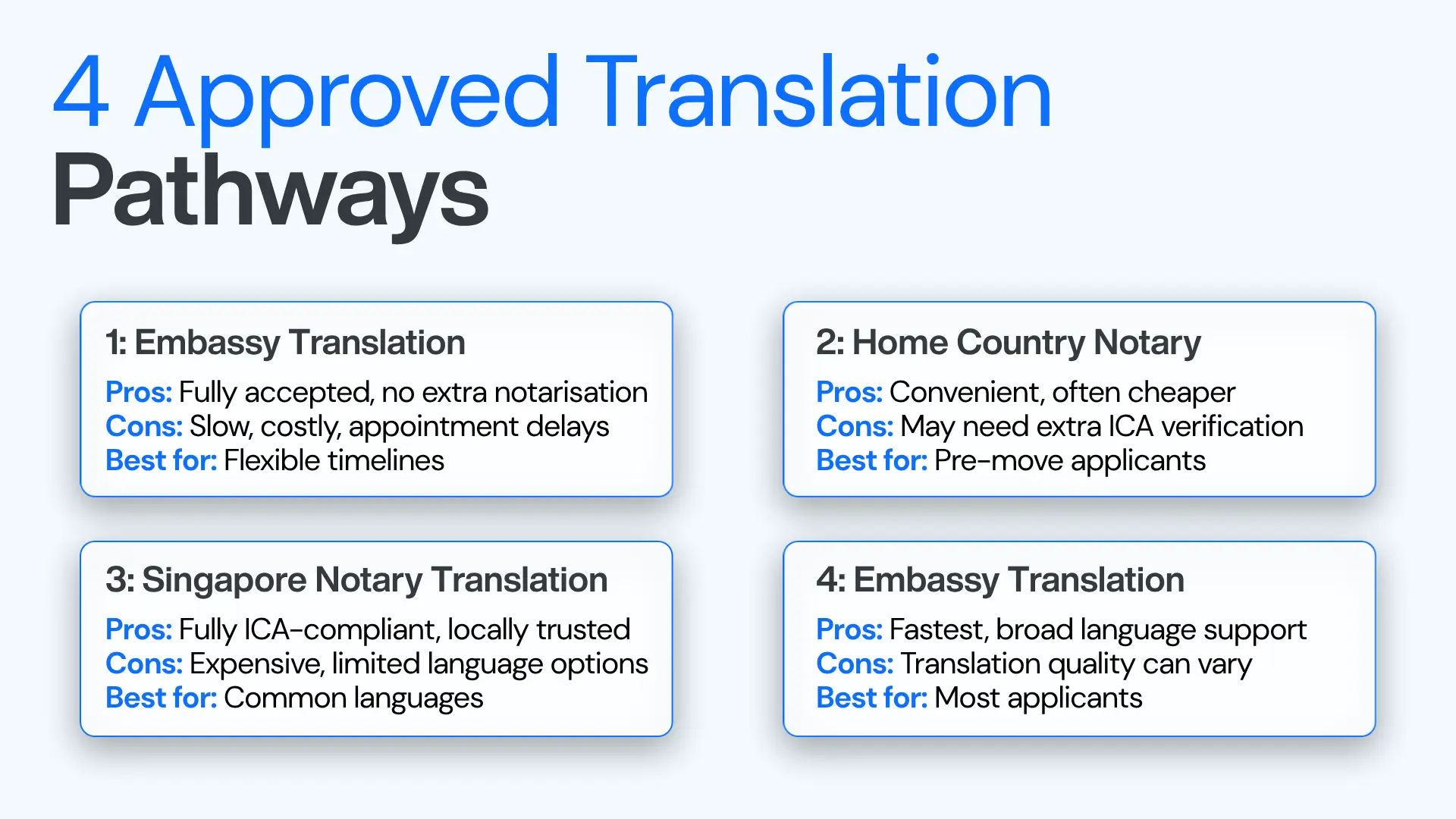
Looking at how applications actually move through ICA's review queue in 2026, here's a practical breakdown of each option.
1. Embassy Translation (Issuing Country's Embassy in Singapore)
The embassy of the country that issued your birth certificate translates the document and certifies it on official letterhead.
- Pros: Universally accepted. No further notarisation needed.
- Cons: Most embassies take three to four weeks. Fees vary, and some embassies only translate certain categories of documents. Appointments are often required and can be hard to secure.
- Best for: Applicants with a flexible timeline who already need to visit the embassy for other reasons.
2. Notary Public in the Issuing Country
A notary public in your home country translates and notarises the document before you arrive in Singapore.
- Pros: Convenient if you're preparing documents before relocating. Often cheaper than Singapore notarisation.
- Cons: ICA may require additional verification if the notary's credentials aren't easily verifiable. Some applicants have faced extra back-and-forth where ICA asks for embassy attestation on top.
- Best for: Applicants who haven't yet moved to Singapore and have access to a reputable notary at home.
3. Singapore Notary Public Direct Translation and Notarisation
A Singapore notary public who is fluent in your source language translates the document themselves and notarises their own work.
- Pros: Fully ICA-compliant, locally verifiable, the cleanest legal chain.
- Cons: Singapore notaries are senior lawyers (minimum 15 years' experience, age 40+), and few are fluent in less common languages. Availability is limited for languages outside Mandarin, Malay, Tamil, and a handful of others. Costs are typically higher.
- Best for: Common languages (Chinese, Malay, Tamil, Indonesian) where a Singapore notary fluent in the language is realistically available.
4. Private Translation + Singapore Notarisation (The Most Common Route)
A professional translator translates the birth certificate. The translator then signs a declaration of accuracy in front of a Singapore notary public, who notarises the declaration. The document is then authenticated by SAL.
- Pros: Fastest path. Wide language coverage. Legally robust. This is the route most applicants use in practice and the one most familiar to ICA reviewers.
- Cons: You're coordinating between a translator and a notary, which can be clumsy without help. Quality of translation varies widely, and that's where most rejections originate.
- Best for: Almost everyone.
How the Process Actually Works: Step by Step
Here's the realistic sequence for a typical applicant using the private-translation-plus-notarisation route in Singapore.
Step 1: Get a clean copy of your original birth certificate. Faded, partly torn, or laminated documents create translation problems. If your original is damaged or barely legible, request a fresh certified copy from the issuing authority. The cost of a new certificate is far smaller than the cost of a rejected application.
Step 2: Send the document for translation. You don't need the physical original at this stage. A clear, high-resolution scan or photograph (showing all four edges, no shadows, no glare) is enough for the translator to start. Turnaround for a standard birth certificate is 1–3 working days.
Step 3: Quality-check the translation before notarisation. This step is what separates accepted submissions from rejected ones. Verify:
- Names match your passport spelling, character-for-character
- Dates use a consistent format
- Every stamp, seal, watermark, and handwritten note is described
- Document numbers, registration numbers, and certificate numbers are exact
- Pages are in the correct order and complete
Step 4: Schedule a Singapore notary public. Notaries are often booked one to two weeks ahead. Don't leave this until the last minute. The translator (or a representative of the translation agency) attends to swear the declaration.
Step 5: Authentication at the Singapore Academy of Law. Once notarised, the document is taken to SAL at 1 Coleman Street, #08-06 The Adelphi, for authentication. A proxy may attend on your behalf; no authorisation letter is required. SAL turnaround is typically same-day at the counter, or 2–3 business days for online submissions.
Step 6: Compile your ICA submission package. ICA's e-PR portal and other digital submission systems generally want:
- Source document (original or certified true copy)
- English translation
- Translator's certificate of accuracy
- Notarial certificate
- SAL authentication
These are usually combined into a single PDF in that order, unless ICA specifies otherwise.
Step 7: Submit. Upload through the relevant ICA e-Service. Keep digital copies of every page and certificate for your records. If ICA later flags an issue, you'll need them.
The Rejection Trap: Why Translated Birth Certificates Get Sent Back
Across the actual rejection patterns reviewed in 2026, almost every translation-related rejection traces back to one of these issues.
Untranslated Stamps, Seals, and Watermarks
This is by far the most common cause of rejection. ICA treats every visible mark on the document as part of its content. A red registry seal, a re-issuance stamp, a barely visible watermark, and a handwritten correction if it's not described in the translation; the document is incomplete.
A correct translator's note for an unclear stamp looks something like this:
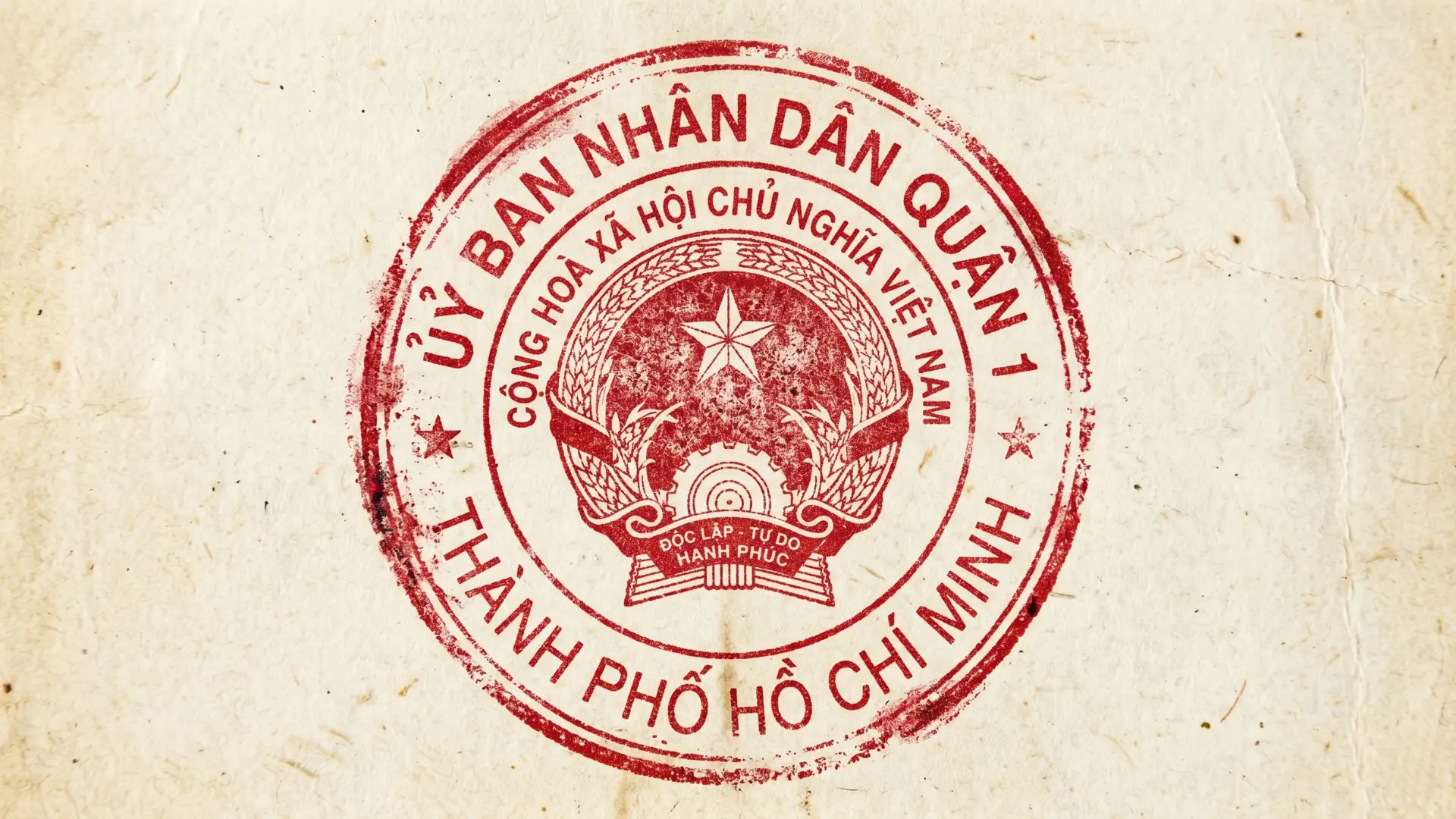
Bracketed annotations like this should describe what is visible, not skip it.
Name Mismatches with the Passport
If your passport reads "Wei Ming Tan" but your translated birth certificate reads "Tan Wei Ming," ICA flags the mismatch. The fix is straightforward: the translation should reflect the original name order (which is whatever it actually says), and you provide a separate explanatory document, a deed poll, a name change certificate, or a notarised self-declaration to bridge the difference.
This applies to:
- Romanised vs. native-script names
- Maiden vs. married names
- Diacritics and accents (é, ü, ñ these matter)
- Common transliteration variants (Mohamed, Mohammed, Muhammad)
Self-Translations, Even When Done by Bilingual Family Members
ICA does not accept translations done by the applicant or by family. The reasoning is straightforward: the translator must be impartial. This rule is not negotiable.
Incomplete Translations
Every page of the original must be translated. Some applicants only translate the front of a two-sided certificate, missing official endorsements on the back. Others skip the issuing authority's footer or address block. ICA reviews from both sides.
Notarisation Without SAL Authentication
A document notarised by a Singapore notary public but not subsequently authenticated by SAL is rejected. This rule has been in force since October 2019, but is still missed by older translation guides circulating online.
Format That Doesn't Mirror the Original
The translation should preserve the layout: tables stay as tables, the order of fields stays the same, and page breaks roughly align. A translation that turns a structured form into a flat paragraph triggers verification difficulties for ICA reviewers, and that often translates into a request for resubmission.
Damaged or Illegible Source Documents
If the translator must use bracketed tags like [illegible] or [unclear] in the final version more than rarely, the submission risks rejection. The remedy is to obtain a fresh copy of the certificate from the issuing authority before translation.
Inconsistencies Across the Family File
When a PR application includes the applicant, spouse, and children, ICA cross-checks names across all documents. If the spouse's name appears as "Li Mei" on her own birth certificate and "Mei Li" on the children's birth certificates, ICA queries the discrepancy. A translation that's accurate to each source but inconsistent across the file still creates problems. The translator handling all documents together usually catches this; a piecemeal approach often misses it.
What an ICA-Compliant Translated Birth Certificate Must Contain
Treat this as a pre-submission audit list for your translated document.
- All personal details: name, date of birth, place of birth, gender, nationality at birth
- Parents' full names, including any title or honorific present in the original
- Issuing authority and full address as printed
- Registration number and certificate number, exactly as they appear
- Date of registration and date of issue
- Description of every seal, stamp, watermark, and signature, with location on the page
- Description of any handwritten amendments or corrections, with their position
- Translator's certificate of accuracy, signed and stamped
- Translator's full name, qualifications, contact details, and date
- Notarial certificate issued by a Singapore notary public
- SAL authentication sticker or certificate (since October 2019)
- Source document attached behind the translation, in correct page order
If any item is missing, that's the gap reviewers will find.
What to Do Next
If you're preparing an ICA submission, work backwards from your intended submission date. Six weeks gives you a comfortable runway. Here's the order of operations:
- Confirm whether your application requires certified or notarised translation (when in doubt, choose notarised, as it's accepted everywhere a certified translation is).
- Obtain a clean copy of your original birth certificate. Replace damaged or laminated copies with fresh certified ones.
- Choose a translation pathway based on your timeline and language. For most applicants, private translation followed by Singapore notarisation and SAL authentication is the most practical option.
- Quality-check the translation against your passport before notarisation. Catching name and detail mismatches at this stage is far cheaper than catching them after rejection.
- Schedule your notary appointment early.
- Submit a complete, ordered PDF: source → translation → translator's certificate → notarial certificate → SAL authentication.
- Keep copies of everything.
If you're managing this on your own, the most useful thing you can do is treat every visible mark on your birth certificate as part of the content. ICA does. The applicants who submit cleanly are the ones who think like reviewers.
For applicants who'd rather not piece this together themselves, coordinating between a translator, a notary, and SAL while making sure no detail slips, working with a translation provider experienced specifically with ICA submissions removes most of the risk.
LetterCrafts handles certified and notarised translations for ICA, MOM, MOE, and other Singapore agencies, with the translation quality control and notarisation coordination built into a single workflow. The point is that you're paying for documents that pass on the first review, not gambling on a translation and hoping ICA accepts it.
Whichever route you choose, the principles are the same: complete translation, exact name matching, full authentication chain, and clean submission package. Get those right, and the birth certificate stops being the bottleneck in your application.
How LetterCrafts Can Help
Most translation-related rejections from ICA don't happen because the translation was inaccurate. They happen because a stamp wasn't described, a name didn't match the passport, or the notarisation chain was incomplete. Getting those details right consistently is what separates a clean first-pass submission from a resubmission that costs four to ten weeks.
LetterCrafts is a Singapore-registered translation service (UEN: 201728634E) with over five years of experience handling personal document translations specifically for ICA, MOM, MOE, and other government agencies. Their certified translations are accepted by ICA and come with a signed, stamped Certificate of Accuracy as standard.
What they handle end-to-end:
- Certified translation of birth certificates across 80+ languages, starting from SGD 38 per page with no additional GST
- Notarisation and SAL authentication coordinate the complete chain ICA requires, not just the translation
- Delivery by email, free SingPost, courier, or self-collection from the notary's office at The Adelphi
- Urgent turnaround available: translations completed in as little as 24 hours, with notarisation and authentication typically within three working days
- No physical originals are needed to start a scan; a photo is sufficient
A few things worth knowing:
You don't need to bring your original documents to start. Send scanned copies or clear photographs by email, and the translation begins immediately. If your deadline is tight, they accommodate urgent requests, but aligning requirements in advance gives them the best chance of meeting your timeline.
All translators are bound by Non-Disclosure Agreements and governed by Singapore's Personal Data Protection Act. Documents are not retained for more than three months, and immediate deletion is available on request.
If a translation needs corrections, LetterCrafts will revise it If the issue can't be resolved, they offer a full or partial refund, depending on work already delivered, and a policy that reflects confidence in their output, rather than fine print designed to avoid accountability.
For family applications where multiple documents need to be processed together, birth certificates for both children, a marriage certificate, and household registers handling them as a set, rather than piecemeal, is what catches name inconsistencies before ICA does.
Conclusion
A birth certificate translation done right clears ICA without a second look. Done wrong, it adds weeks to your timeline and means starting the authentication process all over again.
The requirements are clear: an approved translation channel, every stamp and seal accounted for, names that match your passport exactly, and a complete notarisation and SAL authentication chain. Follow those, and the document does its job quietly in the background.
If you'd rather not coordinate the moving parts yourself, LetterCrafts handles certified translation, notarisation, and SAL authentication as a single workflow built specifically for ICA submissions. Get a quote in 30 minutes and take one thing off your plate.