Key Takeaway
- ICA requires English translations for Tamil documents, despite Tamil being one of Singapore's four official languages under Article 153A.
- ICA accepts three alternative routes: an embassy translation, a notary public translation, or a private translation later attested or notarised.
- Singapore Academy of Law authentication costs S$87.20 including GST per Notarial Certificate, and a notarised document is invalid without it.
- No translation company is ICA-approved. ICA states it does not endorse any private translation companies or entities.
- Notarial fees are fixed by law, including S$75 per Notarial Certificate, so notaries cannot discount or inflate them.
- Certified True Copies may share one Notarial Certificate; every other notarised document needs its own, at S$87.20 each.
- Tamil Nadu birth certificates sometimes carry no registered name, because Tamil Nadu permits names to be added years afterwards.
- MOM asks only for an English translation uploaded with the original, which is a materially lower bar than ICA's.
Tamil is one of Singapore's four official languages. Article 153A of the Constitution says so, alongside Malay, Mandarin and English. It is examinable at PSLE. It appears in Tamil script on identity cards where the holder has one recorded. It is announced on the MRT.
None of that helps when you hand ICA a Tamil birth certificate.
ICA's rule isn't about official status. It's about English. Its published requirement for permanent residence, citizenship and Long-Term Visit Pass applications is an official translation for anything "in languages other than English" and Tamil, for this purpose, is simply not English.
That gap between constitutional status and administrative reality is where most Tamil applicants lose two or three weeks. This guide closes it: what ICA actually asks for, which of its three routes suits Tamil documents, what the process costs in 2026, and the specific ways Tamil Nadu and Sri Lankan records go wrong that Chinese or Indonesian ones don't.
Why Do Tamil Documents Need Translating If Tamil Is Official In Singapore?
Because ICA processes applications in one working language, and that language is English. Constitutional status governs how the state communicates with citizens. It does not govern the evidentiary format of a foreign civil record.
Think about what an ICA officer is actually doing. Matching a name on a certificate against a name on a passport. Checking a date of birth against a declared one. Confirming that the couple named in a marriage record are the couple in front of them. A Tamil-script document cannot be cross-checked against an English-script passport without a bridge. The translation is the bridge.
There's a second reason, less obvious: hardly any Tamil-language document reaching ICA was issued in Singapore.
ICA's PR document checklist asks for a birth certificate "only for births not registered in Singapore," and a marriage certificate "only for marriages not registered in Singapore." Events registered here already sit in ICA's records, in English, and since 29 May 2022, Singapore birth certificates have been issued digitally with a QR code, verifiable through ICA's own e-certificate portal, as HM Passport Office's Singapore country profile records.
So the Tamil paperwork in an ICA file arrived from somewhere else. Usually Tamil Nadu. Sometimes Sri Lanka. Occasionally Puducherry. Which country issued it changes everything about what can go wrong, and we come back to that below.
For a sense of scale: the Census of Population 2020 found Tamil was the language most frequently spoken at home for 2.5% of residents aged five and over, down from 3.3% in 2010; across the same decade English climbed from 32.3% to 48.3%. Households here are shifting to English. The certificates in the family folder are not.
What Does ICA Actually Say About Translations?
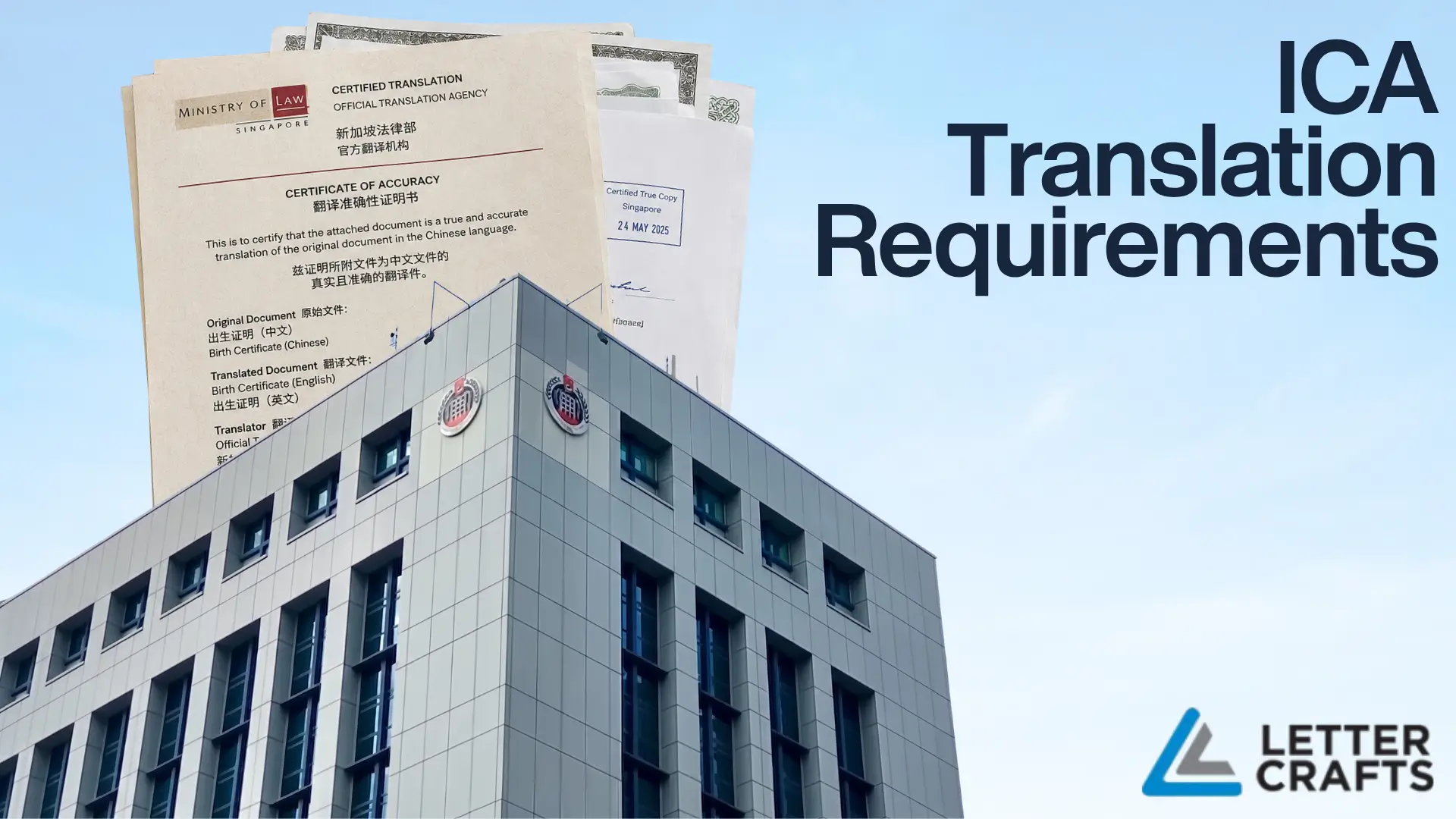
ICA runs identical wording across its main application pages, including Becoming a Permanent Resident and Becoming a Singapore Citizen. In substance: when uploading documents, you must supply certified true copies of the originals and official translations for anything not in English, and ICA accepts
- translations provided by the embassy of the country or place that issued the document;
- translations provided by a notary public in Singapore, or in the country or place that issued the document;
- privately translated documents that are then attested by the issuing country's embassy, or notarised by a notary public in Singapore or in the issuing country.
Two further sentences deserve far more attention than they get: ICA does not endorse any private translation companies or entities, and insufficient documentation may result in non-acceptance of your application.
The same three routes appear on the Long-Term Visit Pass pages, including the parent of a Singapore citizen or PR route, the one most Tamil families use when bringing an ageing parent over from Chennai or Madurai.
Are the three routes a sequence?
No. They are alternatives. This is the single most expensive misreading on the internet, and it appears on translation-company pages constantly.
Route 1 stands alone. Route 2 stands alone. Only Route 3 the private translation, needs a second act of certification attached. Nobody has to run a document past the High Commission and a notary. Pick a lane, finish it properly.
What "official translation" doesn't mean
It doesn't mean a sworn or government-registered translator: Some jurisdictions run sworn-translator registers. Singapore's ICA requirement isn't built that way: it names no accreditation body and no approved-translator list. The test is which certification route the document travelled, not what letters follow the translator's name.
It doesn't mean an apostille: Singapore acceded to the Hague Apostille Convention through the Apostille Act 2020, in force since 16 September 2021. As the Ministry of Law set out, Singapore authorities are now obliged to accept apostilles in place of legalisation for incoming foreign public documents from Contracting Parties, where applicable. Read that carefully; it's a ceiling on what agencies may demand, not a new hurdle. If someone tells you a Chennai birth certificate must be apostilled in India before ICA will look at it, ask them to point to where ICA says so.
It doesn't mean anyone holds ICA accreditation: Nobody does. ICA separately publishes a notice that it has no affiliation with any external migration agency or commercial entity presenting itself as a Singapore immigration specialist or partner. A translation firm advertising ICA approval is describing something that doesn't exist. What a competent provider can honestly promise is a file built to clear notarisation and SAL authentication without bouncing back.
Which Tamil Personal Documents Usually Need Translating?
Set ICA's checklist against what genuinely arrives in Tamil script, and the picture is narrower than most quotations assume:
| ICA checklist item | Typically in Tamil? | What to watch |
|---|---|---|
| Birth certificate/household register | Very often | Form No. 5 records, especially pre-2000 and rural registrations |
| Marriage certificate | Often | Registered and temple marriages across TN districts |
| Death certificate of spouse or child from a previous marriage | Often | Same registrar network as births |
| Deed poll or religious certificate for change of name | Sometimes | Usually the document that explains a name mismatch |
| Divorce papers, incl. Certificate of Making Interim Judgment Final | Sometimes | Court orders may be Tamil, English, or mixed |
| Adoption papers | Sometimes | Court-issued; language varies by district |
| Custody papers, letter of consent from ex-spouse | Sometimes | Frequently handwritten |
| Educational certificates and transcripts | Rarely | TN board and university documents are generally issued in English |
| Skill certificates, professional licences | Rarely | Generally English |
| Employment letters, pay slips, tax assessments | Rarely | Generally English |
The shape of that table is the point. Tamil translation demand in Singapore is overwhelmingly civil-registration demand: births, marriages, deaths, name changes, family court orders. Degree certificates and transcripts from Tamil Nadu institutions usually turn up in English already. If a provider quotes to translate an entire PR bundle without first asking which items are actually in Tamil, you're being quoted for pages nobody needs.
Our sample translations page carries a Tamil Nadu birth certificate and a Tamil death certificate among others, so you can see the output format source layout mirrored, with a signed and stamped Certificate of Translation as the coversheet before committing to anything.
The Three Routes In Practice
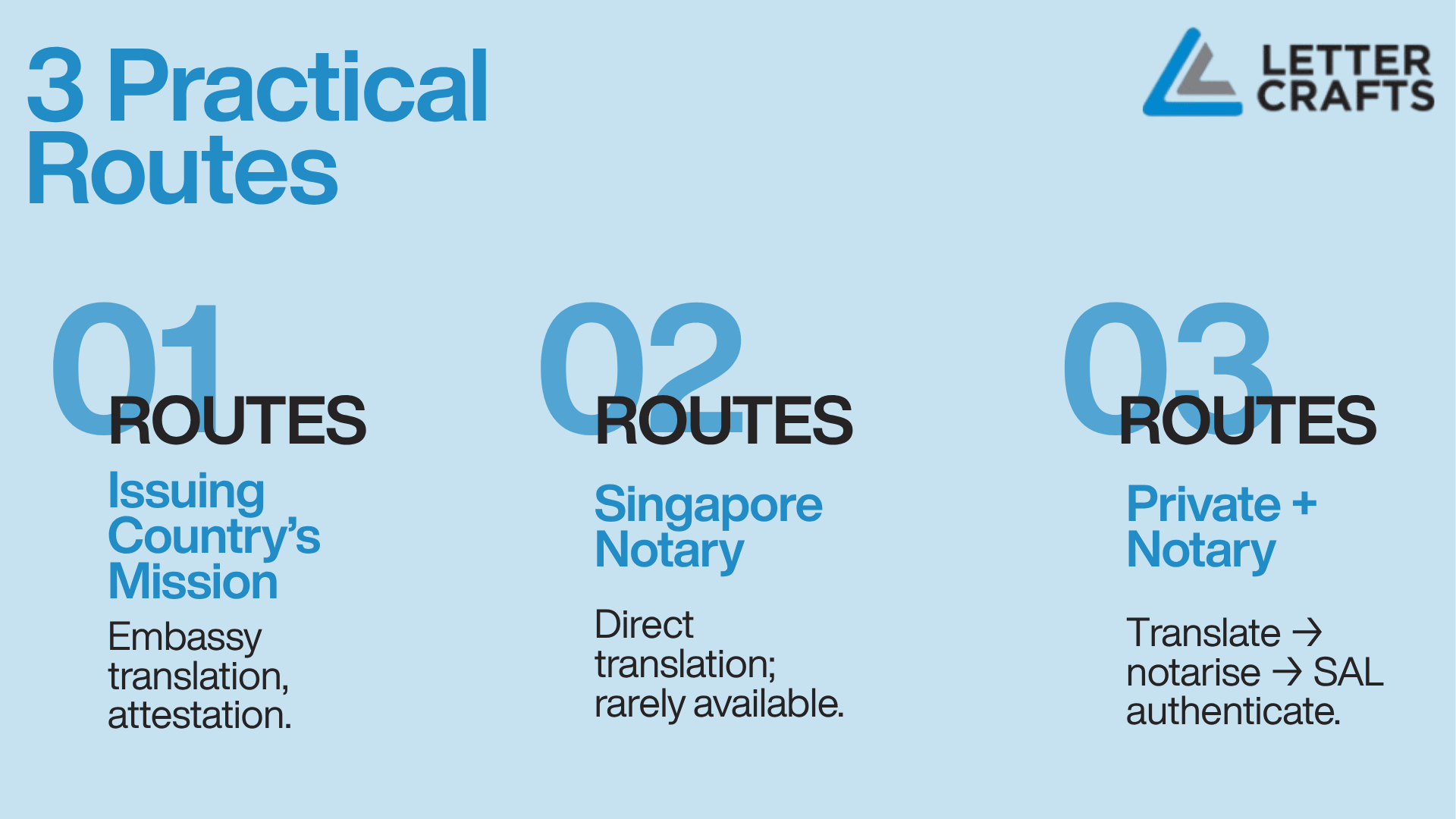
Route 1: through the issuing country's mission
For Indian records, this is the High Commission of India in Singapore; for Sri Lankan records, the Sri Lankan mission. Missions set their own attestation requirements, fees and appointment systems, and revise them without notice. Some will attest a privately prepared translation. Some won't. The service isn't uniform across missions or stable over time.
Genuine route, ICA-listed, entirely outside Singapore's control. Confirm directly with the mission before you build a timeline around it, particularly if an ICA appointment is already booked.
Route 2: a notary public produces the translation
Rare. It needs a Singapore notary public who is personally fluent in Tamil and willing to translate rather than simply certify. That pool is very small.
Route 3: private translation, then notarised in Singapore
Where most Tamil applicants end up, and it's worth knowing why it works rather than just that it does.
The Singapore Academy of Law's own account of notarial powers notes that, unlike a Commissioner for Oaths, a notary public is in a position to witness a document signed in front of them which is in a foreign language. That is precisely the capability a Tamil-to-English file requires: an officer empowered to act formally on a document nobody is pretending is English.
The sequence runs: translator produces the English version with a signed certificate of accuracy → Singapore notary public notarises and issues a Notarial Certificate → SAL authenticates that certificate. Three steps. Skip the third and the chain fails.
The Singapore Academy Of Law Step That Wrecks Timelines
Budgets and dates break here, so precision matters.
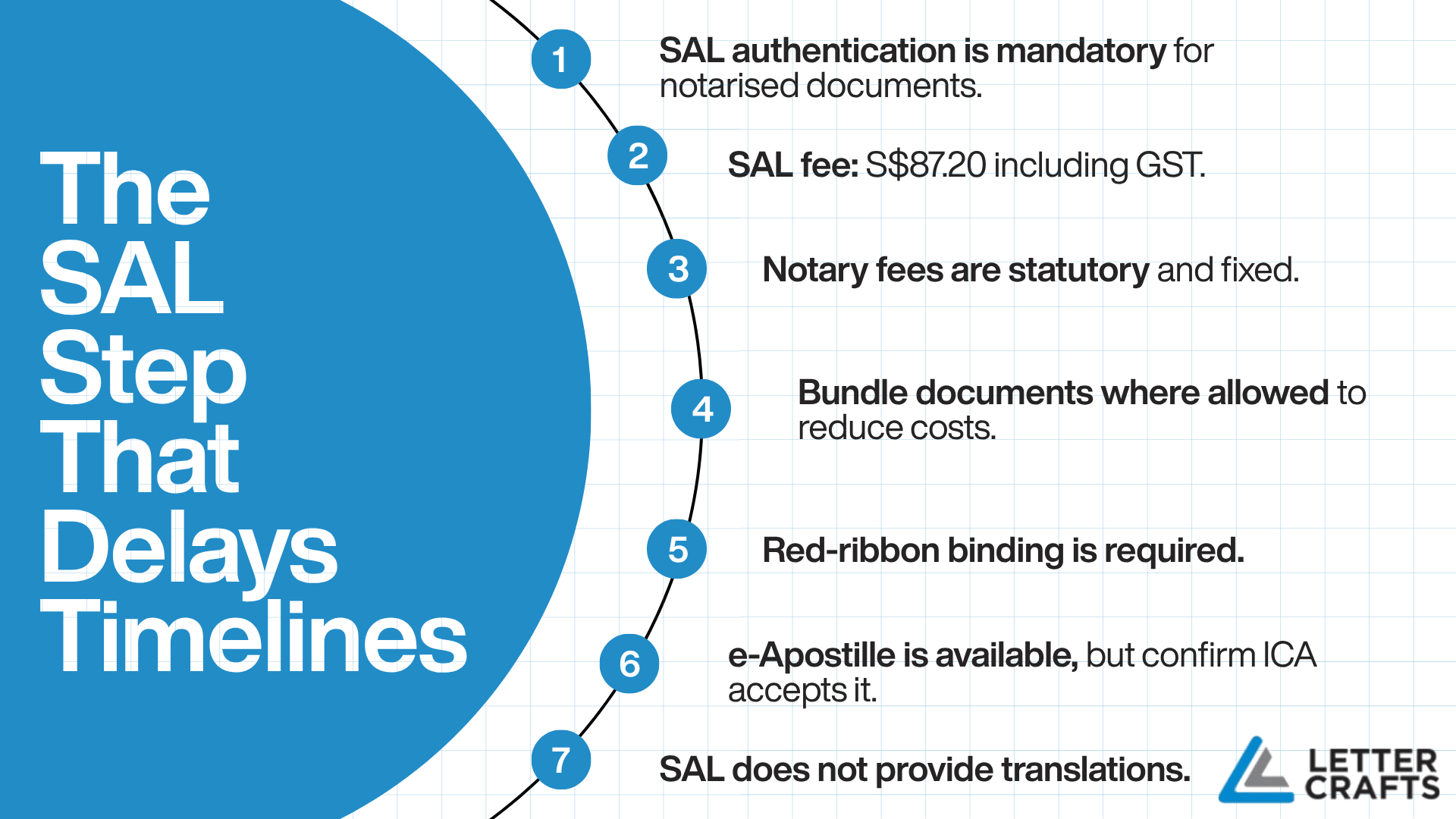
SAL authentication is a validity condition, not an optional flourish. SAL states that under Rule 8(3)(c) of the Notaries Public Rules, a Notarial Certificate must be authenticated by SAL to be valid, and that a notarised document without SAL's authentication and legalisation is considered invalid. That has been the position since 1 October 2019, following the Singapore Academy of Law (Amendment) Rules 2019 and Notaries Public (Amendment) Rules 2019.
The fee is S$87.2, not S$85.60. A remarkable number of translation and law-firm pages still quote S$85.60, which was correct when GST stood at 7%. SAL's published authentication fee is S$87.20 including GST, paid upfront at the notary's office; the notary cannot issue the Notarial Certificate until it's settled. A quotation citing S$85.60 wasn't built this year, which tells you something about how closely that provider tracks the process.
Notarial fees are fixed by statute: The First Schedule to the Notaries Public Rules prescribes them at S$75 for preparing and completing a special Notarial Certificate, and certified-true-copy charges of S$10 for the first page plus S$2 per subsequent page where a seal is required. Notaries can neither discount nor inflate prescribed fees. If two quotes diverge sharply, the difference sits in translation and handling, never in the notarial component.
Bundling can cut your bill, but only one way: SAL's FAQs confirm a Notarial Certificate is mandatory for each document notarised, and that multiple copies of the same document each need their own. The sole exception is Certified True Copies: more than one may be bundled under a single Notarial Certificate, subject to the recipient's requirements. Since S$87.20 attaches per certificate, a family submitting six or seven documents should raise bundling with the notary before certificates are issued. Afterwards, it's academic.
Binding format is substantive: SAL requires notarised documents to be bound with a red ribbon in its prescribed format and treats non-conforming documents as invalid.
There's a digital option, with conditions: SAL offers an e-Apostille for notarised documents, requested at the notary's office and emailed directly, which removes the trip to SAL's counter at The Adelphi. The fee is the same: S$87.20. Two conditions, both from SAL: the e-Notarial Certificate is valid only in digital form and a printout carries no legal effect, and you should confirm the recipient accepts an e-Apostille first. Since ICA also asks applicants to produce original documents at completion of formalities, check with ICA before committing to a digital-only chain. Paper and digital are issued independently; one cannot be converted into the other afterwards.
SAL does not translate: Its FAQs say so plainly, and people do ask.
Appointed notaries are listed in SAL's public directory. We set out the full sequence, with realistic timings, in our guide to ICA translation and notarisation.
Why Names Cause More Tamil Rejections Than Anything Else
If one failure mode hits Tamil files harder than Chinese, Malay or Indonesian ones, it's this. Tamil naming practice collides with ICA's demand for exact identity matching in four separate ways.
Romanisation is unstable, and legitimately so: Tamil script doesn't map one-to-one onto the Roman alphabet, and no single Romanisation standard binds the jurisdictions involved. Krishnasamy or Krishnaswamy. Selvaraj or Selvarajah. Sivakumar or Shivakumar. A registrar in a Tamil Nadu village in 1974 and a passport office in 2019 need not agree, and neither is wrong.
Initials versus expanded names: South Indian naming often places the father's name or village name as an initial ahead of the given name: S. Murugan, R. Lakshmi. Indian passports frequently expand those initials; Tamil-script certificates rarely do. Certificate says one thing, passport says another, both describe the same person.
The s/o and d/o convention: As HM Passport Office's Singapore country profile records, Indian naming in Singapore commonly carries "s/o" (son of) or "d/o" (daughter of) mid-name Govindan s/o Pillay. A Tamil source document expresses that relationship through Tamil grammar, not an English abbreviation. Careless translations either drop the patronymic entirely or invent an "s/o" the original never contained.
Names added years after registration: This one is specific to Indian civil registration, and almost nobody writes about it. Under Tamil Nadu practice, a child's name is registered within a year of birth registration without penalty, and the Directorate of Public Health and Preventive Medicine provides for name registration after that point, within a further window, on payment of a late fee. The practical consequence: a genuine Tamil Nadu birth certificate may show no name at all in the name column, or a name added long after the birth. If that's your document, translate it faithfully, blank field and all, and lead with the explanation rather than letting an officer discover it.
Singapore-side name changes run through deed poll, and ICA's checklist expressly lists a deed poll or religious certificate for change of name.
The working rule
Translate the source; never quietly substitute the passport spelling. A translator who "corrects" Krishnasamy to Krishnaswamy because the passport says so has fabricated a document. The correct handling is faithful transliteration plus a disclosed variance: a translator's note recording the source spelling in Tamil script and its romanisation so the officer sees both spellings and understands the link instead of stumbling over an unexplained mismatch.
Then supply the connective tissue: deed poll, passport bio page, the older passport if the spelling shifted at renewal. A documented variance is an administrative fact. An undocumented one reads as an inconsistency, and inconsistencies are what stall files.
Tamil Documents By Country Of Issue
India: Tamil Nadu and Puducherry
Civil registration operates under the Registration of Births and Deaths Act 1969, applied in the state through the Tamil Nadu Registration of Births and Deaths Rules 2000, with the Director of Public Health and Preventive Medicine acting as Chief Registrar of Births and Deaths. Births are certified on Form No. 5.
Here's the detail that separates a usable translation from a returnable one. The signing officer's designation varies by the type of local body, and it is rarely the word "Registrar." Tamil Nadu's registrars are Sanitary Inspectors in corporations, municipalities and townships; Executive Officers or Sanitary Inspectors in town panchayats; Village Administrative Officers in village panchayats; Health Inspectors in Primary Health Centres; and estate managers on plantations. A translation that flattens all of these into a generic "Registrar" has erased the field ICA uses to test whether the record came from the right authority. The designation must survive translation exactly.
Two other Tamil Nadu quirks worth flagging:
- Delayed registrations carry an order reference. Births registered more than a year after the event require an order from an Executive Magistrate not below the rank of Revenue Divisional Officer. That order number belongs in the translation; it explains an otherwise odd registration date.
- Adopted children's certificates are also issued on Form No. 5, showing the adoptive parents' names, which is worth understanding before you assume a document is inconsistent with the adoption papers sitting beside it.
Older certificates are often handwritten in Tamil, which is a legibility problem before it's a translation problem. If you hold both a handwritten original and a newer computer-generated extract of the same record, send both. And before commissioning anything, ask the issuing local body whether a fresh extract can be obtained under Section 17 of the Act and whether it can be issued in English. Where it can, an English source document beats an English rendering of a Tamil one, every time. It costs nothing to ask.
Sri Lanka
Sinhala and Tamil are both official languages of Sri Lanka, and the Registrar General's Department operates in Sinhala, Tamil and English. A Sri Lankan Tamil applicant might hold a Tamil certificate, a Sinhala one, or an English one, sometimes all three across a single family's documents.
Check each document rather than assuming. A birth registered in Jaffna and a marriage registered in Colombo may not be in the same language, and only the non-English ones need translating.
Malaysia
This one catches people. Singapore has a large Malaysian-Tamil community, yet Malaysian civil records, birth certificates, and school certificates such as SPM are generally issued in Bahasa Malaysia rather than Tamil, including for Tamil-speaking families and graduates of Tamil-medium schools.
So if your family is Malaysian-Tamil, what you almost certainly need is Malay to English translation, not Tamil to English. Look at the document before ordering.
Is ICA Stricter Than MOM?
Yes, and materially so. The pattern we see repeatedly: someone clears a lightly certified translation past MOM, assumes ICA works the same way, and stalls.
| ICA (PR, Citizenship, LTVP) | MOM (EP, S Pass, DP, LTVP) | |
|---|---|---|
| Published requirement | Official translations via one of three specified routes | Original plus English translation, uploaded as one file |
| Who may translate | Embassy, notary public, or a private translator whose work is then attested or notarised | A translation service provider |
| Further certification | Required for privately produced translations | Not specified |
| Endorses providers? | Expressly does not | Not applicable |
MOM's published guidance for work pass applications states that non-English documents must be uploaded with an English translation, and that a translation service provider may do the work. The same wording carries across MOM's Long-Term Visit Pass documentation pages.
One nuance that trips up applicants who deal with both agencies: notarisation solves a translation problem, not an authenticity problem. MOM's guidance says outright that education certificates certified by a notary public are not accepted as verification proof, and that Indian diploma-and-above qualifications may additionally require transcripts and marksheets. So a notarised Indian degree certificate can satisfy ICA's translation requirement while doing nothing at all for MOM's verification requirement. They're different questions with different answers.
The practical conclusion: don't assume a MOM-grade translation satisfies ICA. The reverse holds comfortably: an ICA-grade file clears MOM's bar without difficulty. If both agencies are in your future, build to the higher standard once.
Common Mistakes, And What They Cost
- Treating Tamil's official status as an exemption. ICA's line is drawn at English, full stop.
- Stopping at the translator's certificate. For PR and citizenship, a private translation still needs embassy attestation or notarisation.
- Stopping at notarisation. Without SAL authentication, the Notarial Certificate isn't valid.
- Budgeting on S$85.60. SAL's fee is S$87.20.
- Paying to translate English documents. Tamil Nadu degree certificates and transcripts are usually already certified.
- Missing the bundling window. Certified True Copies can share one Notarial Certificate; raise it before certificates are issued.
- Harmonising spellings to the passport. Faithful translation plus a disclosed variance and the deed poll is the fix.
- Flattening registrar designations. "Sanitary Inspector" is not interchangeable with "Registrar" on a Tamil Nadu certificate.
- Dropping seals, stamps, marginal notes and reverse-side content. If it's on the source, it belongs in the translation.
- Believing a provider is ICA-accredited. None are, and the claim itself is the warning.
- Starting three weeks out. Translation, notarisation and authentication are sequential, and mission timelines answer to nobody.
Getting It Right First Time
ICA doesn't publish rejection statistics by cause, so nobody can honestly tell you what share of applications fail on translation. What we can tell you, from handling Tamil files in Singapore, is that the same handful of problems recur: spellings quietly harmonised instead of properly explained, notarisations left unauthenticated, English documents translated for no reason, registrar designations flattened into something generic, and quotes built on a GST rate that expired two revisions ago.
None of that needs specialist knowledge to avoid. It needs someone to read ICA's wording closely, check what language each document is genuinely in, and carry the chosen route all the way to the end.
If you'd rather hand it over: LetterCrafts handles Tamil translation for Singapore applications, with notarisation and SAL authentication arranged as part of the job, alongside certified translation of personal documents and legal and court document translation. Send scans first. We'll tell you which documents actually need translating before we quote, and it's usually fewer than people expect.