Executive Summary: TEP Translation in Singapore
For legal, compliance, and HR teams in Singapore:
- What it is: TEP (Translation, Editing, and Proofreading) is an ISO 17100-compliant three-stage quality workflow requiring three independent professionals.
- Why it matters: ICA, MOM, and SAL require high-accuracy certified translations. Single-pass translations risk immediate rejection, typically delaying applications by four to twelve weeks.
- The LetterCrafts standard: TEP is the default workflow for all certified translations, starting at S$38 per page with 24–36 hour delivery.
What is TEP in Translation?
TEP translation (Translation, Editing, and Proofreading) is a mandatory three-stage quality control framework defined by the ISO 17100 standard, requiring three distinct professionals: a domain-specialist translator, an independent editor, and a final proofreader, to ensure accuracy in official, legal, and regulatory document submissions.
In Singapore, where a certified translation must pass scrutiny by a Notary Public authentication through the Singapore Academy of Law's e-Register and review by ICA or MOM, TEP is not a premium add-on. It is the minimum standard that the submission process demands.
The Three Stages of TEP Translation
-
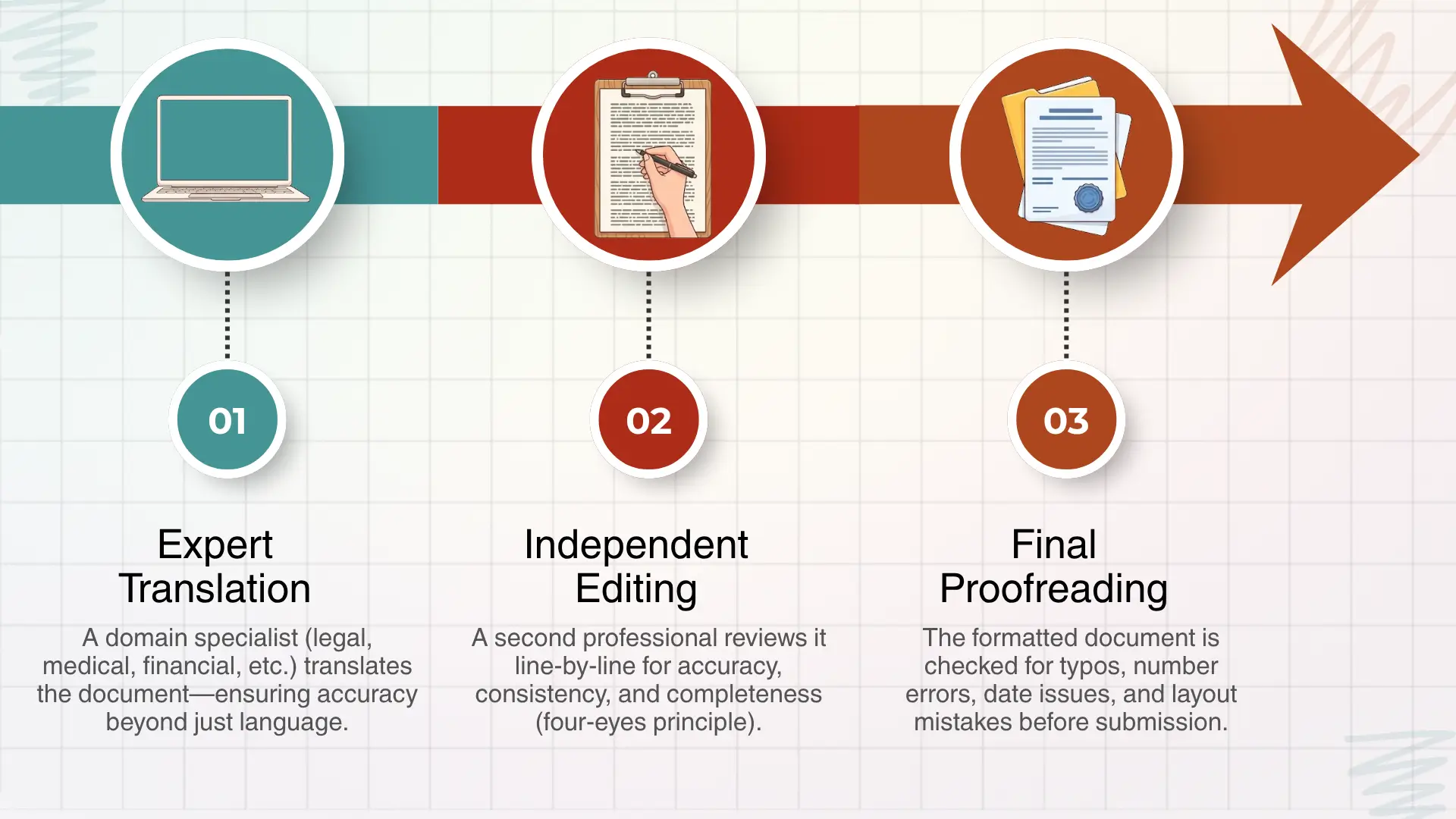
Stage 1: Translation by a domain specialist
A subject-matter specialist working in the declared language pair converts the source document into the target language. Note the word specialist, not just a bilingual professional, someone with domain knowledge in the relevant field. A legal translator for contracts and court documents. A financial linguist for ACRA filings and prospectuses. A medical specialist for clinical credentials and healthcare work pass documents. General linguists handle low-stakes content.
Legal, medical, financial, and technical submissions require someone who understands the terminology's meaning in both jurisdictions, not just its surface translation. At LetterCrafts, documents are matched to translators by domain, not availability.
-
Stage 2: Independent editing (the four-eyes principle)
A different professional from the translator reviews the translated text side by side with the source. This is not a read-through for flow. It is a structured accuracy audit. The editor verifies that every number, date, name, qualification, and regulatory reference appears correctly and completely in the translation; that nothing has been condensed in a way that changes the meaning; that key terms are consistent throughout the document and consistent with any previously submitted documents in the same application bundle; and that the register fits the document type.
A court affidavit sounds different from a corporate profile. ISO 17100 calls this the four-eyes principle: two qualified professionals, independently, on the same document. Without it, the editing stage provides no additional quality assurance.
-
Stage 3: Proofreading the final formatted document
The proofreader works on the formatted, delivery-ready file, the actual document that will be certified and submitted, not a pre-formatting draft. This stage catches typographical errors introduced at any point in production, number integrity issues such as transposed digits and decimal point errors, inconsistent date formats between pages, and layout anomalies from desktop publishing or file conversion.
A translation can be perfectly accurate as a text document and still contain errors by the time it reaches formatted output. A transposed date of birth in a citizenship application is a problem regardless of how accurate the rest of the document is. ICA does not weight errors by proportion.
Why Singapore’s Regulatory Framework Rejects Poor Translations

We work with a lot of clients who come to us after a rejection. Not always from ICA, sometimes from MOM, occasionally from ACRA sometimes from a counterpart's legal counsel who found inconsistencies in a translated contract. And in almost every case, the problem traces back to a workflow that skipped one of the three TEP stages.
Singapore has a more structured legal architecture for translated documents than most businesses realise. The Immigration & Checkpoints Authority requires certified translations that are notarised by a Singapore Notary Public and authenticated through the Singapore Academy of Law's e-Register. That authentication chain, professional translation, Certificate of Accuracy, notarisation, and SAL registration is a chain of human accountability. Every link requires a qualified professional who can be identified and held responsible.
When a Notary Public notarizes a translation, they're attesting to the integrity of the process that produced it, not just to the translator's credentials. A translation produced without independent editing and proofreading is a document where the Notary's attestation rests on very thin ground.
The Ministry of Manpower has its own requirements. Employment documents, educational certificates, and payslips all have to be accurate, consistent, and properly formatted for work pass applications. MOM officers are experienced document reviewers. Inconsistencies get flagged. Errors get queried. Applications get delayed.
The Singapore courts are the sharpest environment of all. A translated affidavit or statutory declaration is read by lawyers and judges who will raise any error that serves their client's interest. In adversarial proceedings, translation quality isn't an administrative nicety. It's a vulnerability.
The Three TEP Failure Points We See Most in Singapore Resubmissions
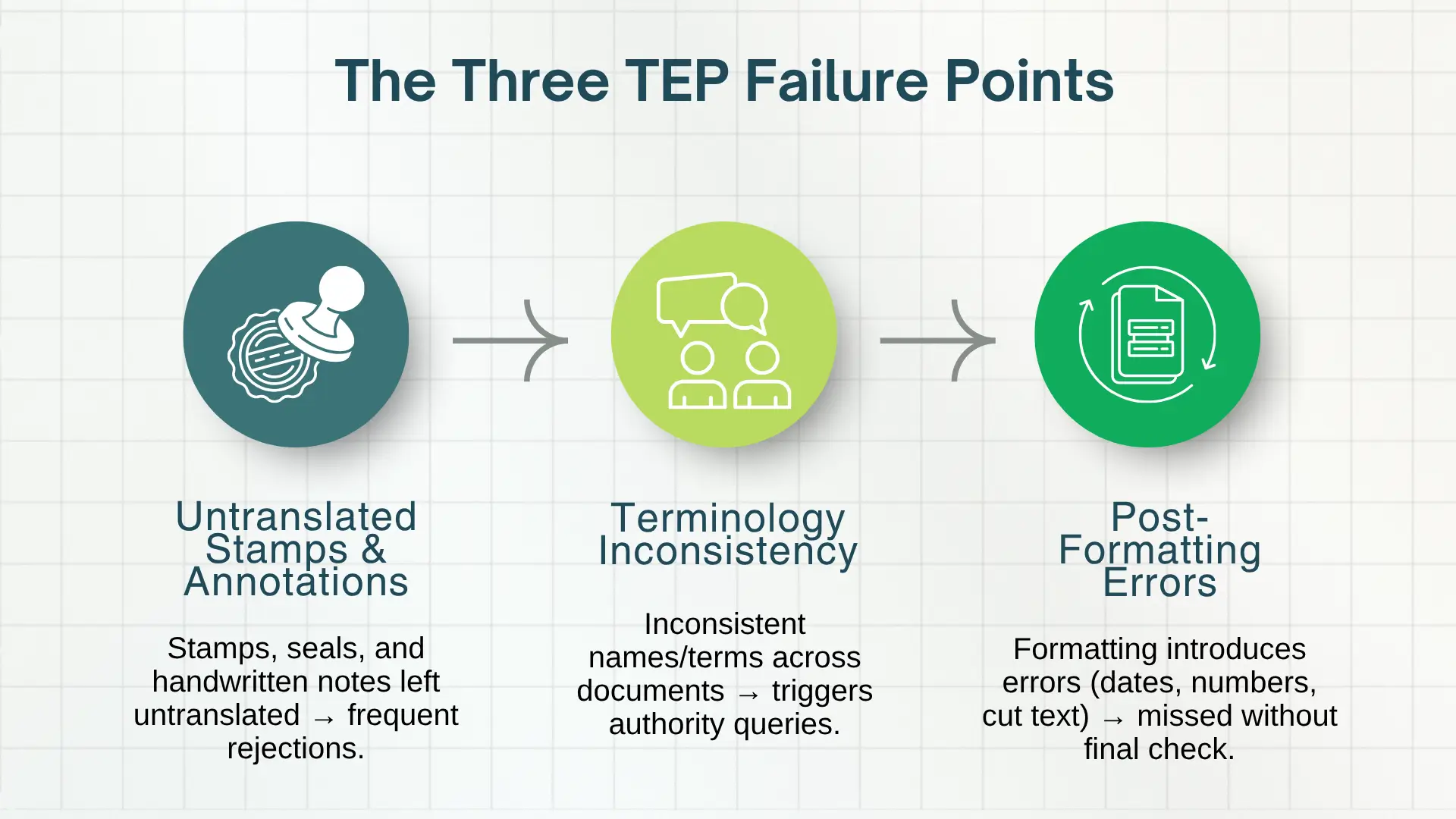
From what we see in resubmission requests, the pattern is consistent. It's rarely a catastrophic mistranslation of the main body text. It's one of three specific failure points, each one mapping directly to a skipped or compromised TEP stage. Here's what each looks like in practice, and why a proper workflow prevents all three.
Failure Point 1: Untranslated Stamps, Seals, and Handwritten Annotations
The translator completes the main body and stops there. Official stamps, government seals, issue dates stamped in red, and handwritten annotations in the margins, the elements that authenticate the document in its original jurisdiction, are left untranslated or noted as "[stamp]" without rendering the content.
Most translators working outside a structured TEP workflow treat stamps and seals as visual elements rather than textual content. The assumption, rarely stated and often acted on, is that ICA will recognise a government seal without a translation. ICA does not. Every element that bears textual content must be translated. At LetterCrafts, stamps, seals, and handwritten annotations are always included; these are precisely the elements that ICA queries most frequently.
Failure Point 2: Terminology Inconsistencies Across a Multi-Document Submission
A client submits multiple documents to ICA or MOM: a birth certificate, a marriage certificate, an academic transcript, and a previous passport. Each was translated separately, possibly by different translators, possibly weeks or months apart. The name romanisation on the birth certificate reads one way. The marriage certificate renders it differently. The academic transcript uses a third variation. MOM flags the inconsistency.
Two translators making independent romanisation decisions from the same Chinese name can each produce a technically correct result, yet the discrepancy between them is still grounds for a query. Without an independent editor checking the new translation against all previously submitted documents, there is no mechanism to catch cross-document inconsistencies. LetterCrafts maintains a translation memory, a database of approved terminology and previously translated segments, to prevent this across submission bundles.
Failure Point 3: Formatting Errors Introduced After the Translation Is Complete
The translation is accurate. The editing pass confirmed it. Then the document goes through desktop publishing layout adjustment, PDF conversion, table reformatting, margin correction, and something shifts. A date that read correctly in the translation draft now has transposed digits in the formatted output.
A number in a financial table that was accurate at the text stage is rendered ambiguously after a decimal point moves during conversion. A table cell is cut off, and a key qualification is partially invisible. Most translation workflows treat the editing stage as the final quality gate, on the assumption that formatting is a mechanical process that does not introduce errors. It does, regularly, and in ways that are easy to miss unless someone is specifically looking for them. Stage 3 is that check.
The common thread across all three is that none of these failures requires a catastrophic translation error to cause a rejection or a query. They're structural failures, things that fall through the gaps when TEP stages are skipped or compromised. And they're all routine in single-pass workflows that get presented as complete professional work. A genuine three-stage TEP process closes every one of these gaps by design.
Cost of TEP Translation in Singapore
LetterCrafts certified TEP translations start at S$38 per page with standard delivery in 24 to 36 hours. Pricing varies by document type, language pair, and the complexity of the domain. Multi-document submission bundles for ICA or MOM applications are quoted individually.
The more relevant comparison is not TEP versus single-pass translation. It is TEP translation versus the cost of a rejection:
|
ICA rejection A rejected translation pauses the entire PR or citizenship application. Resubmission typically requires translating the full document set again. The delay runs four to twelve weeks. The cost of a properly executed TEP translation is a fraction of that timeline. |
MOM query A queried work pass document creates a back-and-forth with MOM that delays issuance. For a company waiting to onboard a senior hire, this has operational consequences that compound over weeks. |
|
Legal exposure A poorly translated contract creates genuine ambiguity about what parties agreed to. In Singapore's courts, the party that produced the document carries responsibility for its accuracy. Errors in contracts or evidence are scrutinised. |
Reputational cost Investor materials, due diligence documents, and client-facing content with visible translation errors communicate something specific about quality control. In Singapore's professional market, that impression is difficult to walk back. |
TEP Translation vs. Single-Pass Translation
Comparing workflow features: TEP vs. single-pass translation
| Feature | Single-pass translation | LetterCrafts TEP |
|---|---|---|
| Independent editor (not the translator) | ✗ No | ✓ Yes |
| Source vs. target accuracy check | Translator self-review | ✓ Independent professional |
| Proofreading of the final formatted document | Often skipped | ✓ Standard |
| Domain-matched subject-matter translator | ✗ General queue | ✓ Specialist assigned |
| ISO 17100 four-eyes principle | ✗ No | ✓ Yes |
| Terminology consistency across multi-doc submissions | ✗ Variable | ✓ Translation memory |
| Suitable for ICA-certified submissions | ✗ Risk of rejection | ✓ Yes |
| Suitable for MOM work pass documents | ✗ Risk of queries | ✓ Yes |
| Suitable for Singapore court documents | ✗ Not recommended | ✓ Yes |
| PDPA-compliant data handling | ✗ Variable | ✓ NDA-bound, no public AI |
| Certificate of Accuracy (named translator) | ✗ Not always provided | ✓ Standard |
| Starting price | Variable | From S$38 per page |
| Standard turnaround | ✗ Variable | ✓ 24–36 hours |
How to Verify If a Singapore Translation Agency Uses a Genuine TEP Workflow
The word "TEP" appears on most agency websites. What you can do is ask five specific questions and watch how they are answered. Hesitation, pivoting to translator qualifications rather than process structure, or vague answers about who does what are reliable indicators of a single-pass workflow with TEP branding on top.
1. Is the editor a different person from the translator?
This is the first and most important question. Any description of the translator reviewing their own work as "editing" means the agency is not running a genuine TEP workflow. ISO 17100's four-eyes principle requires two independent professionals on the same document.
2. Does the proofreader review the final formatted document?
Not a draft, the actual deliverable in its submission format. If the answer describes a pre-formatting review, Stage 3 is not happening the way it needs to.
3. Which translator will work on this document, and what is their subject-matter background?
Domain expertise at Stage 1 is not optional for legal, financial, medical, or technical documents. If the vendor cannot name a specialism, they likely have not assigned one.
4. Who signs the Certificate of Accuracy, and what professional accountability do they hold?
The Certificate of Accuracy is a legal instrument. It must be signed by an identifiable individual who takes personal responsibility for the content. "The agency certifies" is not an acceptable answer.
5. How do you handle documents containing personal data?
This is both a PDPA compliance question and a quality signal. Vendors who have thought seriously about data governance have generally applied the same rigour to their translation process. Vague answers about data handling, or mentions of third-party AI platforms, are a signal about the rest of the workflow, too.
The LetterCrafts TEP Workflow for Singapore Submissions
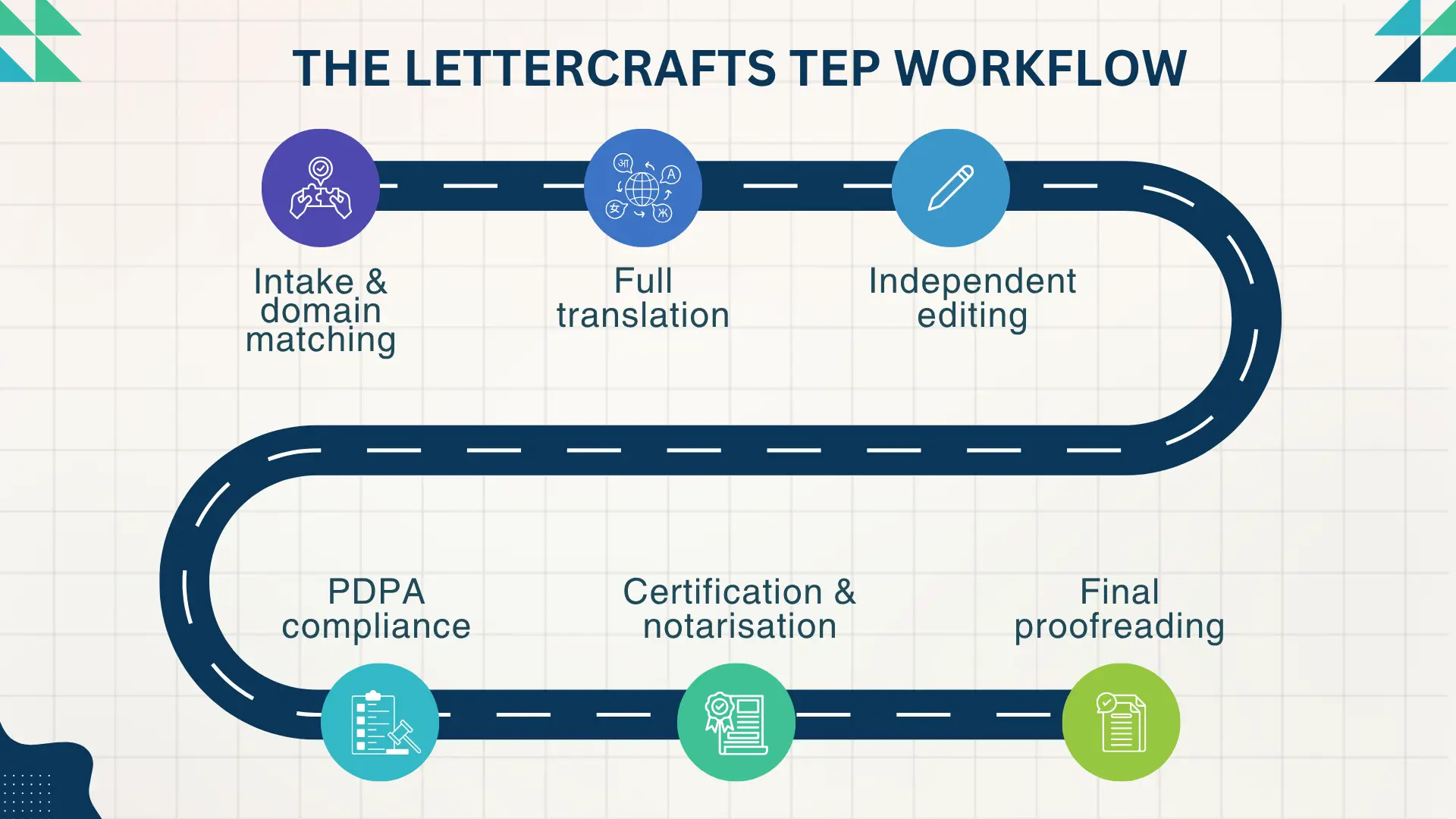
Every certified translation at LetterCrafts follows the same sequence:
Intake and domain matching
Before translation starts, the document is assessed for subject matter and language pair. The right specialist is assigned, not the next available person on a roster. For clients with ongoing work, translation memory ensures consistency across submissions: your approved terminology and previously translated segments are applied to every new document in the same application bundle.
Translation: every element, including stamps and seals
The domain specialist translates the document in full. Every element of the source is accounted for: body text, stamps, seals, handwritten annotations, and watermarks. The elements that get missed most often are the ones ICA asks about most frequently. We translate them as a matter of course.
Independent editing
A different professional reviews the translation against the source with both documents open. Every number, date, qualification, and regulatory term is verified. Terminology consistency is checked against prior submissions where applicable. Any deviation from the source is corrected before the document moves forward.
Proofreading on the final formatted document
The proofreader works on the delivery-ready file, the actual document, not a draft. Typographical errors, number integrity, formatting consistency, and layout quality are all checked before the Certificate of Accuracy is issued.
Certification, notarisation, and SAL authentication
The Certificate of Accuracy is signed by the named translator. For ICA and SAL-bound submissions, we coordinate with a Singapore Notary Public and handle the SAL authentication process. Clients who prefer to manage the notarisation step themselves can do so; we deliver the certified translation ready for that stage.
PDPA-compliant throughout
Documents containing personal data, passports, birth certificates, medical records, and financial statements are never processed through public AI platforms. Every professional working on your files is bound by a confidentiality agreement. Files are deleted after delivery unless you request otherwise.
Conclusion
TEP Translation, Editing, and Proofreading is not a feature. It's not a tier. It's not a selling point that a vendor gets to claim by having translators who sometimes read their own work again.
It is three qualified professionals, working independently, on three distinct quality stages. That's what makes a translation reliable enough to carry your ICA application, your MOM submission, your legal proceedings, or your cross-border contract.
In Singapore, where the regulatory bar for certified translation is as high as it is anywhere in the world, TEP is the only credible baseline. And it's what we build into every translation we produce, not because it differentiates us, but because there isn't a responsible alternative.
Certified translations from S$38 per page. Standard delivery in 24–36 hours.
[Request
a Quote]
Full TEP workflow, domain specialists, Singapore-based team.