TL;DR (Too Long; Didn't Read)
- It's a Hold, Not a Denial: A rejected translation usually means your document failed a compliance check, not that your overall immigration or work pass application is denied. Your application is simply paused until you fix the document.
- ICA vs. MOM Rules Differ: Do not treat them equally. ICA (PR/Citizenship) requires Notary Public notarization and often SAL authentication. MOM (Work Passes) generally only requires a certified translation, but strictly mandates education verification from accredited background screeners.
- Most Common Errors are Procedural: Rejections rarely happen due to bad grammar. They happen because of missing Certificates of Accuracy, name discrepancies with passports, undescribed stamps/seals, or low-resolution PDF scans.
- Act Fast to Avoid Lapsing: A paused application means your processing clock stops. If you have an expiring visa or In-Principle Approval (IPA), fix the specific error with your translation provider and resubmit immediately before you are forced to restart the entire application process.
What "Rejected Translation" Actually Means
When Singapore's Immigration & Checkpoints Authority (ICA) or Ministry of Manpower (MOM) rejects a translation, it does not automatically mean your entire application has been denied. There is a critical distinction that most applicants miss, and understanding it can save you weeks of unnecessary anxiety.
A translation rejection is a document-level failure. The agency has determined that a specific translated document does not meet its compliance standards. Your overall application, whether for Permanent Residency, a work pass, or a long-term visa, is placed on hold until the translation issue is resolved. It is not, in most cases, a final refusal of your immigration status.
An application rejection, by contrast, is a decision on your eligibility as a person. These are fundamentally different outcomes with different remedies.
Ⓘ IMPORTANT DISTINCTION
A translation being flagged by ICA or MOM is a compliance issue it means the document failed, not necessarily that you failed. In most cases, you are given the opportunity to resubmit a corrected translation. The risk is the time lost and the potential cascading delay to your broader application.
Both ICA and MOM operate under zero-tolerance compliance frameworks. English is Singapore's official working language, and any foreign-language document submitted to either agency must be accompanied by a certified English translation. As ICA explicitly states "Insufficient documentation may result in non-acceptance of your application."
ICA vs MOM: Different Agencies, Different Standards
Before diving into what happens after a rejection, you need to understand that ICA and MOM have materially different translation requirements What passes at MOM often will not pass at ICA. Treating them as interchangeable is one of the most common and costly mistakes applicants make.
| Criteria | ICA (PR / Citizenship / LTVP) | MOM (EP / S Pass / Work Permit) |
|---|---|---|
| Minimum Standard | Certified translation + Notarization by Singapore Notary Public | Certified translation (notarization generally not required) |
| Authentication | Often requires Singapore Academy of Law (SAL) authentication | Background screening from MOM-accredited companies for qualifications |
| File Format | PDF via e-PR portal; clear, legible, minimum 300 DPI | Original + translation merged into a single PDF on myMOM Portal |
| Self-Translations | Strictly not accepted | Strictly not accepted |
| Scope Requirement | Every stamp, seal, marginal note, and back-page endorsement must be translated or described | Full document translation; original and translation submitted together in one PDF |
| Education Verification | Not typically required for PR/Citizenship | Mandatory for all EP applications since September 2023; MOM-accredited screeners only |
⚠ CRITICAL WARNING
ICA explicitly states it does not endorse or approve any private translation company. A translation agency claiming to be "ICA-approved" is making an unauthorized claim. What matters is the process: translation + notarization + correct authentication method, not the brand name of the provider.
10 Reasons Certified Translations Get Rejected
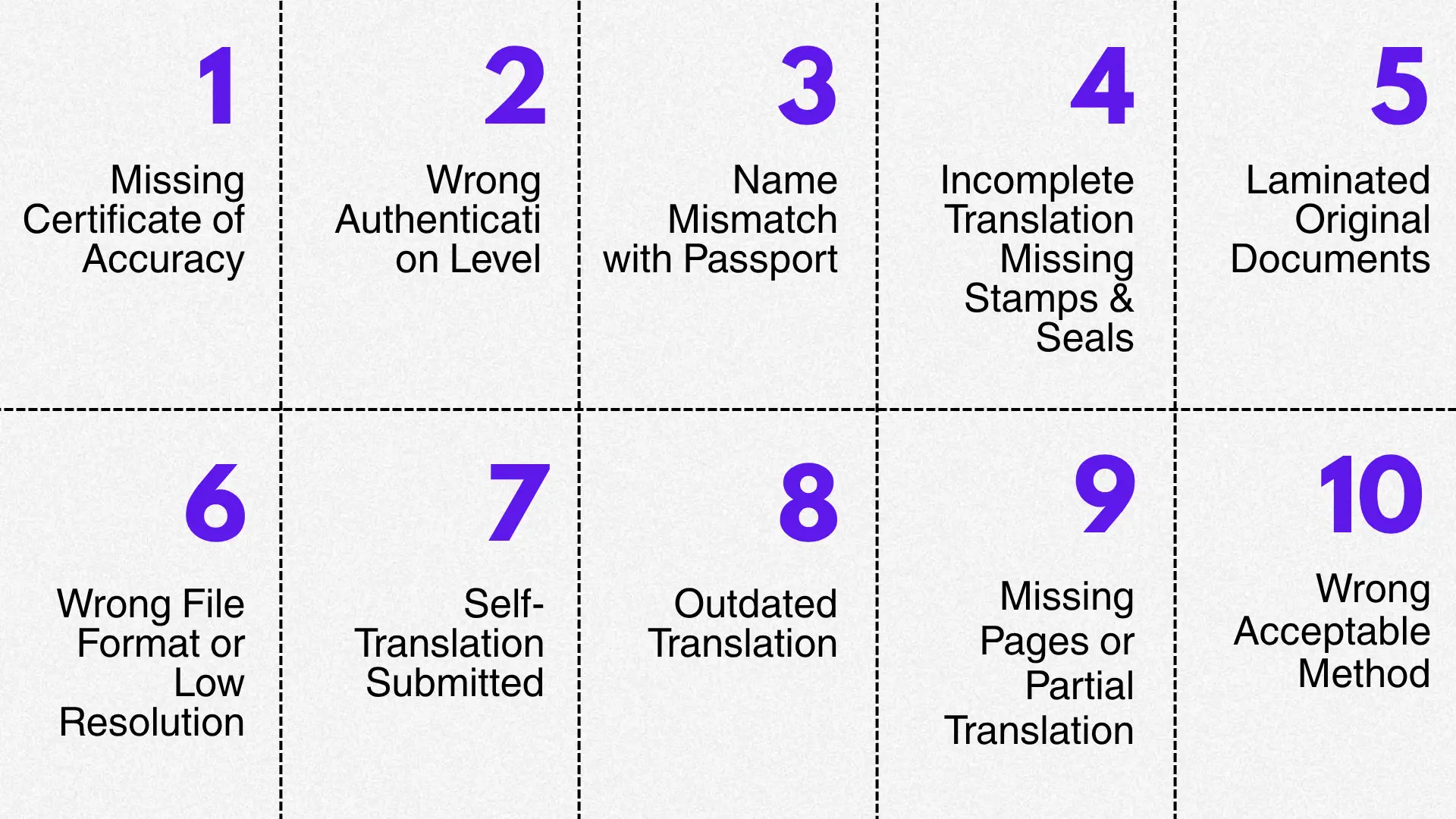
Translation rejections in Singapore rarely happen because of a language quality problem. They happen because of submission compliance failures procedural and formatting errors that trigger automatic flags. As documented by certified-translation.co the issue is usually not English; it is submission compliance. Here are the ten most common causes:
| # | Reason | What It Means & Why It Fails |
|---|---|---|
| 01 | Missing Certificate of Accuracy | Every translation must include a signed Translator's Declaration or Certificate of Accuracy. If this page is absent, uploaded separately, or lacks a signature or date, the translation is immediately non-compliant. Source: certified-translation.co |
| 02 | Wrong Authentication Level | Submitting a certified translation when the agency required a notarized one is extremely common. ICA requires notarization for PR and Citizenship; MOM generally does not. Using the wrong level for the wrong agency causes rejection. |
| 03 | Name Mismatch with Passport | Your translated document must match your passport character-for-character, including name order, spacing, and hyphenation. A single letter discrepancy between your translated birth certificate and passport is grounds for rejection. Source: LetterCrafts Compliance Guide |
| 04 | Incomplete Translation Missing Stamps & Seals | ICA's golden rule: every visual element must be translated or described. Faint stamps, marginal notes, back-page endorsements, and official seals that are left undescribed are automatic rejection triggers. |
| 05 | Laminated Original Documents | The Singapore Academy of Law (SAL) and Notary Publics require the ability to examine security features, watermarks, and paper quality. Lamination physically blocks this examination and leads to automatic refusal of the authentication step. |
| 06 | Wrong File Format or Low Resolution | MOM's portal requires the original and translation merged into a single PDF. ICA's e-PR portal requires scans of a minimum 300 DPI. Files that are too small, blurry, or split incorrectly fail automated document scanning. |
| 07 | Self-Translation Submitted | Neither ICA nor MOM accepts self-translations under any circumstances. As ICA's official FAQ confirms, a translation prepared by the applicant themselves is considered invalid and will be rejected outright. |
| 08 | Outdated Translation | While ICA has no formal expiration date on translations, submitting a translation older than six months significantly increases the risk of rejection. EliteAsia notes that translations within the last six months are the safest practice. |
| 09 | Missing Pages or Partial Translation | Omitting even a single page of a multi-page document or failing to translate both sides of a double-sided document constitutes an incomplete submission. Source: ICA Document Requirements |
| 10 | Wrong Acceptable Method | ICA accepts only four methods: (1) Embassy translation, (2) Notary Public translation, (3) Private translation + Embassy attestation, or (4) Private translation + Notary Public attestation. Any translation outside these four pathways will not be accepted. |
What Happens to Your Application Immediately
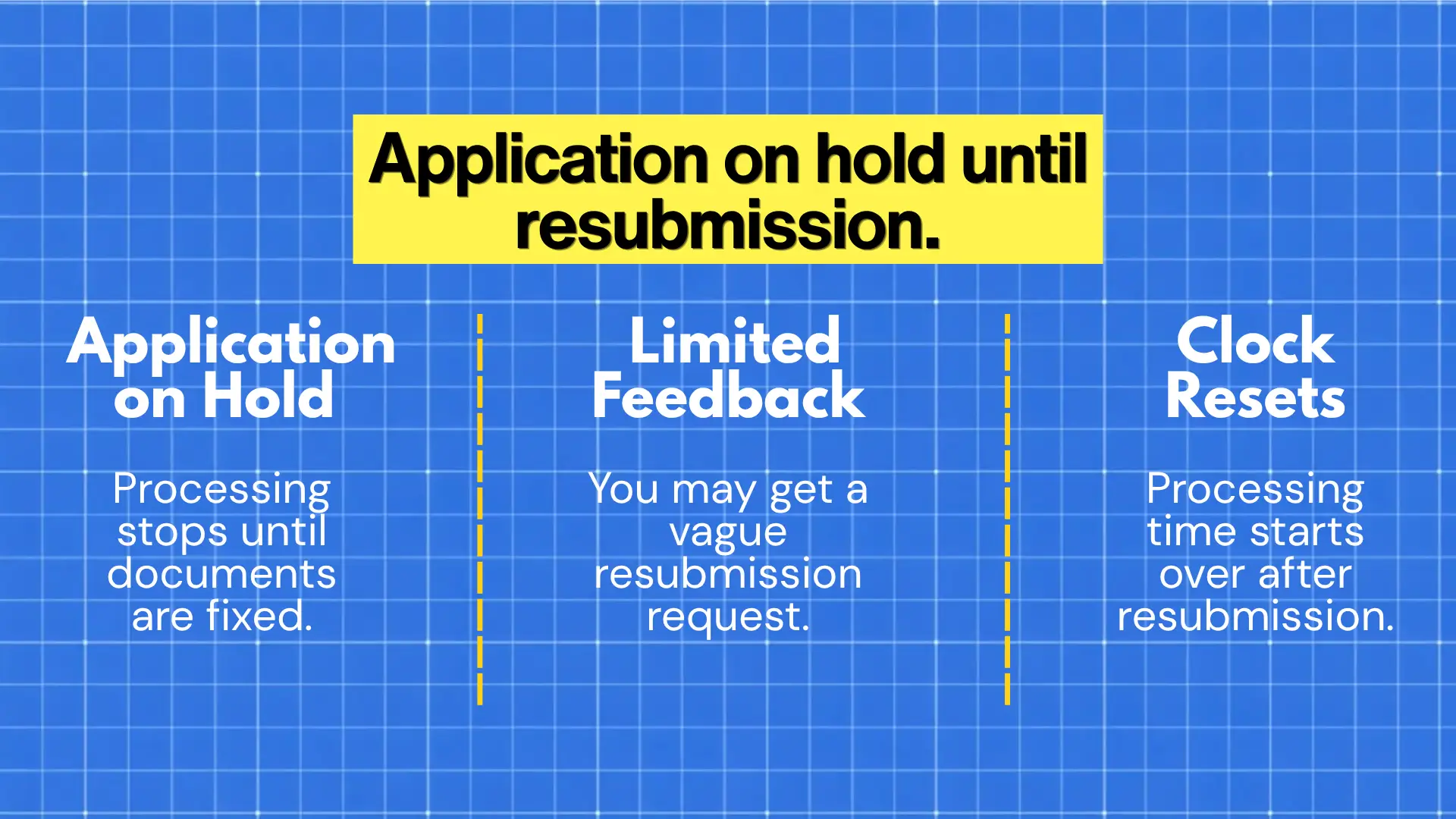
The moment ICA or MOM flags your translation, a chain of procedural consequences is triggered, all of which affect your application timeline. Understanding exactly what happens at each stage helps you respond quickly and avoid making the delay worse.
1. Your Application Is Put on Hold
Neither ICA nor MOM will continue processing your application while a document compliance issue remains unresolved. As stated on ICA's official Permanent Residency page, applications will only be processed within the standard timeframe provided all required documents are submitted and in order. The clock has effectively stopped on your case.
2. You Receive a Notification, or You Don't
ICA typically does not specify exactly why a document was not accepted. You may receive a general notification asking you to resubmit corrected documents. MOM tends to be slightly more specific for work pass rejections, often providing a reason code. For document-level issues, however, the feedback can be vague.
3. Application Processing Clock Resets
Standard processing times for Singapore immigration applications are significant:
| Application Type | Normal Processing Time | Source / Authority |
|---|---|---|
| ICA PR Application | 4–12 months | ICA PR Page (ica.gov.sg) |
| ICA Citizenship Application | Up to 12 months | ICA Citizenship Page |
| ICA Long-Term Visit Pass (LTVP) | Up to 6 weeks | ICA LTVP Info |
| MOM Employment Pass (SG company) | Up to 3 weeks | MOM EP Documents Required |
| MOM Employment Pass (overseas company) | Up to 8 weeks | Piloto Asia EP Guide |
| MOM S Pass | Up to 3 weeks | MOM S Pass Documents |
⚠ TIME-CRITICAL ALERT
If your visa, pass, or In-Principle Approval (IPA) has an expiry date, a translation rejection that causes processing delays could result in your IPA lapsing. If this happens, you may need to restart the entire application from scratch, including repaying the non-refundable SGD 100 PR application fee. Time spent fixing translations is time you cannot afford to lose.
ICA-Specific Consequences and What to Expect
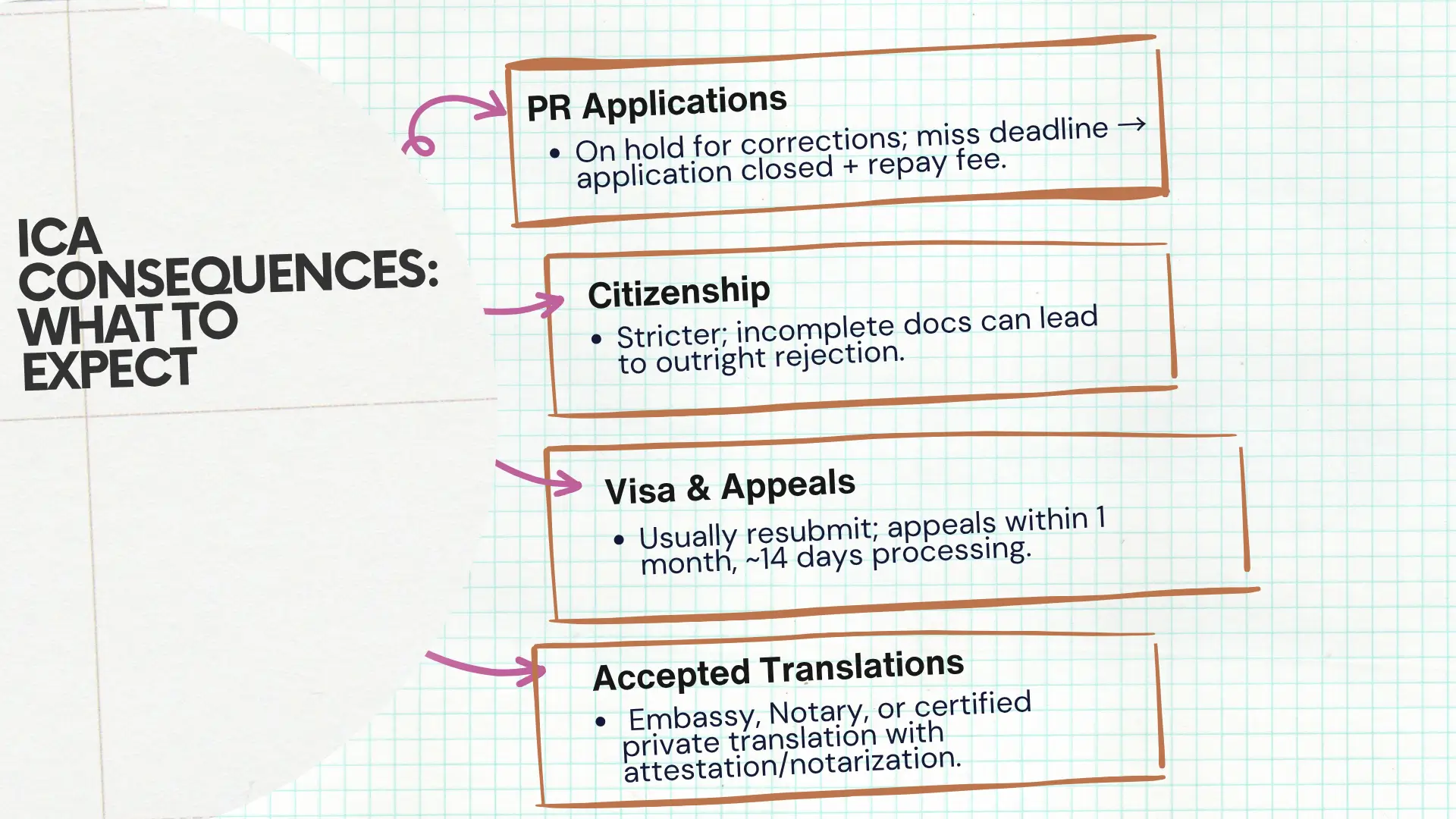
ICA handles some of the most consequential immigration applications in Singapore: Permanent Residency, Citizenship, Long-Term Visit Pass, Dependant's Pass, Student Pass, and Re-Entry Permits. The stakes are high, and the translation standards reflect that. With over 150,000 PR applications annually and only approximately 30,000 (20%) approvals every element of your submission must be watertight.
For PR Applications
A translation that fails ICA's review during a PR application results in ICA requesting supplementary documents through the e-PR portal. The application is suspended pending receipt of corrected documents. If corrected documents are not provided within the requested timeframe, ICA may close your application entirely, requiring a fresh submission with the non-refundable SGD 100 application fee paid again. ICA's official standard processing time is 4 to 6 months. While complex cases can take up to 12 months, stating 4–12 months as the "normal" baseline is slightly misleading.
For Citizenship Applications
Citizenship applications are even more stringent. ICA explicitly states that insufficient documentation may result in non-acceptance of your application, not just a pause, but a closure. The processing time is up to 12 months making any translation delay disproportionately costly.
For Visa Applications Appeal Window
For shorter-term immigration instruments, translation issues typically result in a request to resubmit. For visa appeals specifically, ICA's official FAQ states that you can submit an appeal via the enquiry form within 1 month of the rejection date. The appeal processing time is generally 14 working days though complex cases take longer. Each appeal is assessed on its own merits.
The Four ICA-Accepted Translation Methods
ICA is explicit about what it accepts. As confirmed by the ICA official FAQ on document translation, the four recognized methods are:
- Embassy direct translation: translation produced directly by the embassy of the document-issuing country
- Singapore Notary Public translation produced by a Notary Public in Singapore or the issuing country
- Private translation + Embassy attestation of a private agency's work, attested by the relevant embassy
- Private translation + Notary Public notarization, a private agency's work, notarized by a Singapore Notary Public (most common for PR/Citizenship)
MOM-Specific Consequences and What to Expect
MOM's translation requirements apply primarily to work pass applications. Since September 2023, MOM has made education verification mandatory for all new EP applications, adding a critical layer of document scrutiny on top of standard translation requirements.
For Employment Pass Applications
If a translation is non-compliant in an EP application, MOM will typically issue a request for resubmission through the myMOM Portal. The three-week processing clock restarts. Critically, if your educational qualification's translation is found to be uncertified, MOM has the authority to revoke the work pass entirely and ask the candidate to leave Singapore.
⚠ WORK PASS REVOCATION RISK
Veremark (MOM-accredited) explicitly confirms: if a qualification is found to be not genuine or cannot be verified, MOM will revoke the work pass, and the candidate will be asked to leave Singapore. This makes the integrity of your translated documents a legal obligation, not just a compliance formality.
The MOM Education Verification Requirement (Since Sep 2023)
Since September 2023, all EP applicants must have their foreign qualifications verified by one of only 11 MOM-accredited background screening companies. Non-accredited translations and notary-certified documents cannot substitute for this verification report. The process generates a MOM verification reference number starting with "VM" An application submitted without this number will be automatically rejected, as Veremark confirms.
| Verification Timeline | Timeframe |
|---|---|
| Singapore & Asia (excl. India) | 7–15 working days |
| India & South America | 15–25 working days |
| Recommended lead time before EP application | 2–4 weeks minimum |
Step-by-Step: How to Fix a Rejected Translation
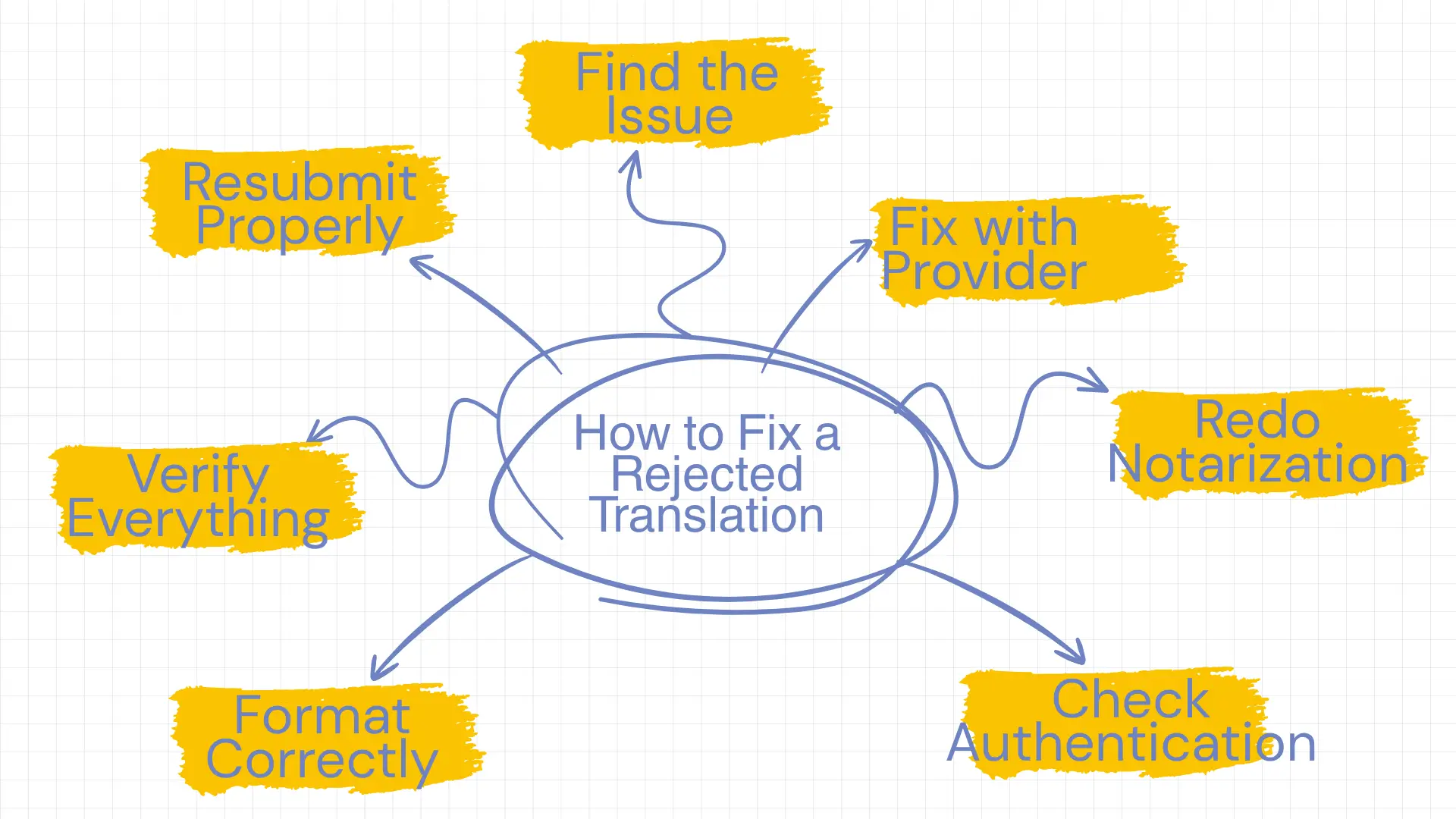
A rejected translation is fixable. But the steps you take and the order you take them in matter enormously. Moving too fast without understanding the specific cause of rejection often results in a second rejection.
Step 1: Identify the Exact Cause of Rejection
Review the notification from ICA or MOM carefully. If the reason is vague, contact the relevant agency through official channels to request clarification. Do not begin retranslation until you know precisely what failed; a name mismatch requires a different fix than a missing notarization.
Step 2: Contact Your Original Translation Provider
Inform your translation service immediately. Reputable providers experienced with ICA and MOM submissions typically offer free revisions when a rejection is due to their error. Get a written commitment on the revision timeline and what changes will be made.
Step 3: Determine Whether Notarization Needs to Be Redone
If the translation text itself changes (even slightly), you will need to return to the Singapore Notary Public for a new notarization; the original notarization is void once the document changes. As LetterCrafts documents, this step typically takes 1–3 business days.
Step 4: Check SAL Authentication Requirements (ICA Only)
For ICA PR or Citizenship applications, certain documents must be authenticated by the Singapore Academy of Law. If your original documents were laminated, contact the issuing authority in your home country for an unlaminated certified copy before proceeding this is a prerequisite that cannot be bypassed.
Step 5: Prepare the Correct File Format Before Resubmission
For ICA: scan at minimum 300 DPI; submit as a clear, ordered PDF via the e-PR portal. For MOM: merge the original document and the English translation into a single PDF (original first, translation second, then certification pages). Verify each file before uploading.
Step 6: Run a Pre-Submission Compliance Check
Before uploading, verify: (1) Translator's declaration is signed and dated; (2) All stamps, seals, and marginal notes are translated/described; (3) Names match your passport character-for-character; (4) All pages included; (5) Correct authentication level applied for this specific agency. Full checklist: LetterCrafts Singapore Compliance Guide.
Step 7: Resubmit Through the Correct Portal
ICA submissions are made via the e-PR portal (MyICA). MOM submissions are made via the myMOM Portal. Keep a record of every submission, including timestamps, reference numbers, and confirmation emails.
When and How to Appeal
There are two distinct scenarios where an appeal may be relevant: a document resubmission (not technically an appeal) and a formal appeal against a full application rejection where document issues contributed to the outcome.
| Appeal Type | ICA Visa Rejection | ICA PR Rejection | MOM EP Rejection |
|---|---|---|---|
| Deadline | 1 month from the rejection date | 6 months from the rejection date | 3 months from the rejection date |
| Processing Time | ~14 working days | 4–6 months | Varies; ~3–4 weeks typical |
| Appeals Allowed | One per rejection | One per rejection only | One per rejection |
| Key Requirement | Signed letter from local contact + corrected documents | Must present significant new information or changed circumstances | Must present new facts or documents, not a resubmission of the same information |
✓ STRATEGIC ADVICE
If your rejection was primarily due to a translation document issue (and not your personal profile), an appeal has a stronger chance of success because you are addressing a procedural error rather than a merit-based assessment. Be explicit in your appeal letter: "The application was made non-compliant due to a document formatting issue in the translated [document name]. The corrected, fully-compliant translation is attached herewith." Full guidance: How to Appeal a Singapore PR Rejection (2026)
How to Prevent Translation Rejection: Pre-Submission Checklist
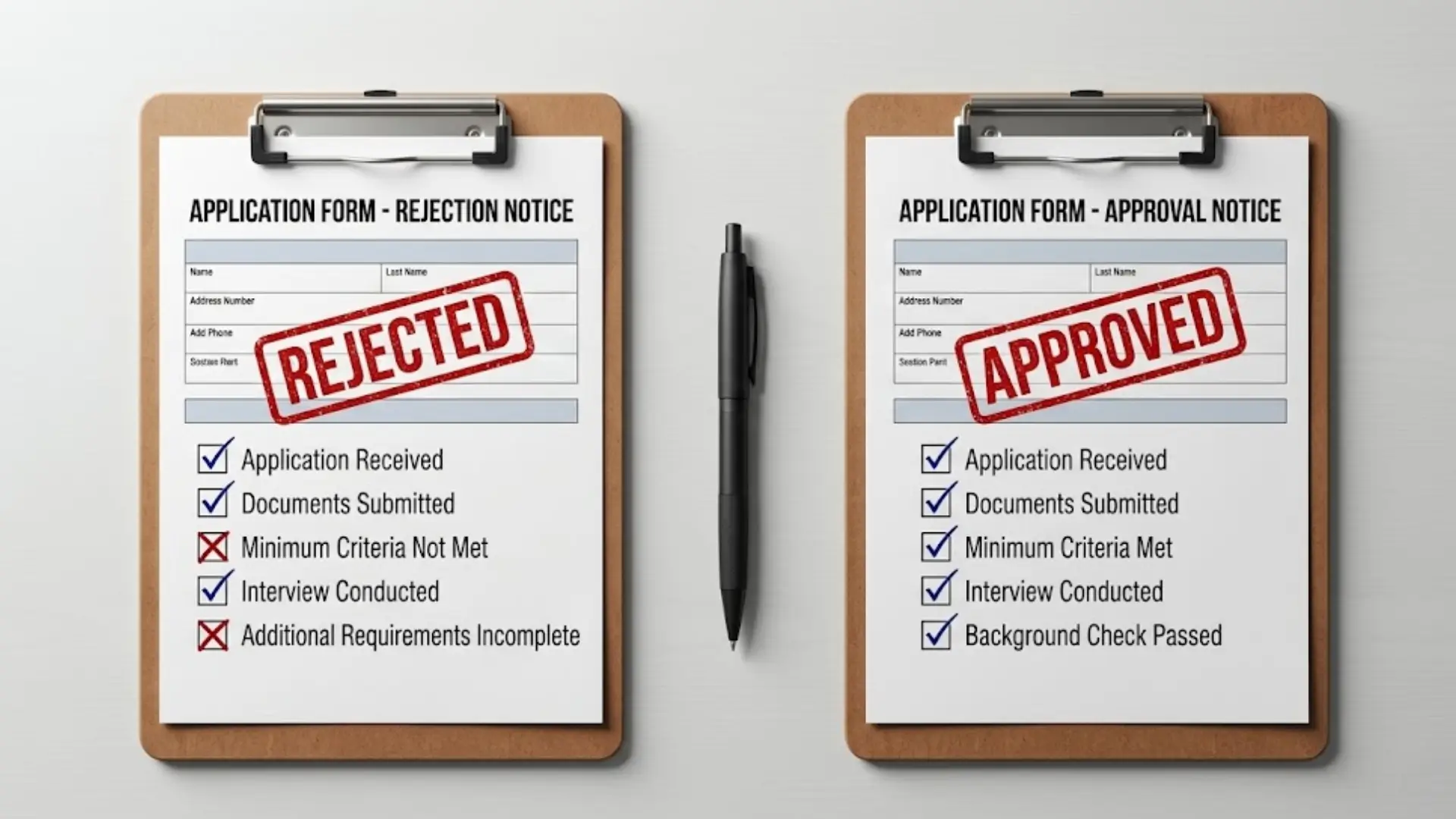
The most effective strategy is ensuring your translation never gets rejected in the first place. The following checklist covers the universal compliance requirements across both ICA and MOM, with agency-specific notes where relevant.
Universal Requirements: Both ICA and MOM
- Use a professional, certified translation service; never self-translate under any circumstances.
- Ensure the translation includes a signed, dated Certificate of Accuracy / Translator's Declaration
- Verify that all names match your passport exactly, character for character, including name order.
- Confirm the translation is complete every page, every side, every stamp, and marginal note.
- Scan at a minimum of 300 DPI; do not submit blurry or partial scans
- If there is a legitimate name discrepancy, include a bridging document (Deed Poll or notarized Letter of Explanation)
- Do not laminate original documents before authentication
ICA-Specific Checklist
- Use one of ICA's four accepted authentication methods (Embassy, Notary, Private+Embassy attestation, or Private+Notary)
- For PR and Citizenship: ensure translation is notarized by a Singapore Notary Public certified translation alone is insufficient.
- Translate every visual element, stamps, seals, back-page endorsements, and marginal notes.
- Keep translations within the last 6 months where possible
- For complex documents (Chinese Hukou, Japanese Koseki, Korean family registry), use a translator specializing in those document types
MOM-Specific Checklist
- Merge the original document and its translation into a single, ordered PDF original first, as required by the myMOM Portal.
- For EP applications: obtain education verification from a MOM-accredited background screening company. Only 12 companies are accredited.
- Include the MOM verification reference number (VM…) in your EP application form; without it, the application is automatically rejected.
- Start verification 2–4 weeks before your EP application submission. Processing takes 7–25 working days, depending on the institution's country.
- Submit verification receipts if verification is pending after 14 business days and the institution appears in MOM's dropdown list.
Conclusion
A translation rejected by ICA or MOM is serious, but it is not the end of your application journey. The key is speed, precision, and understanding exactly what went wrong before you attempt to fix it. Most translation rejections stem from the same set of avoidable, procedural errors: the wrong authentication level, missing certification pages, name mismatches, or incomplete scans.
What separates applicants who recover quickly from those who lose months to cascading delays is one thing: acting on accurate, agency-specific information. ICA and MOM operate by different rules; verify the current requirements directly at ica.gov.sg and mom.gov.sg before every submission.