Key Takeaway
- Certified translation, notarisation, and apostille are three separate steps that prove three different things: accuracy, witnessed authenticity, and cross-border genuineness.
- Singapore has no sworn-translator register, so professional certification plus, where needed, notarisation does the work that a sworn translator would do elsewhere.
- For most local submissions (MOM, MOE, ACRA, ROM, schools, banks), a certified translation is generally sufficient.
- ICA is the major exception. For PR and Citizenship, non-English documents must be notarised by a Singapore Notary Public or embassy-attested. A company certificate alone is generally not accepted.
- A Notary Public is a senior practising lawyer (typically 15-plus years' experience and at least 40 years old under SAL guidelines), not simply any lawyer.
- The Apostille Convention took effect for Singapore on 16 September 2021, with SAL as the sole Competent Authority. Apostilles replace legalisation for Hague member countries; non-members still require embassy legalisation.
- An e-Apostille is now available for notarised documents (from October 2025) and for ACRA Open Attestation documents, but confirm your recipient accepts the electronic version.
Three words trip up almost everyone preparing official documents in Singapore: certified, notarised, and apostilled. They sound interchangeable. They are not. Submit the wrong one to the Immigration and Checkpoints Authority (ICA) and your Permanent Residency Application can sit in limbo for weeks. Send a document overseas with only a translation certificate when the receiving country wanted an apostille, and you are starting again.
After preparing document packages for ICA submissions, court filings, and overseas use, we have watched the same misunderstanding play out again and again. People assume one step covers everything. In reality, certified translation, notarisation, and apostille each do a different job, and Singapore authorities ask for different combinations depending on where the document is going and who is receiving it.
This guide settles the confusion. You will learn what each step actually proves, which Singapore authority accepts which, the correct order to do them in, and the realistic costs and timelines, all verified against the Ministry of Law, the Singapore Academy of Law (SAL) , and ICA's own published guidance.
Quick Answer: The Difference in One Paragraph
A certified translation is a translation accompanied by a signed statement from the translator or translation company confirming it is accurate and complete. Notarisation adds a Notary Public, a senior practising lawyer, who attests to the document or the translator's signature and issues a notarial certificate. An apostille is a certificate issued by the Singapore Academy of Law that authenticates a Singapore public document for use in another country that belongs to the Hague Apostille Convention. Certification proves the translation is accurate. Notarisation proves it was witnessed by a recognised legal officer. An apostille proves the document is genuine for cross-border use.
Certified Translation vs Notarisation vs Apostille: Comparison Table
| Feature | Certified Translation | Notarisation | Apostille |
|---|---|---|---|
| What it confirms | The translation is accurate and complete | A Notary Public witnessed the signing or sighted the original | The origin of a Singapore public document for overseas use |
| Who performs it | A professional translator or translation company | A Singapore Notary Public (senior practising lawyer) | The Singapore Academy of Law (SAL) |
| Legal basis | Industry standard, signed declaration of accuracy | Notaries Public Act 1959 | Apostille Act 2020 (Hague Convention) |
| Typically required by | MOM, MOE, ACRA, ROM, LTA, schools, banks | ICA (PR and Citizenship), Singapore courts, embassies | Foreign authorities in Hague member countries |
| Used for | Most local submissions | Higher-stakes local use and documents heading abroad | Cross-border recognition of documents |
| Standalone? | Often sufficient for everyday official use | Must be authenticated by SAL since 1 October 2019 | Sits on top of a public document or notarised document |
Keep this distinction in mind as we go: the level of authentication you need is decided by the recipient, not by you. Always confirm the exact requirement with the authority or organisation receiving your document before you start.
What Is a Certified Translation in Singapore?
A certified translation is a translation paired with a signed statement, often called a Certificate of Translation Accuracy, in which the translator or translation company declares that the translation is a true, complete, and accurate rendering of the original. The certificate usually carries the company letterhead, an official stamp, the translator's signature, and the date.
Here is a point that surprises people from civil-law countries such as France, Germany, or Spain. Singapore does not operate a register of government-appointed "sworn translators." There is no Ministry of Justice in Singapore and no official sworn-translator list. Any competent professional translator or reputable translation company can certify their own work. That is precisely why, for higher-stakes submissions, Singapore relies on notarisation to add an independent legal layer rather than on a sworn-translator system.
Who Accepts a Certified Translation?
For most everyday official purposes, a certified translation from a credible translation company is enough on its own. This generally covers the Ministry of Manpower (MOM) for work passes, the Ministry of Education (MOE) and schools, the Accounting and Corporate Regulatory Authority (ACRA), the Registry of Marriages (ROM),, the Land Transport Authority (LTA), banks, and most commercial uses.
The certificate works because it ties a named, accountable professional to the accuracy of the translation. If a question ever arises, there is a clear party who stands behind the work.
When a Certified Translation Is Not Enough
The big exception is ICA. For Permanent Residency and Citizenship applications, ICA does not accept a translation company's certificate on its own. It wants the translation either produced by, or notarised by, a Notary Public, or attested by the embassy of the country that issued the original. We cover ICA's exact wording further down, because this single rule is responsible for more delayed applications than almost any other.
What Is Notarisation in Singapore?
Notarisation is the process in which a Notary Public, an independent and senior legal officer, attests to a document. For translations, the notary typically witnesses the translator signing their declaration of accuracy, or certifies that a copy is a true copy of an original sighted in person, and then issues a notarial certificate bound to the document.
In Singapore, a Notary Public is not just any lawyer. Under the Notaries Public Act the Senate of the Singapore Academy of Law may appoint practising advocates and solicitors who have practised for at least seven years.
In practice, SAL's own appointment guidelines go considerably further, requiring applicants to have no fewer than 15 years of active legal experience and to be at least 40 years old, and to be "fit and proper" persons. Appointments run for one year at a time and are valid only while the lawyer holds a current practising certificate. So when you hear that "anyone can be a notary after twelve years of study," that is simply incorrect. Notaries Public in Singapore are vetted, senior practitioners.
Notary Public vs Commissioner for Oaths
People often confuse the two roles. A Commissioner for Oaths administers oaths and witnesses statutory declarations and affidavits for use within Singapore. A Notary Public has wider powers and handles documents intended for use overseas, including authenticating signatures and certifying true copies for international recognition. If your document is staying in Singapore, a Commissioner for Oaths or an advocate and solicitor usually suffices. If it is crossing a border, you generally need a Notary Public.
The Step Most People Miss: SAL Authentication
Since 1 October 2019, every notarial certificate issued in Singapore must be authenticated by the Singapore Academy of Law to be valid. This rule, introduced through amendments to the Notaries Public Rules, was designed to strengthen document integrity and stamp out forged notarial certificates. Under Rule 8(3)(c) of the Notaries Public Rules, a notarial certificate is not valid unless SAL has authenticated it.
What this means in plain terms: notarisation alone is no longer the finish line. The notary's certificate must then be authenticated by SAL, and members of the public can verify any notarial certificate online through the SAL legalisation portal. This authentication step is also where the apostille enters the picture.
What Is an Apostille in Singapore?
An apostille is a standardised certificate, issued under the Hague Apostille Convention, that authenticates the origin of a public document so it can be recognised in another member country without further legalisation. In Singapore, the Singapore Academy of Law is the sole designated Competent Authority for issuing apostilles.
This is relatively recent. The Apostille Convention entered into force for Singapore on 16 September 2021, given effect through the Apostille Act 2020. Before that date, Singapore documents bound for overseas use went through a longer chain of legalisation, often involving the issuing authority, then authentication, then legalisation at the destination country's embassy or consulate. The apostille collapses that chain into a single certificate for documents going to fellow Convention countries.
How an Apostille Works in Practice
There are two routes, depending on the document:
- Singapore government or public documents (for example, an ACRA business profile, or certain official certificates) can be presented to SAL directly for an apostille, with no notary involved.
- Private and non-government documents (such as a certified translation, a private contract, a personal declaration, or a passport copy) must first be notarised by a Notary Public. SAL then authenticates the notary's certificate and affixes the apostille.
For incoming foreign documents, the same logic runs in reverse. Singapore authorities now accept apostilles issued by other Convention countries in place of embassy legalisation, where applicable.
SAL has been modernising the system. An electronic apostille (e-Apostille) is available for ACRA documents issued in Open Attestation format from 4 March 2023 onwards. More significantly, as of October 2025, an e-Apostille via e-Notarisation is available for all notarised documents, requested at the Notary Public's office, with the certificate emailed directly to the client rather than requiring a trip to SAL. Before choosing the electronic option, confirm that your overseas recipient will accept an e-Apostille, as some still expect the physical sticker.
Apostille vs Legalisation: What If the Country Is Not in the Hague Convention?

An apostille only works between countries that are party to the Hague Apostille Convention. If your document is going to a country that is not a member, you cannot rely on an apostille alone. Instead, you follow the older legalisation route: notarisation, SAL authentication, and then legalisation at the embassy or consulate of the destination country.
More than 120 countries belong to the Convention, and the list keeps growing. Mainland China, for instance, joined relatively recently, which changed the process for a huge volume of documents. Because membership shifts over time, always check the current status of your destination country on the Hague Conference status table before assuming an apostille is sufficient.
Which Singapore Authority Requires What?
Different authorities sit at different points on the authentication ladder. Here is how the common ones generally treat translated documents. Requirements can change, so treat this as a working guide and confirm with the relevant body.
| Authority | What it usually accepts |
|---|---|
| ICA (PR, Citizenship, long-term passes) | Translation produced or notarised by a Notary Public, or attested by the issuing country's embassy. A company certificate alone is generally not accepted. |
| MOM (work passes) | Certified translation from a professional translation company is generally accepted. |
| MOE and schools | Certified translation is generally accepted for enrolment and admissions. |
| ACRA | Certified translation for filings; apostille or e-Apostille available for outgoing ACRA documents. |
| Singapore courts | Certified translation by a competent translator; notarisation or sworn translation may be required for evidentiary documents, depending on the matter. |
| ROM (marriage registration) | Certified translation is generally accepted. |
| Foreign authorities (overseas use) | Apostille for Hague countries; full legalisation for non-Hague countries. |
What ICA Actually Says
This is worth quoting carefully, because so much misinformation circulates online. ICA's published guidance states that for documents not in English, it accepts translations provided by the embassy of the issuing country, translations produced by a Notary Public in Singapore or in the country that issued the document, or privately created translations that are then attested by the embassy or notarised by a Notary Public.
ICA also states plainly that it does not endorse any private translation companies. So be cautious of any provider claiming to be "ICA-approved" or "officially registered with ICA." No such endorsement exists. What a strong translation provider can genuinely offer is an accurate, correctly formatted translation that meets ICA's standards, plus coordination of the notarisation that ICA requires. Honesty on this point is itself a sign of a trustworthy provider.
How the Three Steps Fit Together: Two Real Scenarios
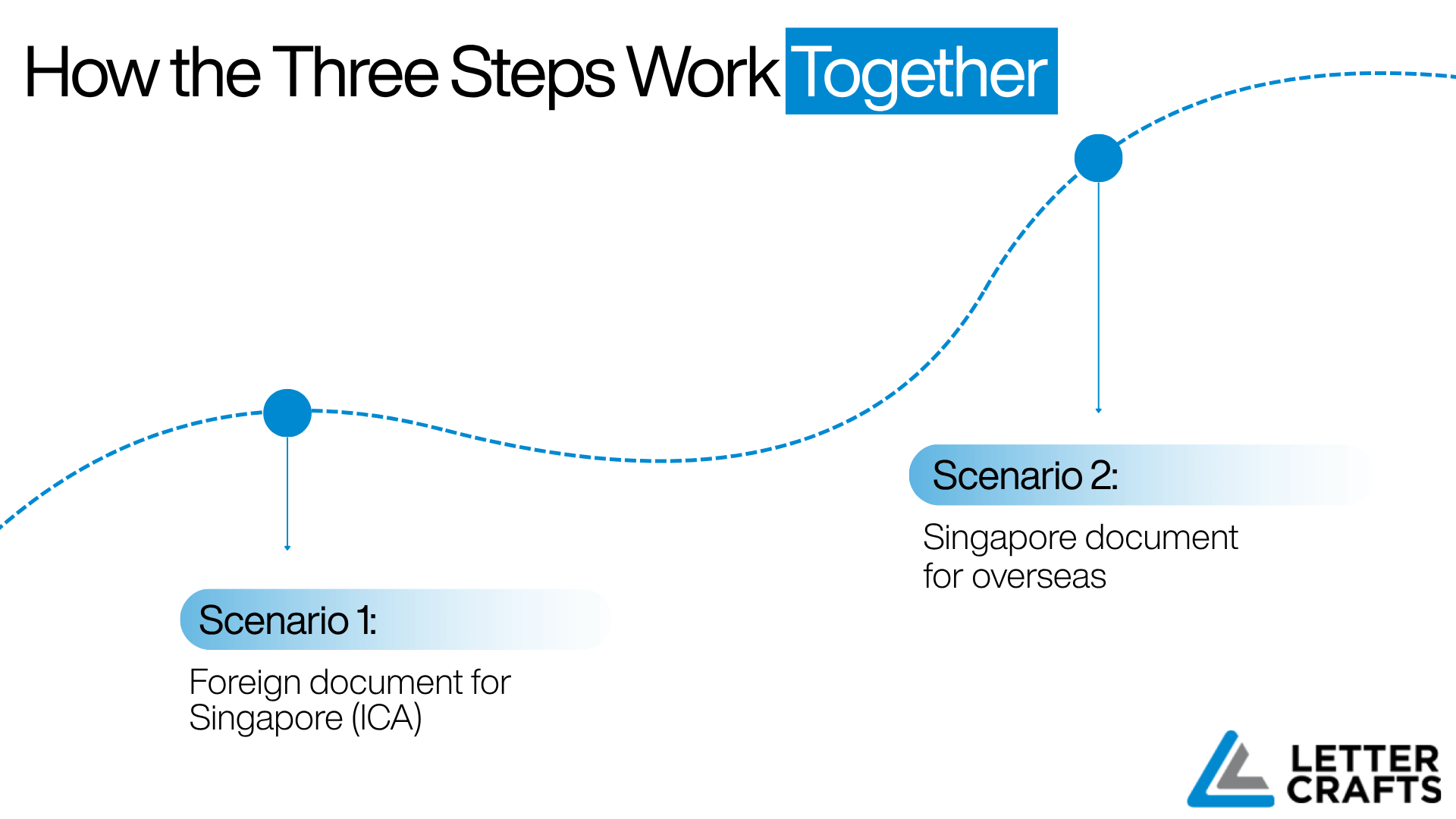
The cleanest way to understand the order is to follow two common journeys.
Scenario 1: A foreign-language document used inside Singapore (for ICA). Say you are applying for PR with a Chinese birth certificate.
- Get a certified English translation from a professional translator.
- Have the translation notarised by a Singapore Notary Public (ICA's requirement for PR and Citizenship).
- The notarial certificate is authenticated by SAL.
- Submit the original document together with the notarised, SAL-authenticated translation to ICA.
You generally do not need an apostille for an ICA submission, because the document is being used inside Singapore. The certified, notarised translation is what ICA is looking for.
Scenario 2: A Singapore document used overseas. Say you need a Singapore-issued document recognised in Germany, a Hague Convention country.
- If it is a private document, have it notarised by a Notary Public. If it is a government public document, you may go straight to SAL.
- SAL authenticates and affixes the apostille.
- Send the apostilled document to Germany, where it is accepted without further legalisation.
If the destination were a non-Hague country, you would replace step 3 with embassy or consulate legalisation after SAL authentication.
How Much Does It Cost and How Long Does It Take?
Costs in Singapore come in layers, and the figures below are indicative. GST rates and fee schedules change, so verify the latest amounts on the SAL legalisation portal and with your chosen notary before you commit.
- Certified translation: charged by the translation provider, based on document type, language pair, length, and turnaround. Urgent jobs typically cost more.
- Notary Public fees: prescribed in the First Schedule of the Notaries Public Rules. As a rough guide, certifying a true copy runs around S$10 per page, with an additional fee of roughly S$75 for issuing the notarial certificate. Notaries may also charge a reasonable fee for the time spent reading and understanding documents. Translation and interpretation fees are not fixed by the schedule.
- SAL authentication: roughly S$87 (inclusive of GST) per notarial certificate for documents that require notarisation, and a much smaller fee, in the region of S$10 to S$11, for public documents apostilled directly without notarisation.
On timing, certified translation usually takes one to five working days depending on complexity and urgency. Notarisation itself is quick, often 30 to 45 minutes by appointment. SAL authentication or apostille is typically same-day or next working day. Full embassy legalisation for non-Hague countries is the unpredictable part and depends entirely on the consulate.
Expert Insights: Where Things Go Wrong
A few patterns cause most of the avoidable problems we see.
The single most common mistake is treating ICA like every other agency. Applicants get a clean certified translation, assume it is done, and only discover at submission that ICA wanted notarisation. That realisation alone can add weeks.
The second is omitting elements of the original from the translation. ICA expects every stamp, seal, watermark, and handwritten annotation to be described, even faint ones. A barely visible red seal that goes unmentioned is enough to get a document returned. Names must also match the passport exactly, character for character.
The third is choosing the wrong authentication for the destination. People apostille a document for a country that is not in the Hague Convention, or pursue full legalisation for one that is, wasting both time and money. Confirm the destination country's status first.
The fourth, and easily fixed, is starting with a damaged or laminated original. Laminated documents cannot be apostilled, and unclear seals cause rejections. If your original is compromised, it is almost always cheaper to request a fresh certified copy from the issuing authority than to gamble on a rejected submission.
Conclusion
The reason certified translation, notarisation, and apostille feel confusing is that nobody experiences all three at once. You meet them one application at a time, usually under deadline pressure, and the rules genuinely differ by authority and by destination. Get the framework right, though, and the path is straightforward: certification proves your translation is accurate, notarisation has a recognised legal officer stand behind it, and an apostille carries it across borders.
The two questions that determine everything are simple. Where is the document going, and who is receiving it? Answer those first, confirm the requirement directly with the recipient, and you will know exactly which combination of steps you need.
This is also where the right partner saves real time and stress. At Lettercrafts we produce accurate, correctly formatted certified translations and coordinate the notarisation and apostille steps so your documents arrive ready for ICA, the Singapore courts, or an authority overseas, without the back-and-forth of resubmissions. If you are unsure which level of authentication your situation calls for, that is exactly the kind of question we help untangle before any work begins.