Key Takeaway
- A foreign divorce decree must be translated into English for most Singapore applications, but ROM and ICA have different rules
- For ICA (PR/Citizenship): certified translation alone is not enough. You need certified translation → notarisation by a Singapore Notary Public → SAL authentication (an Apostille). This applies to non-English documents regardless of language.
- For ROM/ROMM (remarriage): a certified English translation is required only if the document is not in English, Mandarin, Malay, or Tamil. The decree must also be an original or a Certified True Copy.
- An apostille on your foreign decree is usually not required for ICA, because the document is used within Singapore. The apostille that matters is the SAL one applied to your Singapore notarisation.
- Self-translation, machine translation, and partial translations are rejected by every agency.
If you were divorced overseas and now want to remarry in Singapore or apply for Permanent Residency, your foreign divorce decree almost certainly needs to be translated into English before any authority will accept it. The part most people get wrong is how it has to be translated.
A translation agency's stamp is not the finish line for an Immigration & Checkpoints Authority (ICA) application. For PR and Citizenship, ICA needs the translation notarised by a Singapore Notary Public and then authenticated by the Singapore Academy of Law (SAL) . Skip that chain, and a perfectly accurate translation still gets rejected.
This guide explains exactly what the Registry of Marriages (ROM), the Registry of Muslim Marriages (ROMM), and ICA each require, where their rules differ, what it costs, and how long it takes, so your paperwork clears on the first submission.
For the full picture of how certified translation, notarisation, and SAL authentication fit together across every ICA document, see our ICA translation and notarisation guide.
What is a Divorce Decree?
A divorce decree is the court order that legally dissolves a marriage. It is the document Singapore authorities use to confirm you are free to remarry and to verify your current marital status. Depending on where your divorce was granted, it may carry a different name:
| Document name | Typically issued in |
|---|---|
| Decree Absolute / Certificate of Making Decree Nisi Absolute | England, Wales, and several Commonwealth jurisdictions |
| Certificate of Making Interim Judgment Final | Jurisdictions using the interim/final judgment model |
| Final Judgment of Divorce | United States |
| Divorce Certificate / Final Judgment of Divorce | Many civil-law countries |
The title varies; the legal function does not. Whatever it is called, it must state clearly and finally that the marriage has been dissolved. A provisional order that has not yet been made final (for example, a decree nisi that was never made absolute) will not be accepted as proof.
When do You Need a Translated Divorce Decree in Singapore?
| Situation | Authority | Why the decree is needed |
|---|---|---|
| Remarrying (civil) | Registry of Marriages (ROM) | To prove any previous marriage is legally dissolved before filing a Notice of Marriage |
| Remarrying (Muslim) | Registry of Muslim Marriages (ROMM) | Same purpose, under Muslim marriage law |
| Permanent Residency | ICA | To verify your full marital history and current civil status |
| Singapore Citizenship | ICA | Marital history forms part of the assessment |
| Long-Term Visit Pass (LTVP) | ICA | When sponsoring a new spouse or dependent step-children |
| Updating your NRIC | ICA | To update marital status or a name changed after divorce |
In every case, a foreign-language decree cannot be submitted as-is. What differs is the exact translation and authentication standard each authority applies, which is where most rejections happen.
Certified, Notarised, Apostilled, Legalised: What Each One Actually Means
These four terms get used interchangeably online, and that confusion is the single biggest cause of wasted time and money. They are not the same thing.
Certified translation: A professional translator or agency provides a signed, dated statement (a Certificate of Accuracy) confirming the English version is complete and faithful to the original. This proves the translation is accurate. On its own, it is accepted by some bodies (such as MOM for work passes) but not by ICA for PR or Citizenship.
Notarisation: A Singapore Notary Public (a senior lawyer) witnesses the translator signing the certification and issues a Notarial Certificate. This proves the translator is legitimate, not that the translation is linguistically correct. ICA requires this for PR and Citizenship.
SAL authentication (Apostille): Since 1 October 2019, every notarised document in Singapore must be authenticated by the Singapore Academy of Law to be valid. Since 16 September 2021, that authentication is issued as an Apostille. A notarisation without SAL authentication is incomplete and will be rejected. The notary applies for this on your behalf as part of the notarisation process.
Consular legalisation: The older, multi-step embassy route, used when a document is going to (or coming from) a country that is not part of the Apostille Convention.
In plain terms: certification proves the translation; notarisation proves the translator; SAL authentication makes the notarisation valid; legalisation is only for non-Apostille countries.
What ICA Requires for PR and Citizenship
ICA does not accept just any English translation. According to ICA's own guidance, the accepted routes for a non-English document are:
- A translation provided by the embassy of the country that issued the document;
- A translation produced by a notary public in Singapore or in the issuing country; or
- A privately produced translation that is then attested by the embassy, or notarised by a notary public in Singapore or the issuing country.
ICA states it does not endorse any private translation company. What it cares about is whether your translation followed one of those accepted routes. In practice, the cleanest path is route 3: a certified translation, notarised by a Singapore Notary Public, and authenticated by SAL.
So the ICA-ready chain looks like this:
Certified English translation → Notarised by a Singapore Notary Public → SAL authentication (Apostille)
One point that catches many applicants out: ICA requires translation of every non-English document, regardless of the source language. A divorce decree in Mandarin still needs to be translated and notarised. The only exception is a document issued directly by a Singapore government agency in Chinese, Malay, or Tamil. This is stricter than ROM, and stricter than almost any other Singapore agency.
You can read the official position directly on ICA's answer about translating non-English documents and on the ICA PR application page.
What ROM and ROMM Require for Remarriage
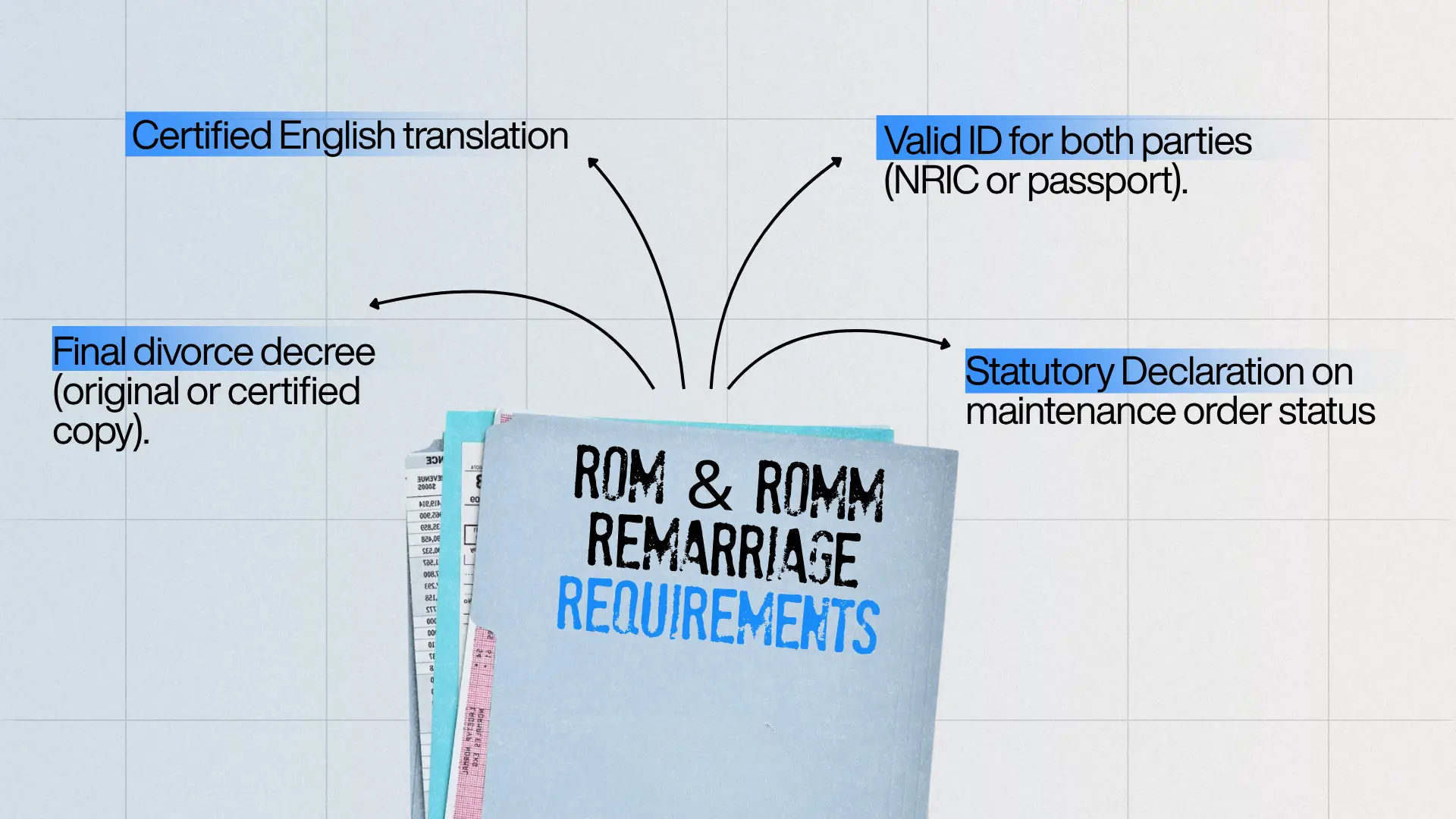
ROM's standard is different, and in one respect more relaxed. To file your Notice of Marriage with a previous marriage on record, you generally need:
- The original or a Certified True Copy of the final divorce decree, clearly showing the marriage was permanently dissolved.
- An English translation by a certified translator if the document is in a language other than English, Mandarin, Malay, or Tamil. Documents already in any of those four official languages do not need translation for ROM.
- Valid identification for both parties (NRIC for citizens and PRs, passport for foreigners).
- A Statutory Declaration confirming whether you have any existing maintenance orders and whether payments are current or in arrears. Divorcees who remarry are required to make this declaration.
ROMM applies the same logic for Muslim marriages, under Muslim marriage law. If either party holds a short-term visit pass, additional documents such as a Letter of No Impediment to Marriage from the relevant home-country authority may be required, and some documents may need to be authenticated by the home country's foreign ministry and the Singapore mission, or by that country's embassy in Singapore. When in doubt, confirm directly with ROM, since requirements vary by case and by the parties' residency status.
You can check current requirements on the Registry of Marriages website.
Do You Need an Apostille on Your Foreign Divorce Decree?
Usually not, if the document is for ICA or ROM use within Singapore.
An apostille authenticates a public document for use across borders. Singapore joined the Apostille Convention on 16 September 2021 , with SAL as the designated authority. But the Apostille Act was deliberately written so that agencies which never required legalisation cannot suddenly demand an apostille. For most PR and Citizenship submissions, ICA does not ask for an apostille on the foreign decree itself, because the document is being used domestically. What it checks is the notarisation and SAL authentication on your Singapore translation.
You may still need an apostille or consular legalisation on the foreign document in specific cases, for example if the issuing country requires it, if your document comes from a non-Apostille country and an authority asks for embassy legalisation, or in the rare instance ICA requests additional authentication. If you are unsure, it is worth confirming before paying for a step you may not need.
ROM vs ICA at a Glance
| Situation | Authority | Why the decree is needed |
|---|---|---|
| English translation needed? | Only if not in English, Mandarin, Malay, or Tamil | Yes, for any non-English document, regardless of language |
| Certified translation | Yes (certified translator) | Yes |
| Notarisation by SG Notary Public | Not generally required for the decree | Required |
| SAL authentication (Apostille) | Tied to notarisation if used | Required (issued with the notarisation) |
| Original or Certified True Copy | Required | Originals/clear scans; ICA may request originals |
| Apostille on the foreign decree | Generally no | Generally no (used within Singapore) |
Step-by-Step: Using a Foreign Divorce Decree to Remarry in Singapore
- Obtain the final decree. Get the original final divorce decree, or a Certified True Copy, from the issuing court or authority. Make sure it shows the marriage was permanently and finally dissolved.
- Get a certified English translation, if needed. If the decree is not in English, Mandarin, Malay, or Tamil, have it translated by a certified translator. The translation must be complete, covering every stamp, seal, and marginal note, not just the operative paragraph.
- Prepare supporting documents. Have ready: the decree and its translation, valid identification for both parties, proof that all previous marriages were dissolved, and your Statutory Declaration on maintenance.
- File your Notice of Marriage. Submit the Notice of Marriage to ROM (or ROMM for Muslim marriages) with your supporting documents.
- Allow time for verification. Because the decree was issued overseas, ROM/ROMM will verify its authenticity, and this takes longer than a standard domestic application. Do not book a venue or pay vendor deposits until ROM/ROMM has confirmed your eligibility to remarry.
Step-by-Step: Using a Foreign Divorce Decree for a Singapore PR Application
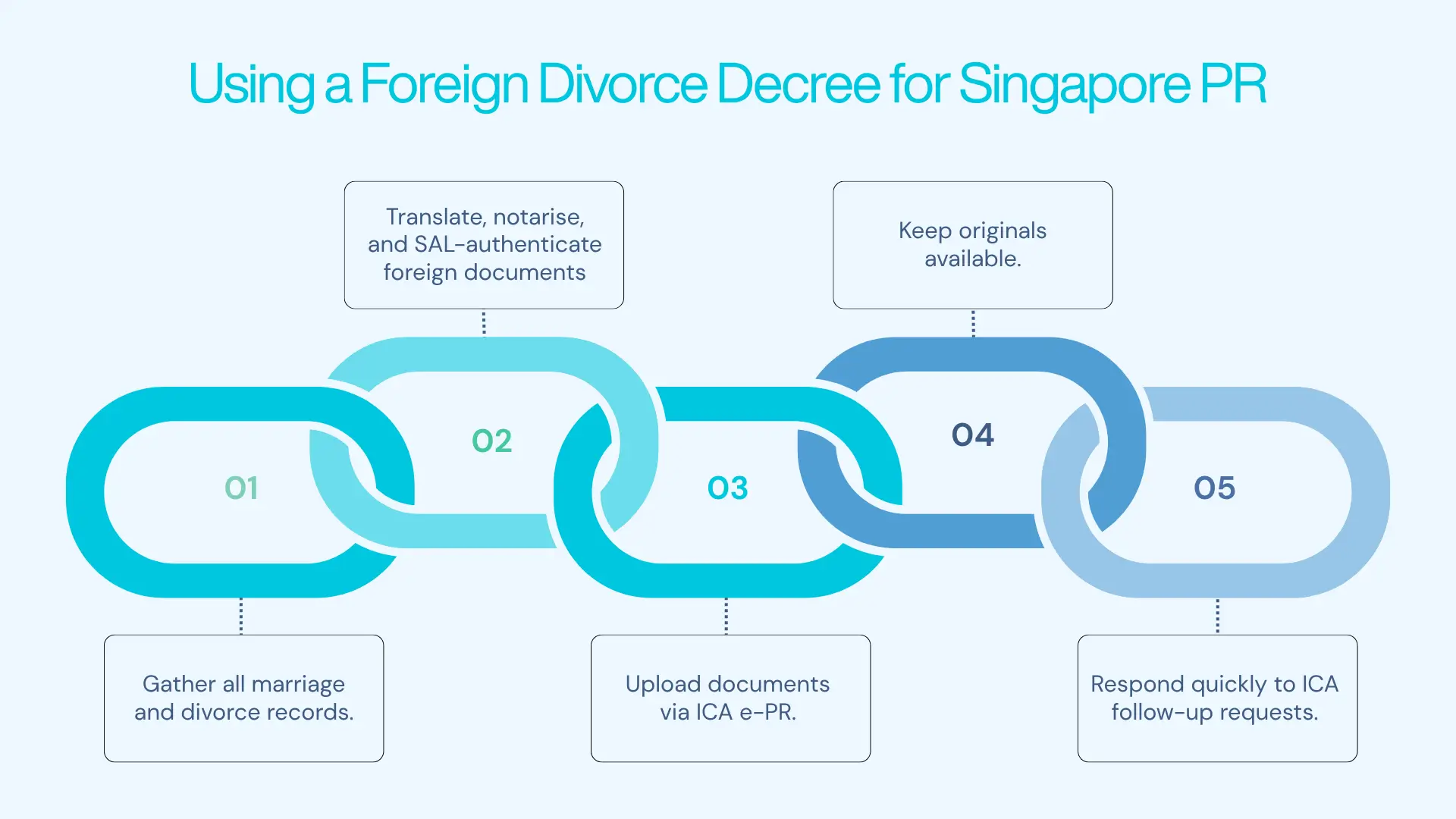
- Compile your full marital history. If you have married and divorced more than once, ICA wants documentation for every previous marriage and divorce, not only the most recent. The timeline must be complete and unbroken.
- Get each decree translated and notarised. Every foreign-language decree needs its own certified English translation, notarised by a Singapore Notary Public and authenticated by SAL.
- Submit through the e-PR e-Service. Log in to ICA's e-PR system with your Singpass and upload clear, high-resolution colour scans of the original documents and the notarised, SAL-authenticated translations.
- Keep originals on hand. Most applications are assessed online without an ICA visit, but ICA may request originals or further clarification in some cases. Keep the physical documents accessible.
- Anticipate follow-up requests. Because PR scrutiny is high, ICA may ask for supporting items such as the corresponding marriage certificates, court-certified copies, or additional authentication. Responding quickly keeps your application moving.
What it Costs and How Long it Takes
Plan for three cost components and two timelines.
Translation. Fees depend on the language, length, and complexity of the decree. A standard one-to-three-page decree is straightforward; a long judgment covering custody and asset division costs more and takes longer. Most standard divorce decree translations are completed within one to three working days.
Notarisation. Charged per document by the notary public's firm; longer documents and multiple decrees cost more.
SAL authentication. Around S$87.20 (including GST) per document as of 2026. This is a mandatory part of the notarisation chain for ICA, not an optional add-on. Confirm current rates with SAL.
ICA processing. The PR application fee is S$100 per applicant, with a further S$20 entry permit fee for successful applicants (S$120 in total). ICA aims to process applications within six months, provided all documents are submitted and in order. Incomplete or unverifiable documents can extend this or trigger a resubmission.
ROM verification. A foreign decree triggers authenticity checks that take noticeably longer than a standard domestic Notice of Marriage. Build in buffer time and avoid fixing a wedding date until ROM/ROMM has approved your paperwork.
Common Mistakes and What They Cost You
| Mistake | Consequence |
|---|---|
| Using machine or self-translation (e.g. Google Translate) | Rejected. No agency accepts unverified translations. |
| Submitting a certified translation to ICA without notarisation and SAL authentication | Rejected for PR/Citizenship. Certification alone is insufficient. |
| Paying for an apostille on the foreign decree when ICA did not require it | Wasted cost and time on an unnecessary step. |
| Translating only the final "divorced" page | Returned. ICA and ROM require the complete document, including annexures, schedules, custody and asset terms, and all stamps. |
| Omitting the Certificate of Accuracy or translator credentials | Treated as an uncertified, invalid translation. |
| Name or date mismatch between the decree and your passport | Triggers manual review and delays. You will need supporting evidence such as a Deed Poll or Change of Name certificate, with its own certified translation. |
| Submitting only the most recent decree when you have multiple divorces | ICA returns the application for a complete marital history. |
Quick Reference: Rejected Translation Action Summary
Singapore's authorities leave no margin for documentation errors, and the requirements differ from one agency to the next. Lettercrafts prepares certified divorce decree translations built to clear ROM, ROMM, and ICA on the first submission, and coordinates the full chain so your package is not missing a step.
- Singapore-specific accuracy. We translate to the standard each authority applies, including the ICA notarisation and SAL authentication pathway, so a correct translation does not get rejected on a technicality.
- Complete, mirror-formatted documents. Every stamp, seal, signature, and marginal note is translated, and the English layout mirrors the original so verification officers can cross-reference at a glance.
- The full chain, coordinated. Certified translation, notarisation by a Singapore Notary Public, and SAL authentication, arranged together rather than left for you to chase separately.
- Broad language coverage. Certified English translations from Mandarin, Malay, Tamil, Bahasa Indonesia, Tagalog, Burmese, Thai, Vietnamese, and major European languages, among others.
- Fast turnaround. Most standard divorce decree translations are ready within one to three working days, with express options for tight government deadlines.
- Strict confidentiality. Divorce decrees hold sensitive personal, financial, and family information, handled under strict data-privacy and non-disclosure practices.
For documents beyond the decree, our ICA translation and notarisation guide walks through the same notarisation pathway for another commonly required record.
Ready to Get Started
Whether you are remarrying through ROM or ROMM or submitting a PR or Citizenship application to ICA, a properly prepared divorce decree translation is what keeps your application moving.
Lettercrafts delivers accurate, complete, Singapore-compliant translations and coordinates the notarisation and SAL authentication ICA requires, so you can move forward without avoidable delays.