Key Takeaway
- You need a translation only when your original transcript is not in English. If your university issues transcripts in English, as many across India, the Philippines, Malaysia and Anglophone Africa do, you generally submit the original and translate nothing.
- "Certified" has a specific meaning: a translation carrying an attestation of accuracy from the translator or translation company, not a casual or machine translation. Uncertified or self-made translations are not accepted.
- Your grading scale matters as much as your grades. Every one of these universities wants the grading system visible; omitting it is one of the most common triggers for a follow-up request.
- Translation is not verification. At the application stage, you upload scanned copies. Sealed or institution-verified transcripts are typically required later, once an offer is in play.
- Notarisation is usually a separate step from translation. It is generally not the admissions baseline for these universities. However, it may apply to a specific programme, or if the same documents are also going to the Immigration & Checkpoints Authority (ICA) for a pass or PR.
- Requirements vary by faculty and programme, not just by university. Confirm on the exact programme page before you translate anything.
If your degree transcript is in Mandarin, Bahasa Indonesia, Korean, Vietnamese, Thai, Arabic, French or any language other than English, one question comes before everything else in your application: will Singapore's universities accept the document as-is, or do you need an English translation before the portal will take it?
The short answer is that all four autonomous universities the National University of Singapore (NUS), Nanyang Technological University (NTU), Singapore Management University (SMU) and the Singapore University of Technology and Design (SUTD) expect supporting documents to be in English, and each asks for an English translation when the original is not. What they do not share is a single, identical rule about who must produce that translation, how it must be certified, and how it must be laid out. Those differences are where applications stall, and they are the reason this guide exists.
Everything below is drawn from each university's own admissions pages, checked against the live versions. Academic document translation for Singapore institutions is part of LetterCrafts' day-to-day certified translation work, and the problems we repeatedly see are rarely about language ability. They are about certification format, module ordering and grading scales, so we'll be specific about all three.
When Do You Actually Need a Transcript Translation?
Start here, because a large share of applicants either spend on a translation they didn't need or skip one they did.
The trigger every Singapore university uses is the same: you need an English translation when the original document is issued in a language other than English. If your bachelor's transcript, degree scroll or (for some applicants) high-school records exist only in Chinese, Japanese, Korean, Thai, Vietnamese, Bahasa, Russian, Arabic, Spanish, French, German or similar, an accompanying English translation is expected.
You generally do not need a translation when:
- Your institution issues transcripts in English by default, or as a bilingual transcript with a full English column. Universities across India, Pakistan, Bangladesh, the Philippines, Malaysia and much of Anglophone Africa fall here.
- Your qualification is one Singapore admissions teams already assess in English, such as UK A-Levels, the IB Diploma, or an English-medium overseas degree.
The grey area worth flagging is the partly English transcript. Some universities in China, Indonesia and the Gulf print course titles in English but keep grades, remarks, the grading key, or official stamps in the local language. The safe reading is that the non-English elements still need translating, because an assessor has to read the whole document, seals and annotations included, not just the course names. When only a stamp or the grading legend is non-English, contact the specific admissions office before commissioning a full re-translation; asking first can save a page or two.
Certified, Official, Notarised: What the Words Mean in Singapore
These three terms get used interchangeably online. For a Singapore university application, the distinctions are practical.
Official transcript describes the source document, one issued directly by your university's registrar, usually bearing an institutional seal or delivered through a secure digital channel. This is about where the document came from, not what language it's in.
Certified translation is a translation accompanied by a signed, stamped statement attesting that it is a true and accurate rendering of the original. In Singapore, a registered translation company certifies its own work with a company stamp and an authorised signature, presented as a Certificate of Translation. This is the standard the universities point to when they require documents "accompanied by certified translations." A do-it-yourself translation, or raw machine-translation output, does not meet it.
Notarised (and SAL-authenticated) translation adds a further layer: a Notary Public verifies the signatory's identity and attaches a notarial certificate, which for use inside Singapore is then authenticated by the Singapore Academy of Law (SAL). This is the standard ICA applies to civil documents like birth and marriage certificates for immigration matters.
For university admissions, notarisation is usually not the baseline; a certified translation is, but it can become relevant if a specific programme asks for it, or if you also need the same academic documents for a Student Pass or PR application. Because many applicants prepare academic and immigration documents in the same window, decide upfront whether any of your documents are also heading to ICA, so the certification level is right the first time. Our certified translation service and notarisation for ICA submissions are handled as distinct steps for exactly this reason.
The core point: for these four universities, "certified" is the operative word, not "notarised". Don't over-buy notarisation you don't need for admissions, but do check whether your parallel immigration paperwork requires it.
What Each University Requires
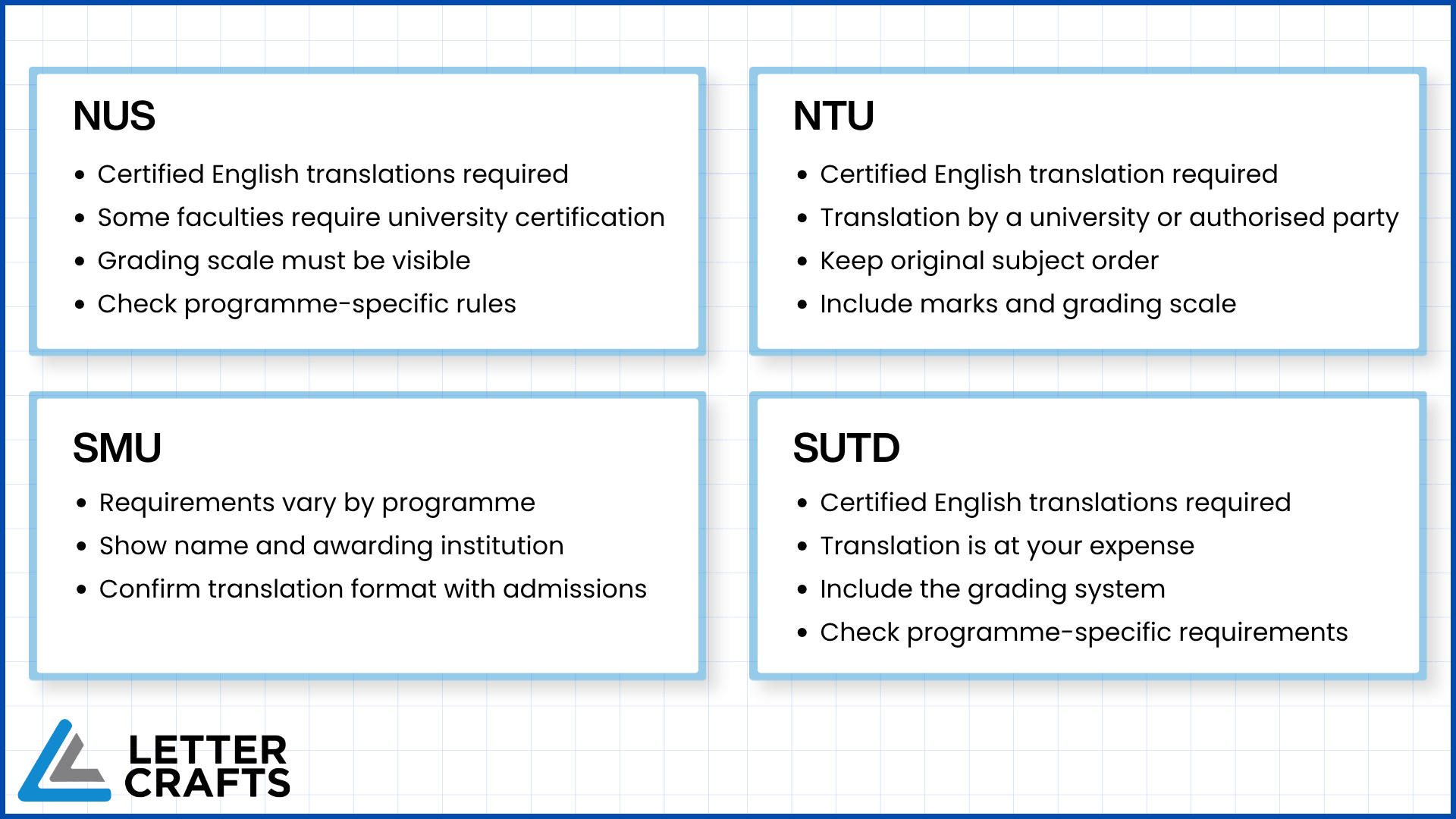
The requirements below come from each university's published admissions pages. Faculties and individual programmes can add their own conditions, so treat this as the current baseline and confirm on the specific page you're applying to.
National University of Singapore (NUS)
NUS's graduate coursework guidance states that all supporting documents should be in English or accompanied by an official English translation, and that translated copies must be certified true copies. For academic documents specifically, the Faculty of Arts and Social Sciences route adds a sharper condition: translated copies of the transcript(s) and degree scroll(s) must be certified by the issuing institution(s). In other words, this route points certification back to the university that awarded your qualification, rather than treating any certified translation as automatically sufficient.
That has a practical consequence. If your university can issue an official English transcript or certify a translation directly, that route aligns cleanly with what NUS asks. Where it can't, you'll need to establish that your translated document meets the "certified true copy" standard, and this is worth clarifying with the specific NUS faculty because certification wording is set at faculty and programme level, and not every NUS programme phrases it identically. Read the page for your programme rather than assuming the FASS wording applies everywhere.
At the application stage, NUS is explicit that transcripts and scrolls do not have to be certified or sent directly from your university, yet you upload clear scanned copies, and the grading scheme must be visible in what you upload. Certification and originals come later. NUS also states plainly that it has not engaged any external agencies to recruit graduate students, and reserves the right to reject applications routed through agents. Document translation is a preparation service, not agency representation; keep the two separate.
Nanyang Technological University (NTU)
NTU's coursework admissions guide asks for a copy of the official transcript showing detailed results from each university attended, including marks obtained in each subject, not just grades, wherever possible. Documents uploaded must be in English; otherwise they must be accompanied by certified translations in English.
Two NTU specifics set it apart from NUS. First, NTU explicitly states that translation can be done by the home university or any officially authorised party; it does not confine certification to the issuing institution the way the NUS FASS route does. Second, if the transcript is in another language, the English translation must list the subjects in the same order as the original, and you should label the transcript if needed so the two can be read side by side. That second point is a layout instruction, and it's easy to breach: a translator who reorganises modules for readability creates exactly the mismatch NTU is trying to prevent.
NTU also names the grading or marking scale as its own required sub-item, alongside the transcript and degree certificate. And for transcripts that don't show a GPA or CGPA, some NTU routes the National Institute of Education; for instance, ask for an official statement from the awarding university certifying the average score or GPA. A clean translation of a transcript that lacks a GPA can still leave a gap you have to fill separately.
Singapore Management University (SMU)
SMU is where the "all four are identical" assumption most clearly breaks down, and where reading the specific programme page matters most.
On SMU's undergraduate international-qualifications route, the document instructions emphasise that academic results, transcripts and certificates must clearly show the applicant's name and the name and logo of the awarding institution. This route does not foreground a standalone "certified translation" clause the way NUS and NTU do. That does not mean a non-English transcript can go in without an English version; it means the stated emphasis is on legibility, identity and provenance of what you upload. If your document isn't in English, provide an English translation and confirm the acceptable format with SMU's Office of Admissions.
On SMU's postgraduate routes, published requirements list copies of degree certificates and transcripts among the documents to submit, alongside TOEFL or IELTS for applicants whose medium of instruction was not English. Where your documents aren't in English, a certified English translation is the sensible standard, and the programme office is the authority on any additional conditions.
The takeaway for SMU: check the exact programme page, and when in doubt, ask admissions directly rather than assuming SMU mirrors NUS or NTU. It often doesn't.
Singapore University of Technology and Design (SUTD)
SUTD's admissions pages are the most direct of the four on cost. Uploaded documents must be in English; otherwise they must be accompanied by certified translations in the English language. And for non-English documents, SUTD states that an official English translation must be provided at your expense, wording that recurs across its programme admissions pages.
SUTD also asks applicants to include the grading policy or system for the transcript, and to provide an official letter of certification from the institution stating the expected graduation date if you haven't yet graduated. Master's-degree holders are asked for the master's certificate and official transcripts too. If your medium of undergraduate instruction was not English, IELTS or TOEFL scores are required within a stated window after the deadline.
Nothing here is exotic, but the combination of certified translation, at your expense, a grading system that tells you precisely what a complete SUTD submission looks like, and where applicants who assume the university will translate on their behalf go wrong.
University-by-University Comparison
A fast reference, not a substitute for the programme page you're applying to. All points are drawn from each university's published admissions guidance and reflect the routes cited above; other faculties may differ.
| NUS | NTU | SMU | SUTD | |
|---|---|---|---|---|
| Translation required if original isn't English | Yes | Yes | Yes (provide English version; confirm format) | Yes |
| Certification emphasis | Translated transcripts/scrolls must be certified true copies, certified by the issuing institution (FASS graduate route) | Certified translations; may be done by home university or any official authorised party | Emphasis on applicant name + awarding institution's name/logo; certified translation the sensible standard for non-English docs | Certified translations in English |
| Distinctive requirement | Certification tied to issuing institution | Translated subjects must follow the same order as the original | Undergraduate route stresses legibility, applicant name, institution logo | Translation explicitly at applicant's expense |
| Grading scale required | Yes upload with grading scheme visible | Yes named as its own sub-item | Show clearly on transcript | Yes include grading policy/system |
| Originals at application stage | Not yet scanned copies; originals later | Upload copies; may be asked for more later | Upload via portal | Upload copies; graduation proof as stated |
Where a cell says "confirm format," that's a genuine instruction, not a hedge: the published pages leave room for programme-level variation, and a two-line email before you translate is cheaper than a re-do after.
What to Translate and What Usually Comes With It
A transcript rarely travels alone. Depending on the university and programme, a non-English applicant may need English translations of:
- The academic transcript(s): from every tertiary institution attended, not only the degree-awarding one. Transfer credits and exchange semesters count.
- The degree scroll or certificate. NUS references degree scrolls alongside transcripts; SUTD asks for the degree certificate; master's holders are asked for the master's certificate and transcript too.
- The grading scale or grading key is sometimes printed on the transcript, sometimes issued separately. If it isn't in English, it needs translating, because the grades mean nothing to an assessor without it. NTU and SUTD both call this out explicitly.
- An official statement of GPA/CGPA or expected graduation date where your transcript carries no GPA (an NTU/NIE scenario) or where you haven't graduated yet (SUTD's letter of certification). These are institution-issued statements; if non-English, they're translated like any other document.
- Marksheets for systems (common across South Asia) that issue year- or semester-wise marksheets rather than one consolidated transcript, each relevant marksheet may need translating.
What you typically do not need translated: English-language test score reports (IELTS, TOEFL, GRE, GMAT), issued in English by the testing bodies; and your passport biodata page, which in most cases already carries English.
How to Prepare Your Transcript Correctly
Getting the sequence right avoids the two outcomes nobody wants: a rejected upload, or a document request weeks into assessment.
- Confirm whether you need a translation at all: If your institution issues English or bilingual transcripts, request the English version from your registrar and stop here.
- Read the specific programme page, not just the university's general admissions page. Note whether it repeats the university-wide translation clause or adds its own.
- Request official transcripts early, from every institution you attended. Registrars are the slow link, and you can't translate what you don't have.
- Translate the whole document, not just the grades: Course titles, remarks, the grading legend, seals, stamps and official annotations all need rendering; a transcript with an untranslated stamp is incomplete.
- Preserve the original order and layout: This matters everywhere and is a stated NTU requirement: modules in the translation should follow the original's sequence, so the two read side by side. A sound academic translation mirrors the source rather than "improving" it.
- Keep the grading scale visible and translated: If it lives on a separate sheet, translate that sheet too.
- Match the certification to the requirement: For these four universities, that means a certified translation. Add notarisation and SAL authentication only if a programme specifically asks, or if the same documents are also going to ICA.
- Check name consistency across every document: Your name should read identically on your passport, transcript, degree scroll and translation. Romanisation differences common for Chinese, Korean, Arabic and Thai names create verification friction later. Flag any known variant to your translator so it's handled consistently and, where appropriate, annotated.
LetterCrafts handles academic translations to mirror the source document's format, presented on our letterhead with a signed and stamped Certificate of Translation as the coversheet that admissions officers and credential checkers expect when they compare the translation against the original side by side. Our certified translation work covers transcripts, degree scrolls, marksheets and grading statements, including the Chinese and Malay source documents that make up the bulk of academic translation requests in Singapore. We are a Singapore-registered translation service (UEN: 201728634E) with over five years of certified document work for local applications.
Common Mistakes That Delay Applications
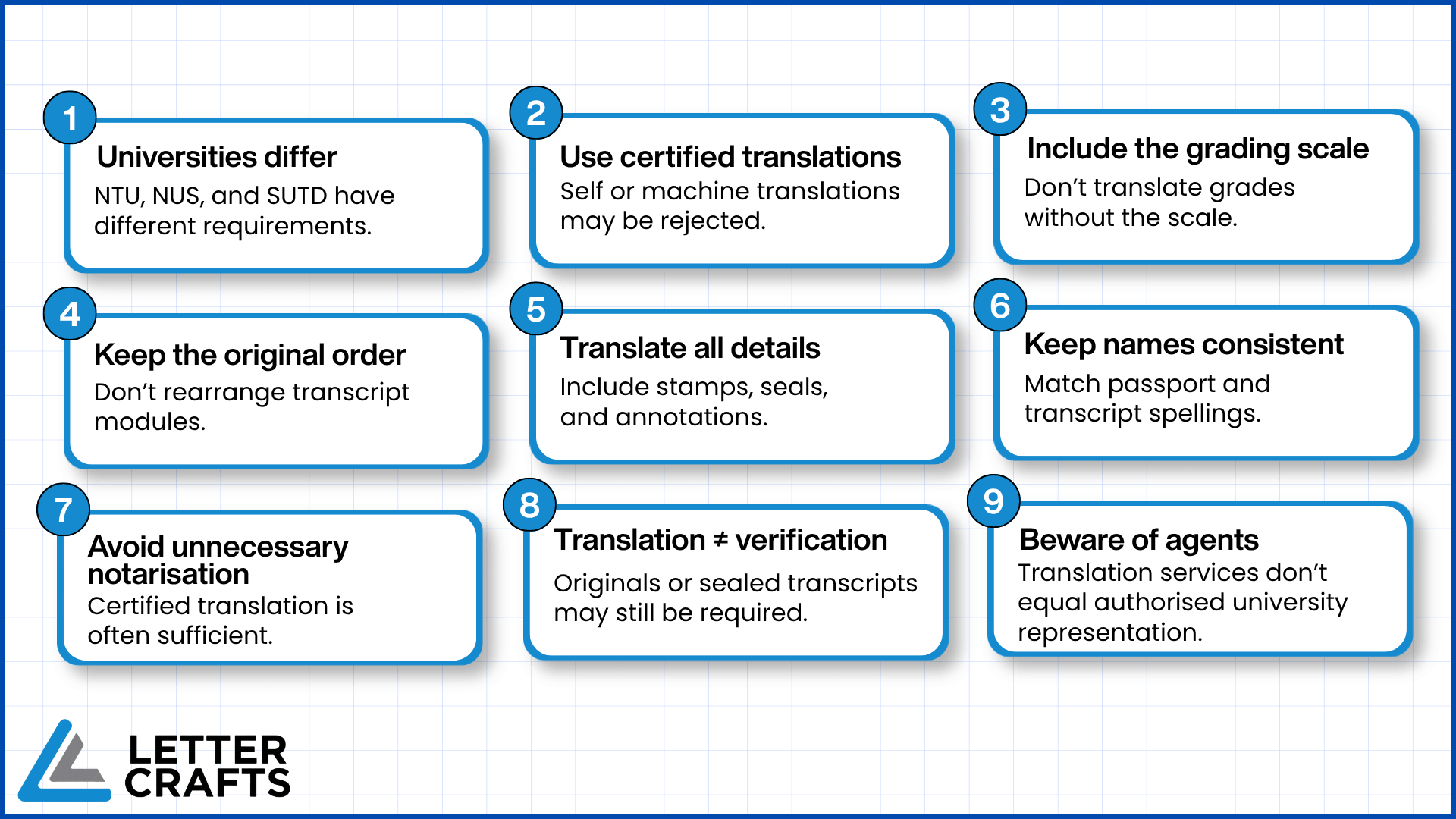
These are the recurring, avoidable problems the ones that turn a two-week task into a two-month one.
- Assuming all four universities are identical: They aren't. NTU's same-order rule and authorised-party allowance, NUS's issuing-institution certification, and SUTD's at-your-expense clause are genuinely different obligations.
- Submitting a self-translation or machine translation: Uncertified translations are not accepted. This is the single most common rejection cause.
- Translating grades but not the grading scale: An assessor can't interpret a 4.2 without knowing whether the scale tops out at 4.0, 5.0 or 10.0.
- Reordering modules for "readability". A reflowed transcript can breach NTU's same-order requirement and makes side-by-side checking harder everywhere.
- Leaving stamps, seals and annotations untranslated: These are part of the document's validity, not decoration.
- Name mismatches across documents: Inconsistent romanisation between passport and transcript triggers verification queries.
- Over-buying notarisation for admissions: Certified is usually the bar for these universities; paying for notarisation and SAL authentication you don't need wastes money and time unless the same documents are also bound for ICA.
- Confusing translation with verification: A certified translation makes your document readable and attested; it does not replace the sealed or original transcript most universities require once you're further along.
- Assuming an agency can submit on your behalf: NUS and NTU both state they are not represented by external agents. Document translation is a preparation service and is not the same thing; keep the distinction clear.
The Bottom Line
The instinct to treat "transcript translation" as one task with one rule is what trips applicants up. The four universities agree on the principle of English, or a certified English translation and part ways on the detail that actually gets your document accepted: who certifies it, whether the module order is preserved, whether the grading scale rides along, and who foots the bill. Getting those right for your programme is worth more than any amount of general advice.
So the sequence is simple. Check whether your institution already issues English transcripts. If it doesn't, read the exact programme page, request your official documents early, and have the full document grades, grading key, stamps and all translated and certified in a form that matches what that programme asks for. Do that, and the translation stops being a risk to your application and becomes the non-event it should be.
If your documents are in Chinese, Malay, Bahasa or another language and you'd rather not guess at the certification format, that's precisely the judgement a Singapore-based certified translation service is there to handle and where LetterCrafts can take the format question off your plate.