Quick Answer
For a non-English marriage certificate submitted to Singapore's Immigration & Checkpoints Authority (ICA), you need three layers: a certified English translation by an independent professional translator, notarisation by a Singapore Notary Public, and SAL authentication of the notarial certificate. Since 1 October 2019, SAL authentication is mandatory on every notarised document. Expect an all-in cost of about S$300-S$400 per certificate and a turnaround of 4-8 working days.
Key Takeaway
- A "certified translation" alone is not enough for ICA Permanent Residency, Citizenship, LTVP, or Dependant's Pass applications. You need certification, notarisation plus SAL authentication.
- The Singapore Academy of Law (SAL) authentication fee is S$87.20 (incl. GST) per notarial certificate as of 2026, payable through your Notary Public. It is not optional and not waived.
- You cannot translate your own marriage certificate, and your spouse cannot translate it either; both parties to the marriage are excluded from acting as translators.
- Every stamp, seal, watermark, and handwritten note on the original must appear in the translation (Singapore's "zero-omission" rule).
- If either spouse was previously married, the prior marriage certificate plus the divorce decree (or former spouse's death certificate) must also be translated, notarised, and SAL-authenticated.
- An apostille is for overseas use only. For domestic ICA submissions, SAL authentication is what you need, not an apostille on the foreign certificate.
- ROM (Registry of Marriages) issues Singapore marriage certificates in English, so no translation is needed for these; only foreign certificates require the full chain.
If you are submitting a foreign marriage certificate to the Immigration & Checkpoints Authority (ICA) for Permanent Residency, Citizenship, a Dependant's Pass, or a Long-Term Visit Pass, a casual translation will not get through. Singapore enforces one of the strictest document standards in Asia.
Most rejections we see do not come from inaccurate translation. They come from missing the second and third step in the chain: notarisation by a Singapore Notary Public and authentication by the Singapore Academy of Law (SAL).
This guide walks you through exactly what ICA requires, what an acceptable certificate of accuracy looks like, where applicants slip up, and when you will also need an apostille for use abroad. It builds on the broader process described in our complete ICA notarisation guide and the cross-agency certified translation checklist.
Who Needs to Translate Their Marriage Certificate in Singapore?
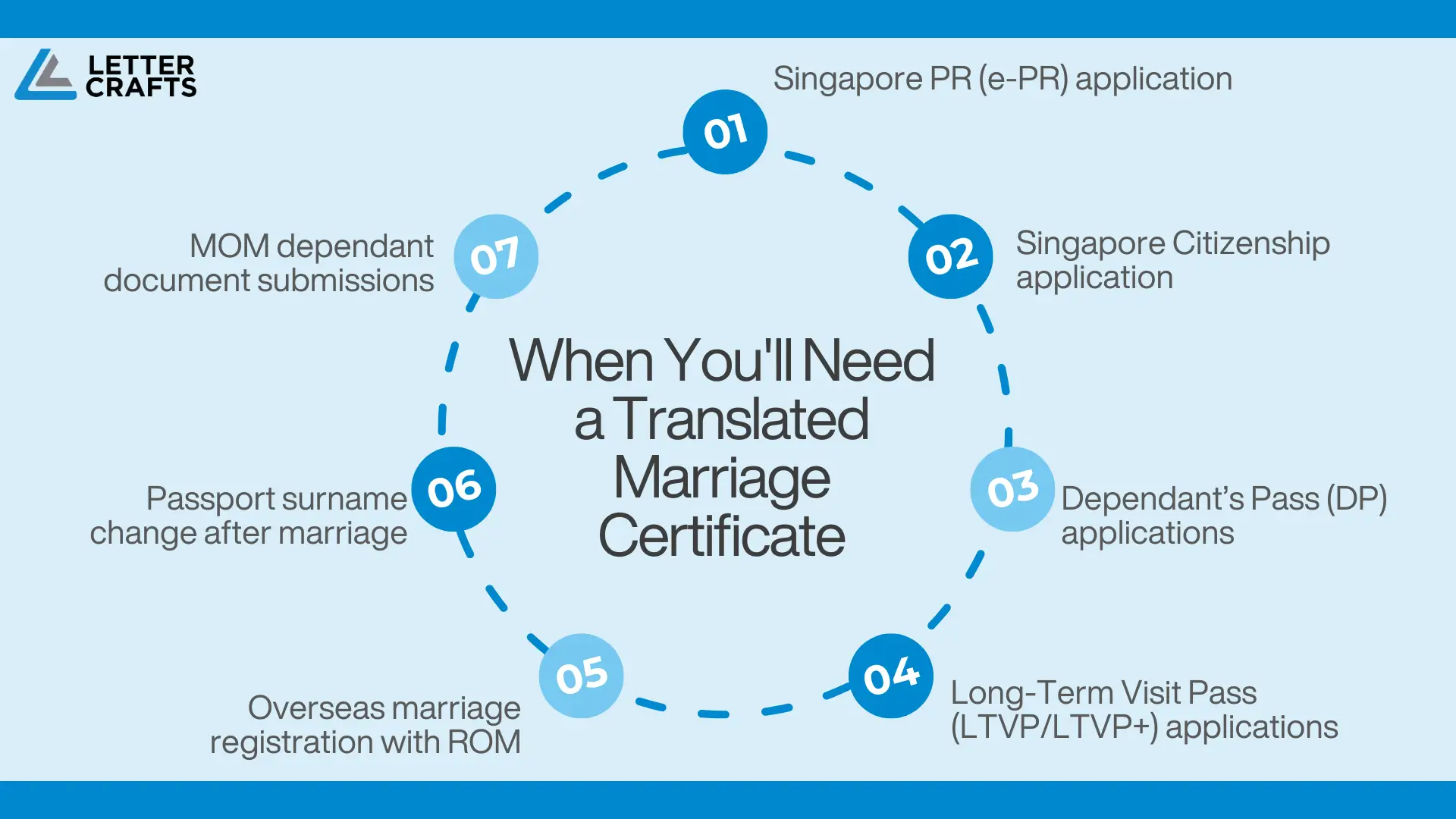
If your marriage certificate is in any language other than English, you will need a certified, notarised translation for almost every ICA-related process. The most common scenarios:
- Singapore Permanent Residency (PR) application via the e-PR portal
- TranslationsSingapore Citizenship Application
- Dependant's Pass (DP) for spouses of Employment Pass or S Pass holders
- Long-Term Visit Pass (LTVP / LTVP+) for foreign spouses of Singapore Citizens or PRs
- Registration of an overseas marriage with the ROM (Registry of Marriages) is voluntary, but is commonly done
- Passport surname change after marriage abroad
- Dependant documentation for MOM work pass applications
If your certificate is in Mandarin, Malay, Tamil, Indonesian Bahasa, Thai, Vietnamese, Tagalog, Korean, Japanese, Arabic, Hindi, or any non-English language, expect ICA to require translation.
Note for Singapore citizens marrying abroad: Under the Women's Charter 1961, re-registering an overseas marriage with ROM is voluntary, not a legal requirement. If you choose to register it, the foreign certificate must be translated and authenticated before ROM will accept it.
What ICA Actually Says About Translations
ICA's published Explanatory Notes for PR, Citizenship, and other applications are explicit. Documents not in English must be translated, and ICA accepts only three categories of "official translations"
- Translations provided by the embassy of the country/place that issued the document.
- Translations produced by a notary public in Singapore or in the country/place that issued the document.
- Privately created translations that are then either attested by the issuing country's embassy or notarised by a Singapore notary public.
ICA explicitly states that it "does not endorse any private translation companies or entities". What it accepts is the certification mechanism, not the brand. A translation, no matter how reputable the agency, is acceptable only when the right authentication chain is attached.
In practice, option (iii) is what most applicants use: engage a translation agency, then have a Singapore Notary Public certify the work, then have SAL authenticate the notarial certificate.
Under the Singapore Academy of Law (Amendment) Rules 2019 and the Notaries Public (Amendment) Rules 2019, all notarial certificates issued from 1 October 2019 must also carry SAL authentication. A notarial certificate that has not been authenticated by SAL is, by law, considered invalid.
Certified vs. Notarised vs. SAL-Authenticated: What's the Difference?
These three terms get confused constantly, often by agencies themselves. Here is what each one actually means in the Singapore context:
| Step | What It Confirms | Who Issues It | Required for ICA? |
|---|---|---|---|
| Certified translation | The translation is accurate and complete | Translation agency/translator | Yes (the base layer) |
| Notarisation | The translator is a genuine, qualified person who signed under oath in front of a Notary | Singapore Notary Public (a senior practising lawyer) | Yes |
| SAL authentication | The Notary's signature and capacity are genuine | Singapore Academy of Law | Yes, since 1 October 2019 |
| Apostille | International recognition under the Hague Convention | Singapore Academy of Law | Not only for overseas use in Hague countries |
For ICA PR and Citizenship, you need all three of the first rows. For use abroad in Hague Convention countries: replace SAL authentication with a SAL-issued apostille.
For a deeper side-by-side comparison of certified vs notarised translations across Singapore agencies, see our certified translation explainer and the complete ICA notarisation guide.
The Five Things Every ICA-Ready Marriage Translation Must Have
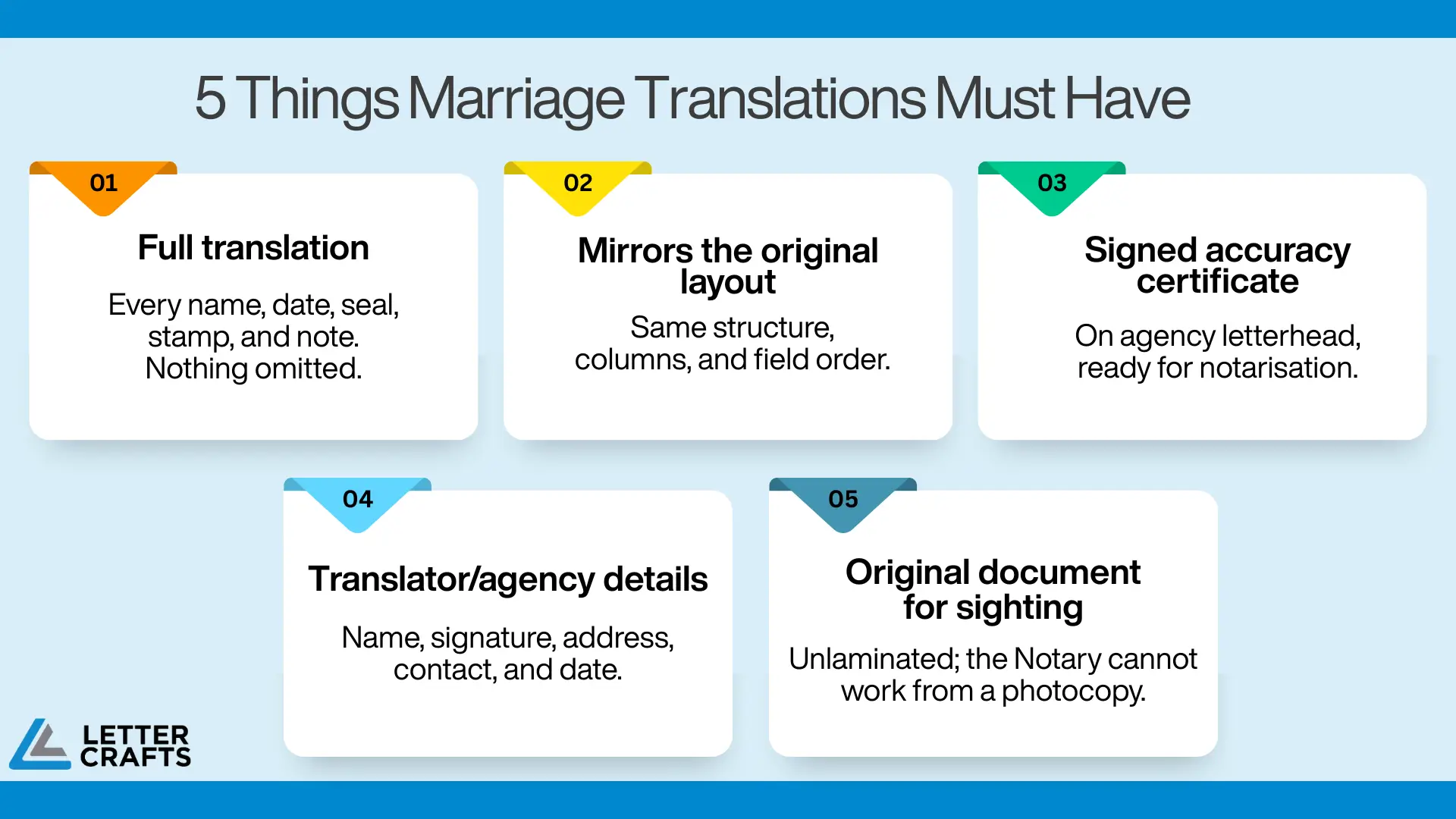
A translated marriage certificate is not "compliant" simply because someone converted the text. ICA officers compare your translation side-by-side with the original and look for the following:
1. A Complete, Word-for-Word Translation (Zero-Omission Rule)
Every visible element on the original document must appear in the translation. No exceptions. This includes:
- Full legal names of both spouses (matching passport spellings)
- Date and place of marriage
- Names of witnesses and the officiant or registrar
- Marriage registration number and registry volume
- Issuing authority and jurisdiction
- All stamps, seals, ribbons, and embossed marks translated or described in brackets, e.g., [Red circular seal: Ministry of Justice, Republic of the Philippines]
- Handwritten annotations and marginal notes
- The reverse side of the certificate, if it carries any text
We have seen ICA query Vietnamese certificates over a faded district committee seal that the translator skipped. Don't take that risk.
2. A Layout That Mirrors the Original
The translation should be visually parallel to the source document. ICA officers cross-check both, so headers, sections, and field order should match. Tables stay tables. Two-column layouts stay two-column.
3. A Signed Certificate of Translation Accuracy
The translation agency attaches a signed statement on its letterhead confirming the translator's competence and the translation's completeness. This is what gets notarised in the next step.
4. Full Translator and Agency Details
The certificate must carry the translator's name, signature, agency name, address, contact details, and date. The Notary will check that this matches their records before sealing.
5. The Original Certificate Available for Sighting
The Notary Public must physically sight the original certificate before notarising. ICA's e-PR portal accepts high-resolution PDF scans, but the notarial step cannot be done from a photocopy alone. Make sure your original is unlaminated; lamination obscures watermarks and is grounds for refusal at the notary's office.
Sample Certificate of Translation Accuracy (Singapore Format)
Below is a working template aligned with the language Singapore Notaries typically accept. The exact phrasing varies by agency, but every element below should be present.
CERTIFICATE OF TRANSLATION ACCURACY
I, [Translator's Full Name], of [Translation Agency Name], do hereby certify that I am fully conversant in both the [Source Language] and English languages, and that the attached English translation of the [Document Name e.g., Marriage Certificate] issued by [Issuing Authority, Country] on [Date of Issue] is, to the best of my knowledge and ability, a true, complete, and accurate translation of the original document.
Translator's Full Name: ___________________________
Signature: ___________________________
Agency Name & Address: ___________________________
Date: ___________________________
Contact Email / Phone: ___________________________
[Agency stamp]
Important: Each document needs its own certificate of accuracy. A single blanket certification covering multiple documents will be rejected by both the Notary and ICA. The Board of Commissioners for Oaths and Notaries Public allows limited bundling for certified true copies of the same document, but not for translations of different source documents.
Who Is Allowed to Translate a Marriage Certificate for ICA?
This catches many people out. The rules in Singapore are tighter than in most countries:
- You cannot translate your own marriage certificate, even if you are bilingual.
- Your spouse cannot translate it unless they are a party to the document.
- The translator must be an independent third party, typically a translation agency that handles Singapore immigration work routinely.
- The translation must then pass through a Singapore Notary Public, who, under the Notaries Public Act, must sight the original document before notarising.
There is no government register of "ICA-approved translators." What ICA actually requires is the chain: independent translator → Notary Public → SAL authentication. For a fuller breakdown of how to evaluate a translation provider, see our guide to choosing the right document translation service.
SAL Authentication: The Step Most Applicants Miss
Since 1 October 2019, every notarial certificate produced in Singapore must be authenticated by the Singapore Academy of Law before it carries legal weight for ICA submissions. The rule comes from the Singapore Academy of Law (Amendment) Rules 2019 and the Notaries Public (Amendment) Rules 2019, and was introduced to stop fraudulent notarial seals.
By law, a Notarial Certificate that has not been authenticated by SAL is considered invalid (Rule 8(3)(c) of the Notaries Public Rules).
The current SAL authentication facts:
- Where: SAL counter, 1 Coleman Street, #08-06 The Adelphi, Singapore 179803
- Hours: Monday–Friday, 9:00 am to 4:30 pm (closed weekends and public holidays)
- Fee: S$87.20 (incl. GST) per notarial certificate payable to SAL through your Notary Public. The Notary will only issue the Notarial Certificate after this fee is paid.
- Turnaround: Typically same-day at the counter. Online submissions via SAL's e-Legalisation portal take 2-3 business days.
- Proxy attendance: A representative may collect on your behalf; no authorisation letter is required.
Since 16 September 2021, a Notarial Certificate is also deemed to be validly authenticated by the affixing of an Apostille to the back of the certificate. In practice, this matters only if your document is also going overseas for purely domestic ICA use; the standard SAL Authentication Certificate is what you need.
Most ICA-experienced translation agencies run translation, notarisation, and SAL authentication as a single workflow within 4 to 8 working days.
When You Need an Apostille (For Overseas Use, Not ICA)
Singapore acceded to the Hague Apostille Convention on 18 January 2021, and the Convention entered into force for Singapore on 16 September 2021. The Singapore Academy of Law is the designated Competent Authority for issuing apostilles, under the Apostille Act 2020.
You will need an apostille on your Singapore marriage certificate (not the foreign one going to ICA) when:
- Registering your Singapore marriage in another Hague Convention country
- Applying for a spouse visa or residency in countries like Spain, France, Germany, Italy, the United States, or Australia
- Establishing marital status for foreign property, employment, or inheritance matters
The process for a Singapore-issued public document (such as a ROM marriage certificate):
- Obtain a certified true copy of the ROM marriage certificate (or the digital certified extract from ROM).
- If the foreign country also requires translation, have it translated and notarised first.
- Submit to SAL for the apostille certificate submission can be made online through SAL's e-Legalisation portal.
- Collect, or have your representative collect, the apostilled document.
For non-Hague Convention countries (such as China, the UAE, or Vietnam in certain contexts), you will still need full consular legalisation: SAL authentication → Ministry of Foreign Affairs (MFA) → the destination country's embassy in Singapore.
Don't Forget Prior Marriages
This is the single most overlooked requirement in marriage-based ICA cases.
If either spouse has been previously married, even decades ago, even in another country, ICA needs to see that the prior marriage was legally terminated. That means the prior marriage certificate AND the divorce decree (or death certificate of the former spouse) must also be translated, notarised, and SAL-authenticated.
We routinely see applications stall because an applicant assumed a 30-year-old divorce in another country was "too old to matter." It isn't. ICA's standard is documentary, not chronological.
For applicants whose names changed across these documents (maiden name on one certificate, married name on another), you will also need a name-bridging document, usually a deed poll or a notarised letter of explanation. The certified translation checklist goes deeper into how to handle these bridging documents.
Seven Mistakes That Get Marriage Translations Rejected by ICA
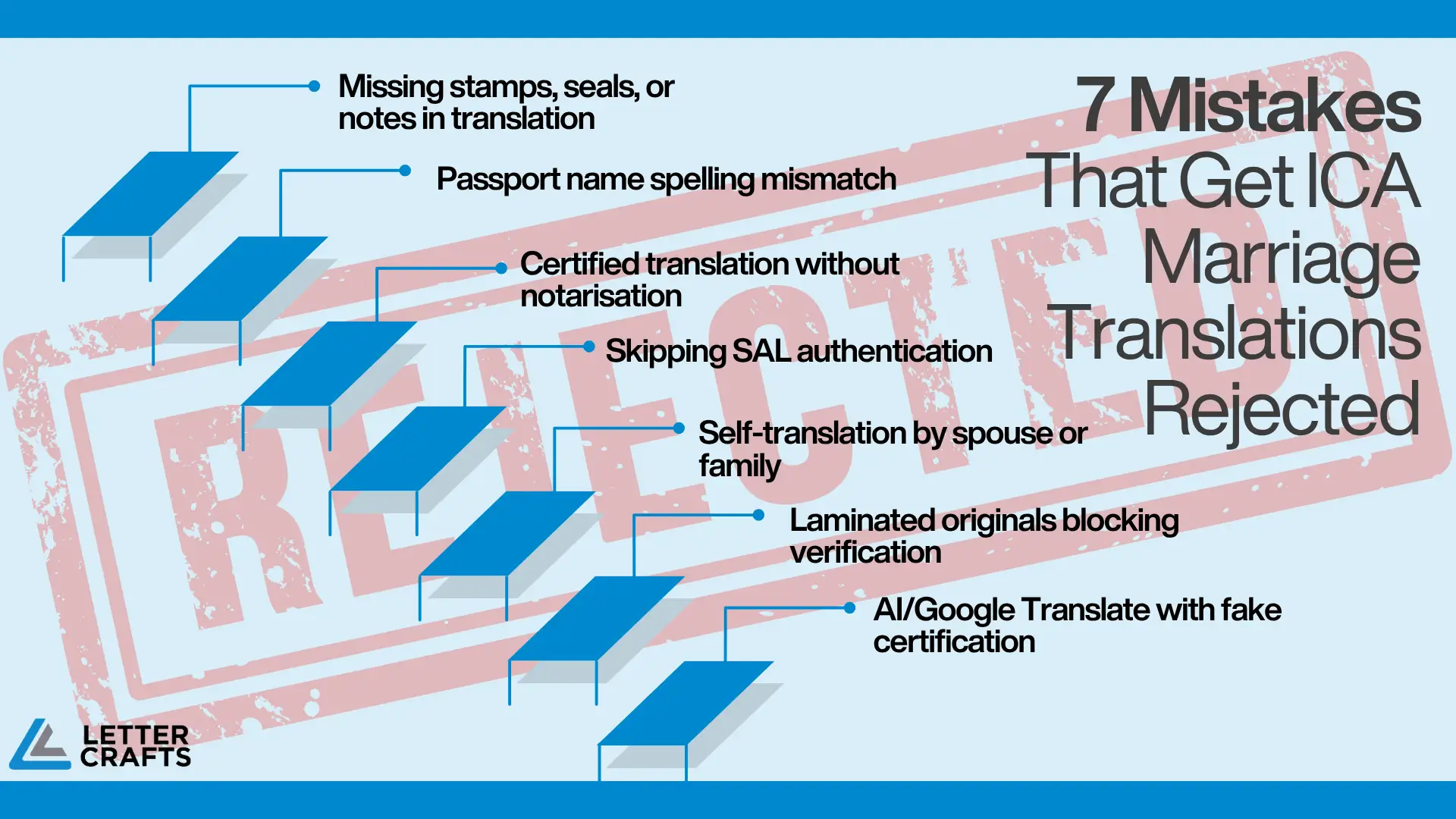
Knowing what to avoid matters as much as knowing what to do. These are the seven causes of translation-related ICA rejections we see most often:
- Partial translation. Missing a stamp, seal, or marginal note triggers a request for resubmission. Singapore's zero-omission policy is unforgiving.
- Name spelling mismatches. The translated name must match the passport spelling exactly. If your passport says "MUHAMMAD" but the translation reads "Muhamad," you will be asked to fix it.
- Submitting only a certified translation, no notarisation. This works for MOM and schools. It does not work for ICA PR or Citizenship.
- Skipping SAL authentication. Common when applicants engage a Notary directly without involving an ICA-experienced agency.
- Self-translation by a bilingual spouse. Automatically rejected.
- Laminating original documents. SAL and Notaries require originals to verify watermarks and security features. Laminated certificates cannot be authenticated.
- Machine translation dressed up with a human signature. ICA officers are good at spotting Google Translate output with a stamp on top. We cover why AI alone still does not meet certified-translation standards in our analysis of whether AI can replace certified translation in Singapore .
For a deeper analysis of how to head these issues off before submission, our TEP (Translate-Edit-Proofread) workflow guide walks through the multi-pass review process we use to catch these issues internally.
Marriage Certificate Information Typically Translated
Marriage certificates vary widely by country. A Chinese 结婚证 (jiéhūnzhèng) looks nothing like a Filipino PSA certificate, which looks nothing like a Vietnamese giấy chứng nhận kết hôn. Whatever the format, expect the translator to capture:
- Full legal names of both spouses (with passport romanisation noted if applicable)
- Dates and places of birth
- Parents' names (common in Asian certificates)
- Date and place of the marriage ceremony
- Names of witnesses
- Officiant's name and title (civil registrar, judge, religious authority)
- Registry book number, volume, and entry number
- Issuing authority and date of issuance
- Signatures of officials and parties
- Every seal, stamp, watermark, or embossed mark (described or translated)
The more administrative annotations the original carries, the more critical it is to work with a translator experienced in that specific country's vital records.
Cost & Timeline: What to Budget in 2026
Market rates in Singapore (as of 2026) for a marriage certificate going to ICA:
| Line item | Typical 2026 cost |
|---|---|
| Certified translation (per page) | S$30 - S$80 |
| Notarial certificate fee (regulated, First Schedule of Notaries Public Rules) | S$75 |
| SAL authentication fee per notarial certificate (incl. GST) | S$87.20 |
| Witnessing the translator's first signature | S$40 |
| Express courier of the notarised hard copy | ~S$25 |
| All-in for a typical single-page marriage certificate | S$300 - S$400 |
For a more detailed breakdown of how translation pricing in Singapore works, see our transparent pricing guide
Standard timeline:
- Translation: 1-3 working days
- Notary appointment: 1-2 working days (often booked a week ahead)
- SAL authentication: same day at the counter or 2-3 days online
- End-to-end: 4-8 working days, with 24-hour express options for genuinely urgent cases
If your ICA submission includes the marriage certificate, prior divorce decrees, plus birth certificates for children, plus a household register, budget closer to two weeks, and handle them as a single batch, that is how you catch name inconsistencies before ICA does.
Marriage Certificate Translation Requirements at a Glance
| Requirement | ICA (PR, Citizenship, LTVP, DP) | MOM (DP/EP families) | ROM | Embassies (overseas use) |
|---|---|---|---|---|
| Certified translation | ✅ Yes | ✅ Yes | ✅ Yes | ✅ Yes |
| Notarisation | ✅ Yes (mandatory) | Often | Sometimes | Often |
| SAL authentication | ✅ Yes (since 1 Oct 2019) | Sometimes | Sometimes | Often |
| Apostille | ❌ No (domestic use) | ❌ No | ❌ No | ✅ Yes (Hague countries) |
| Consular legalisation | ❌ No | ❌ No | ❌ No | ✅ Yes (non-Hague) |
| Self-translation accepted | ❌ No | ❌ No | ❌ No | ❌ No |
| Prior marriage documents required | ✅ Yes | Sometimes | ✅ Yes | Varies |
How LetterCrafts Handles Marriage Certificate Translations for ICA
LetterCrafts is a Singapore-registered translation service (UEN: 201728634E) with over five years of experience handling personal document translations specifically for ICA, MOM, MOE, and other government agencies. Our certified translations are accepted by ICA and come with a signed, stamped Certificate of Accuracy as standard. (Translation services for legal documents follow the same workflow. See our legal translation buyer's guide for the broader picture.)
What we handle end-to-end:
- Certified translation of marriage certificates across 80+ languages, starting from S$38 per page with no additional GST
- Notarisation and SAL authentication of the complete chain ICA actually requires for PR, Citizenship, LTVP, and Dependant's Pass applications, not just the translation
- Delivery by email, free SingPost, courier, or self-collection from the notary's office at The Adelphi
- Urgent turnaround available: translations completed in as little as 24 hours, with notarisation and SAL authentication typically within three working days
- No physical originals are needed to start a clear scan, or a photograph is sufficient for the translation phase. The original is only needed at the Notary stage, and our runner service can handle that for you.
A few things worth knowing:
You don't need to bring your original marriage certificate to start. Send a scanned copy or clear photograph by email, and the translation begins immediately. If your ICA deadline is tight, we accommodate urgent requests, but aligning requirements in advance gives us the best chance of meeting your timeline, particularly when prior marriage documents (divorce decrees or death certificates of former spouses) also need to be translated alongside.
All translators are bound by Non-Disclosure Agreements and governed by Singapore's Personal Data Protection Act. Documents are not retained for more than three months, and immediate deletion is available on request for relevant points for marriage records, which carry sensitive personal information about both spouses.
If a translation needs corrections, we revise it. If the issue can't be resolved, we offer a full or partial refund depending on the work already delivered, a policy that reflects confidence in our output, rather than fine print designed to avoid accountability.
For marriage-based applications where multiple documents need to be processed together, your marriage certificate, prior divorce decrees if applicable, birth certificates for any children, and family registers handling them as a single set rather than piecemeal, is what catches name inconsistencies between documents before ICA does. A spouse whose maiden name appears on one certificate and married name on another is a common source of RFEs that a coordinated submission prevents.
Conclusion
A marriage certificate translation for ICA isn't a one-step task; it is a three-step chain: certify, notarise, authenticate. Skip any link, and your application either stalls for weeks or gets returned. The fix is straightforward: work with a translation agency that handles ICA submissions as routine business, knows the SAL workflow, and delivers a complete, ready-to-upload package.
If you're partway through preparing your PR, Citizenship, LTVP, or Dependant's Pass submission and want a second pair of eyes on your marriage certificate before you upload, send us a clear scan. We'll come back with the exact languages involved, what the bundle will look like, and what it will cost. No commitment, no follow-up sales calls.
You can also browse our deeper guides on the complete ICA notarisation process and the certified translation checklist for Singapore submissions if you'd rather work through the process yourself.