Key Takeaway
- All non-English academic transcripts must be translated for ICA Dependant Pass applications no exceptions, regardless of how official the original looks.
- Partial translations are rejected. Every section grades, headers, footnotes, and grading scales must be fully translated, not summarised.
- Dependant Pass needs certified translation; PR/Citizenship needs notarisation too. Knowing which level applies prevents costly resubmission.
- Always submit the original alongside the translation. ICA cross-references both documents during review.
- Typical turnaround is 2–5 business days. Factor this into your application timeline; don't leave it last.
- Translation errors delay applications by weeks, not days. Getting it right once costs less than resubmitting.
- Brief your translator on the end use. ICA submissions have different standards than academic or personal translations.
When a family relocates to Singapore on the back of an Employment Pass or S Pass, the excitement of a new chapter often collides quickly with a very practical reality: paperwork. Specifically, the kind of paperwork that arrives in Mandarin, Hindi, Arabic, Korean, or any one of dozens of other languages and must somehow satisfy the exacting standards of Singapore's Immigration and Checkpoints Authority (ICA).
Academic transcripts are among the most commonly mishandled documents in the Dependant Pass application process. Families assume that because their spouse or child's credentials are obvious, the translation is a formality. It rarely is. A poorly translated transcript missing grades, carrying informal terminology, or lacking proper certification can push your application timeline back by weeks.
This guide explains what ICA actually expects when it comes to academic document translation, when you need it, how to get it done correctly, and what to avoid. If you're navigating a Dependant Pass application and your household includes academic records in a non-English language, you'll want to read this carefully.
What Is Academic Transcript Translation?
Quick Definition: Academic transcript translation for ICA applications is the process of converting an official educational record, including grades, subjects, institutional details, and academic standing, from its original language into English, in a format that meets Singapore's immigration documentation standards. The translation must accurately reflect every element of the source document and be produced by a qualified, certified translator.
An academic transcript is not the same as a certificate or diploma. A certificate confirms that a qualification was awarded. A transcript is the detailed record behind that qualification: the subjects studied, the marks achieved, the academic terms completed, the institution's grading scale. Both may be required for a Dependant Pass application depending on the circumstances, but transcripts tend to be the more complex translation task because of their technical and institution-specific terminology.
Why does accuracy matter so much? Because ICA uses these documents to verify the educational background of dependants, particularly when assessing whether children will be enrolling in Singapore's school system or when a spouse's prior qualifications are relevant to the application review. A translation that omits a grade column, mistranslates a subject name, or doesn't reflect the institution's grading nomenclature correctly can create discrepancies that flag an application for closer review or outright rejection.
When Does ICA Require Academic Transcript Translation?
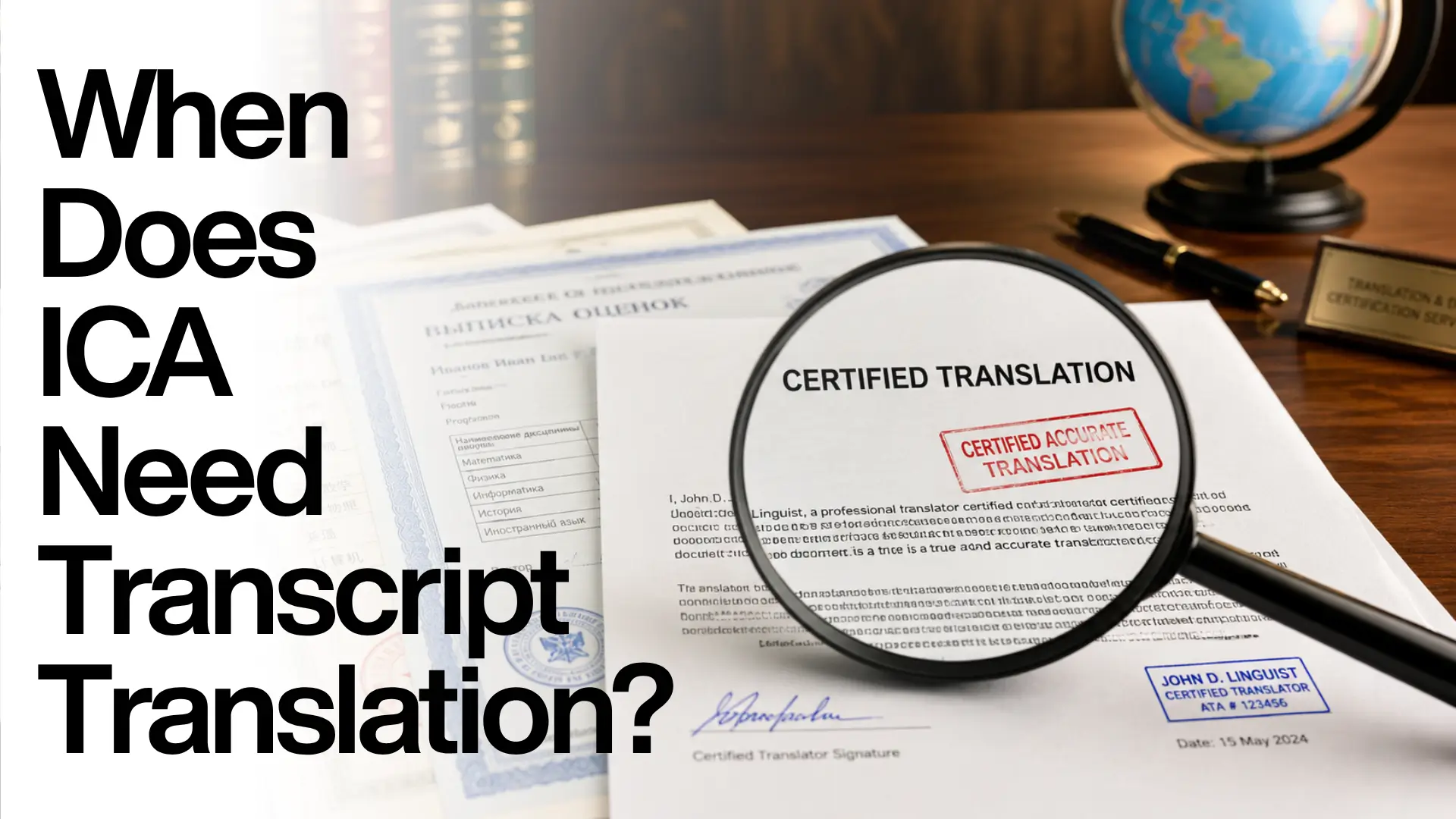
ICA does not publish an exhaustive list of every scenario in which an academic transcript must be translated. What ICA does require is that all supporting documents submitted in a language other than English must be accompanied by an accurate English translation.
In practical terms, this means:
- For dependent children: If you're including school or university records to support your child's application, for example, to facilitate enrollment in a Singapore school, those records will need to be translated if they are not already in English.
- For dependent spouses: In certain application reviews, ICA may request or consider the educational qualifications of the dependent spouse. Any academic records submitted must be in English or accompanied by certified translations.
- During document verification: Singapore's document verification process involves cross-referencing submitted records. If a translated document doesn't align clearly with the original, it triggers further scrutiny.
- When applying for school placement: The Ministry of Education (MOE) and individual schools may additionally require translated academic records when assessing which year level a child should enter. This is separate from the ICA application itself, but families often need translated transcripts for both purposes simultaneously.
The safest approach: if a document is in a language other than English and it forms part of your Dependant Pass application, have it professionally translated. Do not assume an official-looking document in a foreign language will be accepted as-is.
New to ICA document requirements altogether? Our Complete ICA Translation & Notarisation Guide 2026 covers the full spectrum from certified translations to notarisation and SAL Apostille and is worth reading alongside this article.
Why Certified Translation Matters for ICA Applications
There is a meaningful difference between a translation and a certified translation. A bilingual friend or colleague can produce a translation. A certified translation comes with a formal declaration, typically a signed statement from the translator confirming their competence in both languages and the accuracy of the translation that makes it suitable for official submission.
ICA expects certified translations for immigration-related documents. Submitting an uncertified translation is one of the most common causes of document rejection and application delays.
Here's why certification matters in practice:
Accountability: A certified translation carries the name, credentials, and signature of the translator. If there's ever a dispute about accuracy, there's a responsible party on record. An anonymous translation from an online tool has no such accountability.
Accuracy standards: Certified translators work to professional standards. They translate complete documents, not just the parts that seem relevant, and they preserve the formatting and structure of the original where necessary.
Institutional recognition: Certifying bodies, embassies, law firms, and government agencies, including ICA, have a baseline expectation for how translations should be presented. A certified translation from a professional service meets that expectation. A Google Translate printout does not.
Risk reduction: An application based on certified translations is far less likely to be questioned on documentation grounds. Given that Dependant Pass applications involve processing fees, waiting periods, and significant logistical planning, the cost of getting translation right the first time is almost always less than the cost of a delay or resubmission.
Practical example: A family relocating from South Korea submits the children's school transcripts in Korean. The transcripts are translated by a bilingual relative who happens to work in education. The translation looks professional and is largely accurate, but the grading scale is described using informal terminology that doesn't map to standard Korean educational nomenclature, and one subject is translated using its colloquial name rather than its official title.
ICA flags the discrepancy during review. The family must obtain a properly certified translation, resubmit, and wait an additional processing cycle. This scenario plays out regularly and is almost entirely avoidable.
Important distinction: For Dependant Pass applications, certified translation is the standard requirement. However, if your academic documents are also being used in a PR or Citizenship application or for legal proceedings, notarization and SAL authentication may additionally be required. Our Complete ICA Translation & Notarisation Guide explains the difference between certified, notarised, and apostilled documents in full detail.
Common Transcript Translation Mistakes That Delay Applications
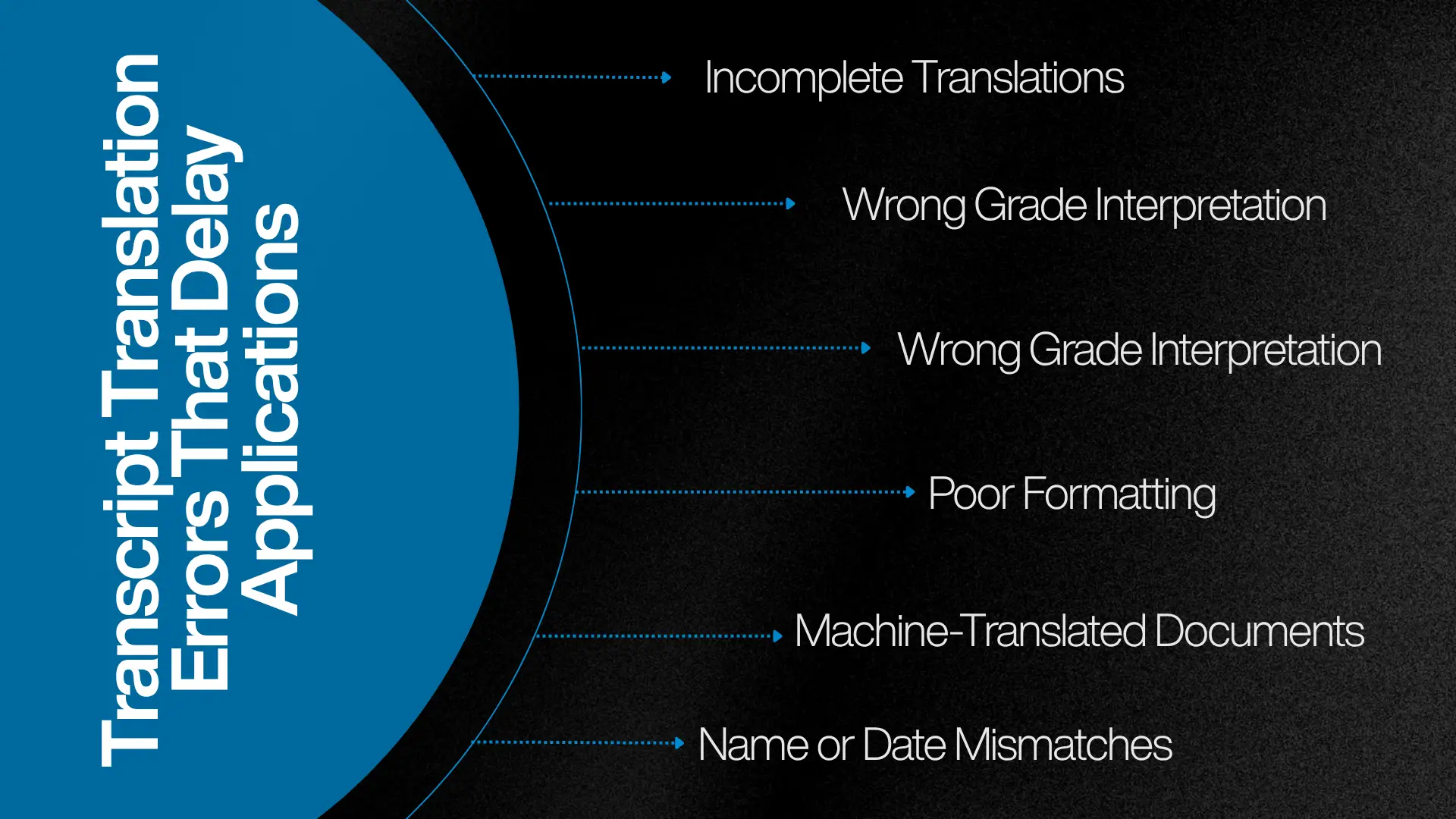
If you've gathered accounts from families who've experienced document-related delays in their Dependant Pass applications, certain patterns emerge. These are the translation errors most likely to create problems:
1. Incomplete Translations
Some translators translate only the "important" parts of a transcript the subjects and grades and omit institutional details, dates, headers, footnotes, and grading scale explanations. ICA requires the complete document to be translated. Partial translations are typically rejected.
2. Missing or Misrepresented Grade Information
Grading systems vary significantly by country. Some use percentages, some use letter grades, some use numerical scales that run in reverse of what Western systems use (where higher is better). A translator who doesn't understand the source country's grading conventions may transcribe grades literally without providing the contextual explanation that makes them interpretable. This creates confusion at the review stage.
3. Incorrect Subject Terminology
Academic subjects have official names in every educational system, and those names don't always translate literally. A subject that is officially titled something that translates as "Natural Science Fundamentals" might be rendered informally as "Basic Science" by a casual translator. The discrepancy, however minor it seems, can raise questions about document authenticity.
4. Formatting That Doesn't Reflect the Original
A certified translation should, where possible, mirror the layout of the source document. If a transcript has two columns, a translation that reorganises this into a paragraph format may look different enough from the original to raise questions during cross-referencing.
5. Uncertified Translations
Translations that lack a certification statement identifying the translator, confirming their competence, and attesting to the accuracy of the translation are not suitable for ICA submission. This applies even when the translation itself is technically accurate.
6. Translations Produced by Machine
Tools like Google Translate or DeepL can be useful for personal understanding but are not appropriate for official document submission. They cannot be certified, they handle specialist terminology poorly, and they produce no accountability trail.
7. Name and Date Inconsistencies
Transliteration of names from non-Latin scripts (Arabic, Chinese, Devanagari, Cyrillic) can produce multiple plausible romanised versions. If the name on the translated transcript doesn't match the name on the passport exactly, it creates an identity verification issue that must be resolved before the application can proceed
Step-by-Step Guide to Getting Your Academic Transcript Translated for an ICA Dependant Pass Application
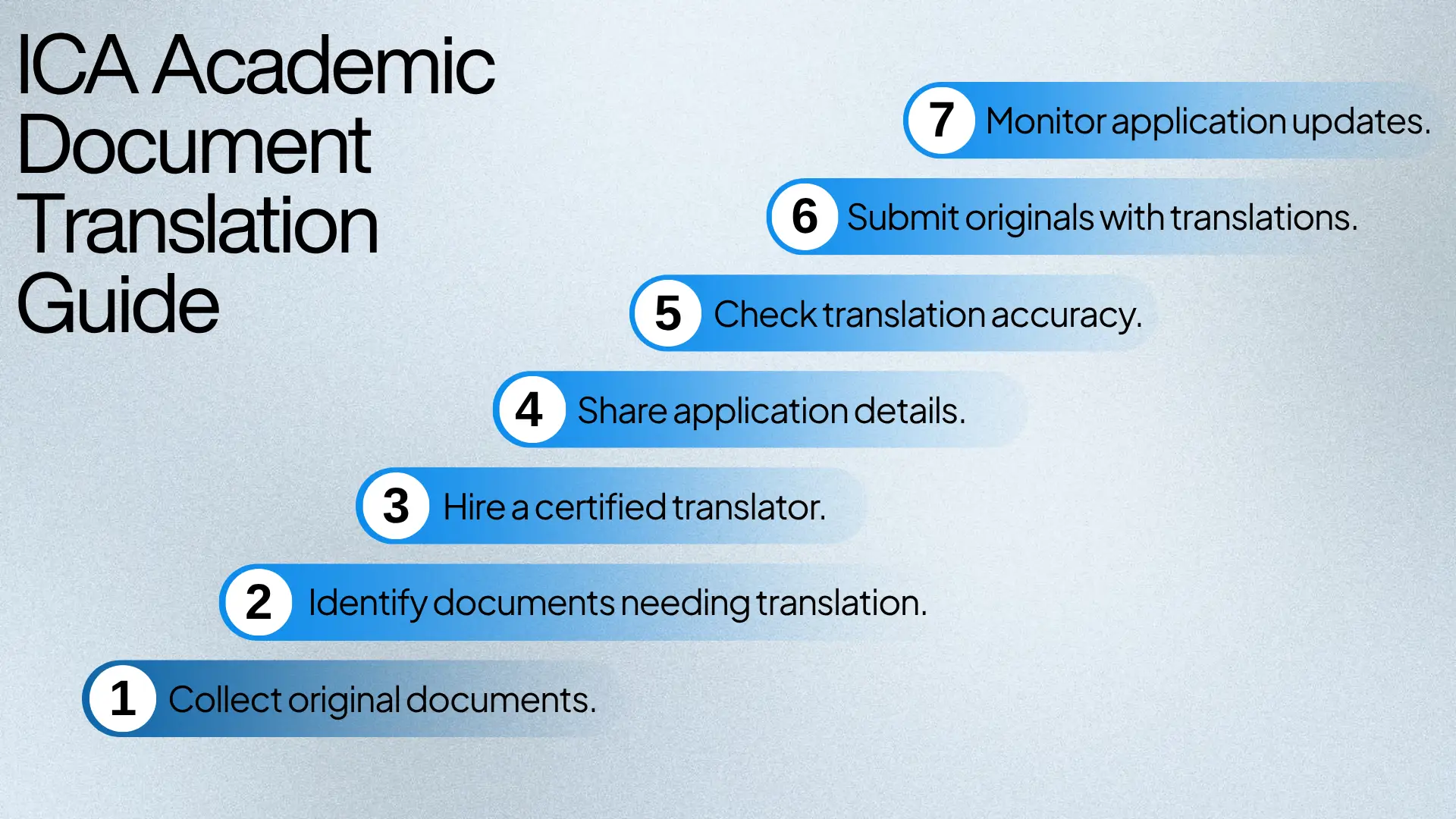
Step 1: Gather Your Original Documents
Collect all academic transcripts, certificates, and educational records that will form part of your Dependant Pass application. Where possible, work with certified true copies from the issuing institution rather than personal photocopies. Make sure you have clear, legible versions; poor quality scans can complicate the translation process.
Step 2: Confirm Which Documents Need Translation
Review all documents and identify those not in English. Note the language of each document, as this determines which translator is required. Check whether ICA has requested specific documents or whether you're submitting a standard supporting document set.
Step 3: Choose a Certified Translation Provider
Select a professional translation service with demonstrable experience in immigration document translation for Singapore applications. Key considerations are covered in the next section. Do not base your decision purely on price or turnaround time; the quality and certification of the translation matters more.
Step 4: Brief the Translator Fully
Provide the translator with all relevant context: the purpose of the translation (ICA Dependant Pass application), the country and institution the documents are from, and any specific formatting or certification requirements you're aware of. A good provider will ask these questions; a poor one won't.
Step 5: Review the Completed Translation
When you receive the translated document, compare it carefully against the original. Check that all sections have been translated, that names and dates match your passport details exactly, and that the certification statement is present and complete. If anything looks incomplete or inconsistent, raise it before accepting the final document.
Step 6: Prepare Your Submission Package
Organise your documents so that each translated document is submitted alongside its original. ICA typically expects to see both. Keep copies of everything submitted, both original and translated, for your records.
Step 7: Submit and Monitor
Submit your application with the translated documents included as specified by ICA's submission guidelines. Monitor your application status and respond promptly if ICA requests any additional documentation.
How to Choose a Reliable Translation Service in Singapore
Not all translation services are equal, and for ICA applications, the differences matter. Here is a practical checklist for evaluating providers:
✓ Certified translators with relevant language pairs: The service should use translators who are formally qualified in both the source language and English. Ask directly whether the translators handling your documents are native or near-native in the source language.
✓ Experience with Singapore immigration documents specifically: General translation experience is not the same as experience with ICA submissions. A provider who regularly handles immigration documentation will understand the certification format, the terminology conventions, and the specific requirements that Singapore authorities expect.
✓ Clear certification process: The provider should be able to explain clearly what certification statement they include, what it says, and why it satisfies ICA requirements. If they can't answer this plainly, that's a warning sign.
✓ Complete translation, not selective: Confirm that the provider translates the full document every section, header, footnote, and annotation rather than summarising or omitting parts that seem less important.
✓ Confidentiality practices: Academic records and immigration documents are sensitive. The provider should have clear data handling and confidentiality policies. Ask how documents are stored, who has access to them, and how they are disposed of after the project is complete.
✓ Reasonable turnaround with quality assurance: Beware of providers offering unusually fast turnarounds with no quality review step. A professional service will have, at minimum, a proofreading stage before finalising a certified translation. Standard turnaround for a certified academic transcript translation in Singapore is typically 2–5 business days depending on document length and language complexity.
✓ Clear pricing with no hidden costs: Reputable providers give clear, itemised quotes. Watch for additional charges for certification, express handling, or document formatting that aren't mentioned upfront.
✓ Accessible customer support: For immigration applications with fixed timelines, you need to be able to get answers quickly. A provider with responsive communication is worth a premium over a cheaper option you can't reach easily.
If you're comparing multiple providers, How to Choose the Right Document Translation Services offers a structured framework for making that decision based on what actually matters for Singapore submissions.
Why Applicants Choose LetterCrafts for Certified Translation Services
LetterCrafts approaches academic transcript translation for ICA applications as documentation work first, translation work second. That distinction matters.
The starting point for every transcript project is understanding its end use. A translation prepared for a Dependant Pass application has different certification requirements, formatting expectations, and accuracy standards than a translation prepared for personal reference or academic purposes. The team works within Singapore's immigration documentation context by default, not as a special service but as standard practice.
Every translation produced by LetterCrafts undergoes a structured quality review. The translated document is checked against the source for completeness, terminology accuracy, and formatting consistency. Certification statements are prepared in the format that ICA submissions require. Names are verified against provided passport details to prevent the transliteration inconsistencies that commonly cause identity verification problems.
Document handling is treated as a confidentiality matter. Academic records and immigration documents are handled by the translators assigned to the project and are not circulated beyond what the work requires.
For families working against application deadlines, communication matters. LetterCrafts provides clear timelines at the start of each project and keeps clients updated on progress, particularly where complexity or document condition might affect turnaround.
The service is built around the practical realities of Singapore immigration documentation: what ICA expects to see, how documents need to be presented, and what level of accuracy is required to avoid the revision cycles that extend application timelines.
Conclusion
Academic transcript translation is not a bureaucratic afterthought in the Dependant Pass application process. For families relocating to Singapore from countries where education records are in non-English languages, it is one of the few documentation steps where a mistake has a direct, measurable impact on application timelines.
The requirements are not especially complex when approached correctly: identify which documents need translation, work with a qualified provider who understands ICA submission standards, review the completed translation before submission, and keep copies of everything. Where families run into trouble is typically at the point where they assume the process is simpler than it is that a bilingual colleague's help will suffice, or that machine translation is adequate, or that an uncertified translation will pass review.
Working with experienced documentation professionals who understand Singapore's immigration context removes most of that risk. The translation itself may take only a few days; the delays that arise from getting it wrong can take far longer to resolve.
If you have academic transcripts or other non-English documents forming part of a Dependant Pass application and want to be certain they meet ICA's standards, LetterCrafts can help. Contact the team to discuss your documents, timeline, and what a certified translation involves for your specific case.