I've been working with translation clients for over a decade, and the question I get most often is surprisingly simple: "Do we really need professional translation, or can we just use Google Translate?"
Here's the honest answer: If you're translating a dinner menu for your personal vacation, Google Translate is fantastic.
But if you are a law firm handling a multi-million dollar international contract? A hospital explaining treatment options to a non-English speaking patient? A manufacturer distributing equipment manuals across 40 countries?
That's when mistakes stop being funny and start being expensive. Or dangerous. Or both.
Below, I break down exactly who needs translation services in 2026, the specific risks of getting it wrong, and why the "Human + Tech" approach is the only way to ensure safety and compliance.
Why Translation Services Matter More in 2026 Than Ever Before
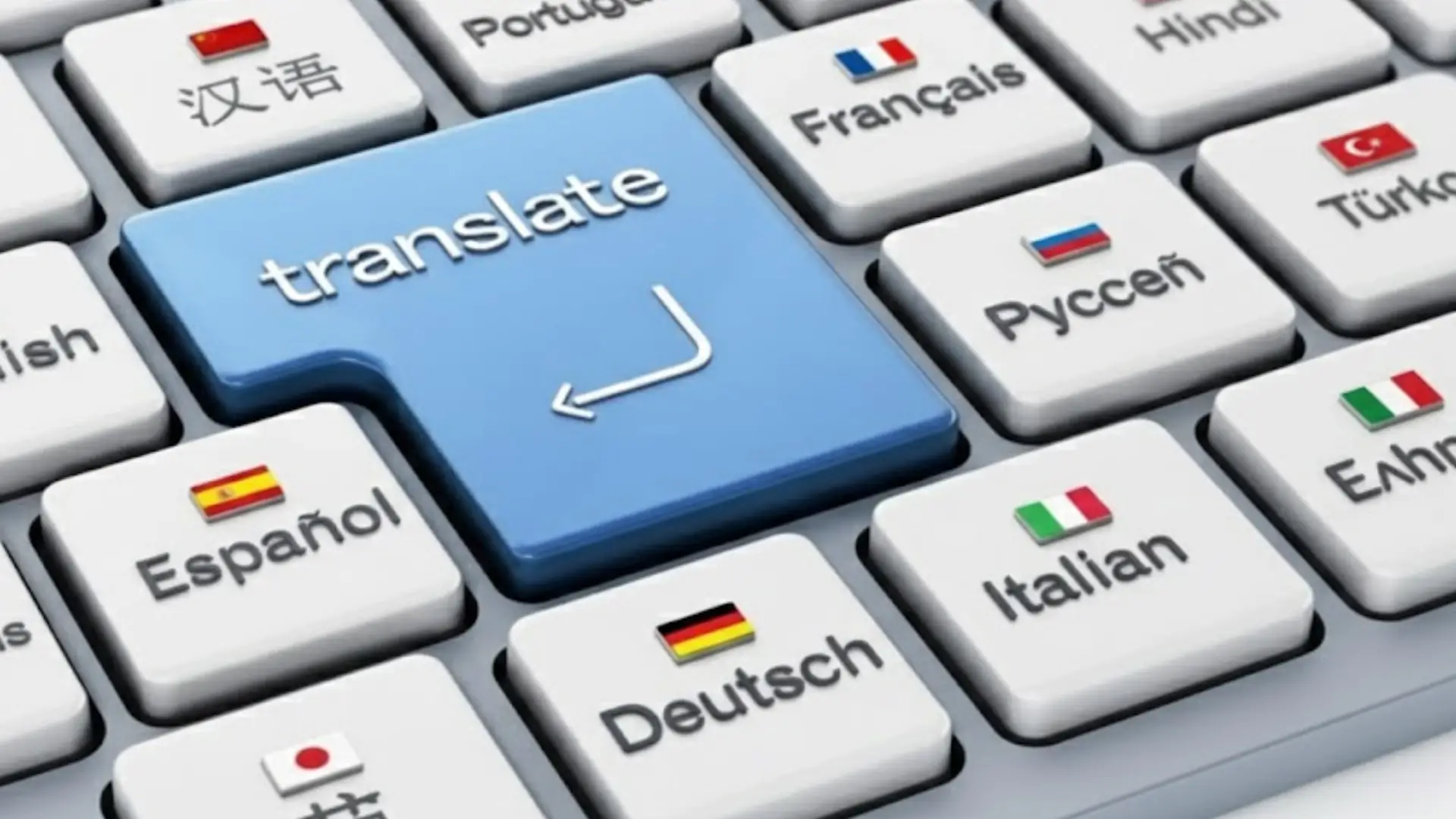
The machine translation market is growing (reaching $1.25 billion in 2026) but it's growing alongside professional human translation services, not replacing them. Companies are using MT for low-stakes content while investing even more in expert human translators for anything that matters.
Why? Because businesses have learned expensive lessons:
- Translation errors cost companies millions in recalls, lawsuits, and brand damage. For example, HSBC spent $10 million to rebrand after their tagline "Assume Nothing" was mistranslated as "Do Nothing" across multiple markets.
- 65% of non-native English speakers prefer content in their native language even when they're fluent in English.
- 72% of companies have paid substantial fines due to translation errors in legal documents, with 30% facing actual legal action in court.
- Professional translation represents a modest investment compared to the risks it prevents; fixing translation mistakes typically costs far more than getting it right the first time
The businesses thriving in 2026 understand that translation isn't just about converting words from One Language to another. It's about maintaining meaning, preserving legal integrity, ensuring safety, and building trust across cultural boundaries.
And the numbers prove it: companies that invest in quality translation are 1.5 times more likely to see revenue increases, with some reporting that localized content improved their organic performance by 2,500%.
Who Needs Translation Services? The 6 Industries Where It's Non-Negotiable
The 6 Industries Where It's Non-Negotiable are Law firms, Financial institutions, Educational organizations, Manufacturing companies, Technology businesses and Healthcare providers all of which need professional translation services.
Any organization operating across language boundaries, whether serving international clients, expanding to new markets, or ensuring compliance with multilingual regulations, requires expert translation to maintain accuracy, legal validity, safety standards, and cultural appropriateness that machine translation cannot provide.
Law Firms and Legal Services: Where One Wrong Word Costs Millions

Law firms require professional translation services for contracts, immigration documents, court filings, intellectual property, and other legal documentation that crosses international borders.
Legal translation isn't like other translation work. You're not just translating words, you're translating entire legal systems.
What Law Firms Actually Need Translated
The documents passing through legal translation services include:
- International contracts and merger agreements
- Confidentiality agreements and NDAs
- Immigration paperwork (visas, work permits, asylum applications)
- Birth certificates, marriage licenses, and vital records
- Court documents and legal correspondence
- Regulatory compliance filings across jurisdictions
- Patent applications and intellectual property documentation
- Corporate bylaws and shareholder agreements
Why Legal Translation Is So Complicated
Here's what makes legal translation different: legal concepts don't always exist across languages.
The English "trust" (as in a legal trust) doesn't have a direct equivalent in many civil law countries. Japanese contract law approaches obligation differently from U.S. contract law. What's a binding commitment in one legal system might be a non-enforceable statement of intent in another.
Professional legal translators need two areas of expertise:
- Complete fluency in both languages
- Deep understanding of both legal systems
That's why law firms don't just hire bilingual people; they hire legally trained translators who understand how different jurisdictions structure agreements, define terms, and enforce obligations.
Financial Services and Banking: Where Numbers Meet Words (And Both Must Be Perfect)
Banks, investment firms, and financial institutions need translation for cross-border transactions, regulatory compliance, client communications, and any financial documentation serving international markets.
Financial translation might be the most exacting specialized translation field. You're dealing with numbers, yes, but also with highly technical terminology, regulatory requirements that vary by jurisdiction, and client trust that evaporates with a single mistake.
What Financial Institutions Translate
Financial translation covers everything from high-stakes contracts to routine client communications:
- International transaction agreements
- Regulatory compliance documents and filings
- Annual reports and investor communications
- Banking correspondence and account statements
- Insurance policies and claims documentation
- Financial prospectuses and offering memoranda
- Audit reports and financial statements
The Triple Challenge of Financial Translation
Financial translation is the "Triple Threat" of difficulty: Precision, Compliance, and Culture. A misplaced decimal is bad; a mistranslated regulatory disclosure is illegal.
| Challenge | Why AI Struggles | The Human Solution |
|---|---|---|
| Precision | AI misses nuance in financial obligations. | Linguists ensure exactitude in figures and terms. |
| Compliance | AI ignores jurisdiction-specific laws (SEC vs. EU). | Experts adapt text to local regulatory standards. |
| Culture | Concepts like the German "Sparkasse" lack English equivalents. | Translators adapt the concept, not just the word. |
Why Machine Translation Fails in Finance
I've seen banks try to cut costs by using machine translation for client communications. The results? Confused customers, compliance violations, and damaged reputation.
Financial services require human expertise because:
- Regulatory language must be precisely correct
- Client trust depends on clear communication
- Market-specific terminology varies even within the same language
- Cultural attitudes toward finance, risk, and investment differ globally
When Wells Fargo expanded into Latin America, it didn't use Google Translate for their marketing materials. They hired native speakers who understood not just Spanish, but how different Latin American markets approach banking relationships.
Educational Institutions: Breaking Down Language Barriers to Learning

Language is not an accessory to education; it is the medium through which learning, safety, and belonging happen. As campuses become more global, translation moves from a nice-to-have service to an urgent academic imperative. U.S. universities alone hosted over 1 million international students in 2025 and those enrollments mean nothing if students cannot access, understand, and act on the materials that shape their success.
When course content, assessments, or safety instructions are unclear, the consequences are immediate and measurable: students struggle academically, administrative processes stall, compliance risks rise, and institutional reputation suffers.
What Educational Institutions Need Translated
Focus on materials that directly affect learning, safety, and enrollment experience:
- Course materials: textbooks, syllabi, lab manuals, handouts
- Instructional media: lecture transcripts, captions, educational videos
- Assessments: exam papers, rubrics, assignment briefs
- Admissions and enrollment: applications, registration, visa guidance
- Records and credentials: transcripts, diplomas, transfer documents
- Family and community communications: parent-teacher messages, outreach content
- Policies and compliance: codes of conduct, privacy notices, consent forms
- Digital platforms: LMS interfaces, help centers, course pages
- Safety and emergency: evacuation plans, health protocols, incident reporting
The Educational Translation Challenge
Translating educational content is not a mechanical swap of words; it’s teaching in another language. When translation is done poorly, the result is not merely awkward phrasing; it is a barrier that prevents students from learning, demonstrating competence, and staying safe.
For educators and administrators, that translates to a pedagogical issue, not an administrative one.
A confusing test question can change a student’s GPA. A mistranslated safety guide can lead to accidents. When assignment prompts are lost in translation, students can’t demonstrate their true potential.
These barriers are especially damaging for multilingual learners, adding unnecessary stress to the challenge of studying in a new language. High-quality translation is about more than just accuracy; it’s about fairness, safety, and ensuring every student has the support they need to stay and succeed.
Good educational translation requires:
- Preserve learning objectives so assessments test subject mastery, not language skills.
- Use age- and level-appropriate language aligned with students’ reading and cognitive levels.
- Culturally adapt examples and metaphors so concepts land as intended.
- Ensure clarity and unambiguity in instructions, rubrics, and exam items.
- Standardize terminology with glossaries and style guides to maintain consistency across materials.
Translation quality directly impacts educational outcomes. Schools that invest in professional educational translation see higher international student retention, better academic performance, and fewer administrative problems.
Manufacturing and Industrial Companies: When Bad Translation Means Someone Gets Hurt

Manufacturing companies need translation for safety manuals, equipment instructions, technical specifications, and any documentation where misunderstanding could cause injury, equipment damage, or production failures.
Let me tell you about the scariest translation failure I've ever encountered.
A German machinery manufacturer sold equipment to a Brazilian factory. The safety manual translation had an error; it described a "safety shutdown procedure" when it should have said "emergency shutdown procedure." The distinction mattered because the emergency shutdown was immediate; the safety shutdown took 30 seconds.
A worker following the translated instructions during an emergency was seriously injured because he waited for the 30-second "safety" shutdown when he needed the immediate emergency stop.
That's why manufacturing translation isn't just important, it's literally a life-or-death issue.
What Manufacturers Need Translated
Industrial translation covers extensive technical documentation:
- Equipment operation manuals and guides
- Safety procedures and warning labels
- Maintenance schedules and procedures
- Technical specifications and engineering diagrams
- Quality control documentation
- Training materials and certification programs
- Supply chain documentation
- Product packaging and labeling
- Installation instructions
Why Manufacturing Translation Is So Critical
Manufacturing translation errors create three types of risk:
- Safety Risks: Unclear instructions or mistranslated warnings can lead to workplace injuries, equipment accidents, or production hazards.
- Quality Risks: Misunderstood specifications result in defective products, failed quality control, and costly recalls.
- Operational Risks: Confusing documentation causes production delays, equipment damage, and communication breakdowns across international supply chains.
The Technical Complexity Factor
Manufacturing translators need to understand:
- Technical terminology in both languages
- Industry-specific measurement systems
- Safety standards and regulations
- Engineering concepts and specifications
When a U.S. company translates torque specifications for international markets, the translator needs to correctly convert measurements, understand the technical context, and ensure nothing gets lost in translation that could cause equipment failure.
Technology Companies: Making Innovation Accessible Globally

Tech companies need translation for software interfaces, technical documentation, customer support materials, and any content helping users understand and use technology products across different languages and markets.
Technology moves fast, and tech translation needs to keep up. By the time a software update is ready, the marketing materials, user guides, help documentation, and customer support resources all need to be translated across potentially dozens of languages.
What Tech Companies Translate
Technology translation covers a massive range of content:
- Software user interfaces and menu systems
- Mobile applications
- Technical documentation and API guides
- User manuals and help systems
- Error messages and system notifications
- Marketing websites and product descriptions
- Customer support knowledge bases
- Developer documentation
- Release notes and update information
The Localization Challenge
Tech translation isn't just translation; it's localization. The difference matters.
Translation converts words. Localization adapts the entire user experience for different markets, including:
- Interface text that fits within design constraints
- Date formats, currency displays, and measurement systems
- Cultural references and idioms
- Color symbolism and imagery
- User interface conventions that vary by region
When Microsoft launches Windows in 80+ languages they're not just translating text; they're creating 80 versions of the product that feel native to each market.
Why Tech Translation Is Uniquely Complex
Consider these real challenges:
- A button label perfect in English ("Submit") might require three times the space in German ("Einreichen und Bestätigen"). Your UI design needs to accommodate this.
- A playful error message in English ("Oops! Something went wrong") might confuse or offend users in more formal cultures who expect direct, serious communication.
- Technical terms that have established English equivalents might require creative translation in languages where those concepts are newer.
Real-World Example
When Airbnb expanded globally they didn't just translate their website; they completely rethought how they presented concepts like "host" and "guest" in cultures with different hospitality traditions. In some markets, they adapted messaging around trust and safety because cultural norms around staying in strangers' homes vary dramatically.
That level of localization requires translators who understand both technology and culture.
Healthcare and Medical Services: Where Translation Errors Can Be Fatal

Hospitals, clinics, pharmaceutical companies, and healthcare providers need translation for patient communications, medical records, consent forms, prescriptions, and any healthcare information where misunderstanding could harm patient safety or health outcomes.
Medical translation isn't just important; it's an ethical imperative.
What Healthcare Providers Need Translated
Medical translation encompasses critical patient-facing and clinical documentation:
- Patient medical records and case histories
- Medication instructions and prescription labels
- Informed consent documents
- Treatment plans and discharge instructions
- Medical device instructions
- Clinical trial documentation
- Healthcare marketing and patient education materials
- Insurance documentation and billing information
- Public health communications
Why Medical Translation Requires Specialized Expertise
Medical translators often have clinical backgrounds because the stakes are so high. They need to:
- Understand complex medical terminology in multiple languages, including anatomical terms, disease names, medication classes, and treatment procedures.
- Navigate healthcare regulations that vary by country, including patient privacy requirements, informed consent standards, and medical device labeling rules.
- Communicate diagnostic information accurately without ambiguity or distortion.
Translate cultural concepts around health, illness, pain, and treatment that don't always map directly between languages and cultures.
Building Trust Through Clear Communication
Quality medical translation does more than prevent errors; it builds trust between healthcare providers and patients.
When patients fully understand their diagnosis, treatment options, and care instructions, they:
- Make more informed medical decisions
- Follow treatment plans more accurately
- Experience better health outcomes
- Trust their healthcare providers more
Healthcare systems that invest in professional medical translation see measurably better patient outcomes, fewer readmissions, and reduced liability exposure.
Common Translation Needs That Cut Across All Industries
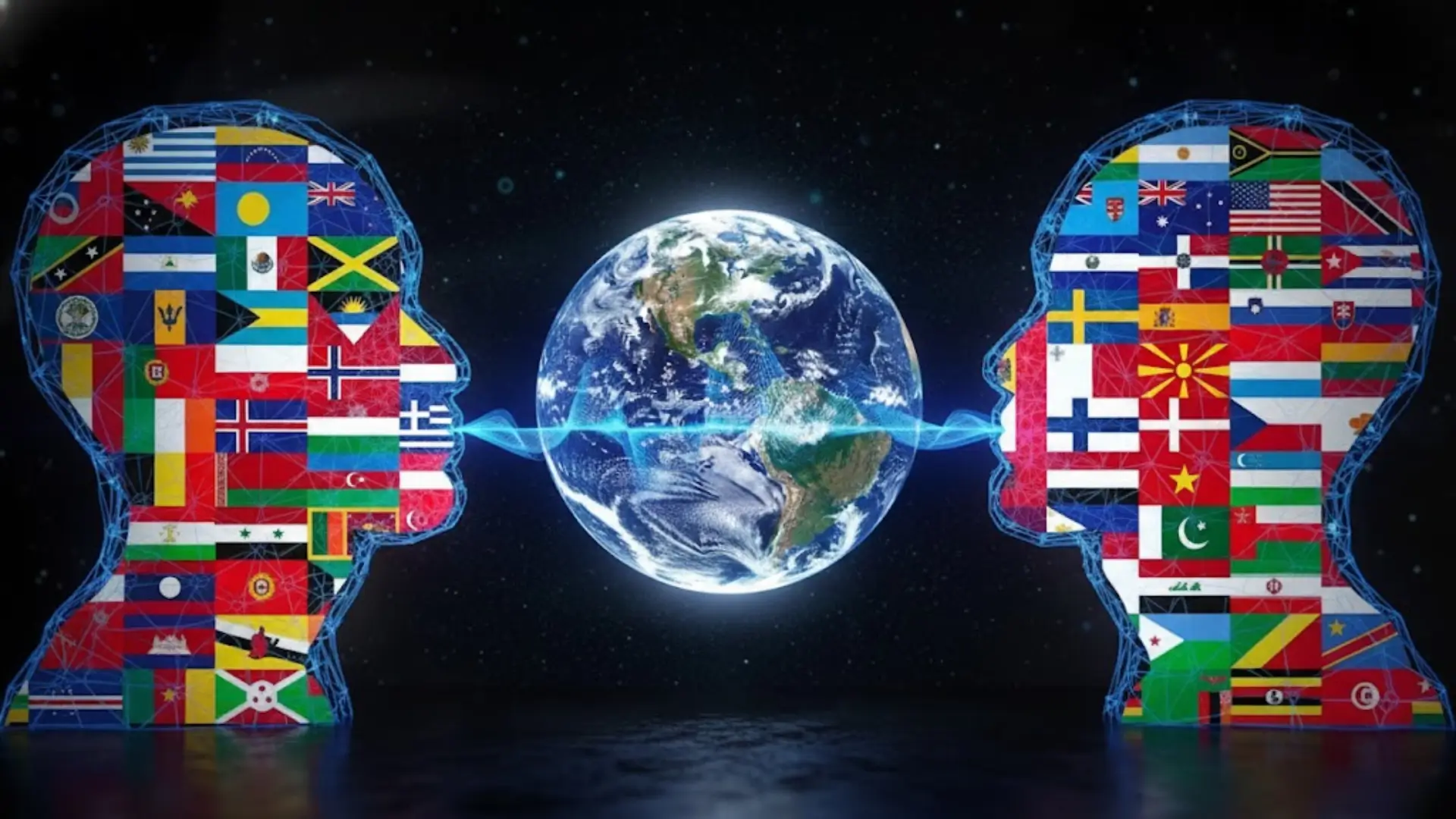
While each industry has specialized requirements, certain translation needs appear consistently across sectors:
Regulatory and Compliance Documentation
Every regulated industry, including finance, healthcare, pharmaceuticals, manufacturing, and food service, needs to translate compliance documentation to operate in international markets.
These translations mustnot only be accurate but also legally valid and compliant with local regulations. Professional translators understand the regulatory landscape and structure translations accordingly.
Customer-Facing Marketing Content
Your website, brochures, product descriptions, and advertising need translation that maintains your brand voice while adapting to local cultural expectations.
This is where localization expertise really matters. Professional translators don't just convert words; they adapt messaging, imagery, and positioning for each target market.
Internal Corporate Communications
Multinational companies need to translate:
- Employee handbooks and HR policies
- Training materials and corporate communications
- Internal announcements and company updates
- Performance reviews and evaluation criteria
Clear internal translation ensures all employees understand expectations, procedures, and company culture, regardless of their native language.
Technical and Product Documentation
From user manuals to installation guides, technical documentation needs precise translation that maintains usability while meeting local language and regulatory requirements.
Poor technical translation confuses customers, increases support costs, and can create safety or liability issues.
Legal and Contractual Materials
Contracts, terms of service, privacy policies, licensing agreements, and any legally binding documentation need translation that preserves legal meaning and enforceability across jurisdictions.
This requires translators with both linguistic and legal expertise.
What Makes Professional Translation Services Worth the Investment?

Now that you've seen which industries rely on translation services, let's talk about what you actually get when you hire professional translators instead of using free machine translation.
Human Expertise and Cultural Understanding
Professional translators bring something AI can't replicate: deep cultural understanding.
They know that a marketing message that works perfectly in New York might completely fail in Tokyo, not because of language barriers, but because of cultural differences in how people respond to directness, humor, emotional appeals, or authority.
They understand that colors carry different meanings across cultures (white signifies purity in Western weddings but mourning in parts of Asia). They recognize when idioms don't translate and find equivalent expressions that convey the same meaning.
Industry-Specific Knowledge
Professional translation services match projects with translators who have real expertise in your field.
Legal translators often have law degrees. Medical translators frequently have clinical backgrounds. Financial translators understand complex financial instruments and regulatory requirements.
This specialized knowledge ensures translations are not just linguistically accurate but professionally appropriate.
Quality Assurance and Consistency
Reputable translation services use multi-stage review processes:
- Initial translation by a subject matter expert
- Editing by a second linguist to check accuracy
- Proofreading to catch any remaining errors
- Final quality review to ensure consistency and completeness
This layered approach catches errors that single-pass translation misses.
Consistency Across Projects
Professional services maintain translation memories and terminology databases to ensure consistency across all your documents.
If you've decided that "customer" translates to a specific term in your target language, that same term will be used consistently across your website, marketing materials, contracts, and support documentation.
This consistency reinforces your brand and prevents confusion.
Legal and Regulatory Compliance
Many industries face legal requirements for translated documentation. Professional translation services understand these requirements and ensure compliance.
They provide certified translations when needed, maintain confidentiality for sensitive documents, and structure translations to meet regulatory standards in target markets.
Risk Mitigation
The cost of professional translation is almost always less than the cost of fixing problems caused by bad translation.
Consider:
- A $5,000 legal translation that prevents a $500,000 lawsuit
- A $10,000 medical translation that avoids patient harm and liability
- A $3,000 product manual translation that prevents safety incidents and recalls
Professional translation is risk management, not just a cost center.
How to Choose the Right Translation Service Provider (Based on What Actually Matters)

I've seen companies make expensive mistakes when selecting translation providers. Here's what to actually look for
Industry Specialization That Matters
Don't hire a generalist when you need a specialist. A great literary translator might struggle with financial documents. An excellent medical translator might not understand manufacturing terminology.
Ask providers: "Do you have translators with professional experience in our specific field?" Request examples of similar projects they've completed.
Native Speakers (Not Just Bilingual People)
There's a huge difference between speaking a language and being a native speaker who understands current usage, cultural nuance, and regional variation.
Verify that translators are native speakers of the target language and currently live in (or regularly engage with) the target market.
Clear Quality Assurance Processes
Ask: "What's your QA workflow?" Good providers should describe a multi-stage review process with specific quality checkpoints.
Red flag: any provider who can't clearly explain how they ensure translation quality.
Technology Integration Without Technology Dependence
Modern translation benefits from translation memory tools, terminology databases, and consistency checking software.
But technology should support human expertise, not replace it. Be wary of services that rely primarily on machine translation with minimal human review.
Realistic Turnaround Times
Fast, cheap, good pick two. Professional translation takes time.
Be skeptical of providers promising unrealistically fast turnarounds. Rushed translation typically means corner-cutting that shows up as quality issues.
Robust Confidentiality and Security
For sensitive documents, legal contracts, medical records, financial statements, and proprietary technical information, you need:
- Signed confidentiality agreements
- Secure file transfer protocols
- Clear data handling and deletion policies
- Information security certifications
Ask directly: "How do you protect confidential information?"
Transparent Pricing Without Hidden Fees
Understand the cost structure upfront. Per word? Per page? Are there setup fees? Rush charges? Revision fees?
Good providers offer clear, detailed quotes that specify exactly what you're paying for.
References and Proven Track Record
Don't take providers' word for their expertise. Ask for:
- Client references you can contact
- Case studies from similar projects
- Examples of previous work (with confidential information redacted)
A provider with a strong track record won't hesitate to provide evidence.
Why LetterCrafts for Your Translation Needs?
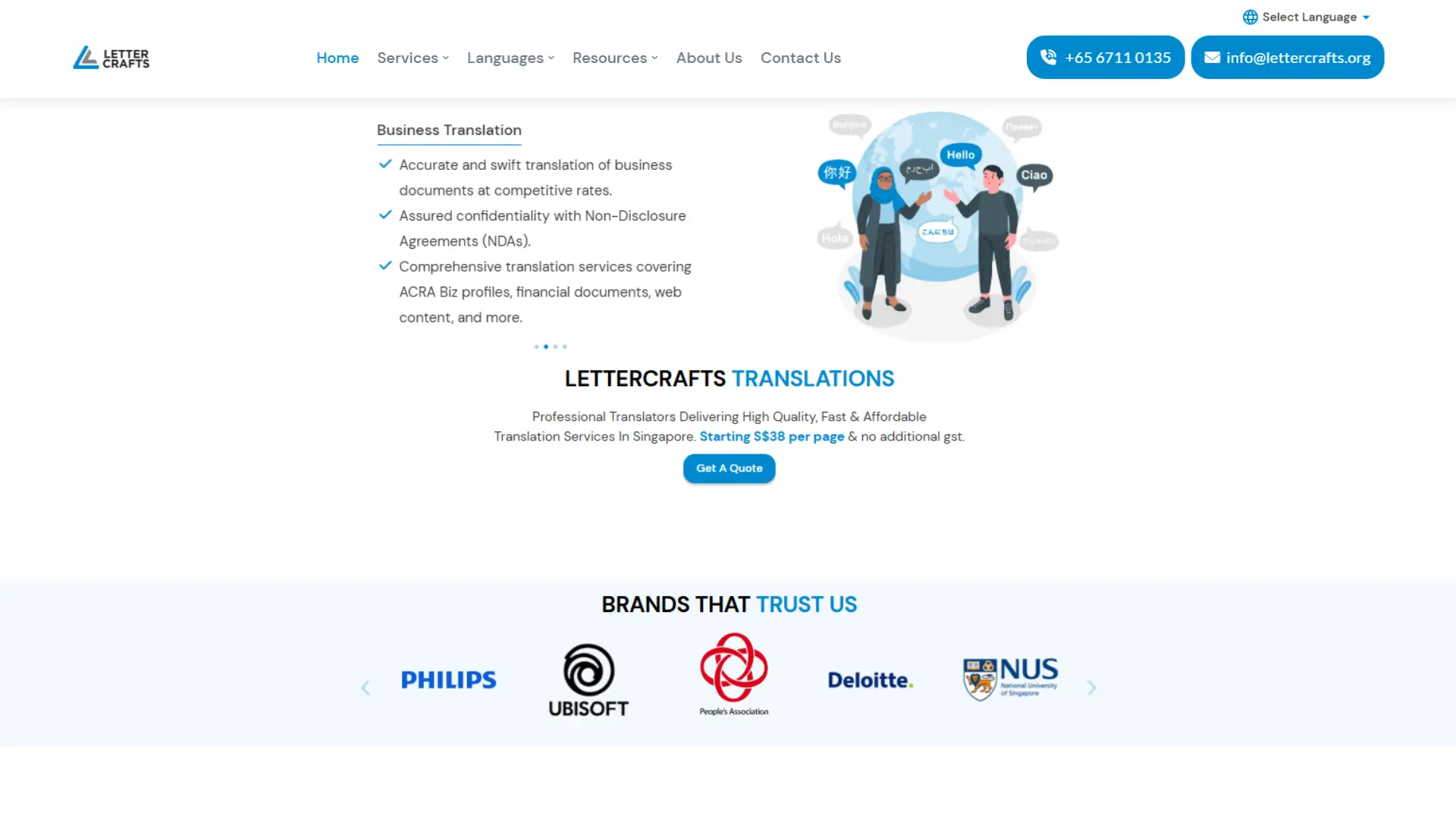
LetterCrafts doesn’t just swap words between languages; it preserves meaning, tone, and purpose so your message lands exactly as you intend. Below is a ready-to-use blog section that explains how LetterCrafts turns complex, sensitive, and market-facing content into translations you can trust.
Deep Industry Expertise: Translators at LetterCrafts know the vocabulary and the stakes: legal clauses that must hold up in court, medical phrasing that affects patient safety, and technical terms that prevent costly errors. That industry knowledge keeps translations accurate and practically useful.
Rigorous Quality Process: Every project moves through translation, second-pass editing, proofreading, and a final quality review. This layered approach catches subtle mistakes single-pass work misses, and delivers documents that are publication- or court-ready.
Cultural Intelligence: LetterCrafts adapts tone, examples, and idioms so your content resonates with the target audience. The team knows when to translate directly and when to reframe ideas so they feel natural and persuasive in another culture.
Security and Confidentiality: For contracts, medical records, and financial statements, LetterCrafts enforces confidentiality agreements and secure handling at every step to protect client data and maintain trust.
Technology-Enhanced Human Expertise: Translation memories and centralized terminology databases speed delivery and ensure consistency, while human translators preserve nuance, context, and cultural fit. The result is efficient work that never sacrifices accuracy.
Proven Track Record: LetterCrafts has supported international litigation, healthcare providers, global manufacturers, and tech companies entering new markets. Their portfolio spans legal and medical work as well as product and marketing localization.
The Bottom Line on Translation Services in 2026

So who needs professional translation services?
The straightforward answer: any organization that operates across language boundaries and can't afford mistakes.
Law firms protecting clients and navigating international regulations. Financial institutions are building trust across borders and meeting regulatory requirements. Educational institutions supporting diverse student populations. Manufacturers ensure safety and quality worldwide. Technology companies are scaling innovation globally. Healthcare providers delivering accurate, life-saving information to all patients.
But it goes beyond just these six industries. Government agencies, e-commerce businesses, entertainment companies, research institutions, nonprofits, hospitality companies, retail brands, and virtually every organization operating internationally need professional translation.
The world hasn't gotten bigger, but business has gotten more global. As cross-border communication increases, the need for clear, accurate, culturally appropriate translation grows exponentially.
Professional translation is a strategic necessity in 2026, not a cost center but a safeguard for reputation, compliance, and human safety. When accuracy, context, and cultural nuance matter, human-led translation paired with the right technology prevents costly mistakes and unlocks global growth. Choose expertise over convenience so your message performs everywhere it’s read.
Your message matters. Your brand matters. Your customers matter. Make sure your words work accurately, completely, and effectively in every language your audience speaks.
Talk to an industry specialist about your highest‑risk content and get a tailored plan: Get a Free Quote