TL:dr
Can AI replace certified translation in Singapore?
No, and not primarily because of translation quality. Certified translation in Singapore is a legal chain of accountability that requires a human professional to sign a Certificate of Accuracy, a Singapore Notary Public to notarize the translation under oath, and the Singapore Academy of Law (SAL) to authenticate the document in its official e-Register. AI has no legal standing anywhere in this chain. It cannot be notarized, cannot be registered with SAL, and cannot be held liable for errors that affect immigration, court, or regulatory outcomes.
Why "Just Use AI" Is the Wrong Answer for Certified Translation in Singapore
Every few months, a new wave of headlines declares that artificial intelligence has finally cracked language. Translation apps grow sharper. Large language models produce prose that feels eerily fluent. And across Singapore, a deceptively simple question gets asked: "Can't we just use AI for our translations?"
Professional document translation is an act of legal and contextual fidelity. A single misplaced term in a financial contract can alter its enforceability under Singapore law. An ambiguous phrase in a medical record can change a clinical interpretation. A formatting inconsistency in an immigration document can mean rejection by the Immigration and Checkpoints Authority (ICA) and weeks of delay to an already complex application.
"Certified translation is not about language fluency. It is about legal accountability, regulatory compliance, and the integrity of official documents. These are things AI cannot provide, not because it lacks intelligence, but because it lacks standing."
This piece examines what the existing conversation is missing: not just the quality argument against AI translation, but the structural, legal, and uniquely Singaporean reasons why certified human translation remains irreplaceable and will for the foreseeable future.
What ICA Actually Requires: Singapore's Legal Infrastructure for Certified Translation
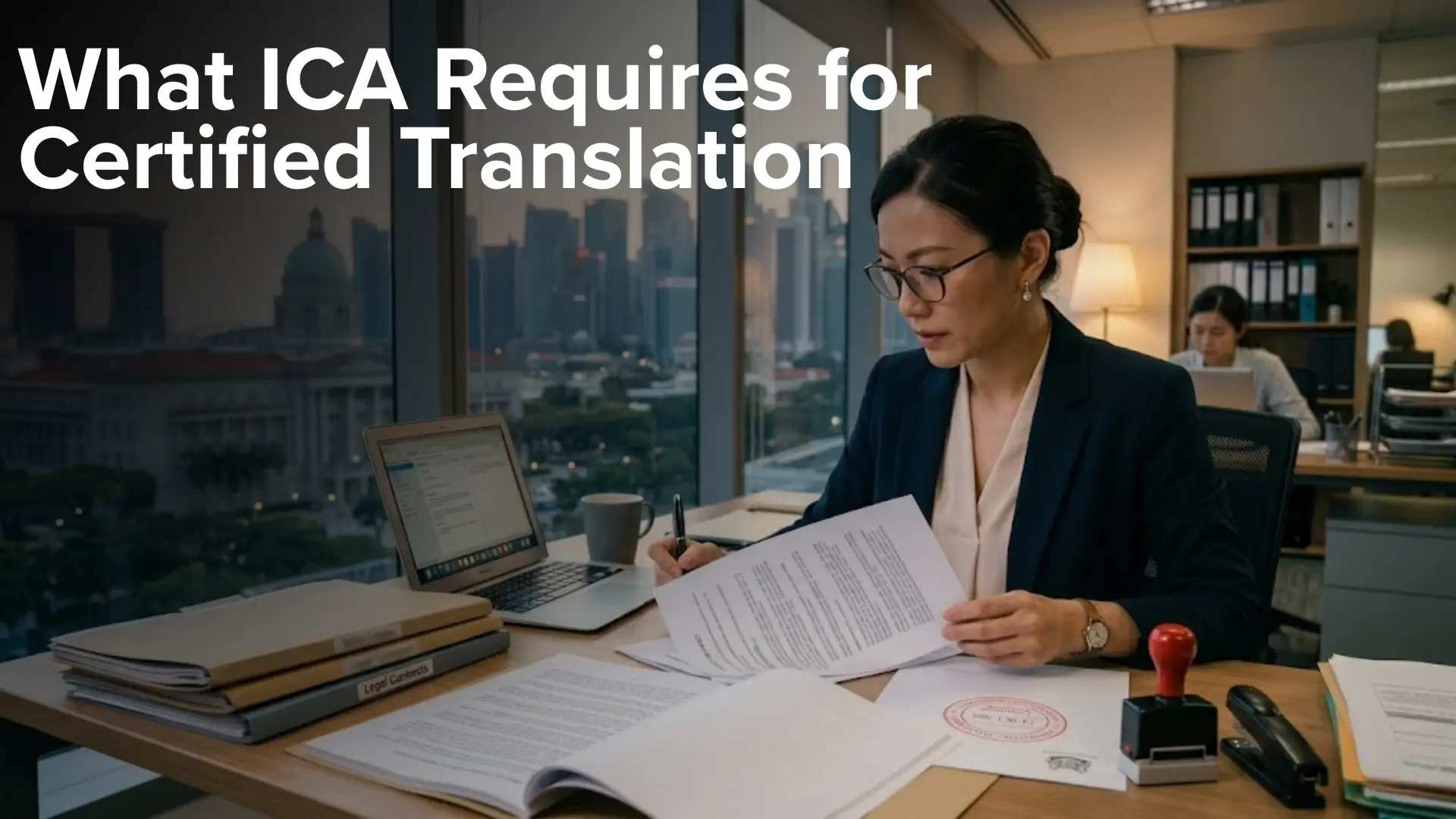
Submitting a translated document to a Singapore government body is not a matter of language competence. It is a matter of legal architecture. The Immigration & Checkpoints Authority (ICA), which processes PR, citizenship, and long-term pass applications, has specific requirements for what constitutes an acceptable translation, and none of them can be satisfied by an AI system.
Per ICA's official translation requirements, accepted translations must come from one of four sources: the embassy of the issuing country, a notary public in Singapore or overseas, a private translation agency whose work is subsequently notarised, or a notary public who also serves as the translator. For the vast majority of applicants, this means engaging a professional translation agency and a Singapore Notary Public, a senior lawyer who reviews the translator's credentials and notarises the translation under oath.
Since 1 October 2019, this process has included a further mandatory step. Under a regulatory change announced by the Singapore Academy of Law (SAL), all notarised documents must also be authenticated through the SAL authentication portal and registered in the government's official e-Register. This was not a procedural tweak; it was a structural change designed to close fraud loopholes and create a fully traceable chain of accountability for every document that enters Singapore's legal system.
The result is a four-step process: professional translation, Certificate of Accuracy, notarisation by a Singapore Notary Public, and SAL authentication. What matters for the AI question is this: every step requires a human professional with legal standing. AI translation can contribute to the first step at most, and most reputable Singapore agencies explicitly do not use machine translation even there for ICA submissions, because the downstream liability falls on the human certifier.
"A translated document in Singapore is not just a piece of paper. It is a verified artefact in a government-maintained legal registry. AI cannot be notarised. It cannot be registered with SAL. These are not quality thresholds; they are legal gates."
Deep Dive → ICA Translation Service
Singapore: Complete Notarization
Guide for PR & Citizenship Documents
The four accepted authentication methods, timelines,
costs, and the most common rejection reasons are fully updated for 2025.
Checklist → Certified Translation Checklist for Singapore Submissions (2026)
The zero-rejection checklist for ICA, MOM, LTA, and ACRA submissions,
including stamps, seals, and what gets missed most often.
Why Singapore's Language History Makes AI Translation Dangerously Unreliable for Official Documents

Most commentary on AI translation limitations uses Singapore as a generic backdrop without engaging with what makes the country genuinely, specifically challenging. That specificity matters because Singapore is not simply a multilingual country. It is a country whose official linguistic history is far narrower than its actual linguistic reality.
Four Official Languages. Dozens of Real Ones.
Singapore's four official languages are English, Mandarin, Malay, and Tamil. But the documents that ICA regularly receives tell a different story. The Chinese community historically spoke Hokkien, Teochew, Cantonese, Hainanese, and Hakka many mutually unintelligible, and colonial-era documents often reflect this. A birth certificate from the 1950s may be in a Chinese dialect script. A marriage certificate from the 1970s might be in Jawi. Documents from Malaysia, Indonesia, Sri Lanka, Bangladesh, Myanmar, or India submitted to ICA span dozens of languages, registers, and scripts.
Singapore's deliberate language policy, including the Speak Mandarin Campaign (1979) shifted the languages appearing in official documents across generations. An applicant's own family documents may span three different language eras. No AI system is trained equally across all these language pairs. Performance degrades sharply for lower-resource languages and historical scripts.
The consequences of getting this wrong are concrete:
Real Consequence
A mistranslated date of birth, a name rendered in the wrong transliteration system, or a missed seal annotation on a pre-independence document can cause ICA to pause or reject an entire PR or citizenship application, setting the process back by months. These are not hypothetical risks. They are the most common reasons certified translation agencies see resubmission requests.
AI vs. Human Certified Translator: Singapore Context (Comparison Table)
| Capability | AI Translation | Certified Human Translator |
|---|---|---|
| ICA / SAL legal standing | ✗ None | ✓ Full |
| Can be notarised | ✗ No | ✓ Yes |
| Handles dialect-era documents | ✗ Unreliable | ✓ Specialist available |
| Handles Singlish register-switching | ✗ No | ✓ Yes |
| Legally liable for accuracy | ✗ Cannot be | ✓ Professionally accountable |
| PDPA-compliant document handling | ✗ Variable | ✓ NDA + PDPA bound |
| Flags own uncertainty | ✗ Often doesn't | ✓ Professional duty to do so |
| Speed for routine documents | ✓ Fast | 24-36 hours (LetterCrafts standard) |
The Singlish Problem: A Dimension No One Is Writing About
There is a dimension of Singapore's linguistic reality that rarely appears in translation service marketing: Singlish. Singapore Colloquial English is a creole spoken by the vast majority of Singaporeans in everyday life, blending English with Malay, Hokkien, Teochew, Tamil, and Cantonese in ways that have their own consistent grammar and phonology.
Singlish does not appear in official documents. But it appears in witness statements, statutory declarations, affidavits, and any legal text derived from what a Singaporean person actually said. A translator working on a court-adjacent document must navigate the boundary between what was spoken in Singlish and what must be rendered in formal Standard English while preserving precise meaning and intent.
This is a task requiring cultural embeddedness that goes well beyond language competence. An AI system trained on formal corpora is structurally unprepared for this register-switching. And unlike a human translator, it will not flag its uncertainty. It will produce fluent-sounding Standard English that may subtly misrepresent what was actually said.
Related → Top 5
Legal Translation Mistakes: A Risk Governance Failure for Global
Businesses
How terminology drift, conceptual non-equivalence, and rushed processes
expose organisations to multi-million dollar liability.
The "Fluent But Wrong" Risk AI's Most Dangerous Failure Mode
Earlier machine translation failed visibly. You could tell within a sentence that something was wrong. Modern neural AI fails differently and more dangerously. It produces confident, fluent, plausible text that contains subtle errors in meaning, terminology, or legal implication. The output looks right. The problem is invisible until it matters.
In a legal context, the difference between similar-sounding phrases can be the entire case:
- "was employed" versus "was self-employed" affects tax and CPF liability
- "date of birth" versus "date of issue" causes ICA identity mismatches
- "legal name" versus "alias" triggers red flags in background checks
- "Civil marriage" versus "customary marriage" affects dependent pass eligibility
The fluency of modern AI makes these errors harder to catch than obvious machine-translation failures. A professional reviewer skimming fluent text can miss a single-word legal distinction that changes an application outcome. Human translators, particularly those with domain specialisation, are trained to flag ambiguity, seek source clarification, and resist producing fluent output when the original is unclear. AI is optimised to produce output. That is a structural difference, not a quality gap.
Across documented international cases, AI translation failures in asylum and immigration filings have included reversed cause-and-effect in persecution claims, wrong country names, and transposed date errors that appeared grammatically correct in the output. In documented cases involving Afghan refugees AI-generated translations contributed directly to rejected claims. The fluency of the errors was precisely what made them dangerous.
Related → The
Importance of Translation Services for Legal Documents
Why legal translation is a compliance function, not a linguistic one, and
what happens when it is treated otherwise.
Uploading Immigration Documents to AI Translation Tools: The PDPA Risk Singapore Applicants Are Ignoring
There is a risk almost absent from Singapore-focused translation commentary: data privacy. When personal documents, passports, birth certificates, medical records, and marriage certificates are uploaded to commercial AI translation platforms, the data-handling implications are serious and largely invisible to users.
Most consumer-facing AI translation services retain the right to use uploaded content for model improvement and training. Even enterprise-tier platforms often route data through third-party cloud infrastructure across multiple jurisdictions. For an individual submitting sensitive personal documents as part of a PR or citizenship application, using an unvetted AI platform introduces exposure that cuts directly against Singapore's Personal Data Protection Act (PDPA)
Professional translation agencies operate under a fundamentally different framework. At LetterCrafts, every translator is bound by a confidentiality agreement. Documents are not stored beyond operational necessity and are deleted on request. The translation workflow does not involve third-party AI platforms for sensitive submissions. This is not a marketing distinction it is a compliance one.
PDPA Consideration
If you are uploading a client's passport, birth certificate, or medical record to a free or commercial AI translation tool, ask: where does that data go after processing? Who can access it? Is it used for model training? If you cannot answer these questions from the platform's published policy, you may be exposing personal data in a way that conflicts with your own PDPA obligations.
AI Translation in Singapore: What It Can Do, What It Cannot Do, and Where the Legal Line Is
Intellectual honesty requires acknowledging that AI is genuinely transforming translation workflows. Neural machine translation has improved dramatically. AI-assisted tools, computer-assisted translation software, translation memory systems, and AI-powered quality checks are becoming standard in professional workflows. Reputable agencies use these tools to enhance productivity and consistency.
But there is a critical distinction between AI as a professional tool within a human-supervised workflow and AI as a replacement for human certification. The former is already happening. The latter is structurally impossible within Singapore's legal framework.
Where AI Translation Works Well in Singapore (Low-Stakes, Non-Certified Use Cases):
- High-volume, low-stakes content: website localisation, product descriptions, internal communications
- First-draft generation for professional post-editing and faster delivery
- Terminology consistency checking across large document sets
- Real-time communication support: customer service, informal correspondence
Documents That Always Require Certified Human Translation in Singapore (ICA, MOM, Courts & More)
- ICA submissions: PR applications, citizenship, dependent passes, long-term visit passes
- MOM documents: employment pass applications, work permit supporting materials
- Court and legal proceedings affidavits, statutory declarations, contracts, evidence
- Academic credentials for Singapore universities and professional bodies
- Medical and pharmaceutical documents requiring regulatory compliance, see our healthcare translation guide
- Financial documents requiring MAS compliance
- Any document requiring notarisation and SAL authentication
Conclusion: The Right Question Is Not "How Good Is AI?" It Is "Who Is Responsible?"

The question of whether AI can replace certified translation in Singapore is ultimately not a question about translation quality. It is a question about legal infrastructure, and in Singapore, that infrastructure is built on human accountability at every stage.
The translator signs a Certificate of Accuracy and takes professional responsibility for it. The Notary Public reviews those credentials and notarises the work under oath. The Singapore Academy of Law authenticates the result and logs it in a government registry. Each of these steps requires a human being who can be identified, questioned, and held accountable. AI offers none of this. It produces text. It does not take responsibility for what that text means in law.
This aligns with the Ministry of Law's March 2026 Guide for Using Generative AI in the Legal Sector, which explicitly states that professional responsibility cannot be delegated to algorithms. Even as AI enters the legal sector, the human signature remains the ultimate point of accountability.
Add to this the specific complexity of Singapore's linguistic landscape, the dialect-era documents, the Singlish register in legal statements, the dozens of language pairs that official submissions span, and the case for certified human translation is not just regulatory. It is practical. The consequences of getting it wrong are concrete: delayed applications, rejected documents, and in serious cases, legal proceedings that hinge on a single mistranslated phrase.
As a translation agency, we use AI tools that make our work faster and more consistent. But what we bring to every certified translation is something AI cannot replicate: a qualified human, a signed declaration, and a stake in getting it right. In Singapore, accountability is not a feature. It is the entire product.
"At LetterCrafts, our translators are not afraid of AI. We use the best tools available to enhance accuracy and consistency. But what we bring to every certified translation is legal accountability. That is something no algorithm can offer."