TL;DR: Executive Summary
Every Employment Pass (EP) application in Singapore now runs through a two-stage gate: a minimum qualifying salary check and the COMPASS points framework. Since September 2023, all post-secondary qualifications declared in EP applications must be verified by one of 12 MOM-accredited background screening agencies, and the results must include a mandatory MOM verification reference number. From 1 January 2026, MOM updated its COMPASS C2 qualification and institution lists, introduced faculty-level scoring distinctions, and expanded the roster of professional qualifications. Non-English documents must be submitted alongside accurate English translations merged as a single PDF, translation page first. Verification reports obtained before September 2023 lack the required reference number and will trigger rejection unless reissued. This guide covers every operational detail you need to get it right.
Quick Facts: MOM EP Verification & Translation 2026
| Parameter | Detail |
|---|---|
| Mandatory verification starts | New EP apps: 1 Sept 2023 • Renewals: 1 Sept 2024 |
| 2026 COMPASS C2 lists effective | 1 January 2026 (new apps); 1 July 2026 (renewals) |
| Accredited screening agencies | 12 agencies (Avvanz, RMI, Veremark, eeCheck, First Advantage, HireRight, Sterling, Verity Intelligence, and others) |
| Verification turnaround | 7-15 business days (standard); 15-25 days for India & South America |
| COMPASS passing score | 40 points minimum across C1-C6 |
| C2 scoring | 20 pts (top-tier institution) • 10 pts (degree-equivalent / standard) • 0 pts (none) |
| COMPASS exemption salary | S$22,500+ fixed monthly salary |
| Translation requirement | All non-English documents: English translation + original, uploaded as one file |
| Pre-Sept 2023 reports | Must be reissued with the MOM verification reference number before submission |
Why does MOM now require third-party education verification for Employment Pass applications?
If you've filed an EP application in the last three years, you already know the landscape has shifted. But if you're new to Singapore hiring, here's the essential context: in June 2023, MOM announced that all post-secondary qualifications declared in EP applications would need to be verified by a panel of approved background screening companies. The policy took effect on 1 September 2023 for new applications and was extended to renewals from September 1st, 2024
The catalyst was a measurable rise in credential fraud among foreign worker applicants. MOM's response wasn't simply to tighten its own checks; it was to shift the burden of authenticity from the government to the employer. This is a subtle but consequential architectural change. Under the old regime, MOM bore the risk of admitting fraudulently credentialed professionals. Under the new regime, the employer is the party legally responsible for ensuring a candidate's claims are genuine. If a qualification is later found to be false, the work pass is revoked, the candidate must leave Singapore immediately, and the employer's track record with MOM is marked accordingly.
Think of it as a "trust economy" model. MOM has essentially told employers: We trust you to hire well, but we require you to prove that trust through auditable, third-party verification. This framing matters because it signals that MOM treats verification compliance not as a formality, but as a legal obligation with real enforcement consequences.
What is COMPASS, and how does C2 (Qualifications) scoring work in 2026?

COMPASS, the Complementarity Assessment Framework, is the points-based evaluation system that governs every EP application (unless the candidate earns S$22,500 or more per month, which triggers an automatic exemption). Introduced in September 2023 for new applications and extended to renewals from September 2024, COMPASS scores candidates across four foundational criteria (C1 through C4) and two bonus criteria (C5 and C6). Each criterion can yield 0, 10, or 20 points. You need a minimum of 40 points to pass.
C2, the qualifications criterion, is where translation and verification collide. Points are awarded based on two factors: the level of the qualification and the reputation of the awarding institution. MOM maintains two lists that determine C2 outcomes. One is the top-tier institutions list, split into Group A (globally ranked) and Group B (regionally reputed, often faculty-specific). The other is the degree-equivalent professional qualifications list, covering credentials in fields like accounting, engineering, law, and applied sciences.
In November 2025, MOM released updated versions of both lists, effective 1 January 2026 for new applications and 1 July 2026 for renewals. The 2026 updates are more granular than previous editions. Some institutions have shifted between Group A and Group B. Others have moved from 20-point recognition to 10-point status, or been removed entirely. Crucially, MOM now requires employers to select both the institution name and the correct faculty in the EP application form. A mismatch or a missing faculty selection can result in zero C2 points, even when the institution itself is on the list.
Critical 2026 Change
Faculty is now determinative, not contextual. Two candidates from the same Group B institution can receive different C2 scores: 20 points for one faculty, 0 for another, depending on whether the specific faculty appears on MOM's updated list. If your COMPASS calculation depends on those 20 points, this distinction can mean the difference between approval and rejection.
What are the MOM EP translation requirements for non-English documents?

MOM's rule is straightforward but frequently mishandled: all documents submitted with an EP application must be in English. If the original document is in another language, a degree certificate from a Chinese university, a diploma from a Brazilian institution, or professional credentials in Japanese, you must upload the original document and an English translation together as a single file.
Unlike certain other jurisdictions (the United States, for instance), MOM does not require notarization of translations. What MOM requires is that the translation be done by a professional translation service provider and that it accurately reflects the content of the original. This distinction matters: a notarized translation (where a notary verifies the translator's identity) adds a layer of legal formality that MOM does not demand. A certified translation (where the translator or agency attests to accuracy and completeness) is the standard MOM expects.
What is the difference between a certified and a notarized translation for MOM?
This question comes up in nearly every briefing with international HR teams, so let's address it directly. A certified translation is one where the translator or translation agency provides a signed statement attesting that the translation is accurate, complete, and produced by a linguistically competent professional. It is the standard that MOM accepts for EP applications.
A notarized translation adds a step: a notary public witnesses the translator's signature and verifies their identity, then affixes an official seal. This process confirms who signed the document, not that the translation itself is correct. The notary is not verifying accuracy; they are verifying identity. For MOM's purposes, this extra step is unnecessary.
Here's the practical implication. If your candidate has a notarized translation already (perhaps prepared for another country's immigration process), you can submit it to MOM without issue it meets the minimum standard. But if you're commissioning a new translation specifically for the EP application, you do not need to pay the premium for notarization. A professional certified translation from a reputable service provider is sufficient and fully compliant.
One final nuance: MOM explicitly states that education certificates certified by a notary public alone, without the third-party screening agency's verification report, do not constitute valid verification proof. A notary stamp on a degree certificate is not a substitute for the MOM-mandated education verification process. These are two entirely separate requirements, and conflating them is a common and costly mistake.
The PDF merge strategy: reducing administrative friction
Here is a specific technical tip that can shave days off processing and reduce the likelihood of queries from MOM officers. When you upload non-English documents, MOM's portal expects them as a single file. The order of pages in that merged PDF matters.
Strategic Tip: PDF Page Order
Always place the English translation first, followed by the original-language document. The MOM officer reviewing your application works in English. If the first page they see is in Mandarin or Portuguese, they must scroll to locate the translation before they can begin the assessment. Placing the English translation upfront eliminates this friction. It is a small operational detail that signals professionalism and accelerates the officer's workflow. Think of it as user-experience design for a government reviewer.
To create this merged file, any standard PDF tool will work. Ensure the final file is under MOM's upload size limit, that all pages are legible, and that the translation covers every element of the original, including stamps, seals, dates, and institutional identifiers. Partial translations or summaries are not acceptable.
Which agencies are MOM-accredited for Singapore work pass education verification?
In June 2023, a selection panel comprising MOM, tripartite partners, and business and HR associations chose 12 background screening companies to provide verification services for EP applications. These are the only agencies whose reports MOM will accept. Using a non-approved provider results in automatic rejection of the verification proof.
The accredited agencies as of 2026 include Avvanz, Risk Management Intelligence (RMI), Veremark, eeCheck (Asia Background Check), First Advantage, HireRight, Sterling, Verity Intelligence, and several others listed on MOM's official documents-required page. Each of these agencies verifies two things: first, that the qualification is authentic (the candidate was actually awarded the degree by the institution); and second, where applicable, that the institution is accredited (recognized by the country's local government authorities).
The accreditation check is triggered when the awarding institution does not appear in MOM's dropdown list within the EP application form. If the institution is listed in the dropdown, only the authenticity check is required. Employers can use MOM's Self-Assessment Tool (SAT) to determine which check applies before engaging a screening agency.
Operational Note
Standard turnaround is 7 to 15 business days for most countries. Verifications involving institutions in India and South America typically take 15 to 25 business days due to institutional response times. If verification is still pending after 14 business days and the institution appears in MOM's dropdown list, you may submit the screening agency's receipt as interim proof while the full report is completed.
What is the "September 2023 gap," and why does it cause EP rejections?
This is the single most under-discussed compliance trap in Singapore EP processing, and it trips up experienced HR teams more often than you'd expect.
When MOM introduced mandatory third-party verification in September 2023, it simultaneously introduced a new report format. This format includes a MOM verification reference number, a unique code that must be keyed into the EP application form during submission. Reports generated before 1 September 2023, or reports generated for purposes other than MOM verification (such as a general pre-employment background check), do not carry this reference number.
Here's where the gap bites: many employers already had education verification reports on file from earlier screening exercises. Those reports may be legitimate; the credentials were checked, the institutions confirmed, and the results documented. But because the reports were produced under a different format and for a different purpose, they are not submission-ready under current MOM requirements. The MOM portal requires the reference number as a structured input. No reference number, no successful submission.
The September 2023 Gap: Action Required
If your verification proof was issued before 1 September 2023, you must contact the screening company and request a reissue with a MOM verification reference number. If the screening company no longer retains your records (due to data retention policies), you will need to commission an entirely new verification. Run a one-time audit of your verification proof archive now before your next renewal cycle creates a last-minute scramble.
MOM's own FAQ confirms this explicitly : pre-September 2023 reports from a listed screening company can be accepted, but only after the company reissues them with the required reference number. Reports from a company that is not on MOM's approved list require a completely new verification through an approved agency; no reissue option exists.
What verification is required if I don't need COMPASS C2 points?
This is one of the most misunderstood aspects of the current framework. MOM's COMPASS guide makes it clear: if you choose not to declare qualifications in the EP application, because you don't need C2 points to reach 40, you are not required to submit verification proof for those qualifications.
This creates a genuine strategic choice. If your candidate scores well on C1 (salary), C3 (diversity), C4 (local employment support), or qualifies for bonus points under C5 (Shortage Occupation List) or C6 (strategic economic priorities), you may be able to bypass C2 entirely. In that scenario, you skip the verification process, the translation process, and the associated costs and timelines.
The trade-off is that you're leaving potential points on the table. For borderline applications where the COMPASS score is tight, sacrificing C2 points could mean the difference between 40 and 30. The decision should be made on a case-by-case basis, ideally during pre-submission planning rather than mid-application.
Strategic Consideration
With the 2026 list updates making faculty selection determinative, some candidates who would have scored 20 C2 points under the 2025 lists may now score 0. Run every candidate through MOM's updated Self-Assessment Tool (SAT) before deciding whether to declare qualifications. In some cases, the optimal strategy is to forgo C2 and strengthen the application through salary adjustments or SOL alignment instead.
What are the 2026 changes to professional qualification recognition under COMPASS C2?
MOM's November 2025 update expanded the list of professional qualifications recognized as "degree-equivalent" under C2. These are credentials in fields like accounting, engineering, law, hospitality, marine studies, design, and applied sciences that carry 10 COMPASS points if declared and verified. The 2026 list is broader than its predecessor, reflecting MOM's growing recognition of international qualification frameworks in technical and creative disciplines.
The critical operational requirement: employers must submit verification proof confirming the authenticity of any professional qualification claimed for C2 points. This is not optional. You cannot claim the 10 points without providing the proof upfront. The verification follows the same process as degree verification commissioned through an MOM-accredited screening agency, submitted with a reference number, formatted to MOM's requirements.
For regulated professions (registered engineers, chartered accountants, licensed architects), the professional qualification may be the primary credential rather than a supplementary one. Ensure your HR intake process captures professional certifications with the same rigor as academic degrees. This includes the exact credential title, the issuing body, the date of conferral, and the registration or license number, where applicable.
How should employers prepare non-English qualification documents for MOM submission?
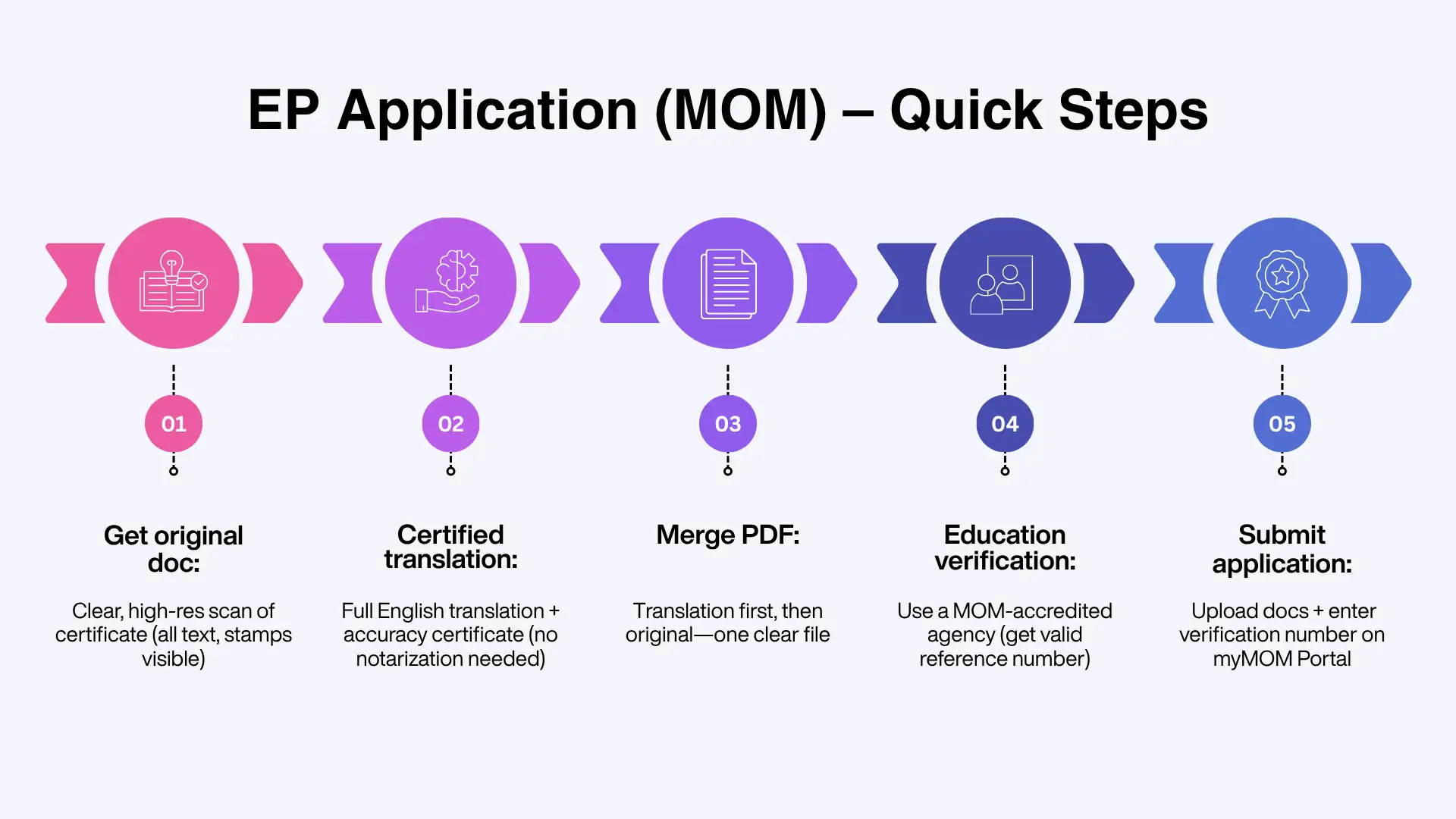
Let's walk through the end-to-end document preparation workflow for a non-English qualification being submitted in an EP application.
- Step 1: Obtain the original document. This is the degree certificate, diploma, or professional qualification credential in its original language. Ensure you have a high-resolution scan. MOM officers need to be able to read all text, stamps, and seals clearly.
- Step 2: Commission a certified English translation. Engage a professional translation service provider. The translation must be complete (covering every element of the original, including institutional stamps and margin notes) and accompanied by the translator's certification of accuracy. You do not need notarization for MOM purposes. Singapore-based providers like LetterCrafts, which specializes in certified translations across 80+ languages and is familiar with MOM's formatting expectations, can typically deliver within 24–48 hours for a standard degree certificate.
- Step 3: Merge into a single PDF. Combine the English translation and the original-language document into one file. Place the translation first. Verify that the file is within MOM's upload size limit and that all pages are clearly legible.
- Step 4: Commission education verification. Engage one of MOM's 12 accredited screening agencies. Specify that the verification is for MOM EP purposes. This ensures the report will be generated in the correct format with the mandatory reference number. Standard reports produced for other screening purposes will not meet MOM's requirements.
- Step 5: Submit the EP application. Upload the merged translation/original file and the verification proof through the myMOM Portal. Key the MOM verification reference number into the designated field in the application form.
What are the financial costs involved in EP translation and verification?
Costs vary by screening agency, the candidate's country of education, and whether an accreditation check is required in addition to an authenticity check. As a general range, expect education verification fees from MOM-accredited agencies to fall between S$105 and S$150 for a standard single-qualification check. Additional charges may apply for institution accreditation checks, expedited processing, or verifications involving countries with longer turnaround times.
Certified translation fees depend on the source language and document length. For a single degree certificate, providers like LetterCrafts offer certified translations starting from S$38 per page with no additional GST, well below the market average in Singapore. Some agencies offer bundled translation-and-notarization packages if the candidate also needs documents for ICA or other government bodies.
These are not large sums in the context of an EP application (where the pass issuance fee alone is S$225). But they are recurring costs for organizations with significant foreign headcounts, and they deserve budget line-item treatment rather than ad-hoc expense claims.
How LetterCrafts Helps Employers Get MOM-Ready Without the Guesswork
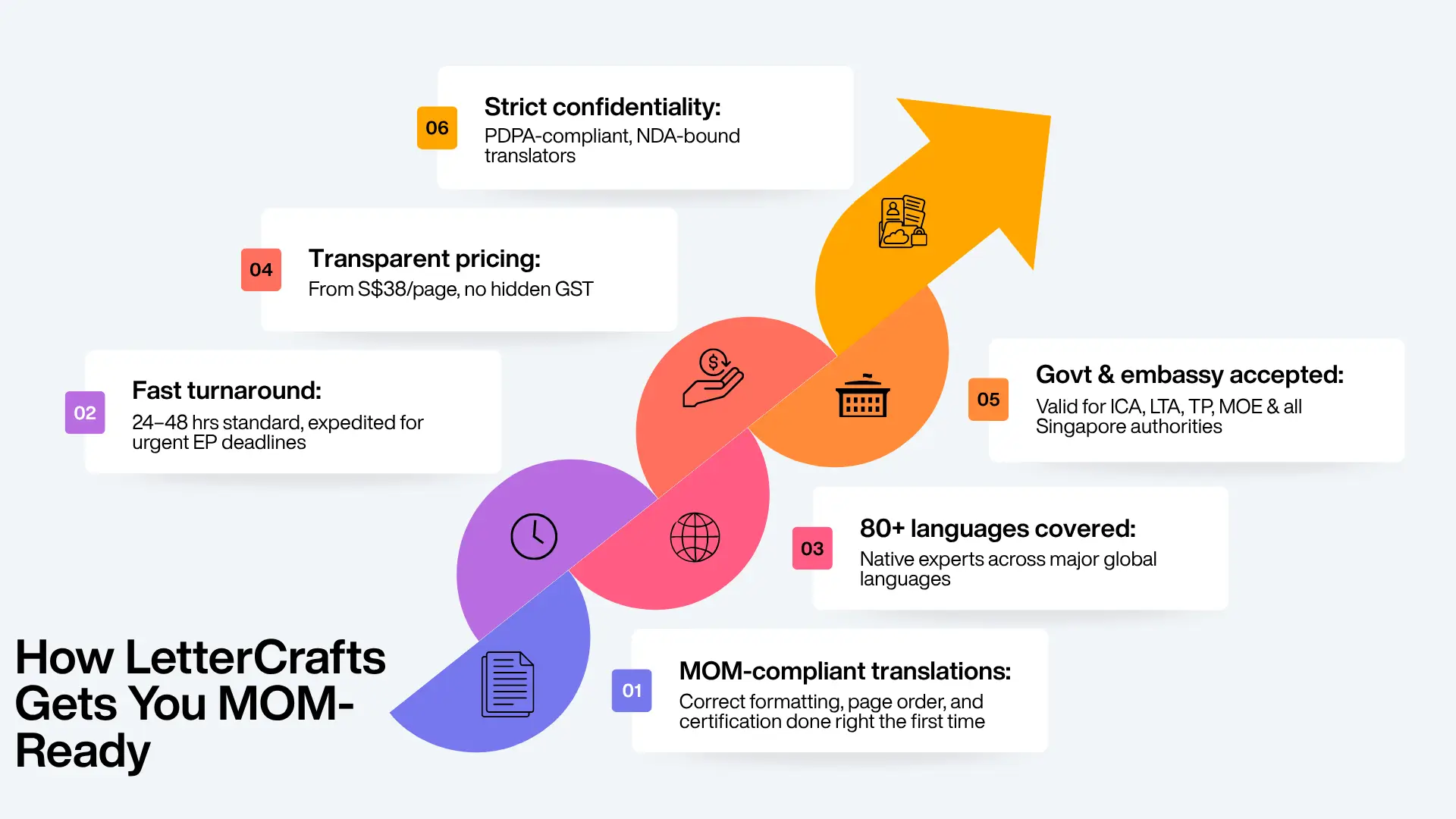
When an EP application hinges on whether a translated degree certificate is formatted correctly, merged in the right page order, and accompanied by a proper certification, you need a translation partner that understands MOM's expectations from the inside out. That's where LetterCrafts comes in.
80+ Languages, One Standard: From Mandarin and Malay to Japanese, Korean, Thai, Bahasa Indonesia, Vietnamese, French, Portuguese, and Arabic, LetterCrafts covers the full spectrum of languages EP candidates bring to Singapore. Every translation is handled by a native-speaking linguist with subject-matter expertise.
Accepted by ICA, LTA, TP, MOE, and Other Govt agencies in Singapore and All Embasies.: LetterCrafts is a Singapore-registered translation service (UEN: 201728634E) whose certified translations are accepted by all Singapore government bodies. Every document ships on LetterCrafts letterhead with an official company stamp and a signed Certificate of Translation.
24-Hour Turnaround Available: Standard degree certificate translations are typically completed within 24–48 hours. For urgent EP submissions with tight MOM deadlines, LetterCrafts offers expedited processing so your application doesn't stall waiting for a translated document.
From S$38/Page, No GST: Transparent, competitive pricing starting at S$38 per page with no hidden GST charges. For HR teams managing multiple EP applications simultaneously, this predictability helps with budget planning, not ad-hoc expense surprises.
PDPA-Compliant Confidentiality: All translators are bound by Non-Disclosure Agreements and governed by Singapore's Personal Data Protection Act. Candidate documents are never shared with third parties and are deleted within 3 months or immediately upon client request.
Whether you're a startup founder filing your first EP application or an HR director managing 200+ work passes across APAC, LetterCrafts fits into your workflow at the exact point where translation compliance meets MOM's expectations. No ambiguity about certification standards. No second-guessing page order. No scrambling for notarization, you don't need. Just clean, certified, MOM-ready translations delivered fast.
Get a Free Quote → info@lettercrafts.org
What common mistakes lead to EP application delays or rejections related to documents?
After reviewing hundreds of EP submissions and consulting with screening agencies, the most frequent failure points cluster around a handful of recurring patterns.
- Submitting pre-September 2023 verification reports without a reference number. This is the single most common preventable rejection. The report may be valid, but it is not submission-ready. The fix is a reissue request to the original screening agency.
- Uploading translation and original as separate files. MOM expects a single merged document. Two separate uploads create processing confusion and may trigger a request for resubmission.
- Placing the original-language document before the translation in the merged PDF. While not a rejection trigger, it introduces unnecessary friction. Translation first, original second.
- Using a non-accredited screening provider. Only the 12 agencies listed on MOM's website are accepted. Reports from any other provider, regardless of their reputation or thoroughness, will be rejected.
-
Failing to capture faculty information during candidate intake. Under the 2026 lists, faculty is a scoring determinant for Group B institutions. If your HR intake form doesn't capture faculty, your team will be chasing candidates for this information at submission time, when delays are most costly. - Confusing notarization with verification. A notary stamp on a degree certificate does not satisfy MOM's verification requirement. These are distinct processes. MOM explicitly states that education certificates certified by a notary public are not accepted as verification proof.
2026 Compliance Checklist
Print this. Pin it to your wall. Share it with your team.
|
Pre-Application Preparation Run every candidate through MOM's updated Self-Assessment Tool (SAT) with the 2026 C2 parameters before deciding whether to declare qualificationsCapture faculty name (exactly as it appears on the certificate) during candidate intake, not after submission begins Determine whether to declare qualifications or forgo C2 points based on the overall COMPASS score strategy Identify whether professional qualifications appear on MOM's 2026 degree-equivalent list |
Translation & Document Assembly Commission-certified (not merely notarized) English translations of all non-English qualification documentsVerify translations are complete: all text, stamps, seals, and dates covered Merge as a single PDF: English translation first, original-language document second Confirm the merged file is within the MOM portal upload size limit and fully legible |
|
Verification Process Engage only one of MOM's 12 accredited screening agencies. Check the official list at mom.gov.sgSpecify that the verification is for MOM EP purposes (not a general background check) Allow adequate lead time: 7–15 business days standard; 15–25 days for India & South America Confirm the report includes the mandatory MOM verification reference number |
Archive Audit (The Sept 2023 Gap) Audit all existing verification proofs: identify any issued before 1 September 2023Tag pre-Sept 2023 files for reissue, contact the screening company proactively Confirm the screening company that issued older reports is still on MOM's approved list Store MOM reference numbers in a consistent HRIS field or folder naming convention |
|
Submission & Record-Keeping Key the MOM verification reference number into the EP application form. This is a required structured inputUpload merged translation/original PDF and verification proof through myMOM Portal Select both institution name and faculty in the EP form dropdowns (2026 requirement) Document your verification strategy (declare vs. forgo C2) for internal compliance records |
Ongoing Governance Monitor MOM for annual C2 list updates (typically released in November for January effectiveness)Build faculty data capture into your standard HR intake template Track screening agency data retention policies, and know when records may expire Brief hiring managers on the "trust economy" model: employer liability for credential claims is real and enforceable |
Conclusion:
The days of treating an Employment Pass application as a routine filing are behind us. MOM has, through COMPASS and its mandatory verification regime, turned every data point into a pass-or-fail decision for the faculty on a certificate, the reference number on a screening report, even the page order of a translated PDF.
The employers who navigate this well aren't necessarily the ones with the strongest candidates. They're the ones with the tightest processes. They capture faculty data at intake, not at submission time. They audit their verification archives before renewal season, not during it. They commission certified translations from providers who already know what MOM expects, rather than repurposing a notarized document from another jurisdiction and hoping for the best.
MOM's "trust economy" model isn't softening, it's tightening. More granular C2 lists, faculty-level scoring, and expanded professional qualification recognition with mandatory proof. Each refinement adds another place where a small misstep can derail an otherwise strong application.
But here's what makes this manageable: the cost of getting it right is remarkably low. A certified translation starting from S$38 per page. A verification turnaround of 7 to 15 business days. A one-time document audit that takes an afternoon. These aren't burdensome investments; they're the minimum inputs that separate confidence from chaos.
Get the translation right, and the rest of the process follows.
LetterCrafts Translations | lettercrafts.org | info@lettercrafts.org | +65 6711 0135