Key Takeaway
- Cambridge and Pearson A-Levels, O-Levels and IGCSEs are issued in English worldwide and need no translation for Singapore.
- IB programmes run in English, French and Spanish, so a French or Spanish IB results certificate does need English translation.
- ICA accepts three routes: embassy translations, notary translations, or private translations that are embassy-attested or notarised.
- ICA endorses no private translation company. Only whether your translation follows one of its published routes matters.
- MOE requires an accurate English translated copy of the birth certificate and other non-English documents for AEIS applications.
- NUS requires translated transcripts and degree scrolls to be certified by the issuing institution, not by a Singapore translator.
- MOM wants the original and its English translation uploaded as one file; a notary stamp is not education verification proof.
- Malaysia and Taiwan are not Apostille Convention parties. Viet Nam joins on 11 September 2026, Thailand on 28 February 2027.
Your daughter finished the IB in Madrid. Your son sat Cambridge A-Levels in Kuala Lumpur. The family is relocating to Singapore in ten weeks, and someone has asked for "certified translations of the educational certificates".
Before you spend a dollar, settle two questions. Does the document actually need translating? And which Singapore body is asking, because ICA, MOE, the universities and MOM each want something different, and the gap between them is where most document packages come unstuck.
We prepare this work at LetterCrafts every week for relocating families and international students. A fair number of our enquiries end with us saying the certificate is already in English and needs nothing done to it. This guide is written so you can get to that answer yourself, and know precisely what to do when translation genuinely is required.
Which Certificates Actually Need Translating?
What matters is the language the certificate was issued in, not where your child studied.
Cambridge and Pearson qualifications: no translation. A-Levels, O-Levels and IGCSEs come in English wherever the exam was sat. A Cambridge IGCSE from Mumbai, Nairobi or Ho Chi Minh City arrives in English. If someone quotes you for an English translation of one, ask what they think they're translating.
IB: usually no, occasionally yes: The IB runs its programmes in three working languages, English, French and Spanish , and issues results documents in the language of the programme. An English-medium IB Diploma needs nothing. A Diploma Programme results certificate from a Spanish-medium school in Latin America, or a French-medium school in Europe or francophone Africa, does need a certified English translation for Singapore.
National qualifications: almost always yes: This is where the volume sits, because most families arriving here hold something other than a Cambridge or IB certificate. SPM and STPM from Malaysia, the UEC, Chinese senior secondary and gaokao records, the Indonesian ijazah and school transcript, the Vietnamese upper secondary diploma, Indian Class X and XII marksheets from state boards, the German Abitur, the French Baccalauréat, the Thai Matthayom certificate. These are the functional equivalents of an O-Level or A-Level, and none of them arrives in English.
The paperwork around the certificate: Even when the headline qualification is in English, the rest of the file usually isn't. Earlier-year transcripts and report cards, the school leaving or transfer certificate, the birth certificate, a household or family register, the parents' marriage certificate, a deed poll. In our experience, these hold up more applications than the certificates do, because families arrive assuming the certificate was the hard part.
The Four Gatekeepers, And What Each One Wants
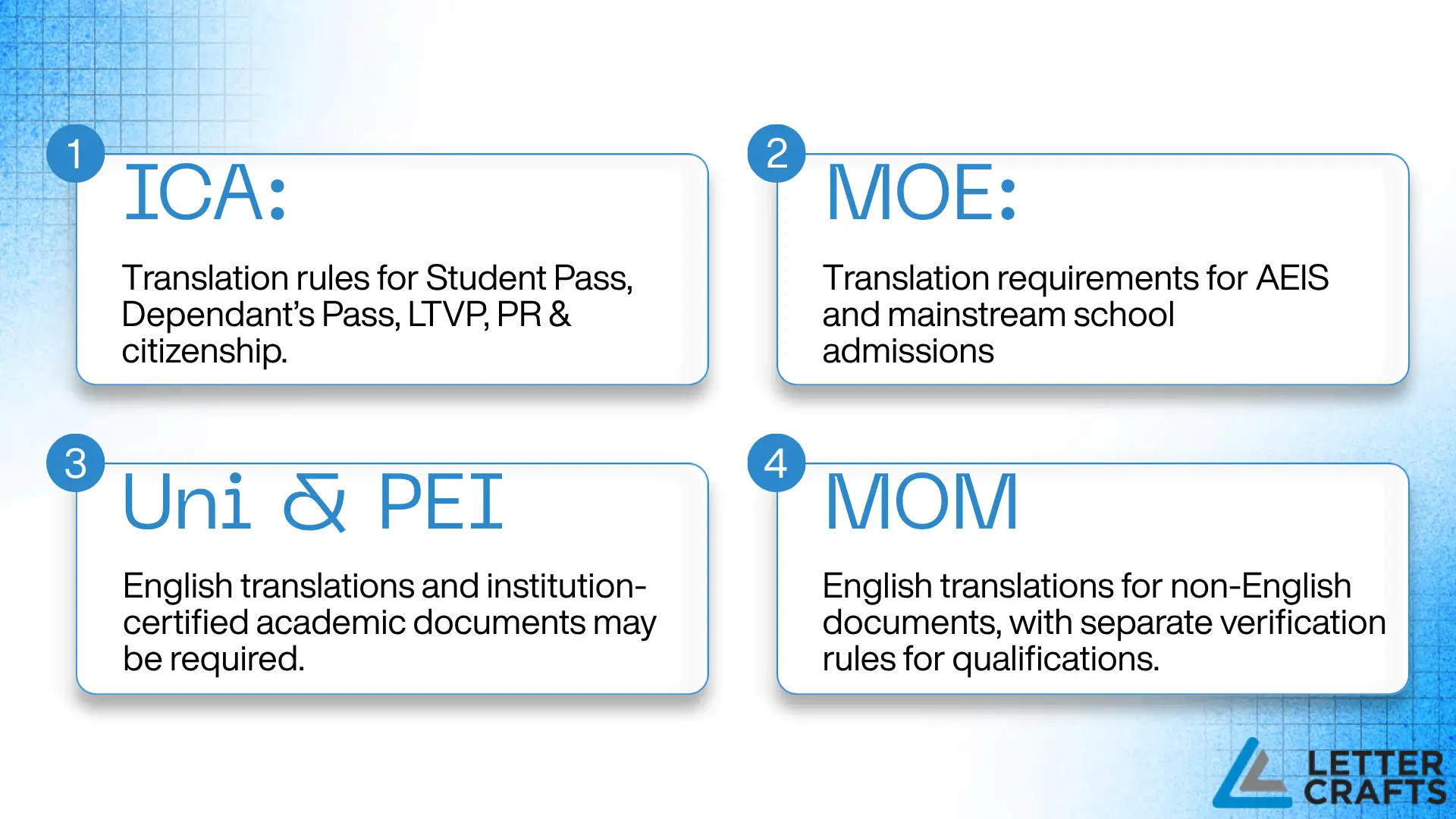
1. ICA: Student's Pass, Dependant's Pass, LTVP, PR and citizenship
ICA publishes its rules on every Student's Pass page, broken out by institution type. The page for Foreign System Schools and privately-funded schools states that you must provide original documents and official translations for anything not in English, plus copies for ICA to retain.
ICA accepts:
- Translations provided by the embassy of the country or place that issued the document;
- Translations produced by a Notary Public in Singapore or in the issuing country or place;
- Privately created translations that are then attested by the issuing country's embassy, or notarised by a Notary Public in Singapore or in the issuing country or place.
The same three routes appear in ICA's general guidance on non-English documents, together with a sentence worth reading twice: ICA does not endorse any private translation companies or entities, and insufficient documentation may result in non-acceptance.
Nobody in Singapore can sell you an ICA-approved translation. Any agency claiming otherwise is overstating its position. What a provider can do is produce work that sits cleanly inside route two or route three, which is the only thing ICA is actually looking at. Our guide to ICA translation and notarisation works through the mechanics.
A cost-saving detail most families miss: ICA advises that photocopies of educational certificates and result transcripts may be certified by authorised personnel from the issuing school, signed and endorsed with the school's stamp, with originals possibly requested at collection. That handles the copy certification step far more cheaply than notarisation. It does nothing about language, so a non-English document still needs one of the three routes above.
Timing: For Foreign System Schools, ICA asks for the application at least two months and not more than three months before the course begins. The processing fee is S$45, with processing stated as within one week, or two if a visa is required. Windows differ by institution type, so use the page matching your school: government and independent schools, institutes of higher learning, or approved private education institutions.
2. MOE: AEIS, S-AEIS and mainstream school places
If your child wants a place in a government or government-aided school, the route depends on age. Children aged 7 and above sit the Admissions Exercise for International Students or its supplementary round. Those seeking a junior college or Millennia Institute place apply directly to the school in December, and polytechnics and universities are approached directly.
MOE's AEIS application instructions call for the child's birth certificate, with an accurate English translation if it is in another language, along with the passport bio-data page, a photograph, and possibly further documents such as a marriage certificate.
Here's the thing families rarely anticipate: AEIS is a centralised English and Mathematics test, so admission turns on test performance, not on the certificates your child already holds. The translation burden at this stage is identity and family documents. Most people arrive braced for the opposite.
3. Singapore universities, polytechnics and PEIs
Admissions offices ask for two things at once and usually receive one.
NUS's Faculty of Arts and Social Sciences sets out the pattern for graduate applicants: supporting documents must be in English or accompanied by an official English translation, and translated copies must be certified true copies. Then comes the clause that changes the plan: translated copies of transcripts and degree scrolls must be certified by the issuing institution.
That is a genuinely different requirement, and one no Singapore translator can satisfy on your behalf. For transcripts and scrolls specifically, the translation needs to come back through the university that awarded them, or at least carry that university's certification. If you are still in the source country, sort it before you leave. Once you're in Singapore, chasing a registrar across time zones adds weeks. Requirements vary by faculty and programme, so read the checklist for the exact course rather than a generic university page.
4. MOM: the parents' work passes and the family's Dependant's Passes
Not a student requirement, but it lands on the same family in the same fortnight.
MOM's guidance states that for non-English documents you must upload the original document and an English translation, and that the translation can be done by a translation service provider. The same document carries a warning that catches out experienced HR teams: education certificates certified by a Notary Public are not accepted as verification proof for qualifications.
Translation, notarisation and MOM's education verification are three separate processes and none substitutes for another. MOM's portal also expects the original and the translation as a single merged file. We cover the operational details in our guide to MOM Employment Pass translation and verification.
Certified, Notarised, Apostilled: Three Words, Three Jobs
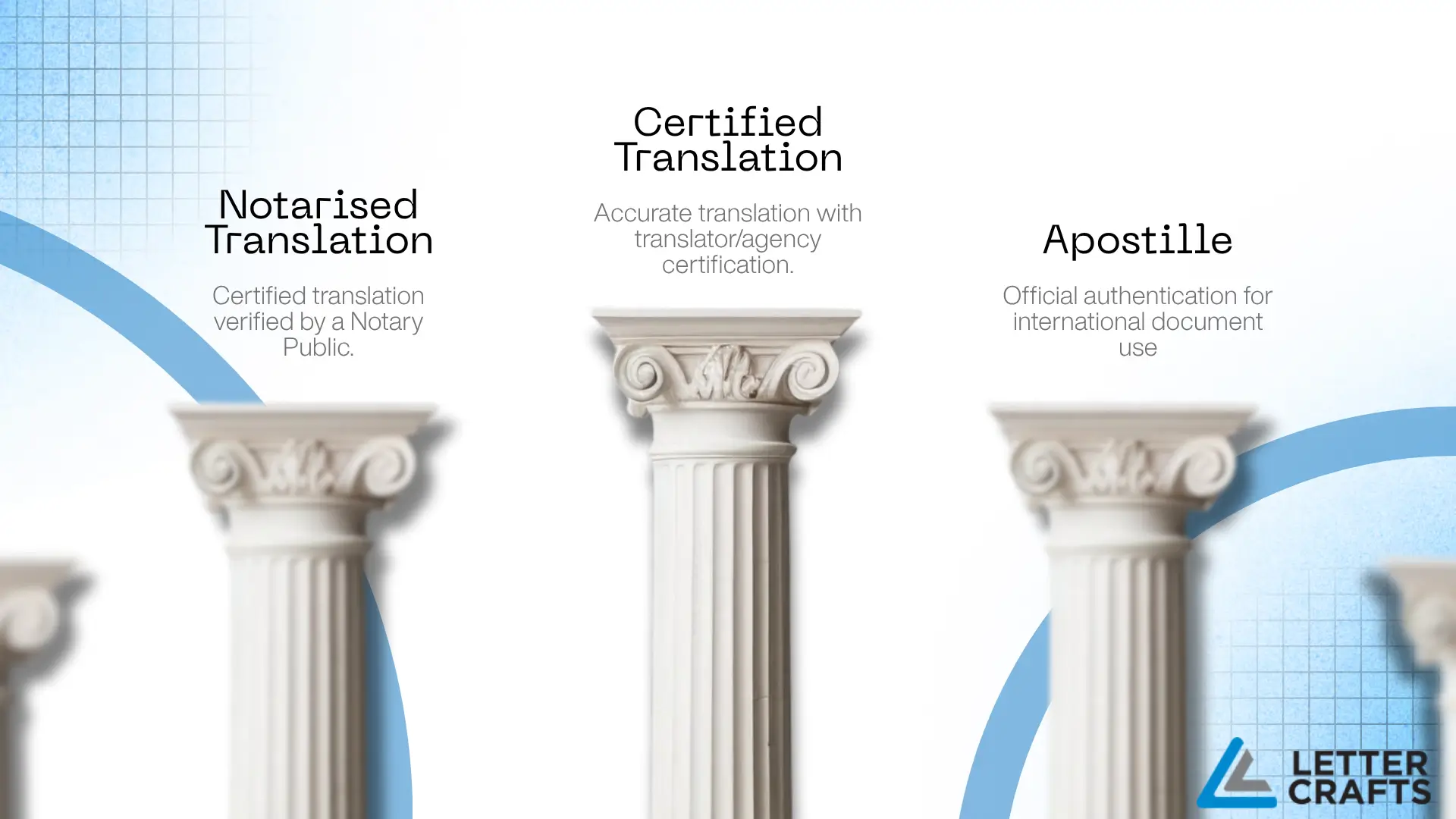
Certified translation: The translation plus a signed statement from the translator or agency, on letterhead, attesting that it is complete and accurate. This is what MOE, MOM, most universities and most PEIs mean by "certified translation".
Notarised translation: A certified translation where a Singapore Notary Public witnesses the signature and issues a Notarial Certificate. This is ICA's route two and route three.
Apostille: Authentication of a public document for cross-border use. For a document coming into Singapore, the apostille is issued in the country that produced it, not here.
Why the process here looks unfamiliar to European families
Applicants from Germany, Spain, France or Italy go looking for a Singapore sworn translator and can't find one, which is unsettling when their home system treats sworn status as the whole point.
There is nothing to find. The German Embassy in Singapore says so plainly: "there are no officially appointed or sworn translators in Singapore". Its own process is that a translator from its acknowledged list does the work and the Embassy then certifies the translator's signature. The French Consulate operates the same way, holding specimen signatures so the translator needn't attend your appointment.
Singapore substitutes an authentication chain for a sworn-translator institution. Weight comes from who verifies the signature afterwards, not from a status the translator carries. Once that lands, ICA's three routes stop looking arbitrary and start looking like the only sensible design.
The Singapore chain, with the actual numbers
The Singapore Academy of Law is the Competent Authority, appointed when the Apostille Convention entered into force for Singapore on 16 September 2021.
A translation produced in Singapore is a private document, so it goes the notary route. Both the notarisation fee and SAL's authentication fee of S$87.20, including GST, are paid upfront at the Notary Public's office. The Notary issues the Notarial Certificate on payment, and SAL affixes an Apostille to the back of it. The ordinary S$10.70 legalisation fee is waived for notarised documents, so don't pay a second time at the counter.
Constraints worth knowing before you plan around SAL, set out in its legalisation guidance and FAQ: originals only, no submissions by post or courier, a proxy is allowed without an authorisation letter, laminated documents cannot be apostilled, and SAL does not provide translation.
Fees are set by SAL and were accurate at the time of writing. Check before budgeting.
Incoming Apostilles: What Singapore Accepts, And From Where
If a Singapore institution asks for the foreign certificate to be apostilled, that apostille comes from the competent authority in the issuing country. Singapore's accession means Singapore authorities accept apostilles in place of legalisation for incoming public documents from other Contracting Parties.
Two points cause most of the confusion.
An apostille does not translate anything. It authenticates origin. A Chinese senior secondary record with a Chinese apostille attached is still a Chinese-language document, and ICA will still want an English translation through one of its three routes.
Not every source country is in the system. As at the HCCH status table's 30 June 2026 update, the Convention has 130 Contracting Parties. Set against Singapore's main inbound flows:
- China joined on 7 November 2023, ending the old embassy legalisation chain for Chinese documents.
- India, Indonesia and the Philippines are long-standing parties.
- Vietnam joins on 11 September 2026. Documents used before that date follow the older consular route, so check which side of the line you fall on.
- Thailand is scheduled for 28 February 2027.
- Malaysia and Taiwan are not parties. Given how many Malaysian and Taiwanese qualifications circulate here, this matters more in Singapore than almost anywhere. Those documents need legalisation through the relevant mission, not an apostille.
- Myanmar, Cambodia and Laos are also outside the Convention.
The translation requirement runs in parallel and is unaffected by any of it.
What We See Go Wrong
Paying to translate an English document: Cambridge, Pearson and English-medium IB documents are already in English.
Supplying a certified translation when a certified true copy was also needed: Universities routinely want both, and sometimes want the translation certified by the issuing institution rather than by anyone here.
Notarising before the translation is signed off: Translate, review, then notarise. After notarisation, one corrected spelling means starting over and paying again.
Name mismatches: The foreign certificate, the passport, the birth certificate and the application form must reconcile. Chinese names transliterated inconsistently across documents, Indonesian mononyms, Malay and Arabic patronymics, Indian names with expanded initials. Flag any of these to your translator at the start so they can be handled with a translator's note, rather than surfacing as a query at the ICA counter. Our note on what happens when a translation is rejected covers how these get resolved.
Converting the grades: A translation reproduces the record. Turning a Malaysian 1A or a Chinese 优秀 into a Singapore A1 is an admissions judgment, not a translator's. Translate the grade as issued and reproduce the certificate's own grading key alongside it.
Dropping seals and stamps: Officials compare documents visually. Every seal, stamp, watermark, and signature block should be accounted for, described rather than silently omitted, with the layout mirroring the source. Our sample certified translations show what that looks like in practice.
Treating a notary stamp as MOM verification: MOM says outright that notary-certified education certificates are not accepted as verification proof.
Bringing only the final certificate: Singapore institutions often want the two or three years preceding it. Order those transcripts before you fly.
Laminating: SAL cannot apostille a laminated document, and neither can most foreign competent authorities.
How LetterCrafts handles this
Most of the value in this work sits in the first ten minutes, before anything gets translated. Send us the documents plus the exact wording of what the school, university, ICA officer or HR team asked for, and the first thing we do is work out which standard actually applies. Getting that call right is what prevents the second round of paperwork.
| Who's asking | Standard that usually applies | What we produce |
|---|---|---|
| ICA (Student's Pass, DP, LTVP, PR) | Certified translation + notarisation by a Singapore Notary Public | Translation, then notarisation and SAL authentication arranged end-to-end |
| MOE (AEIS, school admission) | Accurate English translation of non-English supporting documents | Certified translation on letterhead with Certificate of Translation |
| Universities, polytechnics, PEIs | Certified translation, often as a certified true copy | Certified translation; we flag where the institution must certify it instead |
| MOM (parents' EP, S Pass, DP) | Certified translation, original and translation merged as one file | Certified translation supplied ready to merge |
How the document is built: Every translation is issued on LetterCrafts letterhead with a signed and stamped Certificate of Translation as the cover sheet, and the layout mirrors the source page for page. Seals, stamps, marginal notes, and back-page endorsements are described rather than dropped. Grades are reproduced as issued, with the original grading key alongside them, because converting a Malaysian 1A or a Chinese 优秀 into a Singapore equivalent is the admissions office's job, not ours. You can see the format in our sample translations.
Languages that actually come up here: Mandarin, Malay, Bahasa Indonesia, Vietnamese, Thai, Tamil, Hindi, Korean, Japanese, Arabic, French, Spanish, German, and Portuguese cover most inbound school files, and we work across 80+ languages in total.
Practicalities: Scans or clear photos are enough to start; we only need the physical original when the original itself has to be sighted or certified by the notary. Our notary office is at The Adelphi, the same building as SAL's counter at 1 Coleman Street, which keeps the notarisation and authentication leg short. Finished work goes out by email, SingPost, courier or self-collection, and current per-page rates are published on our pricing page rather than quoted case by case. Translators are bound by NDAs, files are handled under the PDPA, and documents are deleted on request.
What we don't do, and won't claim: No translation company in Singapore is ICA-approved, and any provider telling you otherwise is misrepresenting ICA's published position. We can't produce a sworn translation because Singapore has no sworn translators. We can't certify a transcript on behalf of a foreign university where the institution's own certification is required. And we can't substitute for MOM's education verification, which has to come from an accredited screening company. Where one of those is your actual requirement, we'll tell you and point you at the right party instead of selling you something adjacent.
How Long To Allow
Published timings first. ICA asks for Student's Pass applications two to three months before the course starts for Foreign System Schools, with the window varying by institution type. SAL needs no appointment for authentication, and its counter runs 9.00 am to 4.30 pm on weekdays.
From our own workflow: a certificate-and-transcript pair usually translates within one to two working days, with notarisation and SAL authentication adding a few more. The wild card is always the source country. Apostilles and consular legalisation abroad commonly take one to four weeks, longer in some jurisdictions.
The real constraint isn't Singapore. It's that most of the collecting has to happen while you or someone acting for you is still in the source country. Order spare certified copies of everything before you leave. Flying back for a document you didn't collect is the expensive version of this mistake.
If you're not sure which of these applies to your family, send us the documents with the exact wording of what was asked for, and we'll tell you what standard applies before you commit to anything. Our academic and education document translation work covers certificates, transcripts, school leaving records and the family documents that travel with them.