Key Takeaway
- A passport already showing your details in English usually needs no translation; translate the foreign-language documents accompanying it instead.
- ICA accepts translations from an issuing country's embassy, a notary public, or private translations later notarised or embassy-attested, and endorses no private company.
- MOM accepts a certified English translation with no notarisation, uploaded together with the original as a single file.
- For Permanent Residence and citizenship, ICA generally expects notarisation or embassy attestation, not a certified translation on its own.
- For ROM marriages, foreigners present an original valid passport; foreign-language supporting documents need translation plus foreign-ministry or embassy endorsement.
- Since 1 October 2019, every Singapore notarial certificate must be authenticated by the Singapore Academy of Law to be valid.
- An apostille is for using Singapore documents abroad in Hague Convention countries, not for local ICA, MOM, or ROM submissions.
- Your translated documents must match your passport's name exactly; MOM requires an explanation letter and deed poll for any mismatch.
Plenty of Singapore firms will translate your passport for a fee. Far fewer will tell you whether you need the translation at all.
For many people, you don't. Passports are built to be read across borders, so most already show the holder's core details in the Roman alphabet, which is what international travel-document standards call for. In practice, the passport is often the one item in an application that needs no translation. The documents that actually cause problems are the ones travelling with it: a birth certificate, a marriage certificate, a divorce order, or a page of foreign-language endorsements.
The exceptions are real, though. Some passports print the biographical page in the national script alone, and some Singapore processes turn on a single non-English detail inside the booklet. Miss the translation there, and the application gets queried or sent back.
So this piece is built around two questions: when a passport genuinely needs translating in Singapore, and what each authority will actually accept. It reflects how we handle these files at LetterCrafts, a Singapore-registered translation company, and every requirement below is tied to the Singapore government source it comes from, with the Immigration and Checkpoints Authority (ICA), the Ministry of Manpower (MOM), and the Registry of Marriages (ROM) treated separately, because they do not ask for the same thing.
Do You Actually Need Your Passport Translated?
Look at your passport's biographical page first: the one with your photograph, name, date of birth, and passport number.
If those details already appear in English, or at least in Roman script, a Singapore officer can read the passport as it stands, and you almost certainly do not need it translated. That covers most travellers.
A translation becomes necessary in narrower situations:
- The biographical page is printed only in a non-Latin script, with no English shown.
- The detail that matters sits in a foreign-language endorsement, observation, or stamp: a name-change note, a former-name entry, an official remark, or an entry or exit record an authority wants to read.
- The organisation you are dealing with has its own rule that a non-English identity document must come with a certified English translation.
Translate the part an officer cannot read, not the whole booklet by reflex. And if your wider application holds foreign-language civil documents, that is where to spend your translation budget, because that is where Singapore submissions usually succeed or stall.
When Passport Translation Is Genuinely Required In Singapore
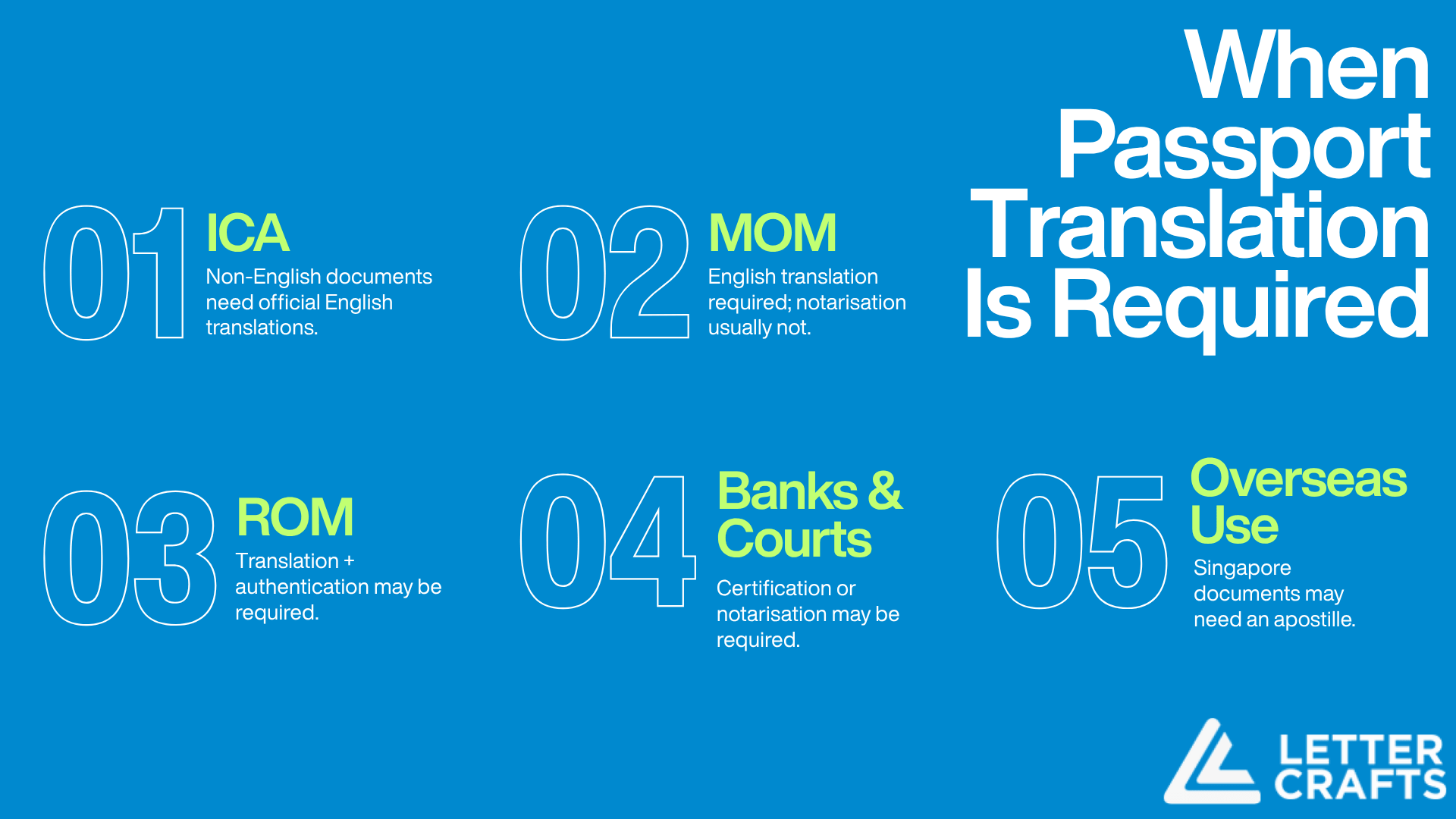
ICA: PR, citizenship, and long-term passes
ICA handles Singapore's residency and immigration matters, from Permanent Residence (PR) and citizenship to long-term passes such as the Long-Term Visit Pass and the Student's Pass, along with processes like renunciation or confirmation of citizenship.
The rule is consistent across them. You submit the originals with official English translations of anything not in English. On the citizenship route, for instance, ICA asks applicants to upload certified true copies and official translations of documents in other languages.
For most applicants, the passport is not the issue, since it already carries English. The translations ICA is looking for tend to be the birth certificate, marriage certificate, divorce order, or household register. The rule still reaches the passport, though: if the biographical page is in a non-English script, or ICA needs to read a foreign-language endorsement inside it, that element must meet the same standard as the rest of the file.
ICA sets the highest bar of the Singapore agencies, and it is where casual or self-made translations come unstuck. Anyone preparing a PR or citizenship submission should get familiar with the ICA translation and notarisation process before ordering, because the certification step, not the translation itself, is what usually goes wrong. That chain is the part we take off your hands: LetterCrafts handles the certified translation, arranges the notary public appointment, and sees the notarial certificate through SAL authentication, so your documents reach ICA in an accepted form rather than coming back for rework.
MOM: Employment Pass, S Pass, Work Permit
MOM handles work passes, and passport translation shows up here more directly than at ICA, because the passport's personal-particulars page is a required upload.
For an Employment Pass, MOM wants the personal-particulars page showing the candidate's details and facial features clearly. If that page is not in English, it needs translating so an officer can read it.
MOM's translation rule sits on its own document pages: for non-English documents, you upload the original together with an English translation as a single file, and a translation service provider can do the work. That holds across the pass types and the supporting documents behind them, degree certificates and transcripts included.
One MOM detail connects straight back to your passport. Where the candidate's passport name differs from the name on other documents, MOM asks for an explanation letter and supporting documents such as a deed poll. It is the same name-consistency logic that runs through every Singapore submission, with the passport as the reference point.
What MOM does not ask for is just as useful to know: no notarisation. A certified translation from a translation service provider is enough. The certified format MOM expects, letterhead plus a signed certificate of translation, is exactly what LetterCrafts produces for work pass documents, ready to pair with your original as the single file MOM asks for. Paying to notarise a MOM-only application, by contrast, spends money and days on a step MOM never required.
ROM: marrying in Singapore or registering an overseas marriage
If you are a foreigner marrying in Singapore, or a Singaporean registering a marriage held abroad, ROM is the authority in question.
For the couple, ROM works from originals. A foreigner presents an original valid passport, and the parties' identity documents must be originals or certified true copies, not photocopies. The passport itself serves as identity and is not usually something ROM asks you to translate.
Translation enters through the supporting documents. If both parties are on short-term visit passes, each needs a Letter of No Impediment to Marriage from their home country's authority, and any foreign-language document must be authenticated, either by that country's Ministry of Foreign Affairs and endorsed by the Singapore mission there, or by the country's embassy in Singapore, as set out in ROM's civil marriage process. The same pattern applies when you register an overseas marriage: a foreign-language marriage certificate needs an English translation that is itself endorsed by the Ministry of Foreign Affairs (or carries an apostille) and the Singapore embassy, or by the issuing country's embassy in Singapore.
Where a foreign marriage certificate is in play, the endorsement chain matters as much as the wording, and it helps to see how a foreign marriage certificate is handled for Singapore before the appointment.
Banks, courts, and other institutions
Outside government, private and legal processes set their own terms.
Banks, insurers, and similar institutions decide their own documentation rules. Some will ask for a certified English translation of a non-English passport page, or of a particular endorsement, before opening an account or processing a request. Because this varies from one to the next, confirm the exact standard with the organisation rather than assuming.
Legal matters tend to be stricter. Singapore courts and legal processes generally expect foreign-language documents to arrive with a translation, often a notarised one, depending on the matter. If a lawyer or a court has asked for a translated passport or endorsement, check whether they want certification, notarisation, or both, so you order the right level once.
Using a Singapore document overseas
Sometimes the direction reverses: you need a Singapore-notarised document, which may attach or reference a passport, for use in another country. That is apostille territory.
Singapore belongs to the Hague Apostille Convention. It deposited its instrument of accession in January 2021; the Convention came into force for Singapore on 16 September 2021, and the Singapore Academy of Law (SAL) is the country's designated Competent Authority for apostilles. An apostille lets a Singapore document be accepted in another member country without further embassy legalisation. It is for outbound use, not for a submission you are making inside Singapore.
What Each Authority Accepts
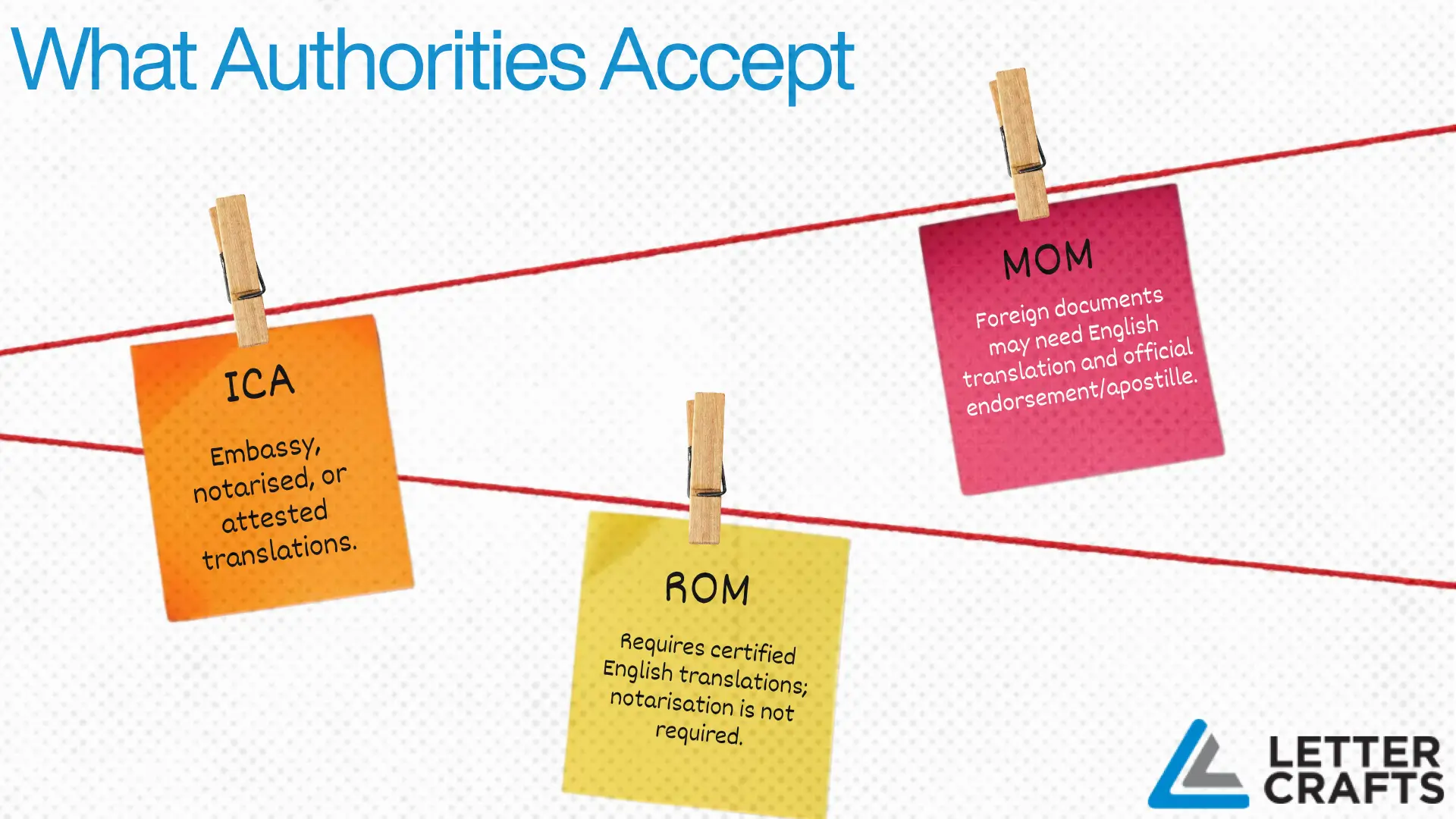
This is the heart of "what's accepted", and the answer changes by agency.
ICA's accepted routes
ICA publishes the routes it will take. ICA accepts:
- Translations provided by the embassy of the country or place that issued the document.
- Translations produced by a notary public, in Singapore or in the issuing country or place.
- Private translations that are then attested by the issuing country's embassy, or notarised by a notary public in Singapore or the issuing country.
Two things sit under that list. ICA endorses no private translation company, so no provider can offer "pre-approval". And insufficient documentation can mean your application is not accepted. A translation only helps ICA once it has gone through one of those routes.
For documents translated in Singapore, the working path is a certified translation followed by notarisation by a Singapore notary public. That notarisation now carries mandatory SAL authentication, covered in the next section.
MOM's standard: certified, not notarised
MOM keeps it lighter. It takes a non-English document uploaded with an English translation as one file, the translation done by a translation service provider, per its work pass document pages. No notarisation, no SAL step. This is the most common way people overspend on Singapore paperwork: told they need a "notarised translation", they pay to notarise a MOM application that never asked for it.
ROM's standard for foreign documents
ROM's route for foreign-language supporting documents is endorsement-led. The English translation should be endorsed either by the issuing country's Ministry of Foreign Affairs (or carry an apostille) and further endorsed by the Singapore mission there, or by that country's embassy in Singapore, per the ROM marriage process. The couple's own passports are presented as originals.
Certified, Notarised, And Apostilled: Which One Do You Need?
These three words get used loosely in marketing, and mixing them up is expensive. Here is what each means in Singapore.
Certified translation: A complete, accurate English translation with a signed statement from the translator or company confirming it is true and correct, usually on letterhead with a stamp and a certificate of translation. This is the base level, and for MOM it is normally all you need.
Notarised translation: A certified translation that a notary public, a senior practising lawyer, then attests to by issuing a notarial certificate. Since 1 October 2019, every notarial certificate issued in Singapore must be authenticated by SAL to be valid, following changes to the Notaries Public Rules. So in Singapore, "notarised" means notarised plus SAL authentication, as one chain. SAL charges an authentication fee of S$87.20, inclusive of Goods and Services Tax (GST), per notarial certificate; the notary's own fees, prescribed under the Notaries Public Rules, are separate.
Apostilled document: A notarised document whose certificate carries an apostille from SAL, which makes it recognisable in another Hague Convention country. Since 16 September 2021, SAL performs its authentication by affixing an apostille, which is why notarisation and the apostille sit so close together here. The distinction is purpose: the apostille is for cross-border use. For a Singapore submission such as ICA, what counts is that your notarised translation carries valid SAL authentication, not that it bears an apostille for its own sake.
For worked examples of when each level applies, this breakdown of certified translation, notarisation, and apostille in Singapore goes deeper.
Why Your Translated Name Must Match Your Passport
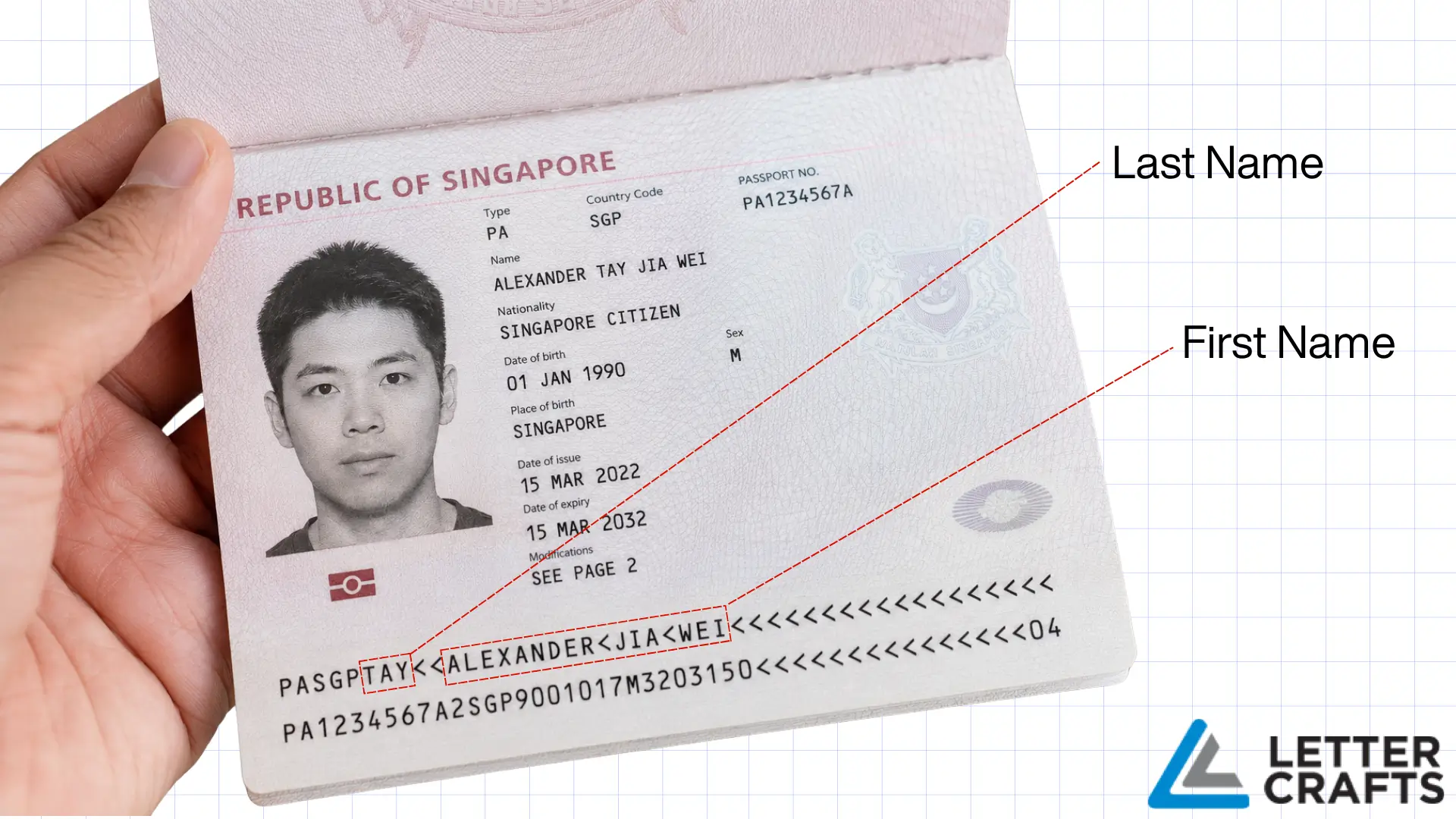
In our experience preparing documents for Singapore submissions, names cause more avoidable delays than translation quality ever does.
Chinese, Tamil, Arabic, and many other names can be spelt in English in more than one valid way. Your passport has already fixed yours, including the order of your names and the spacing. Every translated document has to match that passport spelling exactly, character for character, not a different romanisation that also looks right.
That is why the passport works as the master copy for the whole file. When a translated birth certificate spells your name one way, and the passport spells it another, an officer cannot simply assume they belong to the same person, and the file stalls. MOM writes this into its process by requiring an explanation letter and a deed poll when the passport name differs from the name on other documents, and ICA applies the same scrutiny.
The fix is straightforward, and we build it into the work: send a clear copy of your passport biographical page, we match every name to it, and we share the draft for your approval before finalising, so you confirm the spelling before anything is stamped. A short pre-submission checklist catches the rest before an officer does.
Common Passport Translation Mistakes In Singapore
- Translating the whole passport when one page or endorsement is all that is needed. If the biographical page is already in English, translating the booklet wholesale is wasted money.
- Assuming one standard fits every agency. A certified translation that satisfies MOM will not, by itself, satisfy ICA for PR or citizenship, which generally expects notarisation or embassy attestation.
- Paying for notarisation you do not need. For a MOM-only submission, notarisation and SAL authentication meet no requirement and add cost and days.
- Letting the name drift from the passport. A translation that spells your name differently from your passport is a classic cause of a query.
- Skipping stamps, seals, and the reverse side. A translation has to cover everything on the document, including seals, handwritten notes, and relevant back-of-page content. Omissions get files rejected.
- Trusting an "ICA-approved" claim. ICA endorses no private provider, so that label is a reason for caution, not comfort.
- Self-translating. Even for fluent applicants, a self-made translation is not accepted on these official routes, which are built to keep the translator independent of the applicant.
Getting It Done: How Lettercrafts Helps
Two decisions are yours before anything is translated.
- First, confirm you actually need it: check the biographical page and any endorsements, because if everything the authority needs is already in English, the passport may not need translating at all, only the other documents in your file.
- Second, identify the receiving authority and its bar, since ICA, MOM, ROM, a bank, or a court each expects a different level, from a plain certified translation to a notarised one.
From there, the mechanics are ours to run. You send clear, complete scans of the relevant pages, stamps and annotations included, and LetterCrafts prepares a certified translation on our letterhead with a signed and stamped certificate of translation, formatted to mirror your original so every stamp, seal, and endorsement is reflected.
We match each name to your passport and share the draft for your approval before finalising, so the spelling is confirmed before anything is stamped. Where ICA or a court requires it, we arrange the notary public appointment and carry the notarial certificate through SAL authentication, then courier the completed hard copies to your door. Keep your own originals safe throughout, since an authority can still ask to see them. As a Singapore-registered translation company (Unique Entity Number 201728634E) working across more than 80 languages, we prepare files for ICA, MOM, ROM, and other Singapore authorities as everyday work.
One honest point is worth repeating: no translation company is government-approved, because ICA endorses none. What a registered provider gives you is not a shortcut past the rules, but a file built to meet them the first time, in the route and format the authority accepts, so it is less likely to be queried or returned.