Key Takeaway
- A power of attorney (POA) in a foreign language is only accepted by the Singapore courts if it is accompanied by a translation certified by a sworn court interpreter, or verified by a statutory declaration of a person qualified to translate it, under Order 26, Rule 4 of the Rules of Court 2021.
- For personal use, the two most common instruments are a general or specific Power of Attorney under Part 10 of the Conveyancing and Law of Property Act 1886, and a Lasting Power of Attorney (LPA) under the Mental Capacity Act 2008.
- Foreign-issued POAs used in Singapore typically need an English translation, notarisation, and either apostille or embassy legalisation before they can be relied on for property transactions, banking, or court deposit.
- Singapore-issued LPAs and POAs used overseas usually require certified translation into the destination language, notarisation by a Singapore Notary Public, and an apostille from the Singapore Academy of Law for Hague Convention countries.
- As of 20 February 2026, 404,000 Singapore Citizens have made an LPA, and Form 1 applications are permanently free for Singapore Citizens from 1 April 2026, according to the Ministry of Social and Family Development.
- Statutory notary fees are fixed: S$75 per notarial certificate and S$87.20 per Singapore Academy of Law authentication, on top of translation fees.
- The most common reason POA translations are rejected in Singapore is the omission of seals, stamps, or handwritten notes from the source, not the translation of substantive text.
A power of attorney is one of the few personal documents where a translation error, or the wrong authentication step, can quietly derail a property sale, a bank transfer, or medical decisions for an ageing parent. The stakes are personal, and the process is unusually strict.
Singapore's framework for POA use is set out in Part 10 of the Conveyancing and Law of Property Act 1886, Order 26, Rule 4 of the Rules of Court 2021, and Paragraph 19 of the Supreme Court Practice Directions 2021. Lasting Powers of Attorney sit under the Mental Capacity Act 2008 and are administered by the Office of the Public Guardian (OPG). Each of these instruments has its own translation rule, and none of them treats a plain office translation as sufficient.
At Lettercrafts, we produce certified translations of powers of attorney for private clients whose parents live overseas, expatriates arranging Singapore LPAs, permanent residents selling foreign property from Singapore, and returning Singaporeans repatriating personal affairs. This guide brings all of that into one place, cross-checked against the current Singapore statutes, Supreme Court practice directions, and Ministry of Social and Family Development (MSF) guidance.
Quick Answer: Do I Need to Translate My Power of Attorney?
If a power of attorney was drawn up in a language other than English, and it is to be relied on in Singapore for a property transaction, deposited at the General Division of the High Court, submitted to a bank, or used to support any personal legal action, the courts and most local institutions require an English translation. That translation must be certified by a sworn interpreter of the court, or supported by a statutory declaration from a qualified translator, before it will be accepted. If a Singapore power of attorney or LPA is to be used overseas, you generally need a certified translation into the destination language, notarisation by a Singapore Notary Public, and apostille or embassy legalisation, depending on the destination country.
What "Personal Use" Actually Means in the Singapore Context
Not every power of attorney is a corporate document. In Singapore, the majority of personal-use POAs fall into a handful of recognisable situations. Knowing which situation applies to you determines the type of POA required and, in turn, the translation and authentication steps that follow.
The most common personal-use scenarios include:
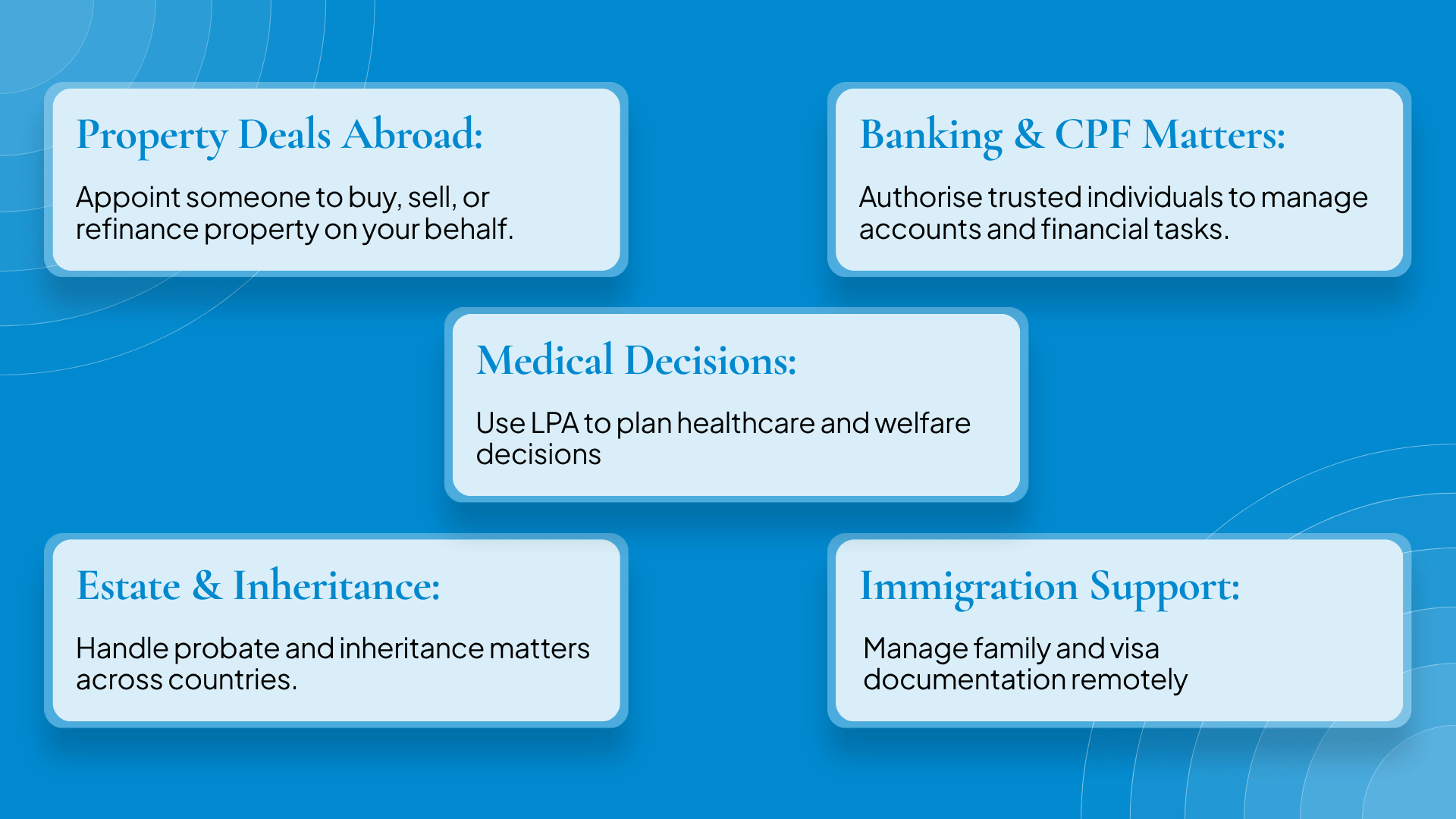
- Property transactions from abroad: A Singaporean or PR living overseas needing to sell, buy, or refinance an HDB flat or private property, and appointing a family member or lawyer as attorney to sign on their behalf.
- Banking and CPF matters: Authorising a spouse, sibling, or child to operate an account, complete a refund, or handle time-sensitive fixed deposits and CPF instructions.
- Medical and welfare decisions: Planning for incapacity through a Lasting Power of Attorney, so a trusted donee can decide on healthcare, living arrangements, and personal welfare.
- Overseas estate and inheritance matters: A Singapore resident authorising a relative in another country to represent them in probate, or vice versa.
- Immigration and family administration: Signing documents on behalf of a spouse or elderly parent during a Long-Term Visit Pass application, dependent's pass extension, or long-distance eldercare.
Each of these has cross-border language complications more often than people expect. Singapore's population reached 6.11 million as at June 2025, with 3.66 million Citizens, 0.54 million Permanent Residents, and 1.91 million Non-Residents, according to the Department of Statistics Population Trends 2025 report. Roughly one in three people in Singapore holds a passport from another country, and many private clients have parents, spouses, or property in jurisdictions where documents are drawn up in Mandarin, Bahasa Indonesia, Tagalog, Japanese, Korean, Vietnamese, Tamil, Hindi, French, German, or Russian. The moment a POA needs to cross that language line, the translation route matters.
The Two Directions of POA Translation in Singapore
Every personal-use POA translation project moves in one of two directions. Establishing the direction is the first step, because it determines which authority sets the rules.
Direction 1: A Foreign-Language POA Used in Singapore
This applies when the donor executed the POA outside Singapore in a language other than English, and the document is now needed to complete a Singapore transaction. Examples include:
- A Chinese-language POA prepared in Shanghai so a son in Singapore can sign HDB sale documents on behalf of his parents.
- A Bahasa Indonesia POA prepared in Jakarta authorising a Singapore lawyer to accept service of process.
- A Japanese POA authorising a spouse in Singapore to renew a lease and manage bank affairs during a long-term posting.
In this direction, the Singapore courts, the receiving bank, HDB, or the Land Transport Authority set the requirement. If the POA has to be deposited at the General Division of the High Court under Section 48 of the Conveyancing and Law of Property Act, translation certified by a sworn court interpreter or verified by statutory declaration of a qualified translator is mandatory.
Direction 2: A Singapore-Issued POA or LPA Used Overseas
This applies when a POA or LPA was signed in Singapore, and the document is now needed abroad. Examples include:
- A permanent resident selling an apartment in Beijing while based in Singapore, using a POA prepared here and translated into simplified Chinese for use in China.
- A Singaporean signing a Lasting Power of Attorney at home and needing the document recognised at a Portuguese bank in Lisbon, where the family owns property.
- An expatriate donor executing a general POA in Singapore to authorise a sibling in Frankfurt to complete an estate distribution.
In this direction, the receiving foreign authority sets the requirement. The Singapore Academy of Law's apostille framework, which came into force on 16 September 2021 through the Apostille Act 2020, replaces embassy legalisation for the more than 120 countries that are party to the Hague Apostille Convention. Non-Hague destinations still follow the older, multi-step legalisation process.
The direction of travel is the single most useful piece of information a translation and legalisation partner can ask for at the outset. A POA that travels in Direction 1 is prepared for Singapore submission. A POA that travels in Direction 2 is prepared for the destination country. Preparing the two the same way is one of the more expensive mistakes we see.
Types of Power of Attorney That Personal Clients Actually Use
There is no single "Singapore power of attorney." Different personal situations call for different instruments, and each has its own translation implications.
| POA Type | Governing Law | Typical Personal Use | Translation Trigger |
|---|---|---|---|
| General Power of Attorney | Common law and Part 10 of the Conveyancing and Law of Property Act 1886 | Broad authority to handle a range of personal or financial matters during absence | Needed if document is in a foreign language and is to be used in Singapore, or is a Singapore document going abroad |
| Specific or Special Power of Attorney | Common law and Part 10 of the Conveyancing and Law of Property Act 1886 | Narrow authority for one act: sign a sale and purchase agreement, refund CPF, close a bank account | Same as above, but limited to the specified act |
| HDB Power of Attorney | Common law, subject to HDB and Housing and Development Act 1959 requirements | Signing HDB purchase, sale, refinancing, or resale documents from abroad | Almost always in English, but a foreign-language POA authorising the HDB transaction still requires English translation |
| Lasting Power of Attorney (LPA) | Mental Capacity Act 2008 | Personal welfare and property and affairs decisions after loss of mental capacity | Triggered when the donor does not understand English, or when a Singapore LPA is used overseas |
| Court-appointed Deputyship Order | Mental Capacity Act 2008, sections 20 and following | Fallback where an incapacitated person never made an LPA and family members must be appointed by the Family Justice Courts | Foreign-language medical reports and supporting documents require English translation |
The Singapore Courts page on powers of attorney confirms that the General Division of the High Court only accepts POAs deposited under Section 48 of the Conveyancing and Law of Property Act. That deposit route is the gateway for personal-use POAs relating to property transactions.
For anyone planning for personal welfare or property matters, the LPA is the instrument the Singapore government actively encourages. According to a parliamentary reply from the Ministry of Social and Family Development on 5 March 2026, 404,000 Singapore Citizens had made an LPA as at 20 February 2026, roughly one in seven adults, and about one in four Singaporeans aged 65 and above. LPA Form 1 applications are permanently free for Singapore Citizens from 1 April 2026.
What the Singapore Courts Require for a Foreign-Language POA
The single most important rule is in the Singapore Courts' published guidance on powers of attorney: "The power of attorney should be deposited with a translation that is certified by a sworn interpreter of the court or verified by a statutory declaration of a person qualified to translate it."
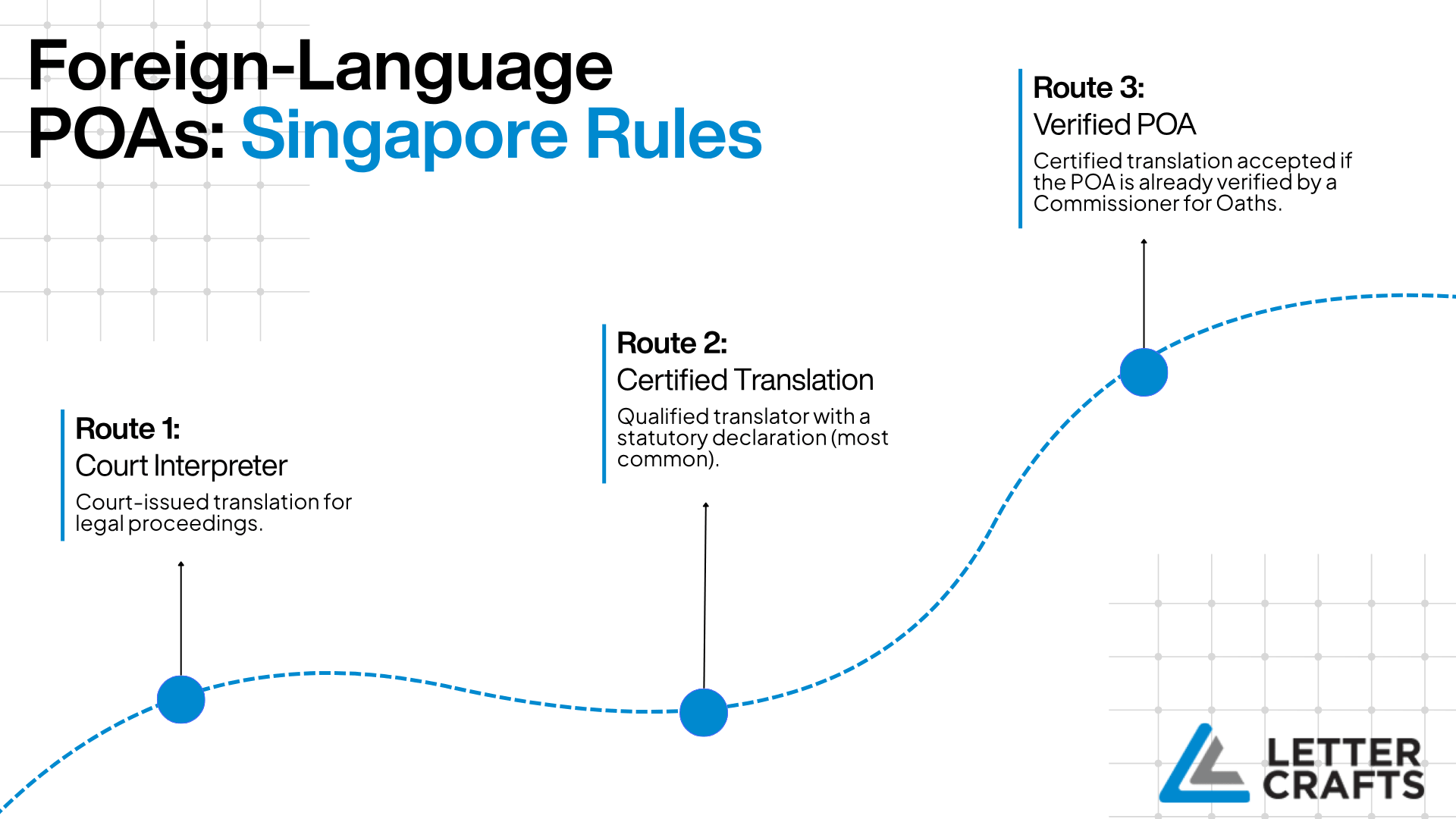
That sentence is often skimmed. It should not be. It sets three permitted routes for a personal-use POA in a foreign language.
Route 1: Translation Certified by a Sworn Court Interpreter
The Supreme Court maintains an in-house Interpreters Section that provides translation services in Chinese, Malay, and Tamil for use in Supreme Court proceedings. Under Paragraph 16(10) of the Supreme Court Practice Directions 2021, requests for translations in these three languages must be filed through the Electronic Filing Service at least four weeks before the translations are required.
This route is most commonly used where the POA is being deposited as part of active court proceedings, and the court itself organises the translation. For most personal-use POAs, the timing and case-related restrictions make this route impractical.
Route 2: Statutory Declaration by a Qualified Translator
The more common route for personal use. A qualified translator produces the English translation, then affirms in a statutory declaration before a Commissioner for Oaths or Notary Public that the translation is a true and accurate rendering of the original document. The declaration is filed alongside the POA under Order 26, Rule 4(1) of the Rules of Court 2021.
Singapore does not maintain a national register of sworn translators in the way that France, Germany, or Spain do. This is one of the most misunderstood aspects of the local system. In the absence of a sworn register, the professional accountability of the translator, backed by a statutory declaration, is what the court relies on. A translation prepared by a reputable translation company that then supports it with a statutory declaration signed before a Commissioner for Oaths satisfies the rule.
Route 3: Verification Where the Execution Is Already Verified by a Commissioner for Oaths
Order 26, Rule 4 also allows execution of the POA itself to be verified by a Commissioner for Oaths acting as witness. Where the execution has been so verified, and the accompanying translation is separately certified, the court may accept the package without a further affidavit specifically for the translation, subject to the Registrar's discretion. This is a narrower route that arises in specific transactional contexts, most often where the POA is signed in Singapore in a foreign language before a Commissioner for Oaths.
What the Office of the Public Guardian Requires for an LPA
The Lasting Power of Attorney is a Singapore-only instrument under the Mental Capacity Act 2008. The prescribed forms are published in English, and the Office of the Public Guardian's online system (OPGO) is the default channel for making and registering an LPA.
Translation questions arise in three specific LPA situations.
Situation A: The donor does not understand English: The Certificate Issuer, who must be an accredited medical practitioner, a Singapore-qualified practising lawyer, or a registered psychiatrist, has to be satisfied that the donor understands the purpose and consequences of the LPA. Where the donor's working language is Mandarin, Malay, Tamil, or another language, a translator sits with the donor and Certificate Issuer to interpret the LPA form and explain the effect of appointing donees. The LPA Certificate Issuer Guide published by MSF specifies that the translator must be at least 21 years old and confirms that the Certificate Issuer records the language of translation in the "Statement by Certificate Issuer" section of the OPGO system.
Situation B: Foreign medical reports supporting a Deputyship application: Where an incapacitated adult never made an LPA, family members apply to the Family Justice Courts for a Deputyship Order under section 20 of the Mental Capacity Act. If the medical evidence was issued overseas, Association of Banks in Singapore LPA guidelines reflect standard local practice: a medical report in a language other than English must be translated into English by a certified translator, must be legible if handwritten, and must clearly state whether the incapacity is permanent.
Situation C: A Singapore LPA relied on overseas: Where a donee needs to present a Singapore-registered LPA to a foreign bank, hospital, or land registry, the LPA typically needs certified translation into the destination language, followed by notarisation by a Singapore Notary Public, then apostille by the Singapore Academy of Law for Hague countries, or embassy legalisation for non-Hague countries. The Mental Capacity Act does not itself require this, but the receiving foreign authority almost always does.
How a Foreign POA Is Translated for Use in Singapore, Step by Step
When a family member calls from Manila, Ho Chi Minh City, Chennai, or Shanghai holding a signed POA and asks how to make it work in Singapore, this is the sequence we walk through.
Step 1: Confirm the Singapore recipient: Is the POA going to the Supreme Court for deposit, to HDB, to a private bank, or to a family solicitor? The recipient's precise standard governs the level of formality required.
Step 2: Prepare a full certified translation: Every element of the source document is translated, including preamble, operative clauses, signatures, stamps, seals, watermarks, notarial certificates, and handwritten annotations. Descriptive translation is used for non-textual marks (for example, "round red seal in the top right corner: [translated text]"). Omitting a stamp or seal is the single largest cause of local rejection, as noted in our certified translation checklist.
Step 3: Support the translation with a statutory declaration: The qualified translator affirms before a Commissioner for Oaths that the translation is accurate and complete. This declaration accompanies the POA when it is deposited under Order 26, Rule 4 of the Rules of Court 2021.
Step 4: Confirm any additional authentication: For a POA executed abroad, the original may need to be legalised in the country of origin before Singapore will accept it. A POA prepared in India, for example, is typically notarised locally and apostilled by the relevant Indian authority. A POA prepared in China, which is now a Hague party, is apostilled by the Ministry of Foreign Affairs of the People's Republic of China. Singapore recognises apostilles issued by other Hague members.
Step 5: File or submit: For deposit at the General Division of the High Court, filing is done through eLitigation, or at the Service Bureau, at a filing fee of $0.80 per page and a deposit fee of $1.50 per document, as set out under the Powers of Attorney (Scale of Fees) Rules. For a bank, HDB, or a private transaction, the counterparty or its solicitor is the receiving party.
Skipping Step 4 is a common oversight. A well-translated Chinese POA is of no help if the Chinese notarisation and apostille steps were not taken back in China before it was couriered to Singapore.
How a Singapore POA or LPA Is Prepared for Use Overseas
The reverse journey is just as structured, and the destination's requirements almost always exceed a plain translation.
Step 1: Establish the destination country's rules: A Malaysian receiving authority expects notarised English documents. A Chinese bank often requires notarised, apostilled documents in simplified Chinese. A German Grundbuchamt (land registry) requires apostilled documents in German with a sworn translator's seal in the destination country, so the Singapore translation is only the first stage. Confirming this in writing with the destination is essential before any local step is taken.
Step 2: Translate into the destination language: For LPAs and personal POAs, this is a high-precision translation. Legal terms of art in English law (donee, donor, Certificate Issuer, Public Guardian, mental capacity, personal welfare, property and affairs) rarely have one-to-one equivalents. A translator who understands both the Mental Capacity Act 2008 and the receiving jurisdiction's private law renders the meaning without distorting the scope of authority. Terminology already published in Mandarin, Malay, and Tamil by the OPG for key LPA terms can serve as an anchor for translations into those three languages.
Step 3: Notarise both the original and the translation: A Singapore Notary Public, a senior practising advocate and solicitor appointed by the Singapore Academy of Law under the Notaries Public Act 1959, witnesses the translator's declaration and issues a Notarial Certificate binding the original and the translation together. Notaries Public in Singapore must have at least seven years of practice under the Act, though the Academy's own appointment guidelines add substantially higher standards. The statutory fee under the First Schedule of the Notaries Public Rules is $75 per Notarial Certificate.
Step 4: Authenticate at the Singapore Academy of Law: Since 1 October 2019, every Notarial Certificate must be authenticated by the Academy to be valid. The Academy's authentication information confirms an authentication fee of $87.20 per document (inclusive of GST). From 16 September 2021, that authentication is affixed as an apostille for Hague countries.
Step 5: Legalise at the destination embassy, if the country is non-Hague: Countries outside the Hague framework still require embassy or consulate legalisation after Singapore Academy of Law authentication. This is where timelines vary the most, from a same-day turnaround at some missions to several weeks at others.
Step 6: Deliver, or apply in the destination: The final package, notarised and apostilled or legalised, together with the translated LPA or POA and the underlying identity documents, is presented to the destination authority.
For personal-use documents, keeping this six-step chain in the correct order avoids the double-work of restarting when a step has been missed. Every step out of sequence typically resets the process.
LPA Translation Situations Personal Clients Face Most Often
Because the LPA is designed for personal welfare and property matters, its translation issues are more human and less transactional. Three situations recur.
An Elderly Donor Who Speaks Only Mandarin, Malay, or Tamil
The OPG has published translations of the key LPA terminology in Mandarin, Malay, and Tamil. That publication supports the conversation between the Certificate Issuer and the donor. It does not replace a professional interpreter or translator, and it does not replace the responsibility of the Certificate Issuer to satisfy himself or herself that the donor understands the LPA. In practice, a certified translation of the completed LPA into the donor's working language is often produced and kept privately, so the donor and the donees have a version they can read in full. That translation is not filed with the OPG, but it provides the record family members most often ask for later.
A Foreign-Issued Medical Report for Deputyship
Where an LPA was never made, and the family applies for a Deputyship Order at the Family Justice Courts, the supporting medical evidence often comes from a hospital abroad, in the language of that country. A certified English translation, produced by a qualified translator and supported by a statutory declaration where required, is what the court expects. The Association of Banks in Singapore guidelines on LPA also confirm that the Donor's medical report from overseas must be translated into English by a certified translator, and must clearly state whether the mental incapacity is or is not permanent. That "permanent or not permanent" line is easily lost in a general medical translation, and its absence has stalled applications more than once.
A Singapore LPA Presented to an Overseas Bank or Land Registry
The most sensitive scenario. A Singapore LPA that gives the donee authority over property and affairs is presented at a bank in Kuala Lumpur, Perth, London, or Jakarta. The receiving bank has to satisfy itself, through the LPA translation, that the donee has the authority claimed. This is not a place for a rushed office translation. The translator has to preserve the exact scope of authority, restrictions, and any special conditions in the LPA, and the notary and Academy of Law steps have to be complete before the document is sent.
What a Personal-Use POA Translation Costs in Singapore
The cost of a personal-use POA translation project is a stack of separate fees. Understanding the stack allows people to plan a realistic budget.
| Fee Item | Amount | Source |
|---|---|---|
| Certified translation of the POA or LPA | Priced by translation provider based on language pair, length, and turnaround | Commercial pricing (indicative range published on Lettercrafts pricing page) |
| Statutory declaration before Commissioner for Oaths | S$25 for the first declaration, plus S$5 for each exhibit | Second Schedule, Commissioners for Oaths Rules |
| Notarial Certificate by a Singapore Notary Public | S$75 per certificate | First Schedule, Notaries Public Rules |
| Certifying a true copy by a Notary Public | S$10 for the first page, S$2 per subsequent page | First Schedule, Notaries Public Rules |
| Singapore Academy of Law authentication or apostille | S$87.20 per Notarial Certificate (inclusive of GST) | SAL authentication information |
| Court filing fee for depositing a POA | S$0.80 per page filing fee, plus S$1.50 to deposit the POA | Singapore Courts POA guidance |
| Embassy legalisation for non-Hague countries | Varies by embassy | Consulate of destination country |
| LPA application fee for Singapore Citizens (Form 1) | Free from 1 April 2026 | MSF LPA Fees Table |
| LPA application fee for Permanent Residents (Form 1 or Form 2) | S$30 | MSF LPA Fees Table |
| LPA application fee for Foreigners (Form 1 or Form 2) | S$160 | MSF LPA Fees Table |
Two costs that are easy to overlook. First, the LPA Certificate Issuer's professional fee, which sits on top of the OPG application fee, is not prescribed. Medical practitioners on the OPG's list charge different amounts, with a median fee for a straightforward Form 1 certification of around S$100 based on figures published by MSF and cited by hospital groups such as Parkway Shenton in its 2026 LPA guide. Second, translation is not a fixed statutory item, and providers price by language pair, length, complexity, and turnaround. Legal translations of POAs and LPAs are more demanding than general documents, and pricing reflects that.
For most personal-use projects, the compulsory notary and Academy of Law fees combined run at S$162.20 per document at a minimum, before translation and any embassy legalisation is added. Building the whole stack into a written quote at the beginning saves surprises later.
Realistic Timelines
A properly sequenced personal-use POA translation project moves faster than most clients expect, provided each step is done in the right order.
- Certified translation of a personal-use POA or LPA: typically one to five working days depending on length, language pair, and complexity.
- Statutory declaration before a Commissioner for Oaths: a same-day appointment for standard cases.
- Notarisation by a Notary Public: most notary appointments take 30 to 60 minutes once the translated and prepared documents are in hand.
- Singapore Academy of Law authentication or apostille: typically same-day or next-working-day counter service for standard requests.
- Embassy legalisation for non-Hague countries: the least predictable stage, from same-day at some missions to two to four weeks at others.
- Supreme Court deposit of a POA under Section 48 of the Conveyancing and Law of Property Act: filed through eLitigation, with the deposit taking effect once accepted.
- LPA application through OPGO: the online submission is fast, but the OPG then conducts a statutory three-week objection period before registration is confirmed, unless the application is treated as urgent.
The bottleneck for personal use is almost always the destination country's embassy, where legalisation is still required. Applications tied to court hearings, property completion dates, or medical decisions should start the process at least six weeks before the deadline.
The Mistakes That Cause Rejections in Practice

Across personal-use POA translations, rejections cluster around a small number of avoidable issues. If your submission avoids these, most of the risk is managed.
Ignoring seals, stamps, and handwritten annotations in the source: The Supreme Court and ICA both expect every mark on the original to be reflected in the translation. A red seal, an initial in the margin, an official chop, or a signature witness endorsement all have to appear in the translated document. See our companion article on why Singapore authorities reject translations for the specific patterns.
Assuming that certification is enough where notarisation is required: ICA and overseas authorities regularly require a Notary Public. A translation company's certificate on its own is often sufficient for MOM, MOE, ACRA, ROM, LTA, and banks, but not for a POA deposited at court or a document heading overseas. Our guide on certified translation versus notarisation versus apostille is the definitive walk-through of the differences.
Missing the apostille or embassy step for overseas use: A perfectly translated and notarised POA is rejected in Hong Kong or Bangkok if the Singapore Academy of Law authentication step was skipped. Where the destination is a non-Hague country, embassy legalisation is still needed. Confirming the destination country's status on the Hague Conference on Private International Law status table at the outset avoids this.
Damaged or laminated original POAs: Laminated originals cannot be apostilled and often cannot be notarised. A fresh certified copy from the issuing authority is almost always faster and cheaper than trying to rescue a damaged original.
Names that do not match the passport: Small differences in transliteration between the Chinese, Tamil, or Malay spelling on a POA and the Latin-alphabet spelling on a passport can freeze a Singapore filing. Establishing the passport name as the reference at the translation stage prevents this.
Undated or unwitnessed original: A POA that fails on the execution formalities of its home jurisdiction cannot be rescued by translation. If the original document is defective, that defect follows the translation into every downstream step.
Where Lettercrafts Fits In
We produce certified translations of powers of attorney and Lasting Powers of Attorney for private clients across Singapore, and coordinate the notarisation, Singapore Academy of Law authentication, and, where necessary, embassy legalisation. We work in more than 80 languages, with dedicated legal translators for Mandarin, Malay, Tamil, Bahasa Indonesia, Japanese, Korean, Vietnamese, Thai, Hindi, French, German, Spanish, and Russian, among others.
For personal-use POA translations, we handle three fixed points. First, an accurate, standalone translation that carries every element of the source, including seals and annotations. Second, a statutory declaration or notary appointment aligned to the Singapore courts' requirements under Order 26, Rule 4 of the Rules of Court 2021. Third, coordination of the Singapore Academy of Law authentication or apostille for documents heading overseas. Where clients are working to a completion date, a court hearing, or a medical decision, we build backwards from the deadline.
If you are unsure whether your document belongs on Direction 1 (foreign POA for Singapore) or Direction 2 (Singapore POA for overseas), that is the conversation to start with. It shapes every step that follows.