Key Takeaway
- A rejected translation is fixable. It's a procedural issue, not an eligibility judgment; most applicants resolve it successfully before their resubmission deadline.
- Read your rejection notice first. The exact rejection reason and resubmission deadline are both stated there; missing either causes further delays.
- Always submit the original document alongside the translation. Authorities compare both side by side; submitting the translation alone guarantees rejection.
- Certification, notarisation, and apostille are three different things. Confusing them is a leading cause of rejection; confirm exactly which your authority requires.
- Machine translation and AI tools are not accepted. Singapore officials are trained to identify them; only human, professionally certified translations meet government standards.
- Every seal, stamp, and annotation must be translated. Omitting any element, even a footer or marginal note, counts as an incomplete submission.
- Missing the resubmission deadline is worse than the rejection itself. It can force a full reapplication with fees. Act immediately upon receiving the notice.
Receiving a rejection notice from Singapore's Immigration and Checkpoints Authority (ICA), Ministry of Manpower (MOM), or Registry of Marriages (ROM) because of a document translation issue is genuinely stressful, especially when your visa status, work pass, or marriage registration is on the line. The good news is that in the vast majority of cases, a rejected translation is a procedural correction, not a judgment on your eligibility. With the right steps, most applicants resolve it and resubmit successfully.
This guide explains exactly why Singapore government bodies reject translations, what you need to fix, and how to resubmit with confidence.
What Is a Certified Translation?
A certified translation is a translated document accompanied by a signed statement known as a Certificate of Accuracy in which the translator formally declares that the translation is complete, accurate, and a true representation of the source document.
In Singapore, government agencies including ICA, MOM, and ROM do not accept translations without this certification. The certificate must include the translator's full name, contact information, a declaration of language competency in both the source language and English, the date of signing, and an explicit statement of completeness. Critically, it must be signed, not just printed.
This is different from notarisation (where a notary public verifies the identity of the signatory) and from an apostille (which authenticates a document for international use). Many rejections occur because applicants confuse these three things or assume a translation alone is sufficient.
What "Translation Rejected" Actually Means By Authority
The experience of having a translation rejected varies depending on which Singapore agency is involved.
ICA Rejections typically occur during applications for Long-Term Passes, Permanent Residence (PR), or citizenship. ICA will issue a formal notice requesting a corrected, compliant translation. Response timelines are strict; failing to reply before the stated deadline can result in the entire application being withdrawn.
MOM Rejections arise when a work pass, Employment Pass (EP), or S Pass application includes a document translation that doesn't meet MOM's standards. MOM will usually give the employer or applicant a fixed window to resubmit. Missing that window often means restarting the application from scratch, including paying fees again.
ROM and ROMM Rejections occur during marriage registration when translated supporting documents such as divorce decrees, birth certificates, or foreign identity documents don't meet the Registry's requirements.
Other Agency Rejections from MOE, LTA, or foreign embassies based in Singapore follow similar patterns but may have their own specific formatting and certification requirements. In every case, the rejection notice will specify the reason. Reading it carefully is the single most important first step.
How to Read Your Rejection Notice
Singapore government rejection notices are typically structured, formal documents. Before doing anything else, locate the following within your notice:
- The stated reason for rejection. This may be phrased as "translation does not meet requirements," "certification incomplete," "source language not specified," or similar. This exact language tells you what to fix.
- The resubmission deadline. This is critical. Set a calendar reminder at least two weeks before this date to give yourself adequate time to obtain a corrected translation, gather supporting documents, and submit the full package.
- The reference or case number. Include this in all correspondence with the relevant authority. It ensures your corrected submission is matched to the correct application file.
- Specific document references. The notice may identify a particular document, for example, "birth certificate translation" rather than your entire submission. Focus your correction effort there.
If the rejection notice is unclear or doesn't state a specific reason, contact the authority directly and request written clarification before taking action.
The 8 Most Common Reasons Translations Are Rejected in Singapore
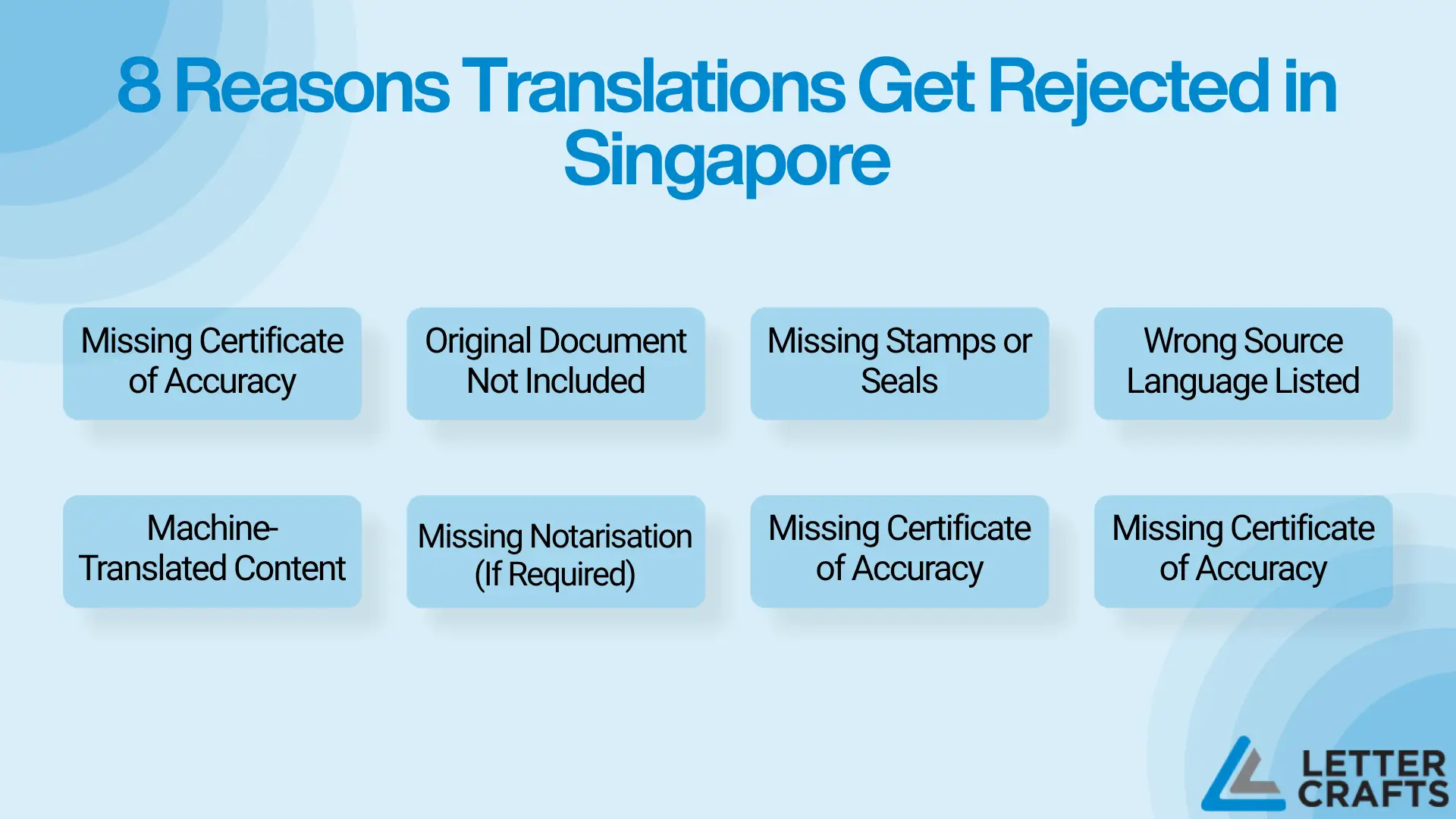
Understanding why translations fail is the most direct path to a successful resubmission. These are the errors Singapore authorities encounter most frequently.
1. Missing or Incomplete Certificate of Accuracy
This is the single most common cause of rejection. Authorities require a formal Certificate of Accuracy, not simply a translated document. If the translator provided a translation without a signed certification statement or if the statement is missing required elements such as contact information, the date, or a declaration of language competency, the submission will be rejected. A translation without certification is treated the same as an uncertified translation.
2. The Original Document Was Not Submitted Alongside the Translation
Singapore authorities need to compare the certified translation against the original foreign-language document. Submitting only the English translation without attaching a clear copy of the original will trigger rejection. Both documents must be submitted together every time.
3. Incomplete Translation: Seals, Stamps, and Annotations Were Omitted
Every element of the original document must be translated, including stamps, official seals, handwritten annotations, footers, and marginal notes. These elements are often overlooked by non-professional translators who treat them as decorative. Authorities view them as material content. Any omission, even a single official stamp, can result in rejection.
4. Incorrect Source Language on the Certificate
The Certificate of Accuracy must explicitly state the correct source language. If the original document is in Tagalog but the certificate states "Malay," or the original is in Portuguese, but the certificate says "Spanish," the translation will be rejected even if the English content is otherwise accurate. Common mix-ups include Hindi/Urdu, Malay/Indonesian, and Spanish/Portuguese.
5. Use of Machine Translation or AI-Generated Output
Singapore government officials are trained to identify machine-translated and AI-generated content. Automated translation tools miss legal terminology, cultural phrasing, and formatting conventions. They also cannot replicate the proper layout of official documents. Submissions identified as machine-generated are rejected immediately. This applies to all AI translation tools, including freely available services.
6. Confusion Between Certification, Notarisation, and Apostille
Certification (a signed translator declaration) is different from notarisation (a notary public verifying the translator's identity), which is different again from an apostille (international document authentication). Certain Singapore authorities and some foreign embassies based in Singapore require notarisation in addition to certification. Submitting only a certified translation when notarisation is also required will result in rejection.
7. Formatting Does Not Mirror the Original Document
The layout of the translated document should visually reflect the structure of the original. Authorities compare the two side by side. If paragraphs are rearranged, pages are out of order, or the overall structure differs significantly, the translation raises concerns about integrity and completeness.
8. The Source Document Was Updated After Translation
If the issuing authority amended your birth certificate, added an apostille, or issued a corrected version of a document after your initial translation was prepared, you must obtain a fresh translation based on the updated document. Submitting a translation of an older version will result in rejection.
Certified Translation vs. Notarisation vs. Apostille: What Singapore Authorities Require
This is one of the most commonly misunderstood areas of document submission in Singapore. Here is a straightforward breakdown.
| Requirement | What It Is | When Singapore Requires It |
|---|---|---|
| Certified Translation | Translated document + signed Certificate of Accuracy from a qualified translator | Required for all ICA, MOM, ROM submissions |
| Notarisation | A notary public verifies the identity of the person signing the certificate | Required for some ICA/MOM documents and most foreign embassy submissions |
| Apostille | International authentication stamp for public documents recognised by Hague Convention member states | Required when sending Singapore-issued documents abroad, or for some inbound foreign document submissions |
| Consular Legalisation | Multi-tier authentication process via the destination country's embassy | Required when the destination country is not a Hague Convention member (e.g., China, certain Middle Eastern countries) |
Singapore acceded to the Hague Apostille Convention in September 2021, meaning apostilles are now available for Singapore-issued documents through the Ministry of Foreign Affairs. For foreign-issued documents being submitted in Singapore, check the requirements of the receiving authority directly.
If you are uncertain which level of authentication your submission requires, contact the relevant authority and request written confirmation before proceeding.
Step-by-Step: How to Fix a Rejected Translation
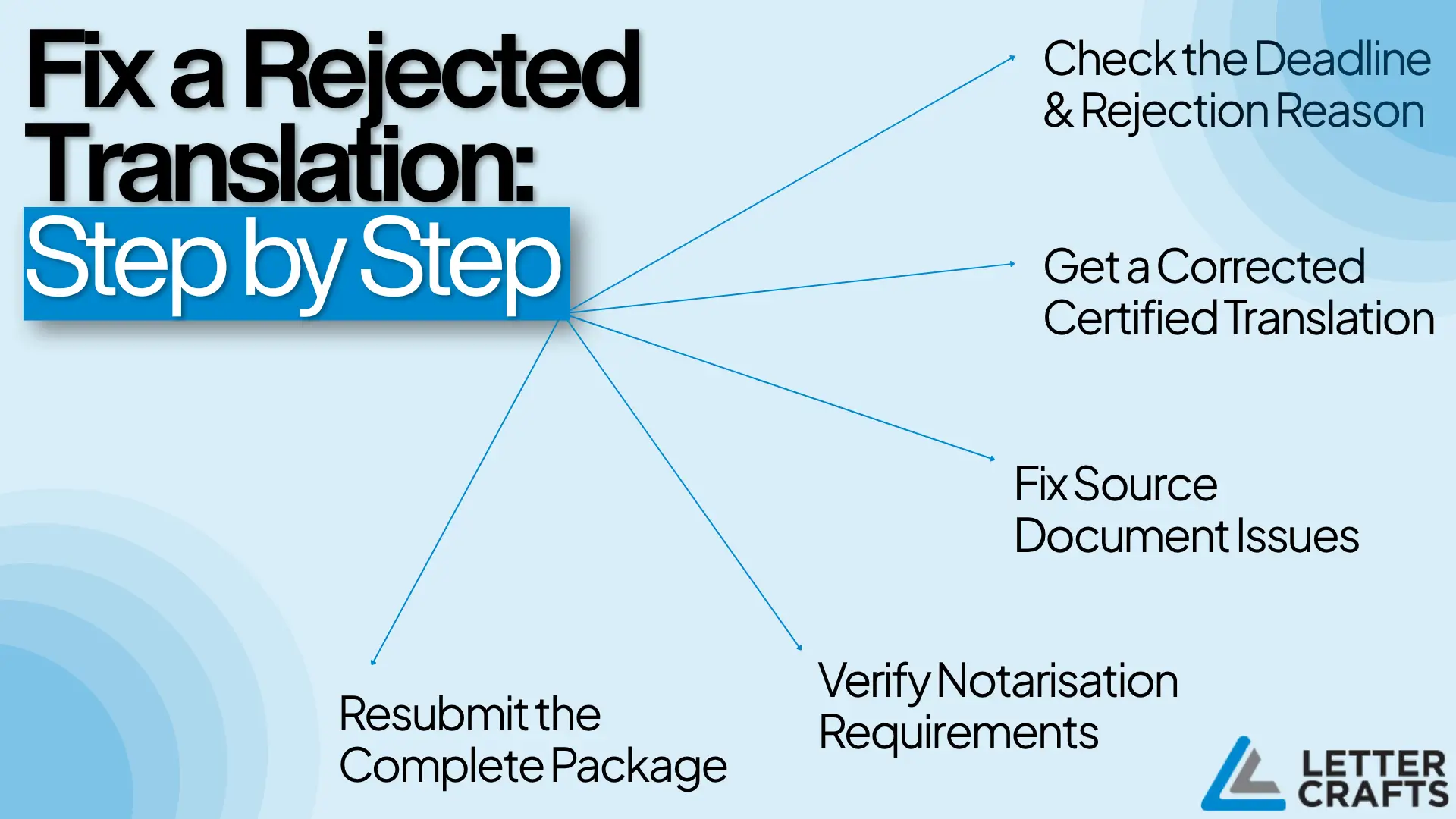
Step 1: Record Your Deadline and Identify the Exact Error
Before anything else, locate your resubmission deadline and record it. Then identify the precise rejection reason from the notice. A vague assumption about what went wrong without reading the notice carefully often leads to a second rejection.
Step 2: Obtain a Corrected Certified Translation from a Professional Agency
Work with a professional translation agency registered in Singapore that is experienced in government document submissions. The agency should:
- Provide a signed Certificate of Accuracy with all required elements
- Translate every element of the source document, including seals, stamps, and annotations
- Mirror the layout and structure of the original document
- Clearly specify the correct source language on the certificate
If you used a non-professional service, a friend, or a machine translation tool previously, do not attempt to correct that submission. Start fresh with a qualified professional.
Step 3: Address Source Document Issues First (If Applicable)
If the rejection stems from a problem with the original document rather than the translation, for example, your original birth certificate is missing an apostille, or you have a name discrepancy between documents, you must resolve that with the issuing authority first. Only then should you request a new translation based on the corrected document.
Name discrepancies between your passport and your source documents are a particularly common ICA rejection trigger. Ensure the translation reflects your exact passport name format before resubmitting.
Step 4: Confirm Whether Notarisation Is Also Required
Check the rejection notice and, if unclear, contact the relevant authority to confirm whether notarisation is required alongside certification. Do not assume certification alone is sufficient for all document types or all agencies.
Notarisation by a Singapore notary public typically adds one to two working days. Plan accordingly.
Step 5: Assemble and Submit the Complete Package
When resubmitting, include all of the following:
- A clear copy of the original foreign-language document
- The corrected certified translation with a complete Certificate of Accuracy
- Notarisation documentation (if required)
- Your original rejection notice (this helps the authority match your corrected submission to the right application)
Submit via the channel specified in your rejection notice, whether that is an online portal, email, or in-person submission. Do not resubmit through a channel not specified in the notice.
Who to Turn to When Your Translation Has Already Been Rejected
Once you know what went wrong, the next decision is who handles the correction. At this stage, the priority is not finding the fastest or cheapest option; it is finding an agency that understands exactly what ICA, MOM, and ROM require, because a second rejection is far more costly than the correction itself.
LetterCrafts is a Singapore-registered translation agency that works specifically with government document submissions. Their translations are accepted by ICA, MOM, ROM, LTA, and MOE, and they cover over 80 languages including Chinese, Malay, Tamil, Vietnamese, Thai, Tagalog, Indonesian, Arabic, and Japanese, among others.
A few things worth knowing if you are working against a resubmission deadline:
- Every element of the source document is translated. Seals, stamps, handwritten annotations, footnotes, and marginal notes nothing is omitted. This is one of the most frequent causes of rejection and the area where non-professional translations most commonly fall short.
- Notarisation can be arranged within one working day. Through HoH Law Corporation, LetterCrafts handles notarisation in-house when an authority requires it alongside certification. This matters when your deadline is close and coordinating separately between a translator and a notary is not realistic.
- The process does not require an office visit. Email your scanned documents to info@lettercrafts.org and receive a quote within 30 minutes. Completed translations are delivered by email, SingPost, courier, or collected at The Adelphi, whichever suits your timeline.
- Name discrepancies are handled carefully. A mismatch between your name as it appears in your passport and as it appears in a source document is a known ICA rejection trigger. LetterCrafts ensures the translation reflects your exact passport name format so there is no ambiguity for the reviewing officer.
Certified translations start from S$38 per page with no additional GST. Standard vital records birth, marriage, and divorce certificates are turned around in 24 to 48 hours.
If you already have a rejection notice in hand, send it across with your documents. LetterCrafts will identify the specific compliance gap and produce a corrected translation built to the requirements of the authority that rejected it.
What Happens If You Miss the Resubmission Deadline
Missing a resubmission deadline is one of the most avoidable and most consequential mistakes applicants make.
- For ICA applications, failure to respond before the deadline may result in the application being closed or withdrawn. There is generally no formal appeals process for this outcome; the applicant would need to reapply entirely, subject to any applicable cooling-off periods.
- For MOM work pass applications, a missed deadline typically requires starting the application from scratch, including repaying application fees and resubmitting the full documentation set.
- For ROM applications, missing a deadline will require you to contact ROM directly to understand your options, which may include rescheduling your appointment and resubmitting documentation from the beginning.
If you believe you cannot meet the deadline, for instance, because the original document is held overseas or requires re-issuance, contact the relevant authority proactively and in writing before the deadline. Requesting an extension is always more productive than allowing the deadline to pass without communication.
How to Prevent Translation Rejections Before You Submit
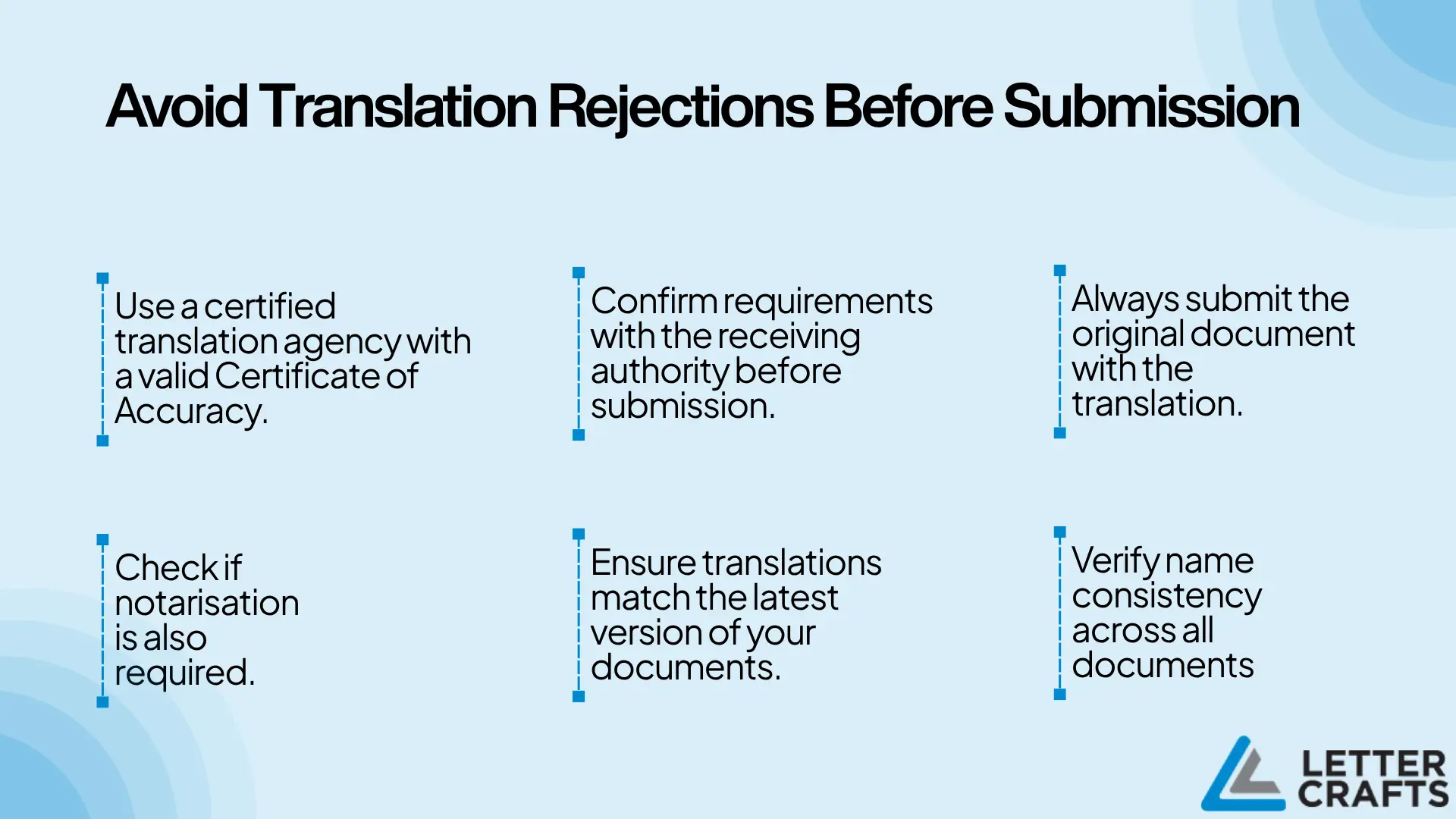
If you are preparing to submit translated documents for the first time, these steps will significantly reduce the risk of rejection.
Use a professional, registered translation agency. Singapore government bodies generally expect translations from professional agencies rather than informal or individual translators. Verify that the agency provides a compliant Certificate of Accuracy and has experience with Singapore government submissions specifically.
Confirm requirements with the receiving authority before submitting. Requirements can vary by document type, nationality, and specific agency. A five-minute enquiry to ICA or MOM can save weeks of delay.
Submit the original document alongside every translation. This is consistently one of the most overlooked requirements and one of the most common rejection triggers.
Check whether notarisation is also required. Do not assume certification alone is sufficient, particularly for legal documents, foreign embassy submissions, or court-related materials.
Ensure your source documents are current. If your birth certificate, marriage certificate, or police clearance was updated or re-issued after your original translation was prepared, the translation must reflect the current version.
Double-check name consistency across all documents. Discrepancies between your name as it appears in your passport and as it appears in your translated documents are a documented cause of ICA rejections.
Documents Most Commonly Rejected for Translation Issues
Certain document types generate a disproportionate number of translation rejections in Singapore, often due to the complexity of the source document or common formatting conventions in the country of origin.
Birth Certificates , particularly those from India, China, and the Philippines, where multiple languages, stamps, and handwritten annotations are common. Every element must be translated, and the layout must mirror the original.
Police Clearance Certificates often contain official seals, reference numbers, and agency-specific formatting that non-professional translators omit.
Marriage Certificates and Divorce Decrees: Especially those from countries where documents are issued in non-Latin scripts, such as Arabic, Mandarin, Thai, or Vietnamese. Formatting of dates and names must be precise.
Academic Transcripts and Degree Certificates: Frequently include institutional stamps, grading scales, and footnotes that are overlooked in informal translations.
National Identity Documents: Documents from countries where the identity card contains biographical data in a national language alongside an official seal or state stamp require careful, complete translation.
What to Do If Your Entire Application Is Rejected
If the rejection goes beyond the translation and the Singapore authority has declined your entire application, your options depend on the specific agency.
For ICA PR or citizenship applications, there is generally no formal appeals process. Applicants may reapply after addressing the grounds for rejection, though cooling-off periods may apply depending on the pass type.
For MOM work pass applications, the employer or applicant may submit a formal appeal to MOM within the timeframe stated in the rejection notice. Appeals should directly address the grounds cited and include any new supporting documentation.
For ROM marriage registration rejections, contact ROM directly to understand the specific documentation gaps. Resubmission requirements vary depending on the nature of the deficiency.
In cases where the rejection involves grounds beyond documentation, such as questions of eligibility, prior immigration history, or suspected misrepresentation, consider consulting a qualified Singapore immigration lawyer before reapplying.
Quick Reference: Rejected Translation Action Summary
| Situation | Immediate Action |
|---|---|
| Translation rejected by ICA | Note the resubmission deadline. Identify the precise rejection reason. Obtain a new certified translation from a professional agency. Resubmit with the original document, the corrected translation, and the rejection notice. |
| Translation rejected by MOM | Act within the stated window. Correct only the specific error identified. Resubmit the complete package before the deadline to avoid restarting the application. |
| Translation rejected by ROM | Contact ROM directly for confirmation of requirements. Resubmit a fully compliant certified translation. |
| Foreign embassy in Singapore rejected translation | Contact the embassy directly to confirm their specific formatting and certification requirements. Note these may differ from Singapore government standards. |
| Entire application rejected | Do not resubmit without understanding the full grounds for rejection. Seek professional or legal advice if the reason is unclear or involves eligibility concerns. |
The Bottom Line
A rejected translation from ICA, MOM, ROM, or any Singapore government authority is a fixable procedural issue in the overwhelming majority of cases. The most important thing you can do after receiving a rejection notice is act quickly, identify the exact error, and work with a qualified professional to produce a compliant, fully certified translation before your resubmission deadline.
Delays almost always come from one of three sources: not reading the rejection notice carefully enough to identify the real problem, using a non-professional service again for the correction, or failing to submit the original source document alongside the translation. Addressing all three of these points will resolve most cases cleanly on the first resubmission.
For complex situations where the entire application is rejected rather than just the translation, where eligibility questions are raised, or where prior rejections are a factor, consult a qualified Singapore immigration professional before reapplying.