Key Takeaway
- Interpretation ≠ translation. Interpretation is spoken; translation is written. The skills, certifications, and pricing models are entirely different.
- Mode matters. Simultaneous, consecutive, whispered, and remote interpretation each suits different settings; choosing the wrong one wastes time and money.
- Mode matters. Simultaneous, consecutive, whispered, and remote interpretation each suits different settings; choosing the wrong one wastes time and money.
- Certifications are non-negotiable for legal, medical, and government work. Look for ISO 18841-aligned providers and interpreters with recognised credentials (e.g., AIIC, NAATI, conference-grade training).
- Pricing depends on five levers: language pair, mode, duration, subject specialisation, and equipment.
- AI tools have a role, but not in high-stakes contexts. Hybrid models work; full automation does not yet.
A Five-Figure Mistake That Started With One Misheard Phrase
A regional manufacturer based in Singapore was closing a supply agreement with a Japanese partner. The meeting ran on Zoom, the freelance interpreter had no industry background, and a single mistranslated phrase around "tolerance specifications" turned a routine clause into a six-month renegotiation. The deal eventually closed, but only after legal fees, two trips to Tokyo, and a damaged relationship.
This isn't a rare story. In a market like Singapore, where English, Mandarin, Malay, Tamil, Bahasa Indonesia, Japanese, Korean, French, German, and Vietnamese routinely sit at the same boardroom table, the difference between a good interpreter and a great one isn't stylistic. It's commercial.
If you're searching for language interpretation services in Singapore, evaluating a Language Service Provider (LSP), or trying to find a reliable translation agency in Singapore to handle spoken communication, this guide will walk you through exactly what to buy, how to evaluate providers, what fair pricing looks like, and where most businesses go wrong. By the end, you'll have a decision-making framework you can use this week.
What Are Language Interpretation Services?
Language interpretation is the real-time conversion of spoken (or signed) communication from one language into another, preserving meaning, tone, register, and cultural intent. Unlike translation, which deals with written documents and allows time for revision, interpretation happens live, often under pressure, and leaves no second take.
A professional interpreter is not a "fluent bilingual." They are trained linguists who can:
- Process and reproduce speech in real time, often at 120–150 words per minute
- Apply specialised terminology (legal, medical, technical, financial)
- Manage cultural nuance, idioms, and indirect speech
- Operate equipment (headsets, booths, RSI platforms)
- Maintain strict confidentiality and impartiality
In short, interpretation is a regulated, skilled profession, not a service you should source on price alone.
Translation vs. Interpretation at a Glance
| Dimension | Translation | Interpretation |
|---|---|---|
| Medium | Written | Spoken/signed |
| Time pressure | Hours to weeks | Real time |
| Revision possible | Yes | No |
| Typical output | Documents, contracts, websites | Meetings, hearings, conferences |
| Pricing unit | Per word | Per hour / half-day / day |
Why Businesses in Singapore Need Professional Interpretation
Singapore is unusual. It's a city-state with four official languages: English, Mandarin, Malay and Tamil, and serves as the regional headquarters for thousands of multinational companies operating across ASEAN, Greater China, India, and beyond. On any given week, a Singapore business might host a Korean delegation, brief a Japanese board, defend a contract dispute involving Bahasa Indonesia testimony, and run a town hall with mixed-language staff.
A few realities make professional interpretation a business-critical service here:
- Cross-border deal flow. Singapore is a leading international arbitration and M&A hub. Legal interpretation isn't optional in these settings; it's foundational to admissibility.
- Healthcare diversity. Public and private healthcare providers regularly serve patients whose first language is not English, including dialects like Hokkien, Teochew, Cantonese, and Hakka, plus migrant worker populations speaking Bengali, Tamil, Tagalog, Burmese, and more.
- Conference economy. From global financial summits to biotech and maritime conferences, Singapore hosts hundreds of international events annually that require simultaneous interpretation infrastructure.
- Regulatory and compliance environments. Inquiries, depositions, and government engagements demand certified interpreters who understand procedural protocol.
The upshot: in Singapore, interpretation is rarely a "nice-to-have." It's part of how business actually gets done.
Types of Interpretation Services Offered
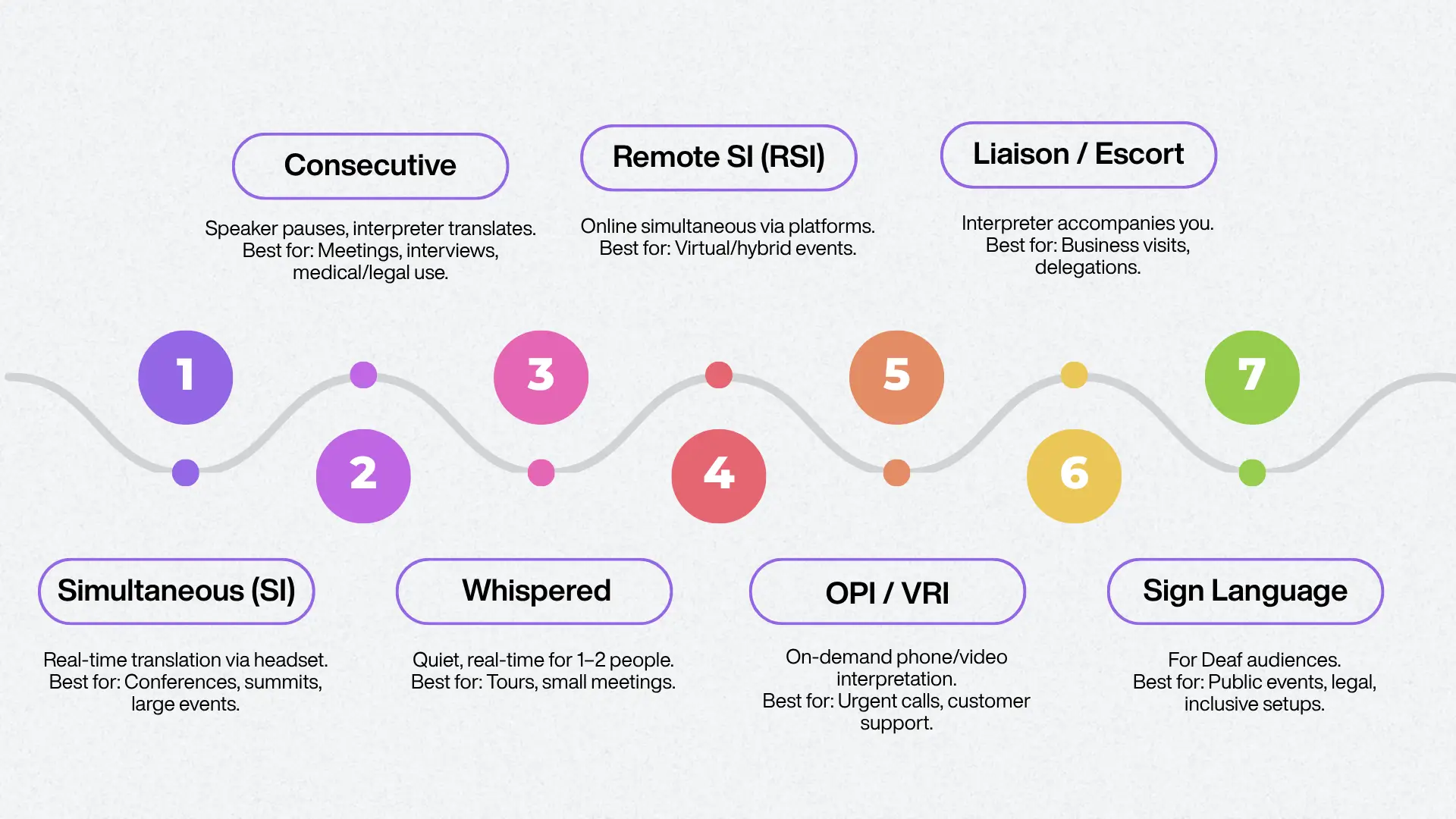
Different settings demand different modes. Choosing the wrong one is one of the most common and costly mistakes buyers make.
1. Simultaneous Interpretation (SI)
The interpreter speaks at the same time as the speaker, usually from a soundproof booth into delegates' headsets. Standard for conferences, summits, and large multilingual events. Always works in pairs (interpreters rotate every 20–30 minutes due to cognitive load).
Best for:
Conferences, AGMs, government summits, and large training sessions.
2. Consecutive Interpretation
The speaker pauses every few sentences while the interpreter renders the message. No equipment required, but the meeting takes roughly twice as long.
Best for:
Bilateral business meetings, depositions, press conferences, and medical consultations.
3. Whispered Interpretation (Chuchotage)
The interpreter whispers the translation to one or two listeners in real time. No booth, no equipment.
Best for:
Site visits, factory tours, and small board meetings where only one or two attendees need
interpretation.
4. Remote Simultaneous Interpretation (RSI)
Delivered via secure platforms (Zoom, Interprefy, KUDO, Webex). Interpreters work from a hub or home studio. Reduces logistics costs without sacrificing quality when run properly.
Best for:
Hybrid events, virtual board meetings, cross-border webinars.
5. Over-the-Phone Interpretation (OPI) / Video Remote Interpretation (VRI)
On-demand, often within minutes. Pay-per-minute pricing.
Best for:
Healthcare triage, customer service escalations, urgent legal calls, immigration interviews.
6. Liaison / Escort Interpretation
A bilingual interpreter accompanies a client or delegation through meetings, negotiations, and informal settings.
Best for:
Trade missions, due diligence visits, executive delegations.
7. Sign Language Interpretation
For Deaf and hard-of-hearing audiences. In Singapore, this typically involves SgSL (Singapore Sign Language) or international sign.
Best for:
Public events, legal proceedings, broadcasts, and inclusive corporate events.
Industries That Rely on Professional Interpretation in Singapore
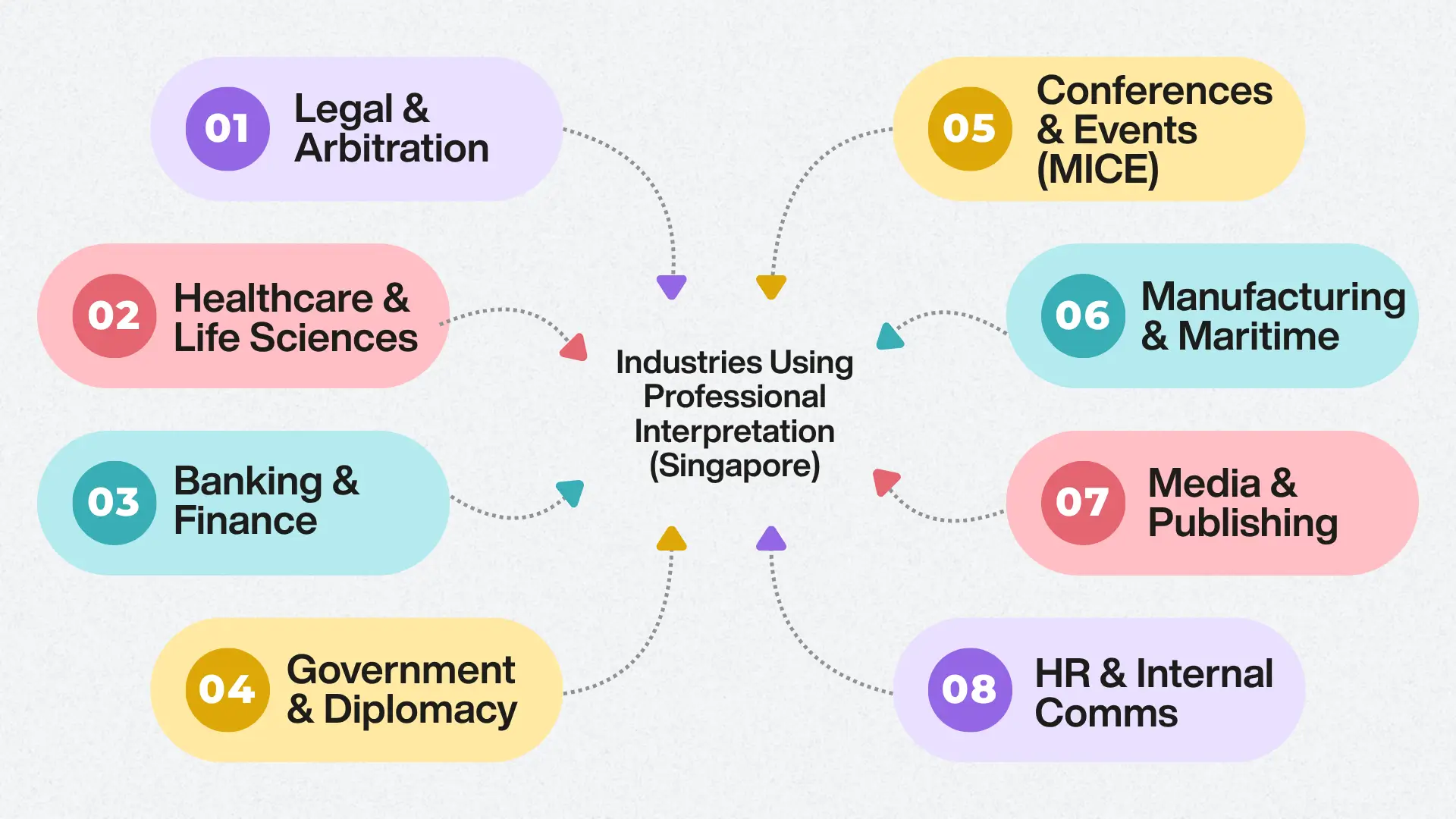
Legal & Arbitration
Singapore International Arbitration Centre (SIAC) cases, court hearings, depositions, and witness interviews routinely involve certified legal interpreters. Accuracy is procedural; every word can affect admissibility.
Healthcare & Life Sciences
Patient-doctor consultations, informed consent procedures, mental health assessments, and clinical research interviews all require interpreters trained in medical terminology and ethics. Errors here aren't inconvenient; they're dangerous.
Banking, Finance & Wealth Management
Regulatory meetings, investor presentations, due diligence sessions, and private banking client interactions need interpreters with financial fluency.
Government & Diplomacy
State visits, bilateral meetings, parliamentary engagements, and public sector consultations.
Conferences, MICE & Events
From the Singapore FinTech Festival to medical congresses and trade shows, simultaneous interpretation is part of the production stack.
Manufacturing, Engineering & Maritime
Factory audits, supplier negotiations, technical training, port and shipping coordination involving Korean, Japanese, German, and Mandarin counterparties.
Media, Broadcast & Publishing
Press conferences, on-air interviews, documentary work, and post-production support.
HR & Internal Communications
Townhalls, training sessions, and grievance procedures involving multilingual workforces.
How to Choose the Right Interpretation Service Provider
Here's a buyer's checklist we'd hand to any procurement team. If a provider can't tick most of these, keep looking.
1. Verify interpreter credentials.
Ask specifically: who is the interpreter, what's their
training, and how many hours have they worked in your subject area? Look for AIIC
membership, NAATI certification, conference interpreting diplomas, or equivalent. For legal
and healthcare, certification isn't optional.
2. Match the mode to the meeting.
A vendor who recommends simultaneous interpretation for a four-person bilateral meeting or
consecutive for a 200-person summit doesn't understand your need. Push back.
3. Confirm subject-matter expertise.
A brilliant conference interpreter may still be wrong for a patent dispute. Ask for relevant
past assignments and references.
4. Check equipment and tech.
A brilliant conference interpreter may still be wrong for a patent dispute. Ask for relevant
past assignments and references.
5. Insist on confidentiality.
NDAs should be standard. For sensitive sectors (legal,M&A, healthcare), ask how
the
provider handles data, recordings, and interpreter briefing materials.
6. Demand transparent pricing.
You should receive a clear breakdown: interpreter fees, equipment, technician, travel,
briefing time, and overtime rules. Vague quotes are red flags.
7. Test responsiveness.
How quickly do they reply? Do they ask the right discovery questions: language pair,
audience size, agenda, materials? A good provider behaves like a consultant from the first
email.
Quick rule:
If a provider can't tell you who is interpreting and why they're qualified for your specific assignment before you pay, walk away.
Why Choose LetterCrafts
Lettercrafts works with businesses, law firms, healthcare providers, and event organisers across Singapore. When procurement teams search for a certified interpreter near me, they need an expert whose work holds up under legal, clinical, or commercial scrutiny.
What clients tell us makes the difference:
- Vetted, specialised interpreters. Each assignment is matched to interpreters with documented experience in the relevant industry, not just the right language pair.
- End-to-end project management. From discovery call to post-event debrief, you have one point of contact. We handle interpreter sourcing, equipment, technician staffing, RSI platforms, and on-site coordination.
- Confidentiality by default. Standard NDAs, secure file handling, and briefing protocols designed for sensitive sectors.
- Quality controls. Pre-event briefings, glossaries built from your materials, and dual-interpreter staffing for simultaneous assignments as standard, not as upsells.
- Transparent quotes. You see what you're paying for, line by line.
We support all major language pairs serving Singapore's economy: English ↔ Mandarin, Malay, Tamil, Japanese, Korean, Bahasa Indonesia, Vietnamese, Thai, French, German, Spanish, Arabic, and more, and we'll tell you honestly when an assignment is outside our wheelhouse.
[Explore our interpretation services / Request a quote]
Professional Interpretation Service vs. Freelancer vs. AI Tools
| Factor | Professional Service (e.g., LetterCrafts) | Independent Freelancer | AI / Machine Interpretation |
|---|---|---|---|
| Accuracy in technical settings | High, with subject-matter matching | Variable | Moderate; struggles with idiom, dialect, and names |
| Industry specialisation | Curated per assignment | Depends on the individual | Generic |
| Confidentiality | Contractual NDAs, secure protocols | Case-by-case | Data handling depends on the vendor; risk in regulated sectors |
| Equipment & technicians | Provided and managed | Rarely | Not applicable |
| Backup/redundancy | Standard (esp. for SI) | Single point of failure | No human judgment on errors |
Bottom line
AI tools are useful for low-stakes communication and as a support layer. Freelancers can be
excellent if you've worked with them before and the assignment matches their depth. For anything
where accuracy, confidentiality, or compliance matters, a managed professional service is almost
always the right call.
What Affects the Cost of Interpretation Services in Singapore
Interpretation pricing varies more than most buyers expect. The five biggest levers:
1. Language pair. English ↔ Mandarin sits at the most competitive end. Rarer pairs (Burmese, Khmer, Mongolian, Dari) carry premiums simply because qualified interpreters are scarce.
2. Mode. Simultaneous is the most expensive, as you're booking two interpreters per booth plus equipment. Consecutive is cheaper but takes longer. Remote often reduces logistics costs but not interpreter fees.
3. Duration and structure. Most interpreters charge in half-day or full-day blocks. A two-hour booking still typically incurs a half-day fee. Overtime and travel are billed separately.
4. Subject specialisation. Legal, medical, and highly technical work commands higher rates because the interpreter pool is smaller and preparation time is longer.
Equipment and logistics. Booths, receivers, technicians, RSI platforms, recording, and on-site coordination all sit on top of interpreter fees.
A useful mental model: interpreter fees + equipment + project management = total cost. A quote that bundles everything into a single mystery number is a quote you can't compare. Always ask for a breakdown.
The Future of Interpretation: Where the Industry Is Heading
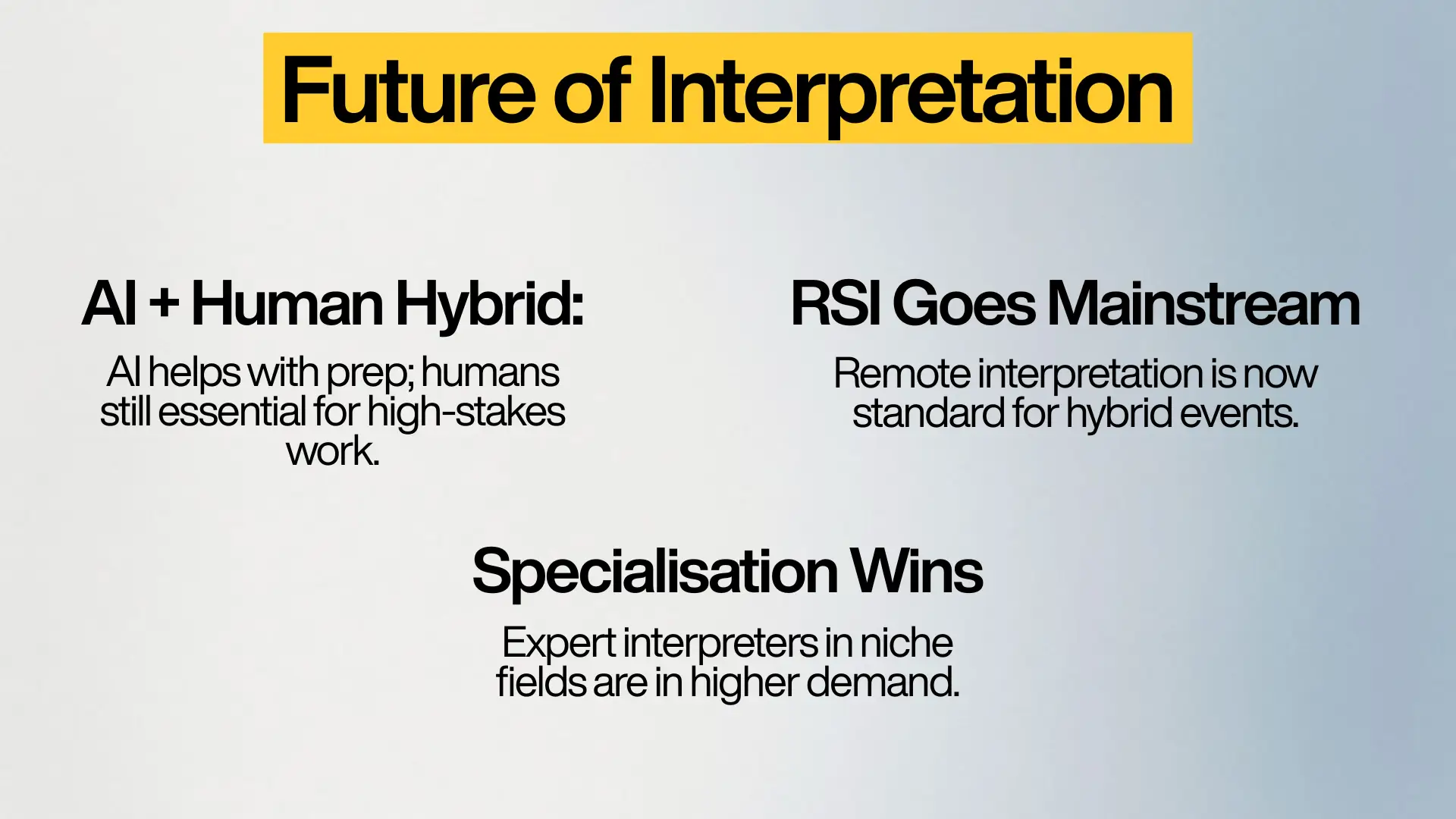
Three shifts worth watching if you're planning interpretation needs over the next few years:
- Hybrid AI + human models. AI is becoming a useful preparation tool for glossary building, terminology research, draft transcripts, and a credible option for low-stakes settings. It is not replacing human interpreters in legal, medical, or diplomatic work, where stakes, nuance, and accountability still demand human judgment.
- RSI as default for hybrid events. Remote simultaneous interpretation has matured. Expect more events to go hybrid by default, with interpretation hubs serving global audiences.
- Specialisation premium. As generic translation gets cheaper, the value of deeply specialised human interpreters, particularly in regulated sectors, is rising, not falling.
The takeaway for buyers: don't wait for AI to "solve" interpretation. Build relationships with a quality provider now, use AI where it's genuinely useful, and keep humans where they matter.
Conclusion: Hire the Interpreter Your Meeting Actually Needs
The cheapest interpretation quote rarely produces the best business outcome. The opposite is also true: the most expensive isn't automatically the safest. What matters is fit: the right mode, the right specialisation, the right equipment, and a provider who treats your assignment like the high-stakes work it usually is.
If you have an upcoming conference, hearing, board meeting, medical engagement, or cross-border negotiation in Singapore and you'd like a clear, no-pressure recommendation on what you actually need, LetterCrafts is built for exactly this conversation
→ Get a tailored quote for your interpretation assignment"
We'll respond within one business day with a clear scope, a recommended interpreter profile, and a transparent quote.