Key Takeaway
- A non-English recommendation letter needs an official English translation only when it is a written document. Portal-submitted references written in English need no translation.
- "Certified true copy" of an English translation is NUS's baseline standard for non-English documents. NTU requires "certified translations in English." Most applicants need only this.
- Notarisation is programme-specific, not universal. Some NUS programmes require notarised translations; others accept certified true copies. Always check your programme's instructions before paying for notarisation.
- Singapore has no sworn-translator system. A certified translation is a signed Certificate of Translation Accuracy from a professional translator or translation company, not a state-appointed stamp.
- You cannot translate your own reference letter. NTU allows the home university or "any officiallly authorized parties" to translate. Self-translations are not accepted by Singapore universities.
- Referee windows are short; NUS gives referees 14 days after notification. Arrange any needed translation before triggering the referee request to avoid missing deadlines.
If your referee wrote your recommendation letter in Mandarin, Bahasa Indonesia, Vietnamese, French, or any language other than English, and you are applying to a master's or PhD programme in Singapore, one question tends to stall everything else: does this letter need to be translated, and if so, what kind of translation actually counts?
The short answer is that a non-English reference letter does need an English translation, but only in specific circumstances, and the type of translation you need is not always the expensive one. Singapore universities treat recommendation letters differently from transcripts and degree scrolls, and confusing the two is one of the quietest ways a strong application loses time at the review stage.
This guide is written for postgraduate applicants to Singapore. It covers what NUS, NTU, and SMU actually state in their admissions instructions, how a reference letter differs from every other document in your file, what "certified translation" means under Singapore practice, when notarisation genuinely applies, and how to avoid the delays that catch international applicants each cycle.
Does a Recommendation Letter Actually Need Translating for a Singapore University?
Start with the rule the major Singapore universities state in almost identical language.
NUS instructs postgraduate applicants that all supporting documents must be "in English or accompanied by an official translation in English," and that translated copies "must be certified true copies." NTU's graduate admission guides repeat the standard across faculties: documents "must be in English. Otherwise, they must be accompanied by certified translations in English." SMU's graduate programmes require, for non-English documents, that "a copy of the original certificates or documents and the notarised / official English translation must be submitted."
A recommendation letter is a supporting document, so where it exists in another language, the rule applies. But here is the distinction that generic international guides consistently miss: at most Singapore universities, a recommendation letter does not reach the admissions office the way your transcript does. For the majority of postgraduate programmes, you never upload the letter yourself.
The Overlooked Point: How Singapore Universities Actually Collect References
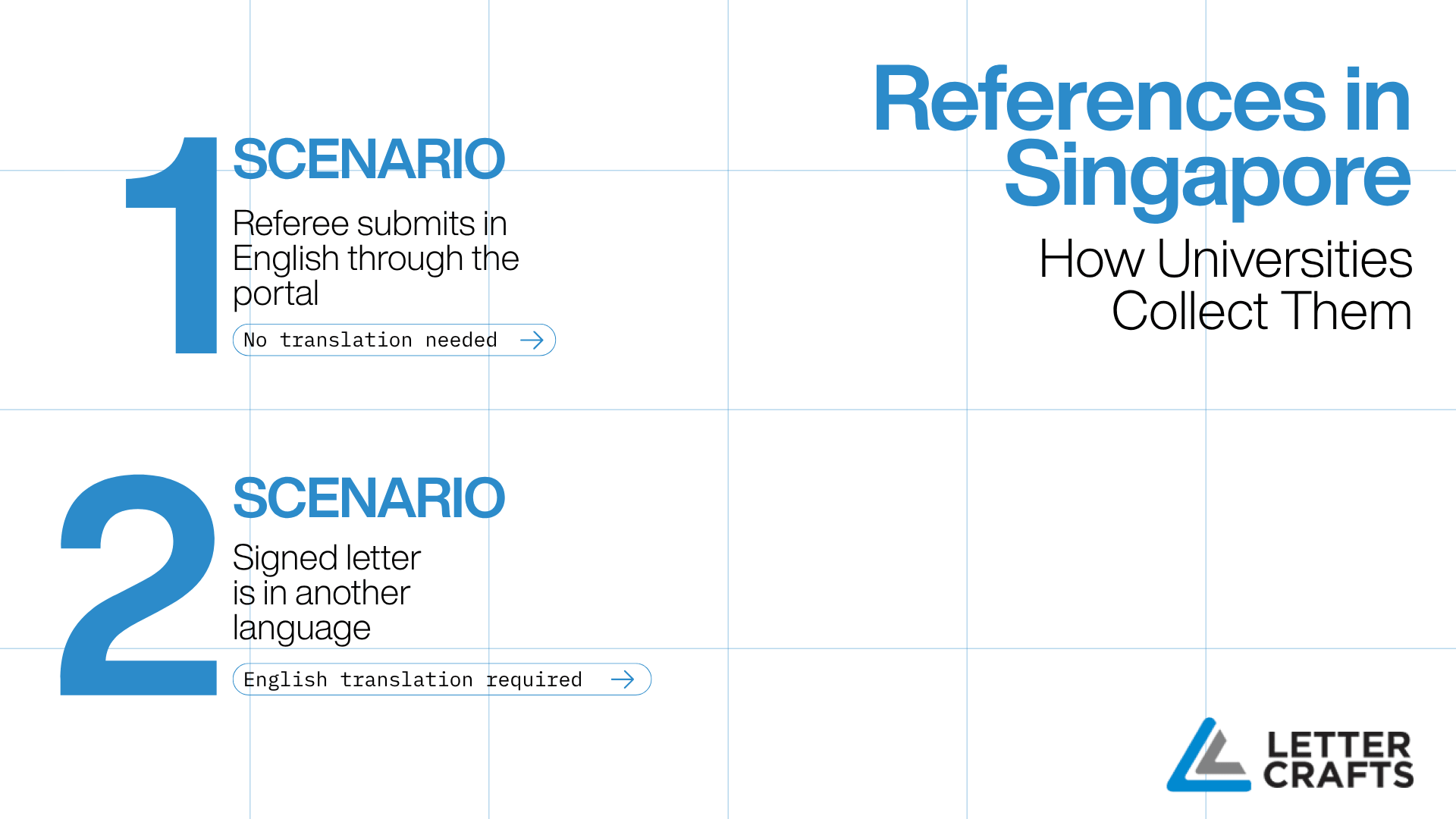
At NUS, referee reports are submitted through the online admission system. You enter each referee's name and institutional email, and the system emails them a secure link to complete the recommendation online. According to the NUS FASS graduate application information, "your referee reports will be sent to us directly via the online application system so there is no need for you to send separate recommendations to us", and referees are given 14 days to submit after receiving the notification. NUS also flags that email addresses from domains other than ".edu" "may be subject to additional screening and filtering".
NTU and SMU operate the same portal-referee model: once you submit your application, your referees receive an e-referee report to complete and return through the system.
This splits recommendation letters into two very different translation scenarios.
Scenario A: Your referee submits directly through the portal; usually no translation needed
If your referee can complete the online reference form in English, as most academics and senior professionals at international institutions can, there is no separate document to translate. The referee writes their assessment in English, submits it through the portal, and translation never enters the picture.
This is the cleanest path. If it is available to you, use it, and give your referee enough notice to write comfortably in English rather than under time pressure.
Scenario B: You are holding a written reference letter in another language; translation needed
Translation becomes necessary when you have a signed letter already written in a non-English language, typically because:
- Your referee wrote a formal letter on institutional letterhead in the national language and cannot or will not redraft it in English.
- The programme asks you to upload a reference letter as a document rather than routing it through a referee link. This does happen; the NUS MSc in Behavioural and Implementation Sciences in Health, for example, asks applicants to submit at least one reference letter directly.
- A scholarship body, sponsor, or joint-programme partner requires the documentary version of the letter.
- Your referee is unreachable through the portal (retired, moved institutions, or without an ".edu" address) and you already hold their signed letter.
In Scenario B, the letter is a foreign-language supporting document, and the "English or official translation" rule applies in full.
Rule of thumb:
If a person types the reference into a form, you rarely need a translation. If a signed letter arrives as a file, you usually do.
What "Certified Translation" Means in Singapore and Why It Surprises Applicants
Applicants from civil-law countries such as China, Vietnam, Indonesia, France, Germany, and Thailand often expect a "sworn translator" or "court translator" system, where a state-appointed individual stamps documents. Singapore has no such register.
In Singapore, a certified translation is a translation issued with a signed Certificate of Translation Accuracy from a professional translator or translation company, declaring that the English version is complete and faithful to the original. It is typically presented as a cover sheet on the translation company's letterhead, with the translated document formatted to mirror the original.
That signed declaration is what a Singapore university means by "certified translation" or "certified true copy." For most postgraduate admissions, that is the standard you need and nothing heavier.
For the full comparison of certification levels, see the LetterCrafts guide to certified translation vs notarisation vs apostille in Singapore.
Who is allowed to translate a reference letter?
Not you. Singapore universities want an official translation, and self-translated documents are not accepted a point stated plainly across academic admissions, and one that also makes intuitive sense, since a reference is meant to be your referee's independent voice, not yours.
The NTU graduate admission guide spells out who may do it: the translation "can be done by the Home University or any official authorized parties." In practice, that means one of three routes:
- The issuing institution, if it can produce an official English version of the letter.
- A professional translation company that issues a Certificate of Translation Accuracy.
- An embassy or other authorised body, where available.
For a recommendation letter specifically, the home institution rarely re-issues personal reference letters in English on request, so a professional certified translation is usually the practical route.
Do you need the translation notarised for a university?
Sometimes, and this is where careful reading pays off.
Notarisation is a heavier step. In Singapore, a Notary Public (a senior practising lawyer appointed through the Singapore Academy of Law) verifies the translator's identity and applies a notarial seal on top of the certified translation. Since 1 October 2019, every notarised document must additionally be authenticated by the Singapore Academy of Law (SAL) to be valid a change introduced through amendments to the Notaries Public Rules.
For universities, the requirement genuinely varies by programme:
- Most NUS and NTU programmes ask for certified true copies of English translations. The general NUS graduate coursework checklist notes that certification "may be made by a responsible person e.g., school principal, commanding officer, personnel manager," and that if you cannot obtain certified true copies, "notarised documents will be accepted," adding that you will have to pay for notarisation. Certification is the baseline; notarisation is an accepted alternative.
- Some NUS programmes require notarisation outright. For instance, certain public-health and health-sciences programmes state that non-English supporting documents "must be accompanied by a notarized English translation".
So the honest answer is: do not assume, and do not over-buy. Read your specific programme's document instructions. If they say "official English translation" or "certified true copy," a certified translation is enough. If they say "notarised," add that step and budget the extra days. Paying for full notarisation and SAL authentication when your programme only asked for certification is one of the most common ways applicants overspend; submitting a certified translation where the programme demanded a notarised one is the opposite mistake, and costs you a resubmission.
Notarisation and SAL authentication are, by contrast, standard for the Immigration & Checkpoints Authority (ICA) in permanent residence and citizenship applications a different pathway many students confuse with admissions. LetterCrafts covers that immigration standard separately in its ICA translation and notarisation guide.
Certified vs Notarised for a Postgraduate Reference: Quick Comparison
| Question | Certified Translation | Notarised Translation |
|---|---|---|
| What it confirms | The translation is accurate and complete | A Notary Public verified the translator's identity and signature |
| Who provides it | A professional translator or translation company | A Singapore Notary Public (senior lawyer), added on top of certification |
| Needs SAL authentication? | No | Yes, mandatory since 1 October 2019 |
| Typical university requirement | The baseline for most NUS and NTU programmes | Required by some programmes; an accepted fallback for others |
| Also used for | MOE, most local admissions | ICA (PR and citizenship), courts, some embassies |
| Relative cost and time | Lower, faster | Higher, adds days |
A Recommendation Letter Is Not a Transcript: Translate It Accordingly
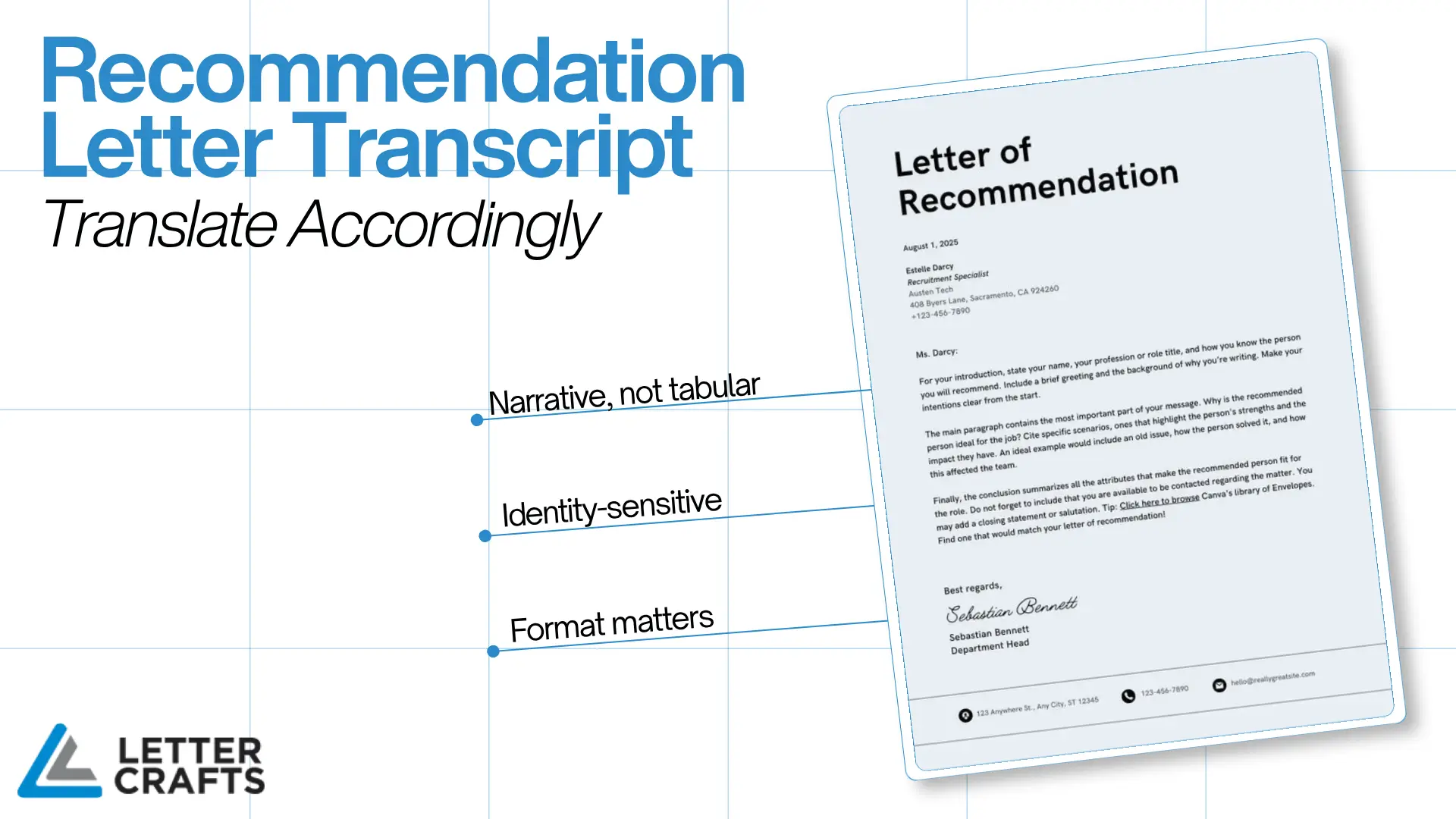
Even when both need a certified English version, how you translate a transcript and a reference letter differs.
For transcripts and degree scrolls, universities often want the translation tied back to the issuing institution. NUS specifies that translated transcripts and degree scrolls "must be certified by the issuing institution(s)." NTU asks that translated transcript subjects "be listed in the same order as that of the original transcript." These are structured, data-heavy documents where format fidelity and institutional certification matter.
A recommendation letter is a different kind of document:
- It is narrative, not tabular. Its value lies in tone, specificity, and the referee's judgement, qualities a careless translation flattens. A reference that reads as generic or stilted in English can quietly weaken an otherwise strong endorsement.
- It is identity-sensitive. The referee's name, exact title, department, institution, and contact details must carry across precisely. Committees may verify referees, and with non-".edu" emails already subject to extra screening at NUS, a mistranslated title or institution name creates friction you do not want.
- It carries meaning in its format. Letterhead, date, and signature block signal authenticity. A good certified translation mirrors the layout of the original so the English version visibly corresponds to the letter your referee signed.
In short, translating a recommendation letter well is less about terminology and more about preserving voice, credentials, and credibility. That is a translation judgement, not a clerical task.
Which Documents in a Singapore Postgraduate Application Need Translation?
Most applicants are assembling a document set, not translating a single item. Here is where the recommendation letter sits, with the general Singapore standard for each. Always defer to your programme's own checklist; departments can set stricter rules than the university baseline.
| Document | Translation needed if not in English? | Typical standard for universities |
|---|---|---|
| Degree scroll/certificate | Yes | Certified true copy; often certified by the issuing institution |
| Academic transcript | Yes | Certified; include grading scale; keep subjects in the original order |
| Recommendation/reference letter | Yes, if it is a written letter rather than a portal entry | Certified translation with faithful formatting; notarised only if the programme requires it |
| Personal statement/research proposal | You write it in English | Not applicable |
| English proficiency scores (TOEFL / IELTS) | Issued in English | Not applicable |
| Passport / NRIC / ID page | Usually English or bilingual | Certified if a section is non-English |
| Medium-of-instruction letter | Ideally issued in English | Certified translation if issued in another language |
Step by Step: Getting a Recommendation Letter Translated the Right Way
- Confirm how the reference is collected: Log in to the application portal and check whether the programme wants a referee link (Scenario A) or a document upload (Scenario B). If your referee can submit in English through the portal, you likely need no translation at all.
- Read the exact wording of the requirement: Look for "official English translation," "certified true copy," or "notarised." The specific word tells you the standard. Screenshot it for your records.
- Get a clean copy of the original letter: Ensure it is on letterhead, dated, and signed, with the referee's full name, title, department, institution, and contact details legible. Translation quality depends on a legible source.
- Commission the certified translation early, before triggering the referee request: Because referee windows are short (14 days at NUS), have the English version ready so nothing stalls once the clock starts.
- Verify names, titles, and institutions letter by letter: This is the single most important review step for a reference. Confirm the referee's designation and organisation match how the university will see them, especially if their email domain will be screened.
- Keep the original and the translation together: Universities generally want the original-language document and its English translation as a pair; NTU explicitly asks for both. Never submit the translation alone.
- Escalate to notarisation only if the programme, scholarship, or sponsor requires it; then factor in SAL authentication and the extra days.
Common Mistakes Postgraduate Applicants Make
- Self-translating the letter: Official translations must come from the issuing institution or an authorised party; self-translations are not accepted, and translating your own reference undermines its independence.
- Assuming notarisation is always needed or never needed: It is programme-specific. Applicants overpay by defaulting to notarisation, and lose time by defaulting against it. Read the instructions.
- Translating too late: Triggering the referee request, then discovering the signed letter needs translating, burns days inside a tight window.
- Losing the referee's credentials in translation: A mistranslated title, department, or institution name weakens the one thing a reference must preserve: verifiability.
- Submitting only the English version: Most Singapore universities want the original and the translation together; dropping the original invites a resubmission request.
- Using a machine-translation tool: Automated output carries no Certificate of Translation Accuracy, so it does not meet the certified-translation standard at all.
How LetterCrafts Handles a Postgraduate Reference Translation
LetterCrafts is a Singapore-registered certified translation company covering 80+ languages. Every translation is issued with a signed Certificate of Translation Accuracy and formatted to mirror your original the standard NUS, NTU, and SMU look for in supporting documents. The process is built to protect the two things that matter most in a reference: the referee's exact credentials, and your deadline.
What the process looks like:
- Get a quote: Email a scanned copy or photo of the signed letter; no physical documents needed. You receive a quote and turnaround estimate, with certified translation starting at S$38 per page.
- Professional translation: A translator matched to the source language produces the English version, mirroring the letterhead, date, and signature block so the translation visibly corresponds to the original.
- Credential check and proofreading: The referee's name, title, department, and institution are verified against the source, then the draft is independently proofread in the review step that keeps a reference verifiable.
- Certification: The finished translation is issued with the Certificate of Translation Accuracy as a cover sheet, ready to upload to your application portal.
- Notarisation, only if your programme requires it: Where a programme, scholarship, or sponsor asks for a notarised translation, notarisation and SAL authentication are arranged as an add-on so you are neither over- nor under-certified for what your application actually needs.
For the wider picture of how academic documents are translated for Singapore institutions, see the LetterCrafts guide to education and academic translation in Singapore. If you are also translating transcripts and degree scrolls, the certified translation checklist for Singapore submissions is a useful final review before you apply.