Key Takeaway
- Every non-English S Pass document must be uploaded as a certified English translation, combined with the original in one file, by a translation provider.
- No notarisation, no SAL authentication, no apostille. A certified translation is the complete standard MOM accepts for every work pass.
- Merge the original and translation into one PDF, English version first, so the MOM officer reviewing in English starts without scrolling.
- Declaring a candidate's qualification is optional. If you declare it, you must ensure it is authentic and from an accredited institution.
- Verification proof is separate from translation. Notary-certified certificates and school letters are rejected; only MOM-listed screening companies qualify.
- Family on a Dependant's Pass need the same: certified English translations of foreign-language marriage or birth certificates, combined with the originals as one file.
- A malformed or missing translation stalls the whole application; MOM pauses processing until you resubmit, so get the format right the first time.
If you are an employer or an employment agent sponsoring a foreign employee for an S Pass, and the candidate's supporting documents are not in English, MOM will not process the application on the strength of the original alone. Every non-English document has to go in as an English translation, and getting that step wrong is one of the more common, and entirely avoidable, reasons applications stall.
The reassuring part is that S Pass translation requirements are lighter than what ICA demands for immigration matters such as PR or Citizenship. There is no notary, no SAL authentication, and no apostille chain to manage. But lighter does not mean optional, and MOM is specific about how the translation must be presented and who can prepare it. This guide walks through exactly what MOM requires, how it differs from Employment Pass and Dependant's Pass rules, and how to avoid the mistakes that trigger delays.
S Pass Translation Requirements at a Glance
| Requirement | What MOM asks for |
|---|---|
| Translation for non-English documents | Required for every non-English supporting document |
| Certification standard | Certified translation from a translation service provider |
| File format | Original and translation combined as one file |
| Notarisation | Not required |
| SAL authentication/apostille | Not required |
| Declaring qualifications | Optional; if declared, must be authentic and from an accredited institution |
| Verification proof (if requested) | Only from a MOM-listed background screening company |
| Notary-certified certificate as verification | Not accepted |
| Application fee | S$105 |
| Pass issuance fee | S$100 per pass |
| Standard processing | Updated within 10 business days (up to 8 weeks for overseas companies without a Singapore-registered entity) |
What Is an S Pass, and Who Needs Translated Documents?
The S Pass is for foreign employees of any nationality who have a job offer in Singapore and earn a fixed monthly salary comparable to the top one-third of the local associate professionals and technicians (APT) workforce by age. For most sectors, that currently means a minimum fixed monthly salary of S$3,300 for new applications, rising progressively with age to S$4,800 at age 45 and above. That floor is scheduled to increase to S$3,600 (up to S$5,100 at age 45 and above) for applications submitted from 1 January 2027. The financial services sector sits on a higher band, currently S$3,800 for the youngest candidates, rising to S$4,000 from January 2027.
S Pass holders typically fill mid-skilled roles such as technicians, associate professionals, and specialists across manufacturing, healthcare, food services, and other sectors, some of which are regulated by their own professional bodies. Any candidate whose supporting documents are not in English will need a certified translation before you can submit. You can confirm the exact salary a candidate needs using MOM's Self-Assessment Tool before you apply; if the tool shows the candidate is eligible, MOM puts the likelihood of approval at around 90 per cent.
When Do You Need a Certified Translation for an S Pass?
The trigger is simple: any supporting document that is not already in English needs an English translation before MOM can accept it. In practice, that happens in a handful of recurring situations.
| Situation | Why translation matters |
|---|---|
| The candidate's educational or professional certificate is not in English | Needed if you choose to declare the qualification, or if MOM later asks for verification |
| The candidate's name differs across documents (e.g. passport vs. certificate) | A supporting document such as a deed poll may also need translation |
| The candidate works in a regulated profession (healthcare, law, football) | Foreign-issued professional body documents may need translation |
| The candidate is bringing a spouse or child on a Dependant's Pass | A foreign-language marriage or birth certificate needs translation |
| Any other document MOM requests during processing | Any non-English document must be translated before it can be accepted |
In every one of these cases, submitting the original foreign-language document on its own is not sufficient. MOM's portal and its case officers work in English.
What Does MOM Require for S Pass Document Translation?
"For non-English documents, you must upload the original document together with an English translation as 1 file. The translation can be done by a translation service provider."
Three things follow directly from that sentence.
- First, both the original and the translation must be uploaded; submitting only the English translation, without the source-language original, is treated as an incomplete document.
- Second, they must be a single combined file, not two separate uploads, because MOM's portal expects one file per document requirement and splitting them is a common cause of processing queries.
- Third, the translation must be certified. MOM does not accept a simple literal translation without a signed declaration of accuracy from the translator or translation company.
That is a materially lighter standard than the one some other Singapore agencies apply to foreign documents.
Certified Translation vs. Notarisation vs. SAL Authentication
This is the point where employers who have dealt with ICA, or with other countries' immigration systems, tend to over-prepare for MOM. Three terms get confused, and only the first one is what MOM actually wants.
- Certified translation: A signed statement from a professional translator or agency confirming the English version is complete and accurate. This is exactly what MOM asks for, and it is where the requirement stops.
- Notarisation: An added step where a Singapore Notary Public witnesses the translator's signature and issues a Notarial Certificate. The notary confirms the translator's identity, not the accuracy of the translation. MOM does not require this for any work pass.
- SAL authentication (apostille): A further layer that authenticates a notarisation. ICA requires it for PR and Citizenship documents. It has no role in S Pass applications.
If a provider tries to sell you notarisation or SAL authentication for an S Pass submission, it is an unnecessary cost. MOM's requirement stops at a certified translation, and paying for the extra legal steps designed for immigration filings will not make your S Pass application any stronger. For the full picture of when notarisation and SAL authentication actually are required, see our guide to ICA notarisation.
How to Format the File: One PDF, Translation First
MOM asks for the original and translation as a single file, but it does not specify page order. A small operational detail helps here: place the English translation first, followed by the original-language document. The officer reviewing your application works in English, so if the first page they open is in Mandarin, Tagalog, or Burmese, they have to scroll to find the translation before they can begin. Leading with the English version removes that friction and signals a properly prepared submission. Whichever tool you use to merge the file, make sure every page is legible and that the translation covers the whole document, including stamps, seals, dates, and grading notations.
Which Documents Does an S Pass Application Require?
For a standard S Pass application, employers upload the personal particulars page of the candidate's passport, along with the company's latest business profile or instant information registered with ACRA. If the candidate's name on the passport differs from the name on their other documents, you also need an explanation letter and a supporting document such as a deed poll.
Supporting Documents for Regulated Professions
Certain occupations require supporting documents from their professional bodies. The most common are set out below.
| Occupation | Professional body |
|---|---|
| Doctor | Singapore Medical Council |
| Dentist | Singapore Dental Council |
| Nurse | Singapore Nursing Board |
| Pharmacist | Singapore Pharmacy Council |
| Physiotherapist, occupational therapist, radiographer and other allied health roles | Singapore Allied Health Professions Council |
| Traditional Chinese Medicine practitioner | Traditional Chinese Medicine Practitioners Board |
| Paramedic or emergency medical technician | Unit for Prehospital Emergency Care |
| Lawyer | Legal Services Regulatory Authority |
| Football player or coach | Sport Singapore |
Documents for Food Establishments
Employees in a food establishment need a copy of the online page accessible through the QR code on the Singapore Food Agency (SFA) foodshop licence, showing the licence validity period. If the establishment is new and does not yet have a licence, the "Application for Foodshop Licence" letter issued by SFA can be submitted instead.
Any of these documents that arrive in a language other than English need the same treatment: original plus certified English translation, combined into one file.
Do You Have to Declare Qualifications for an S Pass?
No. Unlike the Employment Pass, where qualifications are scored under the COMPASS framework, declaring a candidate's qualification for an S Pass is optional. MOM's eligibility page states this plainly.
If you do declare a qualification, you become responsible for ensuring it is authentic and was awarded by an accredited institution listed in the application form's drop-down menu. A certified English translation of a foreign-language degree certificate is what satisfies the language requirement here, so if you plan to declare an overseas qualification that is not in English, factor the translation in early. Our academic and education translation service covers degree certificates, diplomas, and transcripts with the grading notations rendered clearly for MOM assessors.
Verification Proof vs. Translation: Two Separate MOM Requirements
This distinction trips up experienced HR teams, so it is worth stating clearly: a certified translation and a verification proof are two different documents that answer two different questions. A translation tells MOM what a certificate says. A verification proof tells MOM whether that certificate is genuine.
If the awarding institution is not in the application form's drop-down list, or MOM otherwise asks for verification, the requirement shifts from translation to independent verification. According to MOM's verification proof requirements, the proof must confirm both the authenticity of the qualification and the accreditation status of the institution.
Two points matter most here. First, educational certificates certified by a notary public and school letters are not accepted as verification proof; a notary stamp on a degree certificate does nothing to satisfy this requirement. Second, MOM only accepts verification proof from its own list of accredited background screening companies, which includes providers such as Avvanz, RMI, HireRight, Veremark, and Sterling. Most verification checks are completed within around 14 working days, though this varies by country and by provider.
The practical takeaway: a certified translation of a degree certificate will satisfy the language requirement, but it will not satisfy a verification request if MOM raises one. Keep the two workstreams separate in your planning.
How to Apply for an S Pass With Translated Documents
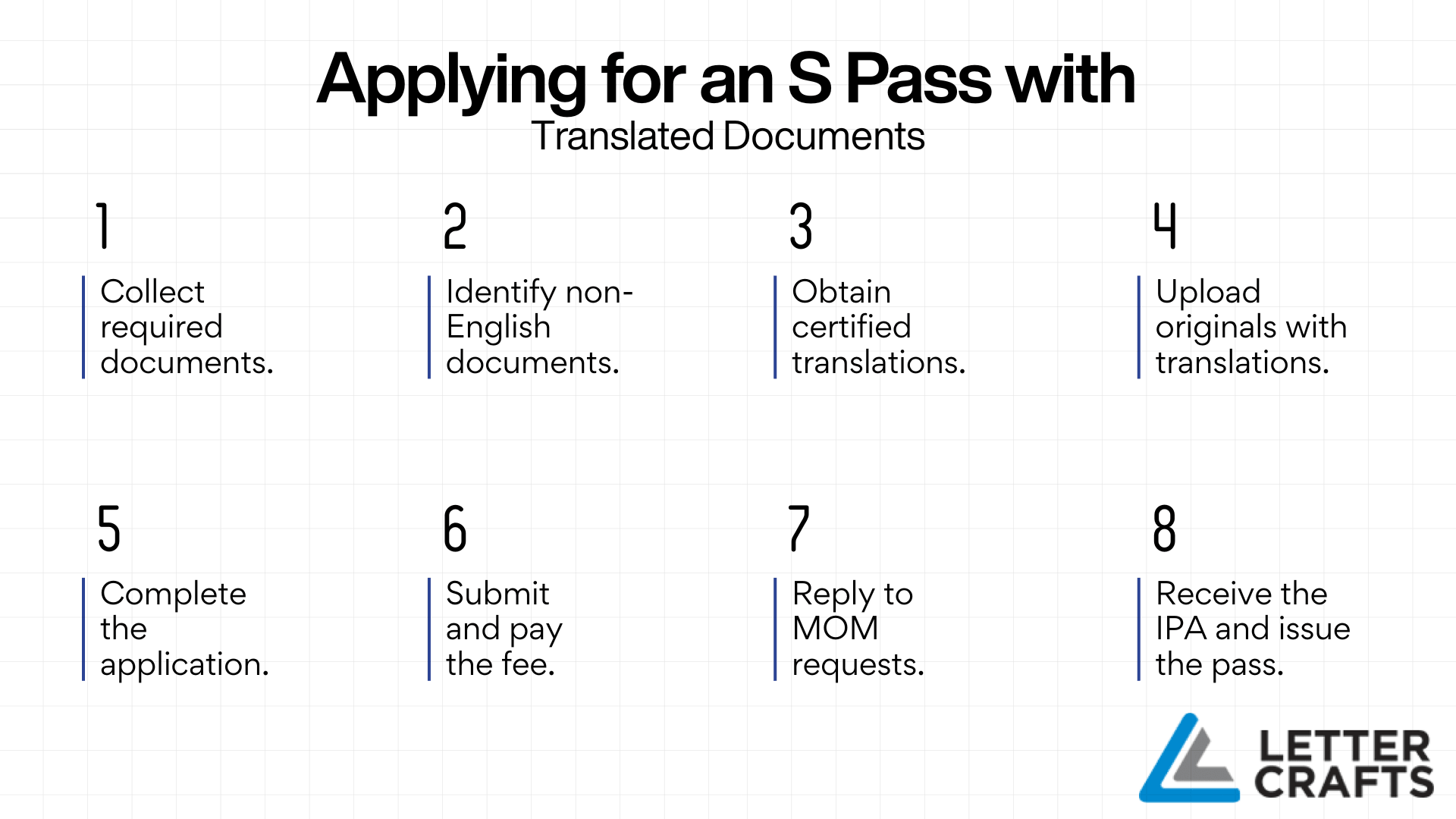
- Gather the candidate's documents. The passport particulars page and, where applicable, qualification certificates, professional body documents, or SFA licence documentation. Check that the passport is valid for at least seven months, as MOM requires.
- Flag anything not in English. Identify every non-English document before you start the online application, not after.
- Get certified English translations prepared. Use a professional translation service provider. The translation should be complete and mirror the original, including stamps and seals.
- Combine the original and translation into a single file for each document, translation first, before uploading.
- Complete the candidate's form and obtain their written consent to apply.
- Submit the application through EP eService and pay the S$105 application fee by GIRO, Visa, Mastercard, or Amex. MOM recommends selecting the option to be considered for both the Employment Pass and the S Pass.
- Respond promptly to any MOM request for additional documents, submitted through the same portal. Requests pause the processing clock until you respond.
- Once approved, print the in-principle approval (IPA) letter. The IPA acts as a single-entry visa and gives the candidate 60 days to enter Singapore and have the pass issued. A further S$100 issuance fee applies per pass once the candidate is in Singapore.
How Much Does an S Pass Cost, and How Long Does It Take in 2026?
What You'll Pay
Translation costs depend on the source language, document length, and complexity. A standard one or two-page certificate is straightforward; multi-page academic transcripts or professional licences take longer and cost more. You can see current per-page rates on our pricing page. On top of that, MOM charges a S$105 application fee when you submit, and a further S$100 issuance fee per pass once the candidate is in Singapore.
How Long It Takes
Applications submitted online are typically processed or given an update within 10 business days. Applications from overseas companies without a Singapore-registered entity can take up to 8 weeks in most cases. If MOM requests additional documents, including a missing or incorrectly formatted translation, processing extends beyond the standard window until you respond. Where verification proof is required, most background screening checks are completed within around 14 working days.
Building a translation buffer into your own timeline, before submission, is far cheaper than absorbing a MOM request-for-documents cycle after the fact.
Do Family Members Need Translated Documents? (Dependant's Pass)
S Pass holders earning a fixed monthly salary of at least S$6,000 are eligible to bring their spouse and unmarried children under 21 to Singapore on a Dependant's Pass. Supporting documents include passport particulars pages and birth or marriage certificates.
The same translation rule applies here as to the S Pass itself. A foreign-language marriage certificate, used to prove the relationship to a spouse, or a foreign-language birth certificate for a child, needs the same certified-translation treatment, combined with the original as one file. No notarisation, but a proper certified translation is expected. Employers can submit the Dependant's Pass application together with the S Pass application or separately at a later date.
Do You Need New Translations to Renew an S Pass?
Only for documents that are not already in English. Translation is not a one-time hurdle you clear at first application and forget. You can apply to renew an S Pass if you want the holder to keep working for you, provided the company still meets the quota and other requirements, and renewal runs on the same document logic as a new application.
If anything submitted at renewal is not in English, whether an updated qualification certificate, a new professional body document after a role change, or any other paper MOM requests, the same rule applies: original and certified English translation, combined into one file. MOM does not relax this for returning holders, and there is no lighter standard for renewals.
The real difference at renewal is timing pressure. A first-time application gives you room to sort out a translation before you commit to a start date. A renewal runs against your existing pass's expiry. If the pass lapses before the renewal is approved, the employee's ability to keep working is affected. Getting any non-English document translated and merged into the correct file format well before you submit is the difference between a routine renewal and a scramble against the clock.
S Pass vs. Employment Pass: Translation Requirements Compared
| Requirement | S Pass | Employment Pass |
|---|---|---|
| English translation for non-English documents | Required | Required |
| Original and translation as one combined file | Required | Required |
| Notarisation of translation | Not required | Not required |
| SAL authentication/apostille | Not required | Not required |
| Declaring qualifications | Optional | Effectively mandatory under COMPASS scoring |
| Verification proof if institution not in drop-down list | Required, from a MOM-listed screening company | Required, from a MOM-accredited screening company, with a mandatory verification reference number |
| Notary-certified qualification accepted as verification | No | No |
The requirements overlap, but the Employment Pass carries an extra layer: mandatory education verification with a MOM reference number keyed into the application. If you handle both pass types, our companion Employment Pass translation and verification guide covers the COMPASS-specific requirements in detail.
What Happens If MOM Queries or Rejects Your Translation?
It helps to be clear about what a "delay" actually means, because it is easy to underestimate.
MOM does not partially accept an application and process the rest around a missing translation. If a required document is non-English and arrives without an English translation, arrives as two separate files instead of one, or is judged incomplete or inaccurate, the application is treated as missing that document. MOM requests the correct version through the same channel you applied on, and the application does not move forward until you provide it.
Two practical effects follow. The processing clock does not hold your place: MOM's standard window applies to a complete application, so a document request pauses progress until you respond, and the real timeline becomes standard processing time plus however long the corrected translation takes. And it is the employer's or employment agent's problem to fix, not MOM's; MOM does not source or correct translations on your behalf, so the turnaround depends entirely on how quickly a compliant translation can be produced and uploaded.
None of this is a formal rejection in the sense of the application being refused outright. It is a stalled application sitting in a queue waiting on your response. But for a candidate whose start date, current pass expiry, or IPA window is already tight, a document query has the same practical effect. This is exactly why getting the translation right on first submission matters more than it first appears. For a fuller breakdown, see what happens when a translation is rejected by ICA or MOM.
Common S Pass Translation Mistakes and What They Cost
| Mistake | Consequence |
|---|---|
| Uploading only the original, without an English translation | Application flagged as incomplete; MOM requests resubmission |
| Uploading the translation and original as two separate files | Processing queries and delays; MOM expects one combined file |
| Paying for notarisation or SAL authentication for a MOM submission | Unnecessary cost; MOM does not require this for work passes |
| Using a notary-certified education document as "verification proof" | Rejected; MOM only accepts verification from its listed screening companies |
| Submitting a self-translated or machine-translated document | Inaccuracies flagged during review, triggering delay |
| Leaving a name mismatch between passport and certificate unexplained | Manual review and delay; requires an explanation letter and a document such as a deed poll |
| Forgetting to translate a dependant's marriage or birth certificate | Dependant's Pass application held up pending the missing translation |
How LetterCrafts Prepares S Pass Documents
Singapore's work pass system runs on precise document standards, and MOM moves quickly when the paperwork is right the first time. LetterCrafts prepares certified English translations built to MOM's exact requirement for S Pass, Employment Pass, and Dependant's Pass applications.
What Sets Our S Pass Translations Apart
- Correctly certified, not over-engineered: We prepare the certified translation MOM actually asks for, without pushing the notarisation or authentication services designed for a different agency's requirements.
- Combined-file formatting, translation first: Original and translation delivered together, English version first, exactly as MOM's portal expects, reducing the chance of a query over file structure.
- Complete, accurate rendering: Every stamp, seal, and grading notation carried through, so the translation stands up to MOM's review.
- Coverage across 80+ languages: Certified translations in 80+ languages, including Mandarin, Malay, Tamil, Bahasa Indonesia, Tagalog, Burmese, Thai, and Vietnamese.
- Fast turnaround with express options: A standard certificate is typically completed within 24 to 48 hours, with express options for candidates working against tight IPA or renewal deadlines.
- Confidential by default: Passport, salary, and family documents handled under NDAs and Singapore's Personal Data Protection Act.
Every translation ships on LetterCrafts letterhead with an official company stamp and a signed Certificate of Translation, and is accepted by ICA, MOM, and other Singapore government agencies. For employers handling recurring foreign hires, our business translation service covers the corporate and personal documents an S Pass application typically involves, from ACRA profiles to degree and marriage certificates.
Whether you are filing a first S Pass, responding to a MOM request for additional documents, or preparing a Dependant's Pass for a spouse or child, get a quote, and we will return a certified, MOM-ready translation that keeps your application moving.
LetterCrafts Translations | lettercrafts.org | info@lettercrafts.org | +65 6711 0135
Conclusion: Getting S Pass Translations Right the First Time
For an S Pass, the translation rule is simpler than most employers expect, and that is exactly why it is so often mishandled. MOM wants one thing: a certified English translation of every non-English document, merged with the original into a single file, prepared by a professional translation provider. No notary, no SAL authentication, no apostille. The extra layers people worry about belong to ICA immigration filings, not to MOM work passes.
Where applications stall is rarely the translation itself. It is the format: two files instead of one, a missing original, a machine-translated certificate, or an unexplained name mismatch. Each of these hands MOM a reason to pause the clock, and the corrected document is always yours to produce, not theirs.
So treat the translation as a step to finish before you submit, not a query to scramble on afterwards. Get the certification standard and the file format right on the first upload, and your S Pass application moves through MOM the way it should: quickly, and without a document request sitting in the queue.