Key Takeaway
- AI translation gets names wrong not by mistranslating, but because one name has several valid romanisations while only one matches a person's official documents.
- The Hindi name श्रीकांत validly romanises as Srikanth, Sreekanth, Shreekanth or Sreekanta, because Devanagari's built-in schwa vowel is dropped in Hindi but kept in Sanskrit.
- One Chinese character has many valid spellings: 陈 is Chen in Mandarin, Chan in Cantonese, and Tan in Hokkien, Singapore's most common surname.
- Older Wade–Giles spellings (Zhou versus Chou) and dropped Pinyin tone marks mean one Latin spelling can represent several different Chinese surnames and characters.
- Japanese kanji names carry multiple valid readings chosen by the family, not fixed by the characters; Japan's 2025 register law now records phonetic readings.
- Machine tools drop French accents (François becomes Francois) and mis-guess gender agreement like né versus née, which can misstate a person's sex on documents.
- Muhammad, Mohammed, Mohamed and Mohamad are all valid romanisations of the same Arabic name محمد, so only a passport confirms an individual's correct spelling.
- Name mismatches between a translation and a passport or birth certificate are a recognised cause of ICA and MOM queries, delays and rejected submissions.
- A certified human translator resolves spelling ambiguity by checking the source document and existing official records; AI merely guesses the statistically most likely version.
AI translation gets names wrong on official documents not because it "mistranslates," but because a single name written in another script can be romanised several different ways and every one of them can be linguistically correct. The Hindi name श्रीकांत is a valid Srikanth, Sreekanth, Shreekanth or Sreekanta. The Chinese surname 陈 is a valid Chen, Chan, or Tan. Only one of those spellings usually matches a particular person's passport, birth certificate, or immigration record. An automated system picks the statistically most common version. A certified human translator checks which version belongs to that person by reading the source document, comparing it against their existing official records, and following the conventions the receiving authority expects.
That distinction matters most exactly where it is least forgiving: personal and legal documents submitted to bodies like Singapore's Immigration & Checkpoints Authority (ICA) and Ministry of Manpower (MOM), where a name is not a label but an identity key that has to line up across every document in a file.
This piece is the practical, linguistics-led companion to our broader guide on whether AI can replace certified translation in Singapore. That guide explains the legal chain of accountability. This one goes underneath a single recurring failure point named and shows you, script by script, why the problem is real and what actually resolves it.
It's Not a Translation Error; It's Too Many Correct Spellings
Most people picture a name error as a typo: the machine simply got it wrong. With proper nouns, that mental model is misleading.
Names are usually transliterated, not translated. Translation carries meaning across languages; transliteration carries sound (and sometimes spelling) from one script into another. And converting sound between writing systems is rarely one-to-one. Different scripts encode different information, different romanisation standards make different choices, and the same characters can be pronounced differently depending on the language, dialect or era behind them.
So a name can have two, three, or a dozen romanisations that are all defensible. Linguistically, none of them is "the answer." The catch is that linguistic validity is not the same as documentary appropriateness. For an official file, the correct spelling is the one that matches the person's existing record: the passport they travel on, the birth certificate that was registered decades ago, the work-pass history already sitting in a government system. A machine has no access to that record. It optimises for the most probable string, not the one true string for a specific human being.
The five examples below make this concrete.
Hindi Names: Why श्रीकांत Has Five Correct English Spellings
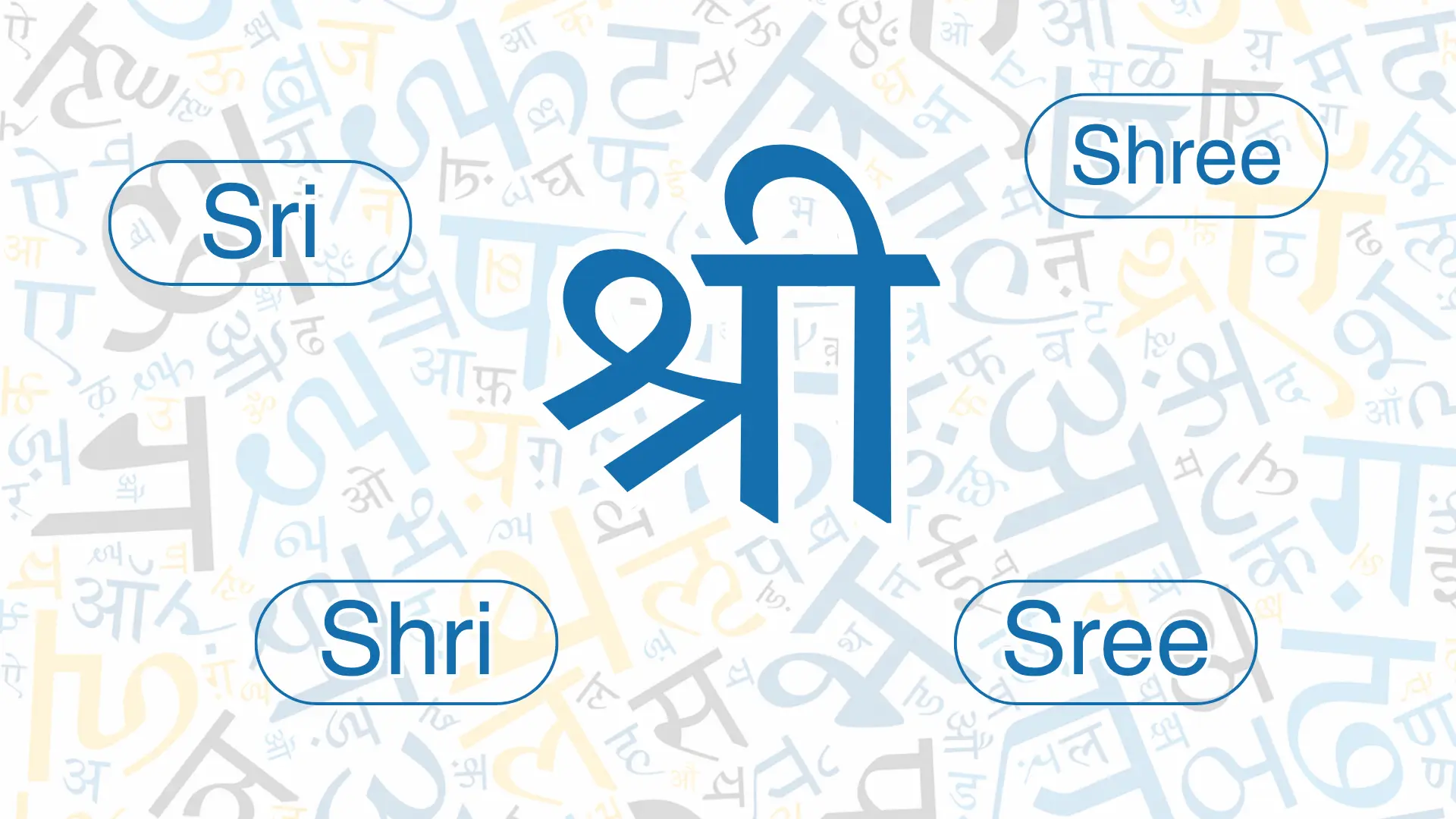
Start with the anchor case. The Devanagari name श्रीकांत is a common male given name in India. Written out, its parts already contain three separate spelling decisions.
- श्री opens with श, a palatal sibilant that English speakers hear somewhere between "s" and "sh," followed by a long ī vowel. That single syllable can reasonably be written Sri, Sree, Shri or Shree depending on whether you render the sibilant as "s" or "sh," and the long vowel as "i" or "ee."
- कांत ends in the consonant त, a dental "t" that has no exact English counterpart, which is why Indian-English spelling very often writes it as "th" (giving kanth) even though nothing is aspirated.
- And then there is the vowel you can't see. Every Devanagari consonant carries a built-in "a" sound called the schwa. In Sanskrit that final schwa is pronounced, so the classical form is …kānta. In Hindi and most modern North Indian languages, the final schwa is obligatorily dropped, a well-documented feature called schwa deletion , so the everyday pronunciation is …kānt.
Put those choices together and श्रीकांत legitimately becomes Srikanth, Sreekanth, Shreekanth, Srikant, Sreekanta, and more. This isn't sloppiness; it reflects genuinely different, coexisting standards. Scholars use IAST; international libraries and digital archives use ISO 15919; and India's own administrative romanisation is the Hunterian system, the method the Government of India adopted for official documents and place names. Each makes slightly different calls about sibilants, long vowels and the schwa.
Why AI picks one: A translation model returns the spelling that appears most often in its training data, very likely Srikanth. That's a perfectly good rendering. It is simply not guaranteed to be this person's rendering.
Why it can still be wrong: If the applicant's passport reads Sreekanth and their university degree reads Shrikant, then a certified translation that confidently prints Srikanth has introduced a third spelling of a name that is supposed to be identical across the file. Nobody mistranslated anything. The document set simply no longer agrees with itself, and agreement is the whole point.
Chinese Surnames: Why 陈 Is Spelled Tan, Chan, or Chen
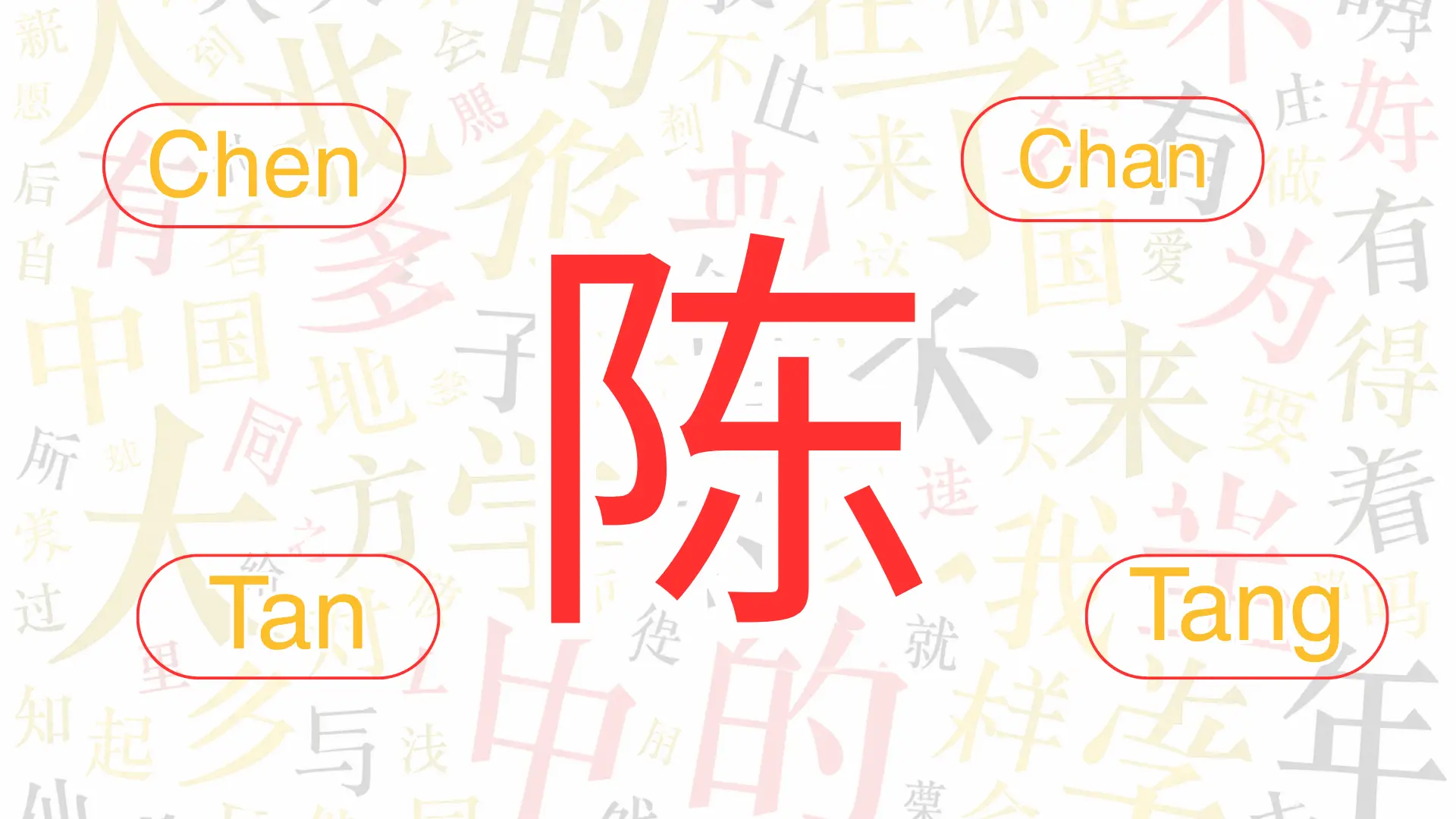
If Hindi shows how one script produces many spellings, Chinese shows how one character does, and nowhere is this more consequential than in Singapore.
One Character, Five Dialect Spellings
Chinese surnames are written with characters, then romanised into the Latin alphabet using whichever pronunciation and system a family follows. The same character can be pronounced completely differently across Chinese languages (often called dialects), and the romanisation preserves the pronunciation, not the character. Consider three of the most common surnames:
- 陈 / 陳 is Chén in Mandarin (Hanyu Pinyin: Chen), but Chan in Cantonese (think Jackie Chan), Tan in Hokkien and Teochew, Chin in Hakka, and Tang for some Teochew speakers. All of these are the same surname .
- 王 is Wang in Mandarin, Wong in Cantonese and Hakka, Ong in Hokkien, and Heng in Teochew one character, many spellings.
- 李 is Li in Mandarin (and commonly in China, Malaysia and Singapore), but Lee or Lei in Cantonese and Hakka, the surname Bruce Lee carried.
The ambiguity even runs in the other direction. In Cantonese, the surnames 王 and 黃 are homophones; both are routinely romanised Wong so a single Latin spelling can point back to more than one character. This is why the character on the source document matters as much as the letters.
Historical systems add another layer still. Even for Mandarin alone, the same character is spelled differently depending on the romanisation system. Hanyu Pinyin is today's mainland standard, but the older Wade-Giles system was used for most of the nineteenth and twentieth centuries and officially replaced on the mainland only in 1979 writes the surname 周 as Chou rather than Pinyin's Zhou, and 張 as Chang rather than Zhang. It is the same reason one leader appears as both Mao Zedong (Pinyin) and Mao Tse-tung (Wade-Giles). Older Singaporean, Malaysian, Taiwanese and Western records are full of Wade-Giles and postal-romanisation spellings, which is how two people whose surname is the same character can hold documents that spell it differently. The letters on any given document tell you which system, and which language, were in play when it was created.
Why Pinyin Tone Marks Disappear From Names
Mandarin is a tonal language: the same syllable means entirely different things depending on its tone, and Pinyin marks those tones with diacritics mā, má, mǎ, mà. In names, those tone marks are almost always dropped. Passports, birth certificates and everyday writing show Li, not Lǐ; Wang, not Wáng.
Dropping the tone throws away information, and eliminating the marks can blur the meaning . Without the tone and without the character, one spelling can stand for several unrelated surnames. The Pinyin surname Si, for example, corresponds to several distinct family names written with different characters Sī, Sí, Sǐ, Sì once tones are shown, all collapsed into a single toneless Si in the Latin alphabet. A machine reading a bare, toneless romanisation has no way to recover which character, which family, or which meaning was intended. Only the source document and the person's own records can settle that, which is why a certified translator works from the character on the page rather than the Latin spelling alone.
How Singapore's 1979–1991 Pinyin Policy Still Affects Your Name
This is not an abstract diaspora problem for Singapore; it is written into the nation's identity documents. Chinese Singaporean names appear in the Roman alphabet on the passport and birth certificate, and historically those spellings followed dialect pronunciation, which is why Tan, Lim, Goh, Wong, Ong and Chua are everywhere, rather than their Mandarin-Pinyin equivalents.
Then policy shifted. From 1 January 1981, Ministry of Education schools began registering and addressing ethnic Chinese students by the Hanyu Pinyin versions of their names, part of the wider push that accompanied the 1979 Speak Mandarin Campaign. The Pinyin-name policy was later reversed in 1991, with dialect surnames permitted again from the following year. The effect was lasting and is still visible: today you find full-Pinyin names (Li Weixiong), traditional dialect romanisation (Lee Wee Heong) and hybrids that keep a dialect surname with a Pinyin given name (Lee Weixiong) all pointing back to the same characters, 李伟雄.
Two Singaporean realities follow directly from this, and both are where automated translation quietly goes wrong:
- The same person can carry different name forms on different official documents: It is common for a Singaporean to have registered both a dialect and a Pinyin name, with one shown in brackets on the identity card. A real, documented example: a person whose birth certificate lists only her dialect name, while her IC reads Chua Sioh Ling (Cai Xiaoling) . Neither spelling is wrong. A translator must know which one the receiving authority needs to see.
- Pinyin is often the wrong default: A machine trained mostly on Mandarin will render 陈 as Chen. For a Singaporean whose NRIC and passport say Tan, "Chen" is linguistically valid it is the correct Mandarin reading, but it is the wrong spelling for their record. As the Singapore founding generation illustrates, "Lee" itself is a dialect (Hokkien) romanisation of 李; in Pinyin it would be Li.
What must be verified: For a Chinese name, a certified translator looks at the character and the applicant's existing romanised documents, then reproduces the spelling those documents already use instead of silently converting the family's Hokkien or Cantonese name into Mandarin Pinyin.
Japanese Names: Why Spelling and Pronunciation Both Trip Up AI
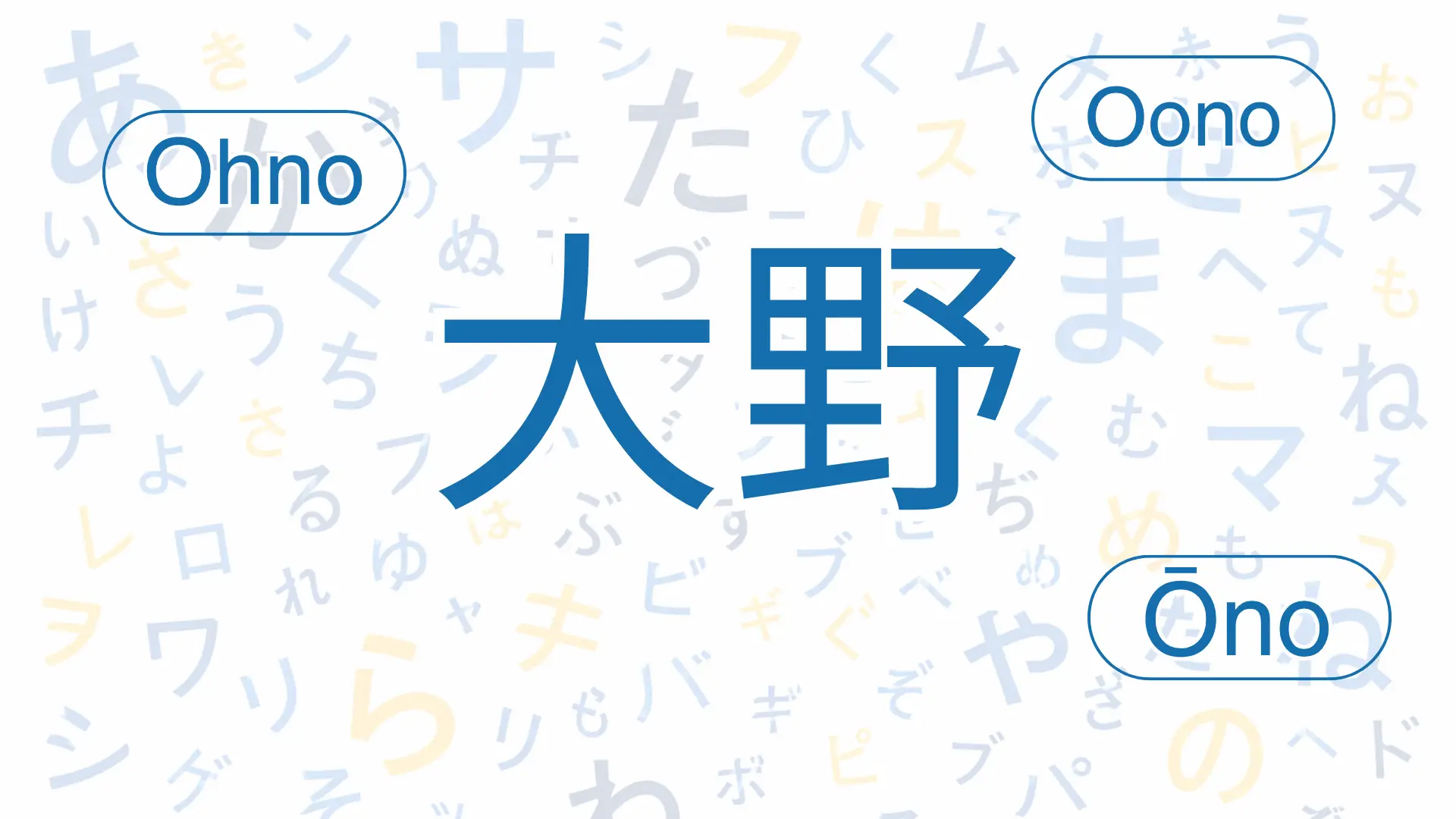
Japanese raises two independent problems at once: how a sound is spelled, and whether the machine even knows the sound to begin with.
Ōno vs. Ohno vs. Oono: One Sound, Three Spellings
Japanese romanisation has three main systems: Hepburn, Kunrei-shiki and Nihon-shiki, and they disagree, especially about long vowels. Take the surname 大野, "large field." In strict Hepburn it is Ōno (with a macron), but the macron is rarely typed in daily life, so the same name appears as Oono (doubling the vowel) or Ohno (adding an "h"). That "h" spelling is so common in names that it has a nickname: passport romaji because Japanese passports permit long vowels to be written that way (which is also how you get Satoh for 佐藤 and Itoh for 伊藤).
Now the trap. A different surname, 小野 ("small field"), is simply Ono, with a short vowel. The moment the macron is dropped, 大野 (Ōno) also flattens to Ono and the two distinct names become indistinguishable in plain letters. A person's koseki (family register) name might therefore turn up as Ono on one document, Ohno on another, and Oono on a third, all pointing at the same characters. A translator has to reproduce the spelling the person actually uses, not "correct" it to a different valid form.
Why Kanji Alone Can't Tell You How to Read a Name
Here is the deeper issue, and it is one that automated tools cannot reason their way around. In Japanese, a kanji character usually has several possible readings: on'yomi, kun'yomi, and special name-only readings called nanori that often can't be found in dictionaries at all. For a given name, the reading isn't dictated by the characters at all; the parents choose it. The same written name can be read completely differently from one family to the next, so two people can share identical kanji and pronounce them nothing alike. Personal names are notoriously idiosyncratic; even native speakers routinely ask a new acquaintance how their name is read, and that is precisely why Japanese forms and records include furigana, small phonetic characters spelling out the pronunciation.
If you can't determine the reading, you can't determine the romanisation. The characters alone don't settle it.
Japan itself has now formalised this. Under the Revised Family Register Act, which came into force on 26 May 2025, phonetic kana readings must be recorded for every citizen's name in the family register a change the government made to standardise readings, match records across IDs like passports and resident cards, and reduce error and fraud. When a nation adds an official pronunciation field to its most fundamental identity document, it is conceding the exact point at issue here: the kanji do not, on their own, tell you how to read or spell a name.
What must be verified: For a Japanese name, a translator needs the intended reading (from furigana or the person's own documents) before choosing a romanisation, and then matches the long-vowel spelling the person already uses on their passport.
French Names: Why Accents and Gender Aren't Optional
French looks familiar, same alphabet, which is exactly why its two pitfalls slip past machines and non-specialists.
Can You Legally Drop the Accent in a Name Like François?
Diacritics carry information in French: François (with a cedilla), é versus è, the ï in Loïc, and so on. Whether they can be dropped depends entirely on the destination.
Passports are the clearest illustration. Under the international standard ICAO Doc 9303, the machine-readable zone at the foot of the passport can contain only the letters A-Z, digits, and a filler character no accents at all. So a passport literally shows a name two ways: the visual page may print François with its accents, while the machine-readable zone strips them to FRANCOIS. And the mapping isn't universal; some accents fold away cleanly, but others are handled differently from country to country (German ü, for example, may become UE or U depending on the issuer).
For an airline booking or a border scanner, dropping the diacritics is standard and expected. For a certified translation of a birth or marriage certificate, it is a judgment call with consequences: the accented form is the person's recorded name, and quietly removing or altering it can misrepresent the record or create a mismatch with a document that does preserve the accents. "Acceptable" is not a fixed rule it depends on what the receiving authority needs and which of the person's existing records the translation has to agree with. A machine has no way to weigh that; it just outputs one form.
Why "né" vs. "née" Can Change What a Document Says
French grammar encodes gender in a way English does not, and on legal and administrative documents that is not cosmetic. The word for "born" agrees with the person: né for a man, née for a woman, the same distinction English borrowed for maiden names. Across civil-status records you'll see the same pattern in marié / mariée (married), époux / épouse (spouse), veuf / veuve (widower/widow), and in the past-participle and adjective agreements that ripple through a sentence.
The failure mode appears most sharply when translating into French. English is largely genderless: "the applicant was born in Singapore and is now married" states nothing about the applicant's sex. To render it in French, a translator must choose né or née, marié or mariée, supplying information the source never contained. An automated system will guess, and it frequently defaults to the masculine, producing an official French document that can state the wrong sex or marital form for a real person. A human translator resolves this by checking the person's actual documents rather than guessing from grammar.
Arabic Names: Why Muhammad Has 12+ Correct Spellings
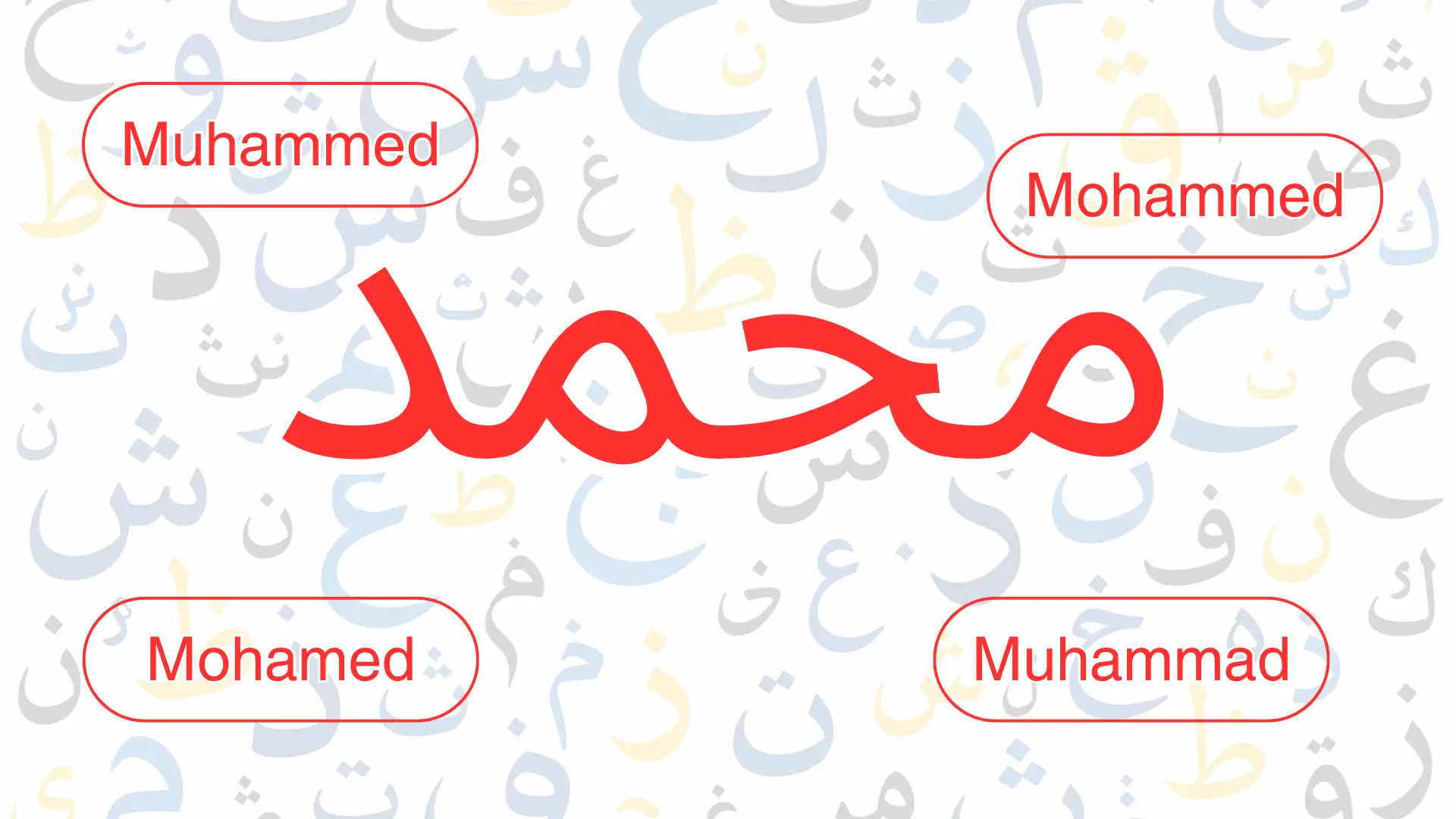
Arabic makes the transliteration problem almost unavoidable, for reasons built into the writing system.
The name محمد comes from the root ح-م-د (ḥ-m-d, "to praise") and is built from consonants with a doubled middle sound. Crucially, Arabic script does not normally write short vowels; the reader supplies them, and Arabic contains sounds English has no letter for. So every romaniser has to make choices: which vowels to insert, whether to double the consonant, how to handle sounds that don't map neatly. The result is that this single name has one of the highest numbers of English spelling variants of any name in the world : Muhammad, Mohammed, Mohamed, Mohamad, Muhammed, and many more.
Those spellings also track regional and colonial traditions. Mohammad is common in Iran, Afghanistan, and Pakistan; Muhammad dominates in India and Bangladesh and is the academic (ALA-LC) standard; Mohamed and Mohamad are widespread across the Arab world, with the French-influenced Mohamed especially common in North Africa; Turkey has Mehmet. The difference is which tradition a family follows, not a difference in meaning.
Why the passport is the anchor: Because so many spellings are equally valid, there is no way to deduce which one belongs to a given individual from the Arabic alone. Only their existing official documents settle it. A machine will output the statistically dominant spelling; if that isn't the spelling on the person's passport, the certified translation now disagrees with the identity document every authority checks first.
AI vs. Certified Translator: Name Spellings Compared by Language
| Name (script) | Some valid romanisations | Why more than one is correct | What AI tends to output | What a certified translator verifies |
|---|---|---|---|---|
| श्रीकांत (Hindi, Devanagari) | Srikanth, Sreekanth, Shreekanth, Srikant, Sreekanta | Sibilant "s/sh," long vowel "i/ee," dental "t/th," and schwa dropped in Hindi but kept in Sanskrit; competing IAST / ISO 15919 / Hunterian standards | Srikanth (most frequent form) | The exact spelling on the person's passport and certificates, kept consistent across the file |
| 陈 / 陳 (Chinese) | Chen, Chan, Tan, Tang, Chin | Same character, different languages (Mandarin Chen, Cantonese Chan, Hokkien/Teochew Tan, Hakka Chin), different systems (Pinyin vs Wade-Giles: Zhou vs Chou), and dropped Pinyin tone marks that merge distinct surnames | Chen (Mandarin Pinyin default, tones stripped) | The character and the applicant's registered romanisation (e.g. NRIC/passport Tan), not a Pinyin conversion |
| 大野 (Japanese) | Ōno, Oono, Ohno (vs 小野 = Ono) | Long-vowel spelling differs by system (Hepburn macron / doubled vowel / "oh" passport romaji); dropping the macron collides with a different name; kanji can have several readings | Ono or Ohno (guessed reading and spelling) | The intended reading (furigana / the person's own records) before choosing romanisation and long-vowel spelling |
| François (French) | François / FRANCOIS; né vs née | Accents dropped in a passport's machine-readable zone but kept in the visual zone (mappings vary by country); gender agreement adds meaning English lacks | FRANCOIS; masculine default for né/married forms | Whether accents must be preserved for the target authority, and the person's actual gender/marital status |
| محمد (Arabic) | Muhammad, Mohammed, Mohamed, Mohamad, Muhammed | Short vowels aren't written; sounds have no exact English letters; regional spelling traditions differ | Muhammad or Mohammed (dominant forms) | The exact spelling already on the person's passport and existing records |
How Name Mismatches Delay ICA and MOM Applications
The abstraction becomes obvious the moment a document reaches a counter.
An ICA permanent residence or citizenship application: A family submits a foreign birth certificate with an English translation. The translation romanises a child's Chinese name in Mandarin Pinyin, while the parent's passport and the marriage certificate use a Hokkien spelling. Nothing was "mistranslated," yet the names no longer match across the bundle. In practice, a name that doesn't line up with existing records can prompt clarification queries, a request for supporting documents (such as a deed poll or a statutory declaration explaining the variant), or a resubmission, which is why matching the spelling to the person's own records from the outset saves time. (For how the notarisation and authentication chain fits around this, see our ICA notarisation guide).
A MOM Employment Pass: Work-pass applications are built on the passport bio-data page, and any foreign-language supporting document has to be translated into English. If a translated degree certificate or marriage certificate spells the applicant's name differently from the passport, an employer may face avoidable back-and-forth. The safe practice is simple: the translated name follows the passport.
A permanent record you can't quietly change: In Singapore, birth and marriage certificates are permanent; a later name change made by deed poll updates the NRIC and passport but not the birth register. That means legitimate spelling differences across a person's documents are normal, and a translator's job is often to reproduce a specific historical spelling faithfully rather than modernise it.
A note on consequences, stated plainly: name mismatches between a translation and a person's official records are a well-recognised cause of authority queries, additional-document requests, and returned or rejected submissions precisely the ICA and MOM delays applicants most want to avoid. What they do not do is fail automatically; outcomes depend on the document, the authority, and the rest of the file, so always confirm requirements for your specific case. The point is that this entire category of problem is avoidable at the translation stage before anything reaches a counter.
What a Certified Translator Checks That AI Translation Can't
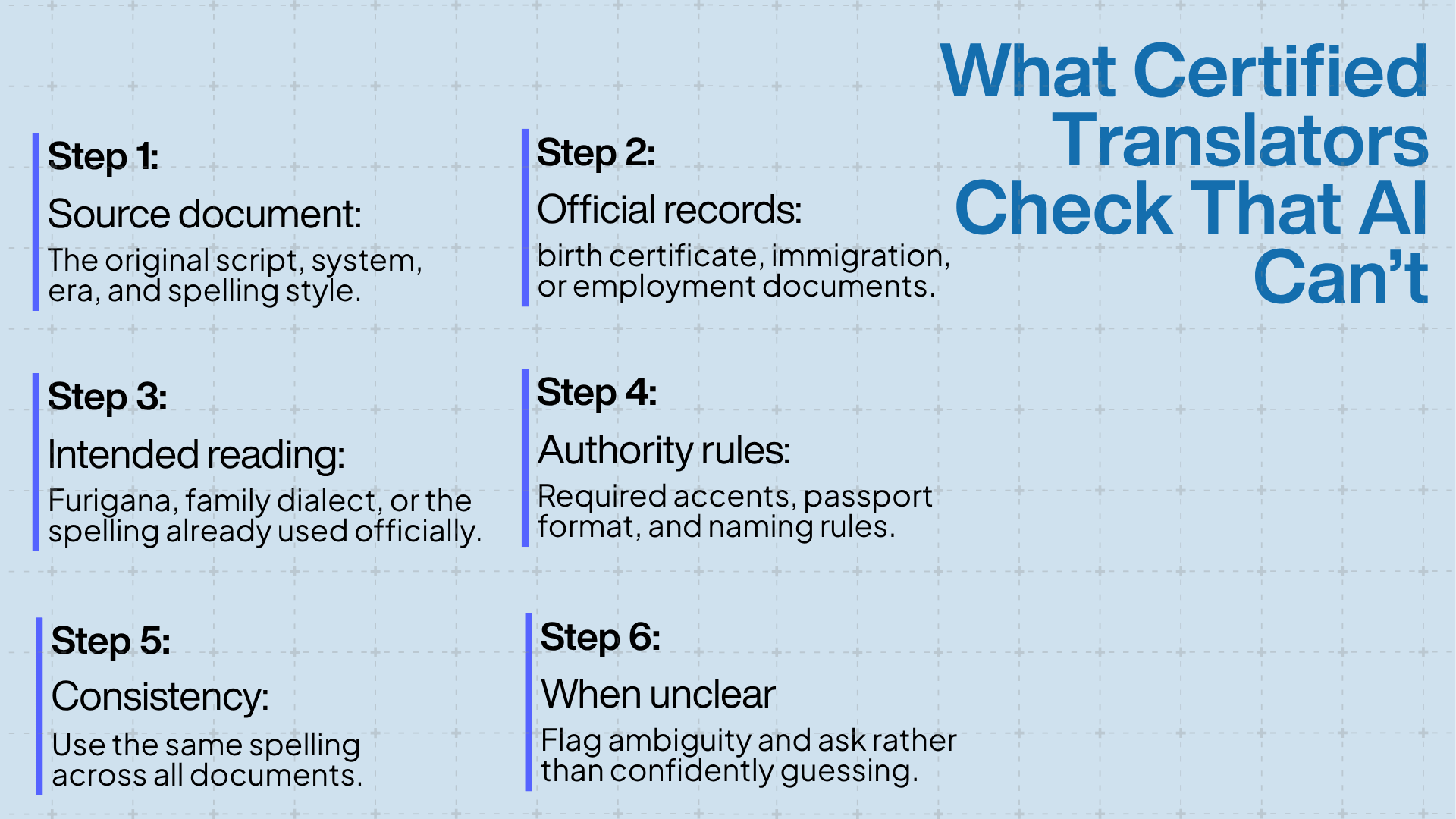
An automated tool sees a string and returns the most probable string. A certified translator treats a name as an identity that has to be reconciled with real-world records. That means checking things a model has no access to:
- The source document itself: the actual characters or script, including which system and era they reflect (a Wade-Giles spelling, a dialect romanisation, an accented civil-status entry).
- The person's existing official records: passport, NRIC/FIN, birth certificate, prior immigration or employment documents so the translated name matches what authorities will compare it against.
- The intended reading, where the script doesn't fix it: furigana for a Japanese name, the family's dialect for a Chinese surname, the vowels a passport already commits to for an Arabic name.
- The receiving authority's conventions: whether accents must be preserved, whether a name should appear exactly as in the passport, how a dual dialect-and-Pinyin name should be presented.
- Cross-document consistency: ensuring one spelling is used uniformly across an entire application, not a different valid variant on each page.
- When to stop and ask: a professional flags ambiguity and seeks clarification instead of committing to a confident guess. Producing fluent, plausible output regardless of uncertainty is exactly what an automated system is built to do; recognising that a name can't be resolved from the source alone is a matter of judgment.
This is the heart of it. The problem is not simply that AI can "translate a name incorrectly." The deeper problem is that several spellings can be linguistically valid, while only one may be appropriate for a person's official record. A certified human translator resolves that ambiguity by checking the source document, existing official records, and the client's required document conventions rather than selecting the statistically likely spelling. For a fuller catalogue of where automated legal translation goes wrong, our top legal translation mistakes piece is a useful companion.
Checklist: Submitting Translated Documents to ICA or MOM
Whether you engage a professional or are simply preparing a file, run through this before anything goes to an authority:
- Gather your existing records first: Put your passport, NRIC/FIN and any prior official documents in front of you before the name is translated; they define the target spelling.
- Decide on one spelling and use it everywhere: Every document in a single application should show the identical romanisation of your name.
- Match the passport for immigration and work-pass files: For ICA and MOM submissions, the translated name should follow your passport unless the authority specifies otherwise.
- Keep the original characters or script visible: For Chinese, Japanese and other non-Latin names, the source characters anchor identity even when the romanisation varies; don't discard them.
- Preserve accents on civil-status documents unless told otherwise: Don't strip diacritics from a French, or other accented, name just because a system elsewhere does.
- Flag every known variant: If your birth certificate and passport already differ, tell your translator up front, and ask whether a deed poll or statutory declaration should accompany the submission.
- Confirm dual-name presentation: If you hold both a dialect and a Pinyin name, clarify how the receiving authority wants both shown.
- Have a human certify anything official: For documents bound for ICA, MOM, the courts, embassies or academic bodies, use a certified translation whose accuracy someone will stand behind. Our zero-rejection submission checklist covers the stamps, seals and authentication steps that sit alongside the name itself.
The Bottom Line: Match Your Name to Your Passport, Not the Dictionary
It is tempting to frame automated translation errors as a quality gap that will close as the technology improves. With names, that framing misses the mechanism. The difficulty isn't that the machine isn't good enough at languages; it's that a name in another script often has several equally correct romanisations, and choosing among them for an official document requires information that lives outside the text in a person's passport, their birth certificate, their existing records, and the conventions of the authority receiving the file.
That is work of verification, not fluency. At LetterCrafts, our certified translations are produced by human linguists who read the source, reconcile a name against the client's actual documents, and reproduce the spelling that keeps an application internally consistent for birth, marriage, educational and immigration documents accepted by ICA, MOM and other Singapore authorities. If you're preparing a personal or legal document and want the name to match your records exactly, you can start with our certified translation service or get in touch with your questions.