Quick Answer: How to Choose a Document Translation Service in Singapore
The 7 things every Singapore translation service must have:
- Verifiable certification with a proven ICA / MOM acceptance track record.
- Domain-expert translators are not just bilingual speakers.
- A formal TEP quality review (Translation, Editing, Proofreading) with a second linguist.
- Transparent, itemised pricing covering translation, certification, notarisation, and SAL authentication.
- Full knowledge of Singapore's ICA, MOM, SAL, and PDPA requirements.
- A written delivery date guarantee.
- A documented PDPA-compliant data security policy.
Most people only discover the true cost of a bad translation after they have already paid for it, a rejected ICA application, a disputed contract, or a failed MOM work pass submission. Choosing a document translation service in Singapore is not a commodity decision. It is a professional one, with professional consequences.
Singapore's multilingual landscape is unlike almost anywhere on earth. Four official languages, a global financial hub attracting professionals from across Asia, government agencies with strict, if often unstated, submission standards, and a translation market that spans world-class professional firms and unregulated individuals operating with no quality controls. Knowing how to tell the difference is not optional. It is essential.
This guide was written specifically for 2026, when AI translation tools are more advanced than ever, when Singapore's regulatory environment continues to evolve, and when the volume of cross-border documentation for immigration, legal, and business purposes is at an all-time high. Whether you are an individual applying for Singapore PR, a law firm handling cross-border contracts, a company expanding into Southeast Asia, or a foreign national navigating official paperwork, the criteria here will help you make the right choice with confidence.
KEY FIGURES 2026
| 80+ Languages served by top Singapore agencies | S$30–S$150+ Certified translation cost per page (2026) | 1–3 days Standard turnaround for most documents | In 2019, SAL authentication became mandatory for notarised documents in Singapore. |
|---|
Why Your Choice of Translation Service Matters More Than You Think
Translation is commonly perceived as a conversion exercise, moving words from one language into another, and you are done. For a menu or a marketing brochure, that might be acceptable. For a legal document, an immigration filing, a birth certificate translation for ICA or a medical record, it is dangerously reductive.
For general communications, a quick email, a marketing blurb, an internal memo, the answer is increasingly yes. But for Certified Translation in Singapore the question reveals a fundamental misunderstanding of what certification actually is.
Expert Perspective: The most dangerous translation errors are not the obvious ones; they are the subtle ones. A term that is technically accurate in one legal system carries entirely different implications in another. This is why domain expertise matters as much as linguistic fluency. A Mandarin-fluent translator who is unfamiliar with Singapore contract law is not qualified to translate a Singapore court submission, regardless of their language skills.
In Singapore's regulatory landscape, specifically, the stakes are amplified by the number of agencies involved. The Immigration and Checkpoints Authority (ICA), the Ministry of Manpower (MOM) the Accounting and Corporate Regulatory Authority (ACRA), the Housing Development Board (HDB), the Land Transport Authority (LTA), and the Singapore courts each have their own standards, and none of them accept machine-generated translations. All of them expect certified, human-reviewed translations produced by qualified professionals.
Beyond regulatory compliance, there is a straightforward business case. The cost of professional certified translation in Singapore ranges from S$30 to S$150 per page. The cost of a rejected ICA PR application, a disputed contract, or a delayed business registration due to inadequate translation is orders of magnitude higher. This is not an area where cutting costs makes financial sense.
Types of Document Translation You Might Need in Singapore
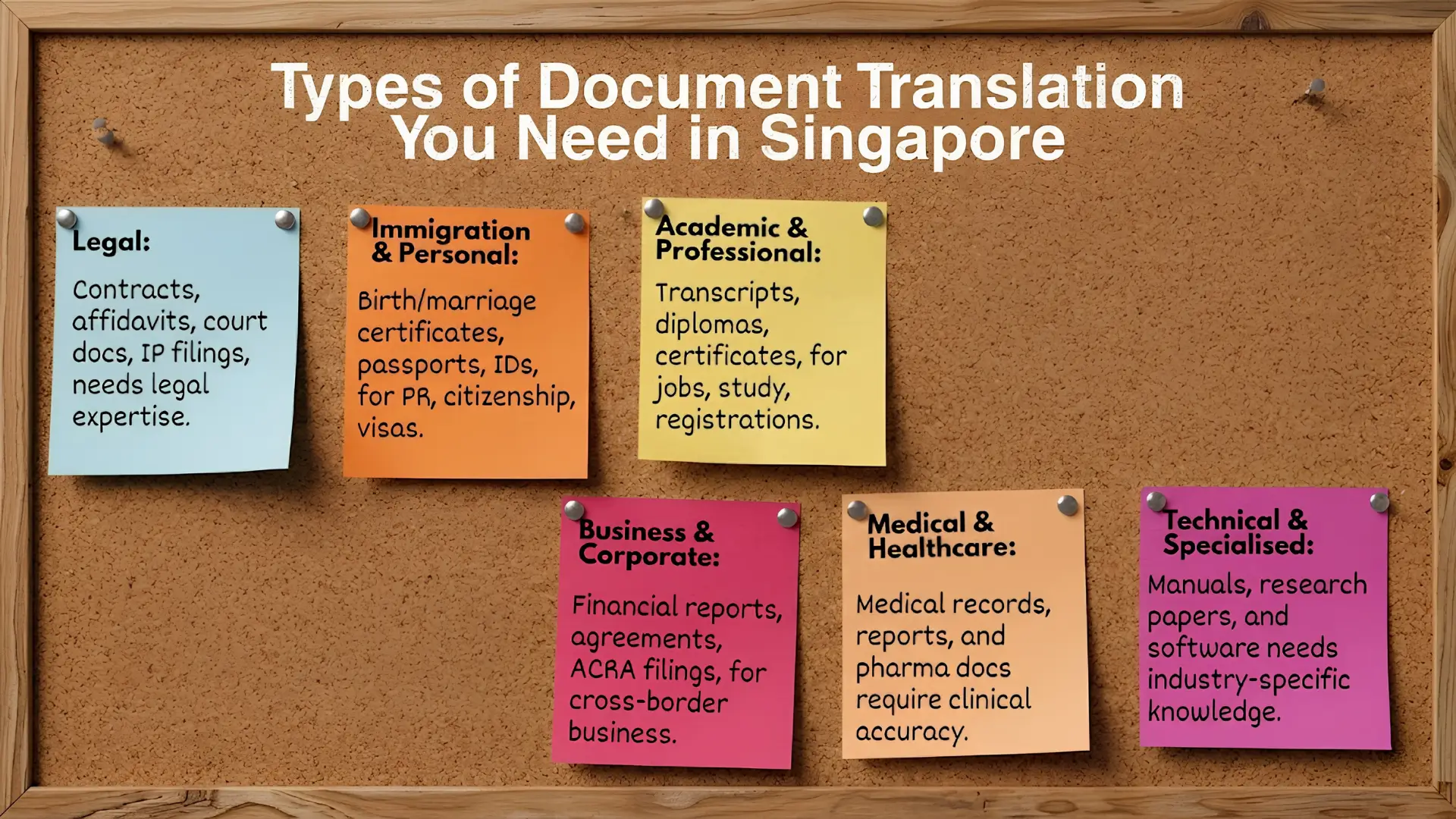
Before evaluating providers, be precise about what you need. Not all translation services are equipped to handle all document categories, and in Singapore, the requirements vary significantly depending on the receiving authority and the nature of the document.
- Legal Documents: Contracts, affidavits, court submissions, power of attorney, IP filings, compliance documentation. Requires legal domain expertise and familiarity with Singapore's common law framework.
- Immigration & Personal: Birth certificates, marriage and divorce certificates, passports, national ID cards, police clearance certificates. Commonly required for ICA PR applications, citizenship applications, and dependant pass submissions.
- Academic & Professional: University transcripts, diplomas, professional qualifications, school certificates for MOM work pass applications, professional registration, or local institution admissions.
- Business & Corporate: Financial reports, shareholder agreements, ACRA filings, HR policies, commercial contracts, tender documents for cross-border business transactions.
- Medical & Healthcare: Medical records, shareholder agreements, ACRA filings, HR policies, commercial contracts, tender documents for cross-border business transactions.
- Technical & Specialised: Engineering manuals, software localisation, scientific research papers, and industry-specific compliance documentation requiring specialist vocabulary.
Each category demands a translator who is not merely bilingual but domain-literate. The qualifier is not the language pair; it is the professional background. A medical translator needs clinical training and bilingual proficiency. A legal translator handling Singapore court documents must understand Singapore's common law framework. This is where generic online translation platforms consistently and predictably fail.
Expert Criteria for Choosing the Right Document Translation Service
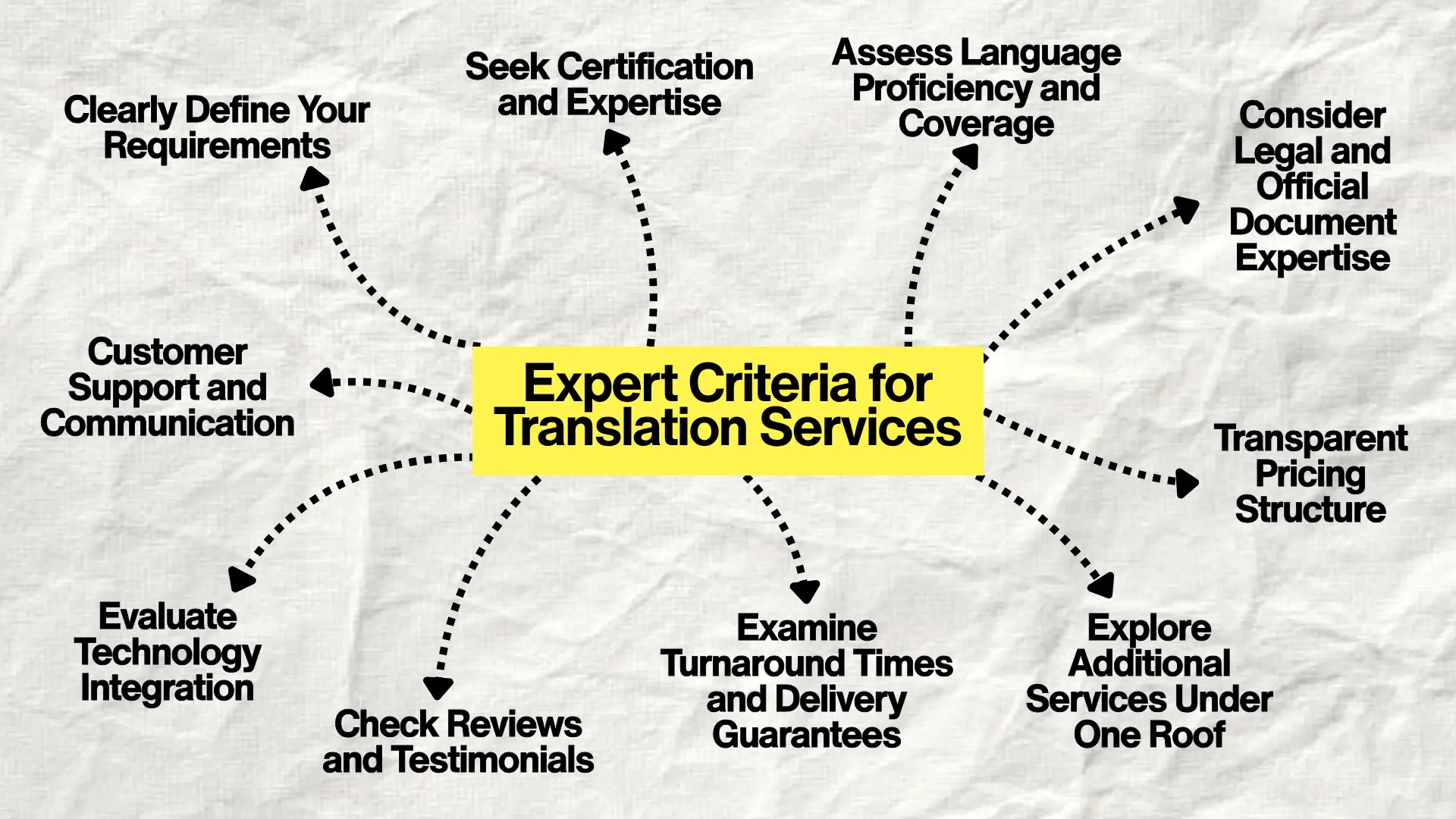
Whether you are an individual, a business, or a legal professional, these 13 factors will guide you to a translation service that meets both your expectations and Singapore's regulatory standards. Each factor includes a practical question you should ask before signing anything.
1. Clearly Define Your Requirements
Before engaging any translation service, it is essential to have a precise understanding of what you need. Identify the type of documents you require translated, the target languages involved, and whether certification or notarisation is required. For example, an ICA PR application requires certified translations with a Certificate of Translation Accuracy, while a corporate filing with ACRA may have different formatting expectations. Defining your requirements upfront allows you to evaluate providers against a concrete brief, avoiding mismatches in scope, cost, or delivery.
2. Seek Certification and Expertise
Certification serves as a testament to professionalism within the translation industry. Ensure that your chosen service provider offers certified translation services and that their translators possess verified expertise in their respective fields, not just language fluency, but domain knowledge, cultural awareness, and familiarity with industry-specific terminology. A certified translation accompanied by a signed Certificate of Translation Accuracy is the standard required by Singapore government agencies, including ICA, MOM, and ACRA.
Ask for: What certifications does your agency hold, and can you confirm which of your translators is qualified to handle my specific document type?
3. Assess Language Proficiency and Coverage
A reputable document translation service should have a team of translators proficient in a wide range of languages. Singapore's most common certified translation needs involve English, Mandarin Chinese, Malay, Tamil, Bahasa Indonesia, Thai, Vietnamese, Japanese, Korean, and Hindi. For European or rare language pairs, the pool of Singapore-based certified specialist translators is smaller, and pricing and turnaround times typically reflect this. Always confirm that the specific translator assigned to your project is a qualified native or near-native speaker of the target language.
Ask for: Who is the assigned translator for my language pair, and what are their qualifications and native language background?
4. Consider Legal and Official Document Expertise
Legal and official document translation demands far more than bilingual competence. A translator handling a Singapore court affidavit must understand Singapore's common law framework. One translating a medical record must be familiar with clinical terminology in both the source and target languages. One working on a financial contract must recognise the legal implications of specific terms in both jurisdictions. Always verify that the assigned translator has professional expertise directly relevant to your document category: legal, medical, immigration, financial, or technical.
Ask for: Does the translator assigned to my document have professional experience in this specific field, legal, medical, or financial, beyond general language skills?
5. Transparent Pricing Structure
Transparency in pricing is essential and non-negotiable. A trustworthy Singapore translation service provides a detailed written quote before any work commences, itemising every component: translation cost per page or per word, language pair surcharges if applicable, certification fee, notarisation fee, SAL authentication fee, and any urgent delivery premium. In 2026, certified document translation in Singapore typically costs between S$30 and S$150 or more per page, depending on complexity and language pair. If a provider cannot itemise their pricing upfront, or if the quote changes significantly after document submission, treat this as a red flag.
Ask for: Can I have a written, itemised quote that separately states the cost of translation, certification, notarisation, and SAL authentication before any work begins?
6. Explore Additional Services Under One Roof
Coordinating between a translation agency, a separate notary public, and the Singapore Academy of Law creates unnecessary complexity and multiple failure points. For documents that require full-chain translation, certification, notarisation, SAL authentication, and potentially Ministry of Foreign Affairs (MFA) legalisation for overseas submission, look for a provider that manages this end-to-end. Having all these services available under one roof streamlines the entire process and eliminates the risk of errors or delays in handoff between separate service providers.
Ask for: Can you handle the complete chain translation, certification, notarisation, SAL authentication, and MFA legalisation under a single coordinated workflow?
7. Examine Turnaround Times and Delivery Guarantees
Time is often of the essence, especially in legal, immigration, or business matters. Most professional agencies in Singapore deliver standard certified translations within 1 to 3 business days, with same-day or 24-hour urgent services available for straightforward documents at a surcharge. Beyond the stated timeframe, what matters is contractual accountability. For applications with regulatory or legal deadlines, ICA filing windows, court submission dates, and MOM work pass expiry, late delivery is not merely inconvenient. It can be costly. Always confirm the delivery date in writing before proceeding.
Ask for: Will you commit to a specific written delivery date, and what is your policy if that date is missed?
8. Check Reviews and Testimonials
Reviews and testimonials provide valuable insight into a service provider's reputation and the real-world quality of their translations. However, generic five-star reviews, such as "great service," "fast turnaround," and "friendly team," tell you very little about translation quality for your specific document type. Look specifically for reviews from clients in comparable situations: an ICA PR applicant whose documents were accepted on first submission, a law firm whose contract translations survived legal scrutiny, or a MOM applicant whose work pass was approved without translation-related queries. Agencies with genuine domain expertise will have specific examples to share.
Ask for: Can you provide client references or testimonials specifically from clients who submitted similar documents to the same receiving authority as mine?
9. Evaluate Technology Integration
In 2026, AI translation tools are more advanced than ever, but their role in professional certified translation must be carefully understood. AI can legitimately support a human translator's workflow as a drafting aid, improving speed and consistency. However, no AI system can provide the signed Certificate of Translation Accuracy that Singapore government agencies require, and machine-translated documents cannot be certified by a qualified human professional. Ask directly whether a qualified human translator is personally performing and certifying your translation, or whether AI is being used as the primary translation method.
Ask for: Is a qualified human translator personally performing and certifying this translation, or is AI being used as the primary method?
10. Customer Support and Communication
Effective communication is a reliable indicator of overall service quality. Document translation projects surface mid-project questions, an ambiguous source term, a formatting decision, and a clarification about the target authority's requirements. The quality of communication before you commit is a direct predictor of communication throughout the project. If your pre-engagement enquiry is handled by someone who cannot answer basic questions about ICA submission requirements or the difference between certification and notarisation, you will encounter the same knowledge gap when it matters most. Choose an agency where your initial contact is knowledgeable, direct, and provides a named project manager for your account.
Ask for: Who will be my named project manager throughout this engagement, and can I have their direct contact details before committing?
11. Insist on a Formal TEP Quality Assurance Process
Professional document translation is not a solo undertaking. Best-practice agencies operate a TEP workflow: translation by a qualified linguist, independent Editing by a second qualified reviewer, and Proofreading against the original for accuracy, formatting, and terminology consistency. Single-translator workflows without an independent review stage are not appropriate for legally significant documents. The presence of a formal TEP process and an agency's willingness to describe it in detail is one of the clearest quality signals you can identify before committing. Any agency that cannot explain its quality assurance process should be treated with caution.
Ask for: Does a second qualified linguist independently review and sign off on the translation before delivery, and can you describe your quality assurance process step by step?
12. Verify Deep Familiarity With Singapore's Regulatory Framework
Singapore's government agencies have nuanced, specific requirements that experienced local providers should know by heart. ICA PR submissions require a Certificate of Translation Accuracy in a specific format. MOM work pass applications have their own document standards. Singapore court submissions may require an affidavit of translation. Since October 2019, all notarised documents must be authenticated by the Singapore Academy of Law (SAL). If an agency seems uncertain about any of these requirements when you ask, if they say they will "look into it" that is a significant concern for documents where accuracy and regulatory compliance are non-negotiable.
Ask for: Can you describe the specific requirements for submitting translated documents to ICA, MOM, and the Singapore courts, including the SAL authentication process?
13. Confirm PDPA Compliance and Document Security
The documents you submit to a translation agency are among your most sensitive passports, national identity cards, marriage certificates, medical histories, financial statements, and legal contracts. Under Singapore's Personal Data Protection Act (PDPA), any translation agency that receives, processes, or stores your personal documents is a data intermediary with legal obligations. These include obtaining proper consent, implementing appropriate security measures, and not retaining personal data beyond what is necessary. Ask for a written data protection policy before submitting any documents. Any agency that cannot answer these questions clearly should not receive your documents.
Ask for: Can you provide your written PDPA compliance statement, confirm that translators operate under NDAs, and explain how my documents are stored and deleted after project completion?
Red Flags to Walk Away From
Knowing what to select is half the decision. The other half is recognising what to reject. These warning signs appear consistently in translation experiences that end badly.
⚠ Unrealistically low pricing Professional certified translation in Singapore has a cost floor. If a provider quotes S$5 per page for a certified legal or immigration document, something is wrong with the quality, the process, the accountability, or all three. The cheapest option is rarely the right option when document accuracy carries legal consequences.
⚠ No TEP process or independent review. Single-translator workflows with no second-linguist review are not an acceptable standard for legal or official documents. If an agency cannot describe a formal quality assurance process, assume one does not exist.
⚠ Vague claims about "government acceptance" without specifics. "All Singapore government agencies accept us" is not verifiable. Ask which agencies, for what document types, with what track record. Reputable agencies can answer this; those who cannot are relying on marketing language, not performance.
⚠ No PDPA compliance or confidentiality policy. If an agency cannot explain how they store and deletes your passport scan or legal contract, you are taking an unnecessary data security risk. This is both a practical and a legal concern.
⚠ AI translation used as a replacement, not a supporting tool. In 2026, AI translation tools are sophisticated but remain unacceptable for official submissions to the Singapore government. Any agency using machine translation as a substitute for qualified human translators rather than as a drafting aid within a human-led workflow is compromising the quality you need and the certification you require.
⚠ No verifiable Singapore business registration or physical address. For documents requiring in-person notarisation or SAL authentication, an agency without a local presence in Singapore creates practical and legal complications. Verify the agency's business registration if you have any doubts.
⚠ No rejection-remediation policy. A professional agency confident in its quality should have a clear, written policy for what happens if the receiving authority rejects a translated document due to a translation error. If they do not, or if the policy is vague, treat this as a direct reflection of their confidence in quality.
Singapore-Specific Requirements You Cannot Ignore
A specific set of local institutions, regulations, and processes shapes Singapore's document translation requirements. If you are submitting documents to Singapore government agencies or obtaining Singapore-issued translations for overseas use, understanding these requirements is not optional.
The ICA Certification Standard
The Immigration and Checkpoints Authority (ICA) does not maintain or publish a formal list of approved translation agencies. Their requirement is unambiguous, however: all translations of foreign-language documents must be accompanied by a Certificate of Translation Accuracy signed by the translator or the agency, confirming the translation is complete, true, and accurate.
When evaluating agencies for ICA submissions, PR applications, citizenship applications, Long-Term Visit Pass applications, and dependant pass documents, ask directly for their ICA track record and zero-rejection rate. The agencies that perform best in this context have submitted hundreds of ICA documents and can tell you so.
Notarisation and SAL Authentication (Mandatory Since October 2019)
Since October 2019, all documents in Singapore that require notarisation must also be authenticated by the Singapore Academy of Law (SAL) This authentication verifies the notary public's signature and credentials. SAL operates from 1 Coleman Street, Singapore, and charges a per-certificate authentication fee.
For documents destined for overseas legal submission, court proceedings, embassy applications,
and foreign government filings, the complete chain is:
Certified Translation → Notarisation by a Singapore Notary Public → SAL Authentication → MFA
Apostille or Embassy Legalisation
A professional translation agency operating in Singapore in 2026 should know this process in detail and be able to coordinate each step.
Singapore Document Translation Requirements by Use Case
| Document / Use Case | Receiving Authority | Requirements |
|---|---|---|
| PR / Citizenship Application | ICA | Certified Translation + Certificate of Translation Accuracy |
| Work Pass Application | MOM | Certified Translation + Certificate of Translation Accuracy |
| Court Submission | Singapore Courts | Certified Translation + Translator's Affidavit |
| Corporate Filing | ACRA | Certified Translation + Certificate of Translation Accuracy |
| Overseas Legal Submission | Foreign courts/embassies | Certified + Notarised + SAL Authentication |
| Embassy / Apostille Documents | Foreign government | Certified + Notarised + SAL + MFA Legalisation |
| Medical / Clinical Records | Healthcare institutions/insurers | Certified Translation by a medically qualified translator |
PDPA and Your Documents
Singapore's Personal Data Protection Act (PDPA) applies to any organisation that collects, uses, or discloses personal data in the course of providing services, which includes every translation agency that handles your identity documents, financial records, or medical histories. Under the PDPA, the agency must obtain your consent to use your data, protect it with appropriate security measures, and retain it only as long as necessary. Ask for a written data protection policy before submitting any documents. Professional agencies will have this ready.
The AI Translation Question in 2026
In 2026, AI translation capabilities have improved significantly. This has led some agencies to use AI as a primary translation tool with minimal human oversight. The position of Singapore's government agencies remains unchanged: they require certified translations accompanied by a signed Certificate of Translation Accuracy from a qualified human translator. No AI system can provide that certification, and none has the legal accountability that authorities require.
AI can legitimately support a human translator's workflow as a drafting aid. Still, it cannot replace the human translator, and it cannot provide the certification that makes a translation officially acceptable in Singapore.
Important Warning
If an agency's pricing is significantly below market rate and they cannot clearly explain their quality assurance process, ask directly whether AI is being used as the primary translation method. Some providers use AI translation with minimal human review and still issue a Certificate of Translation Accuracy, a practice that undermines the value and reliability of that certification. Always ask: Is a qualified human translator personally performing and certifying this translation?
Language Pair Availability in Singapore (2026)
Singapore's most common certified translation needs involve English, Mandarin Chinese, Malay, Tamil, Bahasa Indonesia, Thai, Vietnamese, Filipino, Japanese, Korean, Hindi, Urdu, and Bengali. For European languages, French, German, Spanish, Portuguese, Italian, and for Arabic, the pool of Singapore-based certified specialist translators is smaller, and pricing and turnaround times typically reflect this. For rare language pairs, always confirm the specific translator's qualifications and availability before committing to a deadline-sensitive project.
Practical Note for Businesses
Organisations with ongoing, multi-language translation requirements benefit significantly from a formal retainer or preferred-vendor arrangement with a full-service Singapore translation agency. This typically reduces per-project costs through volume, ensures consistency of terminology and formatting across all documents, provides a dedicated relationship manager, and eliminates the time cost of re-qualifying a new provider for every project.
Questions to Ask Before You Sign Anything
This checklist is designed to be used as a pre-engagement evaluation tool. A professional, trustworthy translation agency operating in Singapore will answer every one of these questions with clarity, confidence, and without hesitation.
- What are the specific certifications or professional credentials your translators hold for this type of document?
- Have your certified translations been accepted without rejection by ICA / MOM / the Singapore courts, and can you provide a specific reference or example?
- What is your quality assurance process? Does a second qualified linguist independently review and sign off on the translation before delivery?
- Can I have a written, itemised quote that separately states the cost of translation, certification, notarisation, and SAL authentication before any work begins?
- What is your PDPA compliance policy? How are my documents stored, who has access, and how are they destroyed after project completion?
- Do your translators operate under NDAs? What secure file transfer method do you use?
- Will you provide a written delivery date that is binding, and what is your policy if that date is missed?
- Who will be my named project manager throughout this engagement?
- Can you handle the complete chain translation, certification, notarisation, SAL authentication, and MFA legalisation if required under one workflow?
- If my translated document is rejected by the receiving authority due to a translation error, what is your remediation policy, and what costs, if any, would I incur?
- Are your translators performing human translation, or is AI being used as the primary translation method? Who personally signs the Certificate of Translation Accuracy?
Conclusion
Choosing the right document translation service in Singapore is not simply a matter of finding the most affordable option or the fastest turnaround. It is a decision with consequences that extend to visa applications, legal enforceability, business compliance, and some of the most significant personal milestones in a person's life.
The criteria in this guide go beyond surface-level considerations. Verifiable certification. Domain expertise matched to your document type. A formal quality assurance process with independent review. Deep familiarity with Singapore's ICA, MOM, SAL, and PDPA requirements. Transparent pricing. Written accountability on delivery. These are the standards that professional translation agencies in Singapore should meet without hesitation, and the questions you should be asking before you hand over a single document.
At LetterCrafts, these are the standards we hold ourselves to on every project. If you have a document translation requirement, a single-page ICA submission, a complex legal agreement, or an ongoing business translation programme, we would be glad to demonstrate what professional translation looks like in practice.