Key Takeaway
Translation converts language. Transcreation converts meaning.
For global brands, translation is the right tool for informational content, legal documents, manuals, and disclosures where accuracy matters most. Transcreation is the right tool for any content designed to make an audience feel something, such as ads, slogans, UX copy, and campaigns where emotional resonance and cultural relevance matter most.
Brands that apply translation logic to marketing content risk losing their voice entirely: the words arrive, but the personality doesn't. Maintaining brand voice across languages requires native creative expertise, a clear intent brief, and a process that asks not "what does this say?" but "what does this need to do?"
The decision rule is simple: if changing the words but keeping the feeling would still make the content work, that's a transcreation job.
There's a moment every global marketing team dreads: a campaign that crushed it domestically goes flat or worse, offensive, the moment it crosses a border. The visuals are identical. The budget was generous. But something broke in the language.
Most of the time, the culprit isn't the creative. It's the copy that wasn't treated like creative.
Brands often assume that translating their messaging is enough to reach a new market. It rarely is. Language carries culture, emotion, and identity. When you ignore that, you don't just lose nuance,e you lose trust.
This is where understanding the difference between transcreation and translation becomes a genuine business decision, not just a linguistic one.
What Is Translation?
Translation is the accurate conversion of text from one language to another, preserving the original meaning as closely as possible.
A professional translator works with the source text and produces a target-language version that says the same thing. The goal is fidelity to the words, the structure, and the intent of the original.
Translation works best when:
- Accuracy is non-negotiable in legal contracts, medical documentation, and technical manuals
- The content is informational, including product specifications, user guides, and financial reports
- The audience needs facts, not feelings, compliance documents, and academic research
Translation is precise, structured, and essential. But it's built for information transfer, not emotional resonance.
What Is Transcreation?
Transcreation is the process of recreating content in another language while preserving its emotional impact, cultural relevance, and brand intent, even when the words must change entirely.
It's part translation, part copywriting, part cultural consulting. A transcreation professional doesn't just ask "What does this say?" They ask, "What does this make the reader feel, and how do I recreate that feeling in this language?"
A well-known example: Pepsi's global tagline, "Come alive with the Pepsi Generation," was reportedly translated into Chinese in a way that read as "Pepsi brings your ancestors back from the dead." That's not a translation error, it's a transcreation failure. The words were technically accurate. The cultural resonance was catastrophically wrong.
Transcreation is the discipline that prevents exactly that.
Transcreation vs. Translation: Key Differences
| Factor | Translation | Transcreation |
|---|---|---|
| Primary Goal | Linguistic accuracy | Emotional and cultural equivalence |
| Creative Latitude | Minimal | High words, tone, and even structure may change |
| Cultural Nuance | Not the focus | Central to the process |
| Source Text Role | Blueprint to follow | Reference for intent and feeling |
| Deliverable | Translated text | Adapted content with creative rationale |
| Best For | Legal, technical, informational | Marketing, advertising, brand copy, UX |
| Skill Required | Linguistic expertise | Linguistics + copywriting + cultural insight |
The distinction matters because applying translation logic to marketing content is like using a hammer on a screw. Technically, a tool. Wrong choice.
Why Brand Voice Gets Lost in Multilingual Markets
Brand voice isn't just what a company says; it's how it sounds. Irreverent. Authoritative. Warm. Premium. It's built deliberately and takes years to establish.
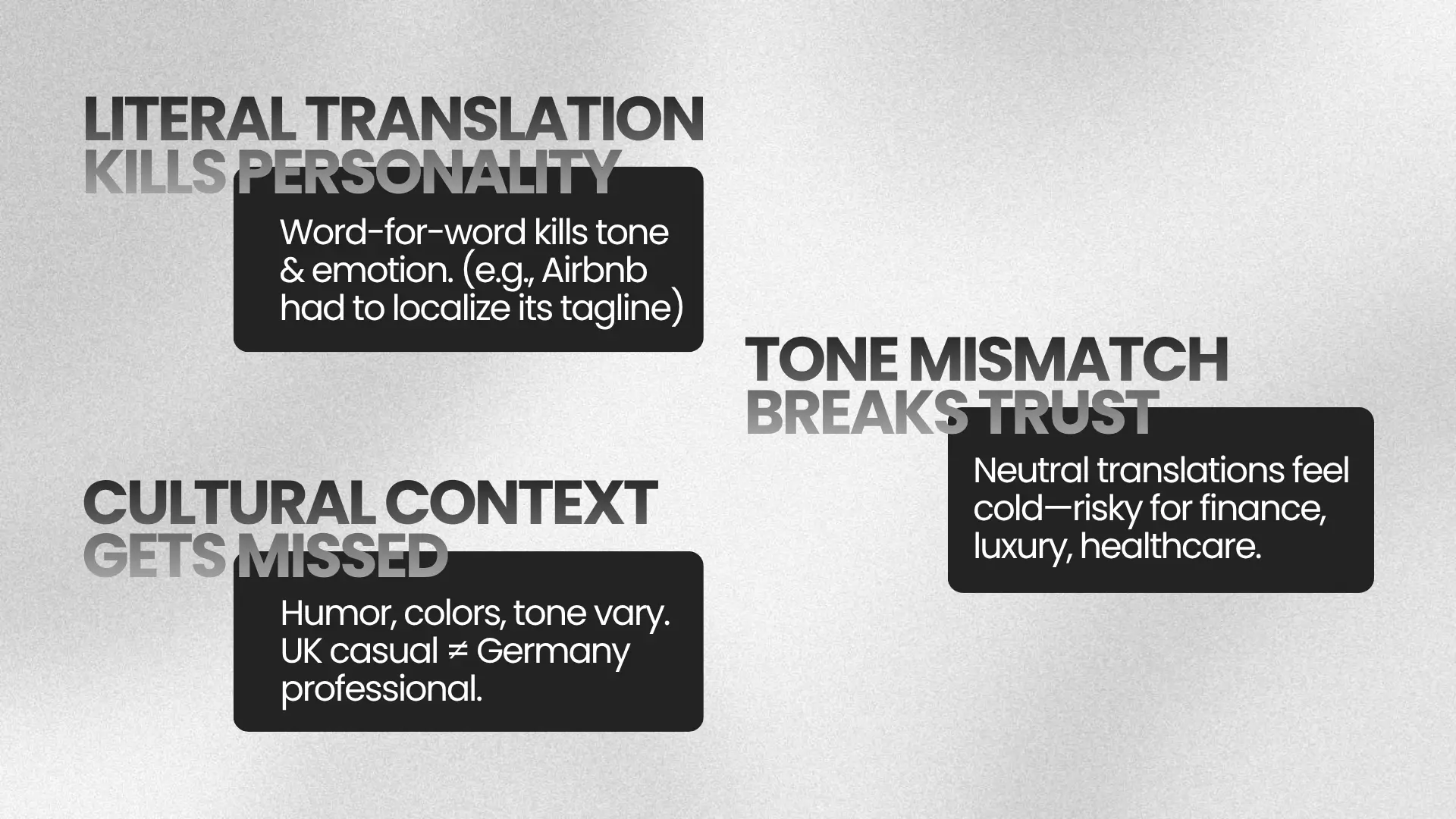
Here's where it typically breaks down across languages:
1. Literal Translation Strips Personality
Idioms, rhythm, tone, and wordplay are language-specific. A brand that communicates with "cheeky wit" in English may sound rude or confusing when those same phrases are translated word-for-word into Japanese or Arabic.
Take Airbnb's early localization work. Their casual, human tone "Belong Anywhere" required market-specific versions that communicated wanderlust and belonging in culturally resonant ways. A literal translation wouldn't have carried the emotional weight.
2. Cultural Context Gets Ignored
Colour symbolism, humor registers, formality levels, and social norms vary enormously across cultures. A campaign that uses self-deprecating humor common in British branding can come across as a lack of confidence in markets where authority and credibility are signaled differently.
German audiences, for example, tend to respond better to rational, benefit-led copy. What reads as "playfully casual" in a British context may read as "unprofessional" in Munich.
3. Tone Mismatch Erodes Trust
Brand tone exists on a spectrum: formal to casual, direct to narrative, technical to emotive. Translators who aren't briefed on a brand's voice default to neutral, and neutral often sounds cold, generic, or off-brand.
This is especially damaging in high-consideration industries: luxury goods, financial services, and healthcare. The tone carries as much of a trust signal as the content itself.
How to Maintain Brand Voice Across Languages
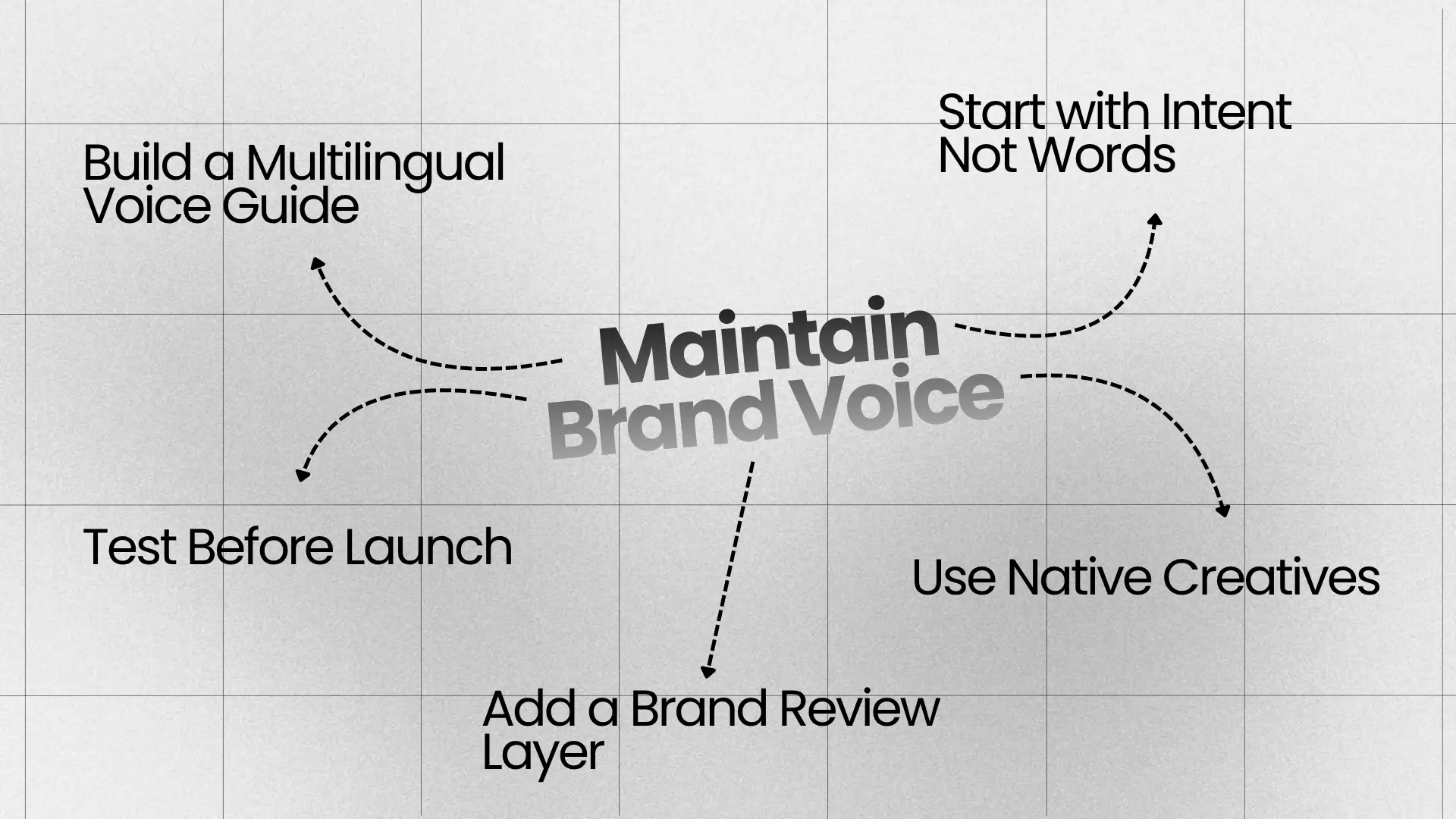
Build a Multilingual Brand Voice Guide
Your brand guidelines shouldn't stop at logo usage and colour palettes. For global markets, document:
- Tone descriptors with language-specific examples ("authoritative but not cold" needs to be demonstrated, not just stated)
- Words and phrases to avoid in each locale
- Cultural sensitivities relevant to your target markets
- Examples of on-brand vs. off-brand copy in each language
This becomes the creative brief for every transcreation project.
Work with Native-Language Creatives, Not Just Translators
Transcreation requires people who think in the target language, not people who translate into it. There's a meaningful difference. A native copywriter understands the cultural grammar that doesn't appear in any dictionary, the references, the rhythms, the things that make a reader feel like the brand gets them.
Use a Briefing-First Process
Every transcreation assignment should start with an intent brief: what is this content trying to make the reader feel? What action should it inspire? What's the emotional arc?
This shifts the transcreator's mandate from "render these words accurately" to "achieve this outcome in your language."
Implement a Review Layer
Transcreated content should be reviewed by someone with both brand knowledge and cultural fluency. Not a legal review, brand review. Someone who can ask: Does this sound like us?
Test Before You Launch
Where possible, test localized content with representative audience samples in the target market. What lands emotionally in a focus group will often outperform what reads "correctly" in a linguistic review.
When Should You Choose Transcreation Over Translation?
The short answer: whenever the feeling of the content matters as much as the information.
Use transcreation for:
- Advertising taglines and campaign copy exist to evoke, not inform
- Brand slogans, especially if they use wordplay, alliteration, or cultural shorthand
- UX microcopy button text, error messages, and onboarding prompts all carry tone
- Social media content, casual, platform-native voice requires cultural adaptation
- Email subject lines and emotional triggers differ by culture
- Product naming and packaging phonetic and semantic associations vary widely
Use translation for:
- Terms and conditions, privacy policies, and user manuals
- Clinical or scientific content
- Internal documentation and HR communications
- Financial disclosures
When in doubt, ask this: If I changed the words but kept the feeling, would this content still work? If yes, transcreation is the right tool.
How Lettercrafts Approaches This Work
At Lettercrafts, the starting point for any multilingual content project is always the same question: what is this content supposed to do?
That question determines whether a project calls for translation, transcreation, or a hybrid approach where legal boilerplate is translated with precision, while the campaign wrapper around it is fully transcreated.
The team works with native-language copywriters and cultural consultants, not simply bilingual translators. Each project is paired with a brand briefing process that anchors all adaptation decisions in the client's established voice, so what comes out in French, Arabic, or Mandarin sounds like the same brand thinking in a different tongue, not a version of the brand filtered through a dictionary.
This isn't a distinction most brands think to ask about. But it's the one that determines whether your global content builds the brand or blurs it.
Conclusion
The global content landscape rewards brands that understand a simple truth: language is culture, and culture is context. No algorithm, no matter how sophisticated, fully bridges that gap without human creative judgment.
Transcreation isn't a premium add-on for big budgets. It's the appropriate tool for any content that asks a reader to feel something, and in marketing, that's almost everything.
Maintaining brand voice across languages requires intent, process, and expertise. The brands that get this right don't just communicate globally, they resonate globally. That's a meaningful competitive advantage, and it compounds over time.
Lettercrafts is a multilingual content and localization studio working with brands that need to communicate clearly and compellingly across cultures. Learn more at: lettercrafts.org