Key Takeaway
- Singapore's Certificate of Clearance has been digital-only since 6 January 2025. Your translator now works from a FileSG PDF with electronic authentication, not a stamped hardcopy.
- The COC is for overseas use only. It is not issued for local employment, and the wrong stated purpose wastes the 7 to 14 day processing window.
- Certified and notarised are not interchangeable. ICA's published position lists four accepted translation routes, and a private agency's certified translation qualifies only once it is notarised or embassy-attested.
- Since 16 September 2021, the Singapore Academy of Law issues apostilles. For a notarised document, SAL's authentication fee is S$87.20 including GST, and the separate legalisation fee is waived.
- SAL requires originals, not copies. A laminated certificate is turned away at the counter.
- ICA excludes self-translation and translation by a spouse. Machine translation cannot be notarised at all, because a notary verifies an identifiable human signatory.
Quick Answer
A police certificate proves whether you hold a criminal record in a given jurisdiction. In Singapore, translation runs in one of two directions, and the certification path is completely different for each.
Into English. A foreign-language police certificate submitted here, most often to the Immigration & Checkpoints Authority (ICA) for permanent residence, citizenship, or a long-term pass. ICA accepts translations from an embassy or a notary public, or a private translation that is then notarised or embassy-attested.
Out of English. A Singapore Certificate of Clearance (COC) going to an authority abroad. The COC is issued in English already, so the question is usually authentication rather than language: an apostille from the Singapore Academy of Law (SAL) for Hague Convention destinations, or SAL followed by embassy legalisation for the rest. Translation into the destination language comes after.
Obtaining the certificate is the straightforward half. The certification layer stacked on top is where files quietly stall.
What a Police Certificate Is, and What Singapore Calls It
A police certificate is an official statement, issued by a police force or designated government authority, on whether a named person holds a criminal record in that jurisdiction over a defined period. That is its entire function. It is not a character reference and not a judgement of any kind.
The label shifts depending on where the document was issued. You will see certificate of good conduct, certificate of no criminal record, judicial record extract, police clearance letter, and criminal record check, all describing the same underlying thing. When you request a quote, name the issuing country and the receiving authority rather than the document title.
Singapore's version is the Certificate of Clearance (COC), issued by the Criminal Investigation Department of the Singapore Police Force to certify that a person has no criminal records in Singapore within a stipulated period.
Three things about the COC that catch people out
It is for overseas-related usage only: The SPF is explicit. The COC may be requested by a foreign government authority or institution for overseas migration, overseas adoption of a child, overseas employment or business, or overseas further education. It is not used for local purposes such as local employment. Applying with a domestic reason attached is a wasted application and a wasted fee.
It is fully digital: Since 6 January 2025, COC applications are entirely digitalised. Successful applicants download a digital COC from the FileSG portal, which can be authenticated through that portal. Hardcopy COCs are no longer mailed to applicants, and applications for duplicate copies have been discontinued.
This practically changes the translator's job. There is no wet-ink stamp or embossed seal to describe. Instead, there is an electronically authenticated PDF whose verification markers still need to be accounted for. A provider whose workflow still assumes a stamped paper certificate will handle this badly, and it is worth asking directly whether they have worked with the current format.
Eligibility carries a residence threshold: An applicant must be at least 16 years old and have resided, worked, or studied in Singapore for a continuous period of at least six months before applying. You must also provide documentary proof from the requesting authority showing that a COC is required and for what purpose. Processing runs 7 to 14 days from receipt of a complete application, and longer if anything submitted is incomplete or inaccurate.
Certified, Notarised, Apostilled: The Distinction That Costs the Most Money
This is where files break. The three terms are not synonyms for "official." They are separate layers answering separate questions, and climbing higher than your destination requires wastes money just as surely as stopping short wastes weeks.
Certified translation
A complete, faithful translation accompanied by a signed Certificate of Accuracy in which the translator or agency attests that the translation is true and complete and that they are competent to have produced it.
What it does not do: no external party has independently verified the claim. It carries the weight of the translator's professional accountability and nothing more. That is enough for many banks, schools, and general commercial purposes. It is not, on its own, one of ICA's four accepted routes.
Notarised translation
A Notary Public verifies the translator's identity and witnesses their signature on the Certificate of Accuracy, then affixes a notarial seal.
The notary is not re-checking the language. They are confirming a narrower fact: that the person claiming to have certified this translation is who they say they are. That distinction is exactly why machine output cannot pass this gate. There is no identifiable, accountable signatory for a notary to verify. As covered in our analysis of whether AI can replace certified translation in Singapore, this is a structural block rather than a comment on output quality.
SAL authentication and apostille
Here is the piece most older guides still get wrong, and it matters because it can save an entire embassy step.
Singapore acceded to the Hague Apostille Convention on 18 January 2021, and the Convention entered into force on 16 September 2021. Since that date, the Singapore Academy of Law affixes an Apostille Certificate on every document requiring legalisation, replacing the older multi-stage chain for destinations that are Convention members. SAL took this function over from the Ministry of Foreign Affairs. ICA does not legalise or authenticate documents and points people to SAL.
For a private document such as a translation, the sequence is notarisation first, then SAL. Your Notary Public issues the Notarial Certificate upon payment of an Authentication Fee of S$87.20 including GST to SAL. SAL's separate legalisation fee of S$10.70 is waived for notarised documents.
Two SAL rules catch people out:
- Originals only. Copies are not accepted. If your document has been laminated, request a certified true copy or extract from the issuing agency before SAL will touch it.
- You need not attend in person. You may appoint a proxy to complete the legalisation on your behalf, and no authorisation letter is required. SAL's counter is at 1 Coleman Street, The Adelphi.
Consular legalisation
For destinations outside the Convention, the apostille does not apply, and the document goes through SAL and then the relevant embassy. Convention membership moves, so this is worth checking rather than assuming: as of the HCCH status table last updated 30 June 2026, there are 130 Contracting Parties, and several accessions have entry-into-force dates still pending. A quick check against the HCCH status table before you pay for anything is worth the two minutes.
The rule of thumb
Apostille is for taking a Singapore document abroad. Notarisation is for bringing a foreign document into ICA. These solve opposite problems, which is why they get confused, and why applicants sometimes pay for the wrong one entirely and only find out under review.
| Layer | What it verifies | Who performs it | When Singapore needs it |
|---|---|---|---|
| Certified translation | The translation is accurate and complete | Translator or agency | Banks, schools, many MOM submissions, general commercial use |
| Notarised translation | The translator's identity and signature are genuine | Notary Public in Singapore | ICA submissions for PR, citizenship, and long-term passes |
| SAL authentication | The notary is genuinely Singapore-registered | Singapore Academy of Law | After notarisation, for documents heading overseas |
| Apostille | A foreign government can trust the document's origin | Singapore Academy of Law | A Singapore COC used in a Hague Convention country |
| Consular legalisation | The same, for non-Convention destinations | Embassy or consulate, after SAL | A Singapore COC used in a non-member country |
What ICA Actually Requires
ICA's published position is specific about the source of the translation, and reading it closely saves a resubmission. For documents not in English, ICA accepts:
- Translations provided by the embassy of the country or place that issued the document
- Translations produced by a notary public in Singapore or in the country or place that issued the document
- Privately created translations attested by the issuing country's embassy
- Privately created translations notarised by a notary public in Singapore or the issuing country
ICA also states plainly that it does not endorse any private translation companies or entities, and that insufficient documentation may result in non-acceptance of your application.
The practical implication is the part most people miss. A certified translation on its own is not one of the four routes. A private agency's work qualifies only once it has been notarised or embassy-attested. For permanent residence and citizenship, plan for notarisation from the outset rather than discovering the requirement after a file comes back. Our complete ICA translation and notarisation guide covers this across all document types.
Two further ICA rules worth stating outright:
Self-translation is not accepted, regardless of how fluent you are. A spouse may not translate on your behalf either. The translator must be an independent third party with no stake in the outcome, which is the whole point of the requirement.
Each person's file is assessed on its own. Every family member added to an application needs their own foreign-language documents translated and certified separately: a child's birth certificate, a spouse's marriage or divorce papers, and each applicant's police certificate. Handling the whole set together keeps name spellings consistent across the bundle, which matters more than it sounds.
What a Correct Police Certificate Translation Contains
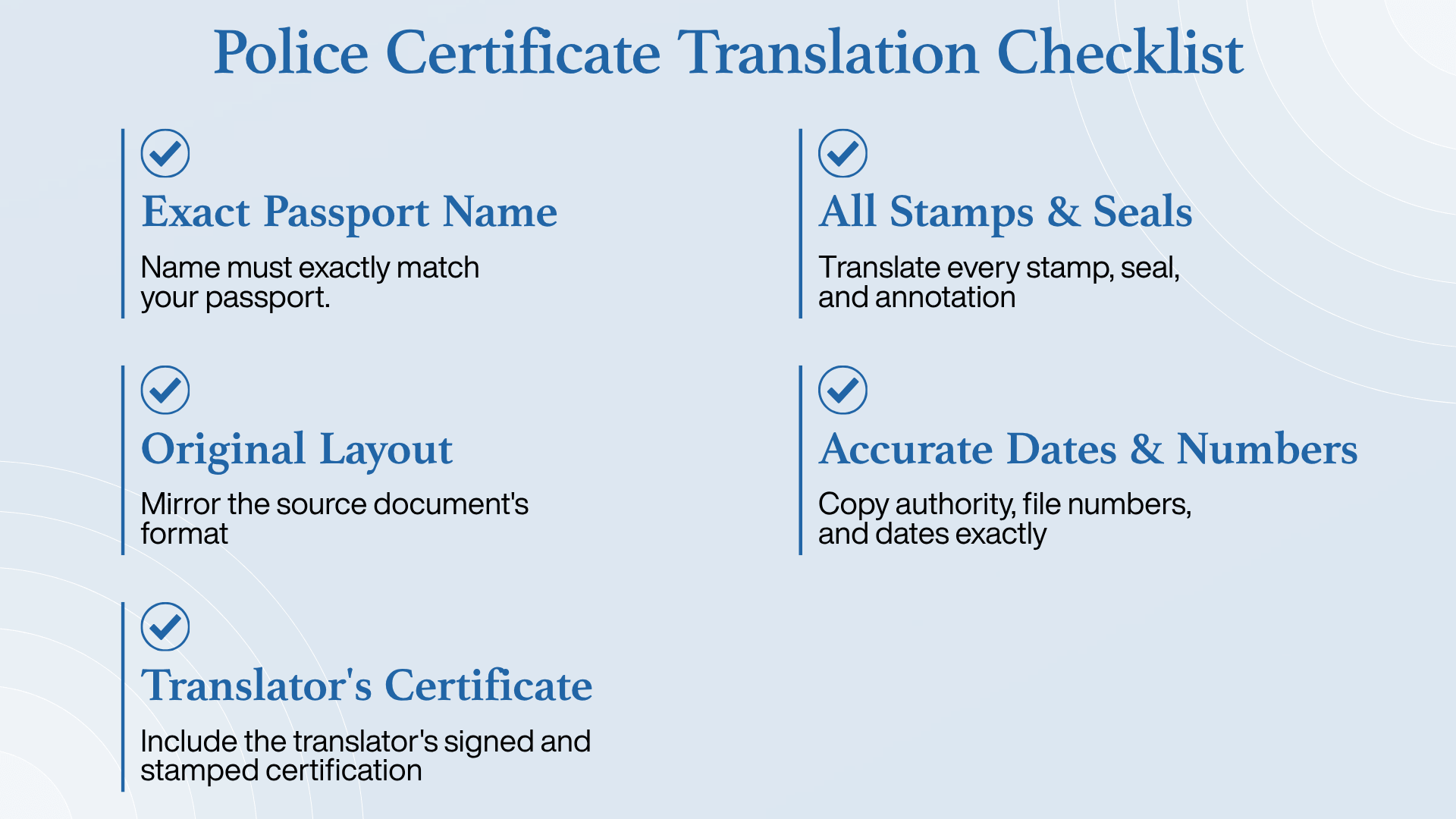
Clearing the right certification level gets your document through the door. The contents decide whether it stays there.
The name must match the passport exactly
This sinks more files than anything else on this list. Romanised names from Chinese, Tamil, Malay, Arabic, Korean, and Thai can each be spelt several perfectly valid ways in English. If the certificate romanises your name one way and your passport or NRIC another, an officer has no safe way to confirm the two documents describe the same person.
There is no "close enough." A transposed letter, a missing hyphen, or a reordered given and family name is enough to stall a file pending manual clarification.
A careful translator does not quietly pick a spelling and hope. Where a name can reasonably go more than one way, the translation carries a bracketed translator's note flagging the variation, so the reviewing officer can see exactly what appeared on the original and why a given spelling was used. That single detail often decides whether a file moves or sits.
Every stamp, seal, and annotation appears
Reviewers expect a complete account of the original, not just its running text. Every stamp, seal, watermark, handwritten annotation, and security marker must be described and translated. An untranslated seal is on its own sufficient grounds for rejection, even when everything else is flawless.
For a Singapore COC, this now means accounting for the digital authentication elements on the FileSG document rather than physical seals.
The layout mirrors the source
A well-prepared translation reproduces the original's structure: tables in the same position, headings in the same order, data points where a reviewer expects to find them when holding the two side by side. This is not cosmetic. It is what lets an officer cross-check quickly instead of hunting for the equivalent field.
Reference numbers, authority, and dates transfer precisely
The issuing authority's name, any file or reference number, and the issue and validity dates carry over without paraphrase or approximation. These are the fields a receiving authority cross-references against the rest of your file, so an inconsistency introduced during translation triggers a query even when it is innocent.
The translator's credentials are attached
The completed package includes the translator's or agency's signed and stamped Certificate of Accuracy, the document that establishes who is professionally accountable for the translation. Without it, even a perfect translation is not a certified one.
Taken together, these point to a single idea: a police certificate translation is a mirror, not a summary. A reviewer should be able to hold it against the original and confirm, line for line and seal for seal, that nothing has been altered, lost, or left out. Our certified translation checklist for Singapore submissions applies the same standard across document types.
The Process, Step by Step
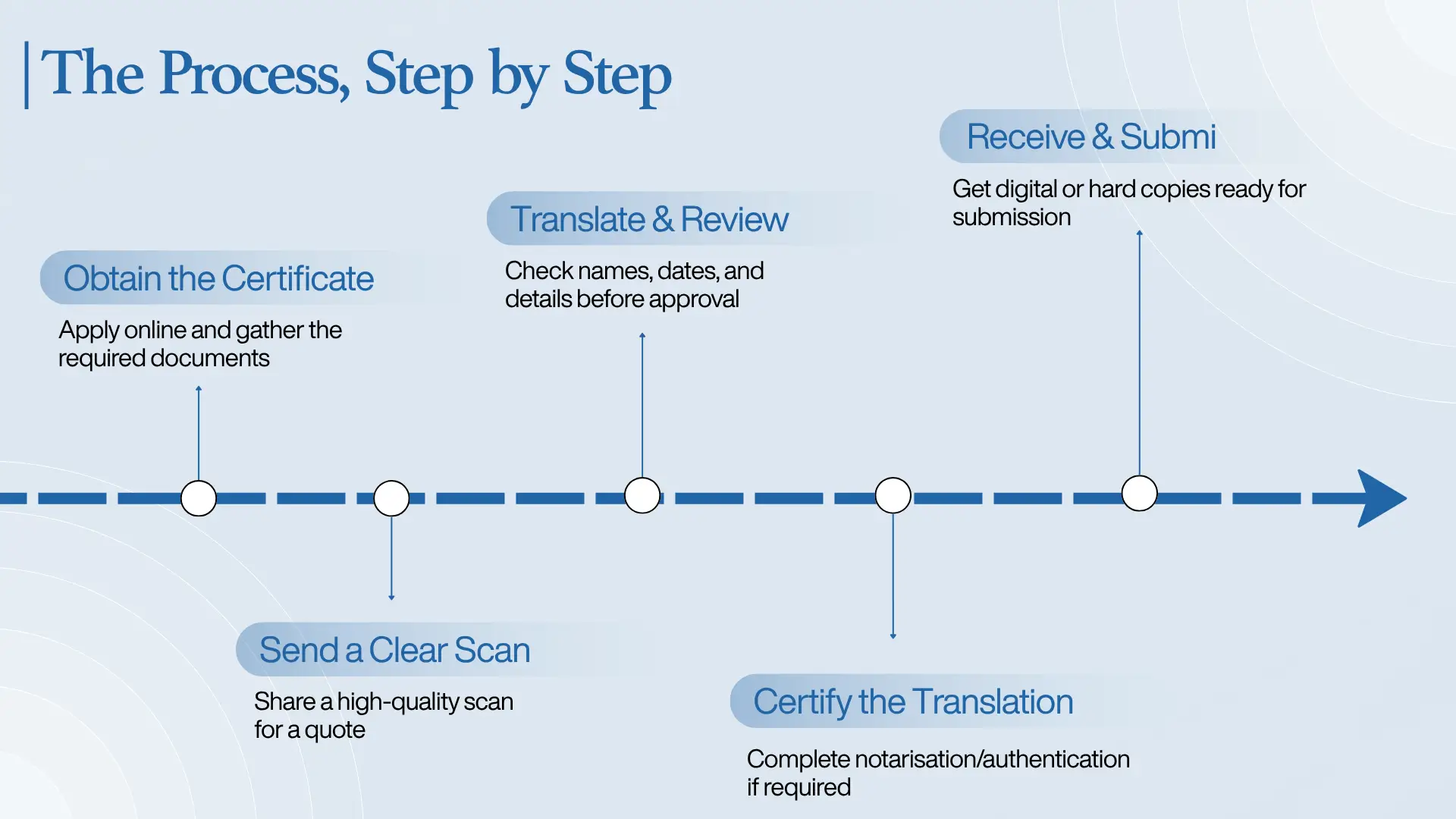
1. Obtain the certificate
For a Singapore COC, apply and pay online. The COC office does not accept walk-in applications.
Singapore Citizens, Permanent Residents, and current FIN holders apply via Singpass. Applicants who previously held a valid FIN but are not eligible for a Singpass account apply using that previous FIN and submit scanned fingerprint impressions to the COC office separately.
You will need documentary proof from the requesting authority stating that a COC is required and its purpose, a scanned biometric passport page, a scanned identification document front and back, and a colour passport-sized photograph on a white background at minimum 400 x 514 pixels. Photographs go in as JPG, BMP, or PNG; other documents as PDF, at up to 2MB per file. The form takes 15 to 30 minutes. Allow 7 to 14 days for processing.
For a foreign police certificate, obtain it from the issuing country's designated authority before anything else. If you already hold it, check the issue date against your Singapore submission deadline.
2. Send a clear scan for a quote
You do not need to hand over a physical original to begin. A reputable provider works from emailed scans or clear photographs and quotes on page count, language pair, and the certification level your destination requires.
Legibility matters more here than people expect. A cropped or low-resolution scan forces a translator to guess at faint stamps and small print, which is precisely what a complete translation does not allow. Five minutes spent producing a flat, well-lit scan saves weeks of back-and-forth.
3. Translation and your review
A qualified human translator produces the work, mirroring the original's layout field by field. A reputable provider then shares a draft for approval before finalising.
This review step is your last clean chance to catch a name mismatch before it becomes a rejection three weeks into an application review. Check the romanisation of every name against your passport or NRIC, and check every date against the rest of your file.
4. Certification, notarisation, authentication
The chain is applied at whatever level your destination requires: notarisation for an ICA submission, or notarisation followed by SAL authentication for a document heading overseas.
Order matters. Notarising before translating means starting again. So does arriving at SAL with a laminated original.
5. Delivery and submission
You receive digital copies formatted for portal upload and, where the receiving authority still requires paper, wet-signed hard copies. Delivery runs same-day by email, one day by courier, or three to five days by SingPost.
| Stage | Typical duration |
|---|---|
| Obtaining a Singapore COC | 7 to 14 days from a complete application |
| Quote after scan submission | Same day to 1 business day |
| Translation and draft review | 1 to 3 business days, by length and language pair |
| Notarisation and SAL authentication | 1 to 2 working days |
| Delivery of final package | Same day digital, 1 day courier, 3 to 5 days SingPost |
When a Police Certificate Translation Is Needed in Singapore
A translation that Traffic Police will accept should:
Permanent residence and citizenship: The most document-intensive category. Foreign-language police certificates go in alongside birth certificates, marriage certificates, and educational records, each requiring the same certification treatment, and each family member's set assessed separately.
Long-term passes and dependant applications: The same ICA translation standards apply to Long-Term Visit Pass, Dependant Pass, and Student Pass submissions. Our academic transcript translation guide for ICA Dependant Pass applications covers the companion documents that usually travel with these files.
Overseas employment and business: A COC is one of the purposes the SPF explicitly issues for. Where the destination employer or authority does not read English, the certificate is apostilled by SAL and then translated into the destination language.
Overseas further education: Universities increasingly request police certificates at admission or enrolment, particularly for programmes involving vulnerable populations. Academic deadlines do not move, which makes turnaround unusually consequential. This work usually sits alongside transcripts, covered in our education and academic translation guide.
Overseas adoption of a child: Listed by the SPF as a valid COC purpose. Adoption processes typically require certificates from both prospective parents and often from other adults in the household.
Overseas migration: The single most common reason a Singapore resident requests a COC, and the case where the apostille question arises first.
Marriage registered abroad: Some jurisdictions require a certificate of no criminal record when one or both parties are foreign nationals. Couples are routinely surprised this exists, because it is rarely publicised alongside standard marriage paperwork. Our marriage certificate translation guide covers the companion document.
Professional licensing: Medicine, law, and finance frequently require a police certificate for credential recognition on relocation, separate from and in addition to any immigration certificate.
The Mistakes That Get Files Rejected
Applying for a COC for a local purpose: The COC is issued for overseas use only. A local employment reason will not get you the document.
Using machine or AI translation: It cannot be notarised because there is no accountable human signatory for a notary to verify. No Singapore government body accepts it.
Translating it yourself, or having your spouse do it: ICA excludes both explicitly, and fluency does not change that. The requirement exists to remove any possibility of bias, real or perceived.
Submitting a certified-only translation to ICA: Certification alone is not one of ICA's four accepted routes for a private translation. It needs notarisation or embassy attestation on top.
Name mismatches: Covered above, and worth repeating because it stays the quietest and most common cause of a stalled file.
Omitting a stamp or seal: A single untranslated watermark that looked decorative can void an otherwise complete translation, and it is usually flagged only after the work has been paid for.
Bringing SAL a laminated original: SAL requires originals and does not accept copies. Get a certified true copy from the issuing agency first.
Getting the order wrong: Translate, then notarise, then authenticate. Reversing any two steps means paying for the sequence twice.
Letting the certificate lapse: Receiving authorities set their own validity windows on police certificates, and if the original expires you need a fresh one and a fresh translation to match it.
Underestimating turnaround: A technically correct translation that arrives after the deadline is as unhelpful as a rejected one. Notarisation and SAL depend on external offices' schedules and counter hours, so treat the buffer as part of the requirement rather than a courtesy.
If a submission does come back, our guide on what happens when a translation is rejected by ICA or MOM sets out how to diagnose the cause and what can be salvaged. Our broader piece on why Singapore authorities reject translations covers the recurring patterns.
How to Choose a Provider in Singapore
Worth asking before you commit:
- Do they work with certified human translators and attach a named, signed Certificate of Accuracy to every job?
- Can they arrange notarisation with a Singapore Notary Public, and SAL authentication or apostille coordination, rather than leaving you to find a notary afterwards?
- Have they handled the post-January-2025 digital COC format specifically, not just older paper certificates?
- Do they share a draft before finalising, so you can catch a name or date error while it is still free to fix?
- Will they handle both directions from one point of contact, into English for ICA and out of English for an overseas authority?
- How do they handle name romanisation where a spelling can go more than one way?
Our buyer's guide to choosing a document translation service goes deeper on evaluating providers.
How LetterCrafts Handles Police and Good Conduct Certificates
A police certificate translation is less a language exercise than a compliance one, and that is where a specialist earns the fee.
LetterCrafts is a registered translation service in Singapore (UEN: 201728634E) covering more than 80 languages, with work accepted by ICA, MOM, LTA, MOE, other government agencies, and embassies. Every translation mirrors the source document's format and is presented on LetterCrafts letterhead with a signed and stamped Certificate of Translation as the coversheet. Certified translations start at S$38 per page with no additional GST.
For police certificates specifically:
- Notarisation arranged in-house, with SAL authentication and apostille coordination for documents bound overseas, plus embassy legalisation where the destination sits outside the Convention.
- A notary runner service. We present your originals to a Singapore Notary Public on your behalf, with proper authorisation, so you do not have to take time off to get into the CBD.
- Careful name romanisation, with a translator's note wherever a spelling can reasonably go more than one way.
- Draft review before finalising, so you confirm names and dates against your passport while changes cost nothing.
- Both directions handled together, which matters when a household has a spouse's foreign certificate coming in alongside a Singapore COC going out. One provider means one consistent set of spellings.
- Confidential handling under non-disclosure agreements and Singapore's data protection framework, with records not retained beyond three months and deleted immediately on request.
One honest note. No provider can guarantee acceptance. The final call rests with ICA or the foreign authority, and that is how it should be. What a correctly certified translation does is remove every avoidable reason for rejection: complete, correctly certified, and consistent across every field. What happens after that is the receiving body's call, but there should be nothing left on our end to give them pause.
To begin, email a clear scan to info@lettercrafts.org Tell us the issuing country, the receiving authority, and your deadline, and you will get back a line-item quote covering translation, notarisation, and any SAL or embassy coordination.
Glossary
Certificate of Accuracy: The signed statement from a translator or agency attesting that a translation is complete and accurate and that the signatory is competent to have produced it.
Notary Public: A legally authorised official who verifies identity and witnesses signatures. In this context, verifies the translator, not the language.
SAL authentication: Verification by the Singapore Academy of Law that a notary who signed a document is genuinely Singapore-registered. S$87.20 including GST.
Apostille: A certificate issued under the 1961 Hague Convention authenticating the origin of a public document for use in another member state. In Singapore, issued by SAL since 16 September 2021.
Consular legalisation: The equivalent process for destinations outside the Convention, performed through an embassy or consulate after SAL.
COC (Certificate of Clearance): Singapore's police certificate, issued by the Criminal Investigation Department of the Singapore Police Force for overseas-related purposes only.
FileSG: The government portal through which digital COCs are issued, downloaded, and authenticated.
The Bottom Line
A police certificate proves your record. Certification is what makes that proof usable across a border.
In Singapore, the fundamentals are consistent whichever way the document is travelling: the translation must be accurate to the letter, complete to the last seal, prepared by an independent professional, and authenticated to exactly the level the receiving authority demands. ICA wants notarisation for foreign-language documents. A Singapore COC heading overseas needs an SAL apostille, or SAL plus embassy legalisation for a non-Convention destination.
Get those right, and the certificate does its quiet job in the background of your application. Get one wrong, and you lose weeks you probably did not have to spare.
Send a scan to info@lettercrafts.org with the issuing country, the receiving authority, and your deadline. You will get back a clear assessment of the correct certification path and a line-item quote, with no guesswork.