Key Takeaway
- The receiving authority decides whether a translation is accepted in Singapore, so identify the recipient before comparing freelancer and agency quotes.
- No private translator is ICA-approved: ICA endorses no private translation company and accepts private translations only once notarised or embassy-attested.
- MOM does not require an agency: Employment Pass translations can come from a translation service provider, uploaded with the original as one file.
- Notarisation costs the same whoever translates: SAL charges S$87.20 per notarial certificate, plus the notary's fee, so a freelancer's discount applies to one line.
- Independent revision is the real quality test: ISO 17100 requires a second linguist, which a solo freelancer can meet only by outsourcing revision
- Businesses remain responsible under the Personal Data Protection Act (PDPA) for personal data a translator processes for them, and overseas transfers add conditions.
- A bilingual colleague cannot produce an official translation alone: ICA still requires notarisation or embassy attestation, and MOM rejects self-translated portal verification proofs.
- Freelancers suit short, informal, niche-domain or rare-language work; agencies suit multi-document, confidential, urgent or bulk projects that others will rely on.
Most freelancer-versus-agency comparisons open with price. In Singapore, price is the third question you should ask.
The first is where your document is going. Each Singapore authority sets its own rules for what counts as an acceptable translation, and those rules matter far more than the translator's job title. The Immigration & Checkpoints Authority (ICA), for instance, states plainly that it does not endorse any private translation company or entity. For an ICA submission, neither a freelancer's signature nor an agency's stamp is enough on its own. What counts is whether the translation reaches ICA through a route ICA accepts.
The second is who handles everything around the translation: the independent check, the certification, the notary appointment, the Singapore Academy of Law (SAL) authentication, and the safe handling of your personal data. A freelancer usually quotes for the translation. An agency usually quotes for the translation plus some or all of that surrounding work. Comparing the two quotes without comparing what sits inside them is where most people go wrong.
This article covers written document translation. Live interpreting for meetings, hearings, or events is a separate service, covered in LetterCrafts' guide to professional interpretation services in Singapore.
Freelancer or Agency: The Short Answer
Choose a freelance translator when the document is short, informal, or for internal use, when you already have a translator whose work you have verified, or when you need a rare language pair that no agency you have contacted can cover.
Choose a translation agency when the document is going to ICA, the Ministry of Manpower (MOM), the courts, or a counterparty who will rely on it; when several documents must match each other; or when volume, deadlines, or confidentiality raise the stakes.
The deciding factor is rarely the translation itself. It is who takes responsibility for everything the translation must pass through after it is written.
What Does Each Singapore Authority Accept From a Translator?
Before comparing providers, identify who will read the translation. This table sets out what the main Singapore recipients say, and whether choosing a freelancer or an agency changes anything.
| Where the translation is going | What the recipient accepts | Does freelancer vs agency matter? |
|---|---|---|
| ICA (permanent residence, citizenship and long-term passes) | Original documents plus official translations: from the issuing country's embassy; produced by a notary public in Singapore or the issuing country; or privately made and then embassy-attested or notarised. ICA does not endorse any private translation company or entity. | Not for acceptance, because both need the same notarisation or attestation. It matters for logistics: someone has to take the translation through the notary and SAL. |
| MOM (Employment Pass applications) | For non-English documents, the original and an English translation are uploaded as one file; the translation can be done by a translation service provider. | Both can qualify. The practical risk is inconsistency, such as a name spelt differently from the passport. |
| Singapore courts | Court interpreters translate Chinese, Malay and Tamil into English only, for documents used in proceedings, at S$45 per translated page, with requests at least 4 weeks ahead. Courts may decline a request, and parties then use a private translation service. | Yes. The translator's legal competence and willingness to stand personally behind the work matter more than business structure. Confirm the required form with your lawyer. |
| Any document notarised in Singapore (local or overseas use) | Every notarial certificate must be authenticated by SAL, and since 16 September 2021, an apostille affixed to the notarial certificate counts as that authentication. | Yes, for coordination. A provider that handles notarisation routinely takes a step off your list. |
| Private and commercial use (contracts, HR policies, marketing, websites) | No authority sets the standard; the counterparty or audience does. SAL notes that the need for notarisation is determined entirely by the party receiving the documents. | Yes, mainly on quality, process, consistency and confidentiality. |
Why an MOM-Ready Translation Is Not Automatically ICA-Ready
A certified translation that satisfies MOM can still fall short for ICA. ICA's accepted routes for private translations add a further step, notarisation or embassy attestation, that MOM's Employment Pass guidance does not ask for.
If a document may serve both purposes, say a degree certificate used first for a work pass and later for permanent residence, tell your provider at the start. We set out the differences between the three levels in certified translation vs notarisation vs apostille, and cover S Pass requirements separately in our S Pass translation guide.
What Are You Actually Paying a Translator to Do?
A translation that an authority or business partner will rely on involves more than converting text. The real difference between a freelancer and an agency is how many of these six jobs each one takes off your hands.
| Job | Freelancer (typical) | Agency (typical) |
|---|---|---|
| 1. Translate every element, including stamps, seals, and handwritten notes | Yes | Yes |
| 2. Revise independently, with a second linguist comparing source and translation | Only if they bring in a colleague | Built into the workflow at reputable agencies |
| 3. Stand behind it with a signed certification statement | The freelancer personally | A named translator, backed by the company |
| 4. Clear the acceptance chain: formatting, file merging, notary, SAL | Usually left to you | Often included or offered |
| 5. Keep the bundle consistent: one spelling of each name and one set of terms across every document | Consistent within their own work; hard across several freelancers | Managed through glossaries and translation memory |
| 6. Protect the data: non-disclosure agreement (NDA), secure transfer, deletion, no public artificial intelligence (AI) tools | Depends on personal practice | Should be written policy; ask to see it |
A lower freelance quote is often a quote for jobs one and three. If you are prepared to handle the rest yourself, that can be a genuine saving. If you are not, the gap narrows quickly.
Why Name Consistency Matters More Than Most People Expect
Job five causes more trouble than its place on the list suggests. MOM already asks for an explanation letter and supporting documents, such as a deed poll, when a candidate's name on the passport differs from their other documents. A translation that introduces a fresh romanisation of a Chinese, Tamil or Arabic name creates exactly that kind of mismatch.
The risk multiplies when a family's birth, marriage and education documents are translated by different people at different times. One provider working from one glossary removes it. LetterCrafts explains why names are so easily mistranslated in this linguist's explanation.
Is a Freelance Translator Cheaper Once You Count the Whole Bill?
On the translation fee alone, often yes. A freelancer has no project manager or reviser to pay, so a freelance quote for the translation itself will frequently come in lower. For an official submission, though, the translation fee is only one line on the bill.
What an ICA-Bound Translation Really Costs
A privately translated document heading to ICA typically involves:
- the translation fee;
- the notary public's fee;
- SAL's authentication fee of S$87.20, including Goods and Services Tax (GST), per notarial certificate, which has applied to every notarised document since 1 October 2019;
- your own time arranging the notary and SAL steps, if the provider does not;
- the cost of re-translating and re-notarising if an error surfaces later.
Worked Example: One Birth Certificate, Two Routes
Say you need a Chinese-language birth certificate translated for an ICA application.
Route one, a freelancer: The freelancer sends you a certified translation. You then find a Singapore notary public, attend the appointment, and pay the notary's fee plus SAL's S$87.20, which is payable at the notary's office before the notarial certificate is issued. Checking that every stamp and seal was translated, and that the child's name matches the other documents in the application, is also on you. If a mistake is found after notarisation, you may have to repeat both steps.
Route two: an agency that coordinates notarisation: You hand over the document once. The agency returns a translation that has already been revised, notarised, and authenticated, and it fixes any error in its own work.
The notary and SAL fees appear on both routes. What changes is who does the running around, and who pays for a correction. LetterCrafts walks through the full process in its birth certificate translation guide for ICA.
How Volume Changes the Maths
For large projects, the comparison shifts again. Computer-assisted translation (CAT) tools store previously translated sentences in a translation memory, so repeated content does not need translating from scratch. Many professional freelancers use these tools too, so ask any provider whether repetitions are discounted.
Agencies are more likely to publish volume pricing. LetterCrafts, for example, charges from S$38 per page for certified translation, with certification included, and moves projects above 10,000 words onto a declining per-word rate.
Which Gives Better Translation Quality: a Freelancer or an Agency?
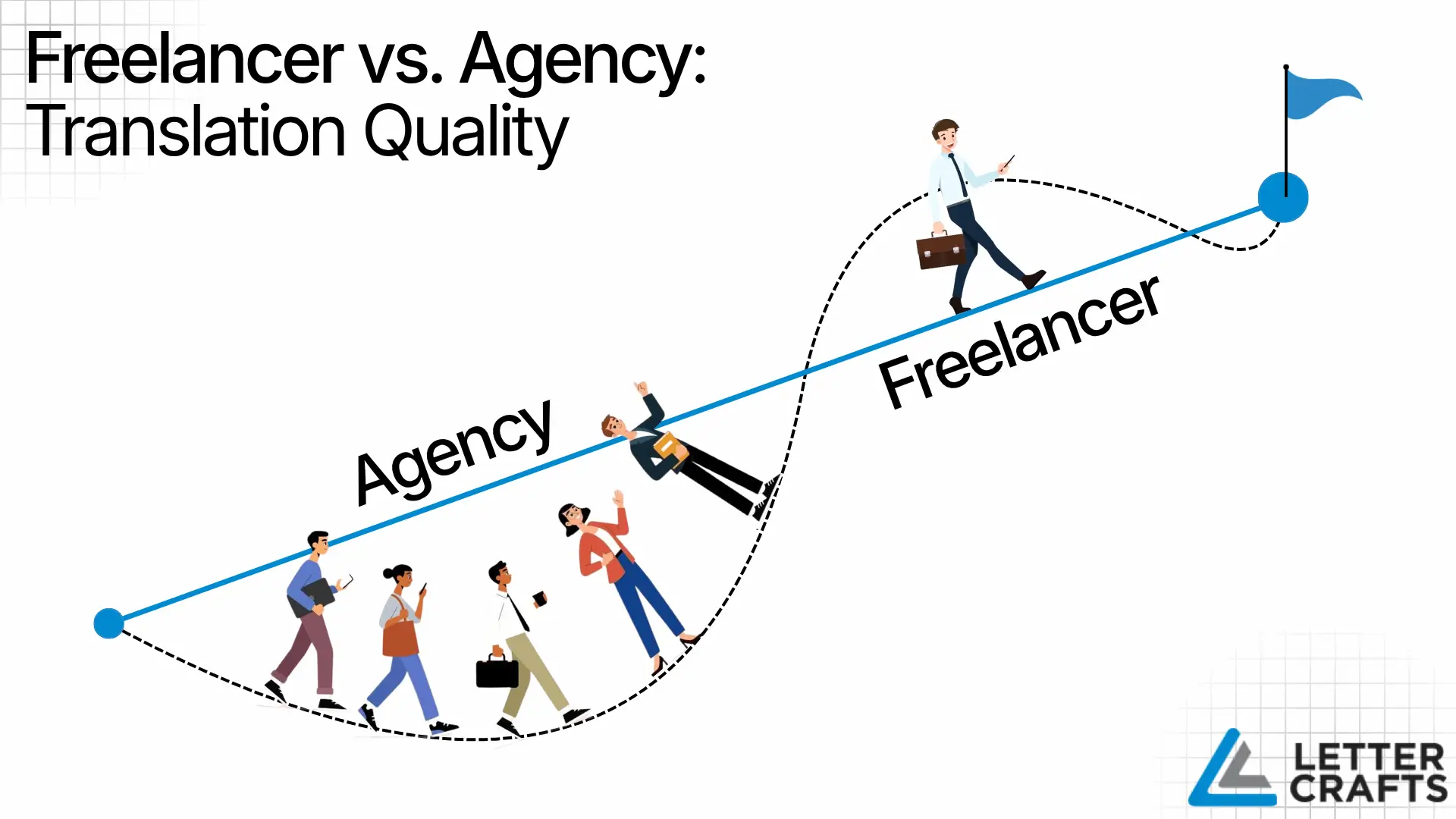
Neither, by default. Quality comes from the translator's competence plus a process that catches the errors every translator makes in their own work.
That second element is why ISO 17100, the international standard for translation services, builds in a "dual control" principle. According to the International Federation of Translators (FIT), the standard's process includes the translator's own check followed by revision by a person other than the translator, so every compliant translation is revised by at least two people. The standard itself is published by the International Organization for Standardization.
What ISO 17100 Does and Does Not Tell You
FIT's guidance clears up four points that often confuse buyers:
- ISO 17100 is voluntary: None of the ICA, MOM, or court requirements quoted in this article mention it.
- Freelancers are not excluded: The standard counts individual translators as translation service providers, and some freelancers have been certified, but they must outsource revision to comply.
- Certification and registration are different: Certification involves a third-party audit; registration is essentially self-declared. There is no central registry, so verify any claim with the body that issued it.
- Machine translation post-editing sits outside ISO 17100: It falls under a separate standard, ISO 18587. LetterCrafts looks at where AI fits in: Can AI replace certified translation in Singapore?
The Quality Question That Tests Any Provider
Ask a freelancer who revises their work. Ask an agency whether the reviser is a different person from the translator, and whether anyone checks the final formatted file rather than a draft. A vague answer to either question tells you more than a portfolio does.
Which Is Faster When the Deadline Is Tight?
For a one-page birth certificate, a responsive freelancer can be as quick as any agency. The difference shows up in two situations.
Volume under deadline: One person has a fixed daily capacity. A 30-page tender pack due on Friday either fits into that capacity or it does not. An agency can split the file across several translators and still run a single revision pass for consistency.
Continuity: If a freelancer falls ill or stops replying mid-project, no one can pick up the file. An agency can reassign it.
Official routes are not always quick either. Singapore's courts ask for translation requests at least 4 weeks before the translated documents are needed and may decline short-notice requests, so urgent filings often have to go to a private provider. LetterCrafts' standard delivery for certified translation is 24 to 36 hours.
Who Is Safer With Confidential Documents Under the PDPA?
Translation means handing someone your passport, payslips, medical records or contracts. For individuals, the question is trust. For businesses, it is also compliance.
The PDPA gives an organisation the same obligations for personal data processed on its behalf by a data intermediary as if it processed the data itself, and the Personal Data Protection Commission (PDPC) describes due diligence on such vendors as good practice. A translator handling your employees' documents can fall into that role. Neither a freelancer nor an agency is automatically the safer choice; the provider's actual practices decide it.
The Overseas Freelancer Question
Global freelance marketplaces connect you with translators anywhere in the world, so the person you hire may not be in Singapore at all. If they are not, sending them a candidate's passport and degree certificate moves personal data out of Singapore. The same PDPC guidelines explain the Transfer Limitation Obligation, which restricts such transfers unless the data receives protection comparable to the PDPA, and your company carries that responsibility.
Four Questions to Ask Before Sending Files
- Will you sign an NDA?
- Where will my files be stored, and when will they be deleted?
- Will any public AI tool see the content?
- Who else will have access?
LetterCrafts binds everyone who works on client files to a confidentiality agreement, does not process personal documents through public AI platforms, and deletes files after delivery unless the client asks otherwise. For commercial material, see its business translation services.
Does Specialist Expertise or Language Coverage Change the Answer?
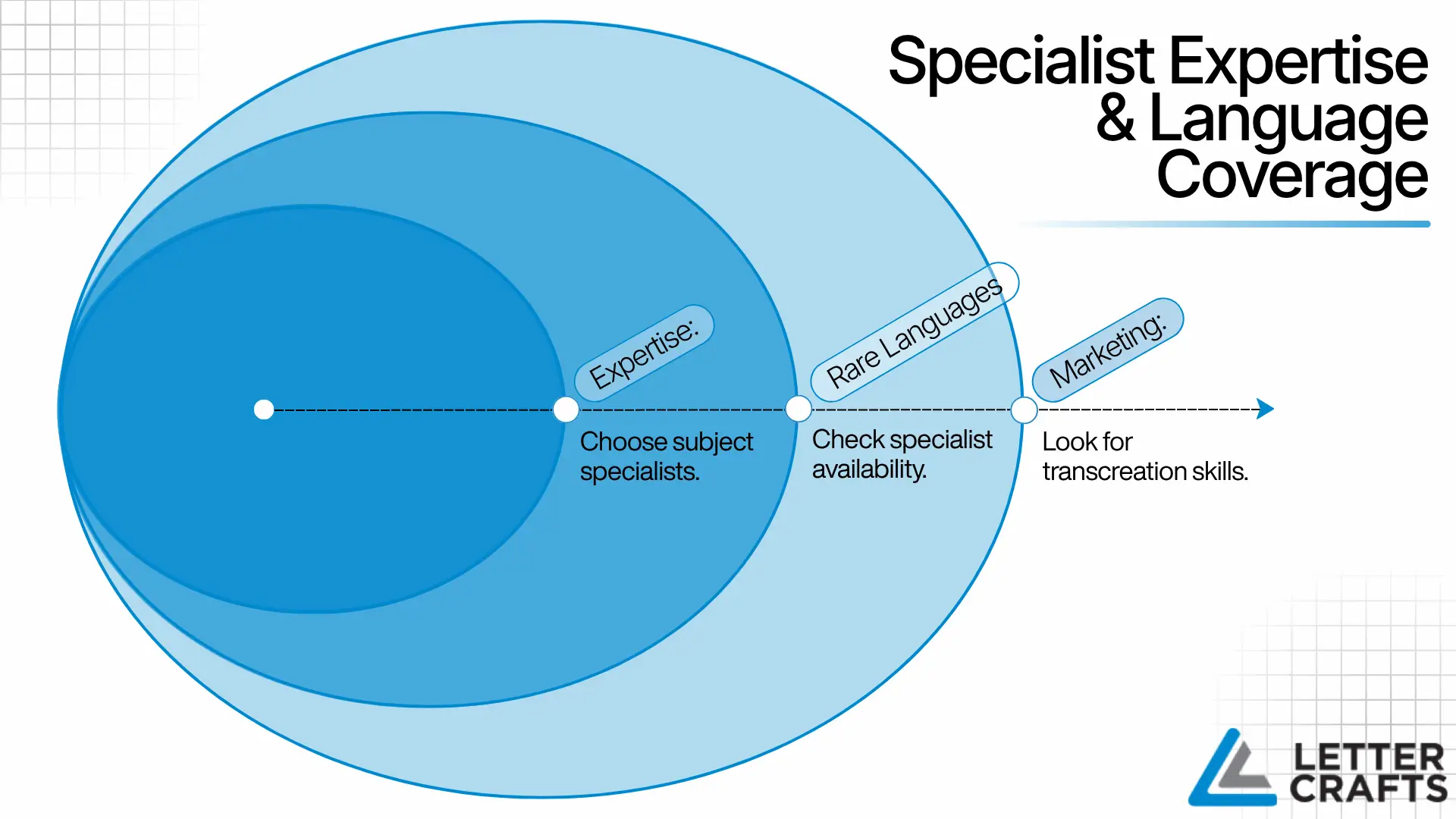
It can, and this is where freelancers make their strongest case.
Subject-Matter Depth
A translator who has spent years on Malay-English shipping contracts or Mandarin-English clinical records may outperform any generalist. Agencies justify their fee here only if they match documents to specialists rather than assigning whoever is free. Ask who will do the work and what their background is.
Rare Language Pairs
For a less common pair, a specialist freelancer may be the only person available. Before assuming so, ask an agency whether it covers the pair and whether the linguist is in-house or subcontracted. LetterCrafts works across more than 80 languages.
Marketing and Creative Content
Marketing copy and websites often need adaptation rather than literal translation. A specialist freelancer with a strong portfolio can be an excellent choice; so can an agency with transcreation capability.
Can a Bilingual Colleague Translate Official Documents Instead?
Singapore is unusually bilingual. In the 2020 Census, English was the language most frequently spoken at home for 48.3% of residents aged five and over, and over 80% of that group also spoke another language at home. That makes asking a bilingual colleague or relative feel reasonable.
For anything official, it rarely works. MOM lists self-translated verification proofs from portals among the items it will not accept. A private translation for ICA still has to be notarised or embassy-attested before ICA will accept it. For contracts and evidence, fluency is not the same as translation competence.
Keep in-house translation for understanding a document internally, not for documents someone else will rely on.
Which Works Better for Bulk and Multilingual Projects?
A business translating an employee handbook into Mandarin, Malay and Tamil, or localising a website for regional markets, needs one approved set of terms applied everywhere. With three freelancers, that means three glossaries, three invoices and no one responsible for consistency across languages. An agency centralises the glossary, the translation memory and the point of contact.
Repeat work benefits in the same way. A provider holding your translation memory handles next year's revision faster and more consistently, in every language. With a single common language pair and a trusted freelancer who keeps your memory files, the gap is smaller, so ask whether yours does.
How Do Invoicing, Registration and Recourse Differ?
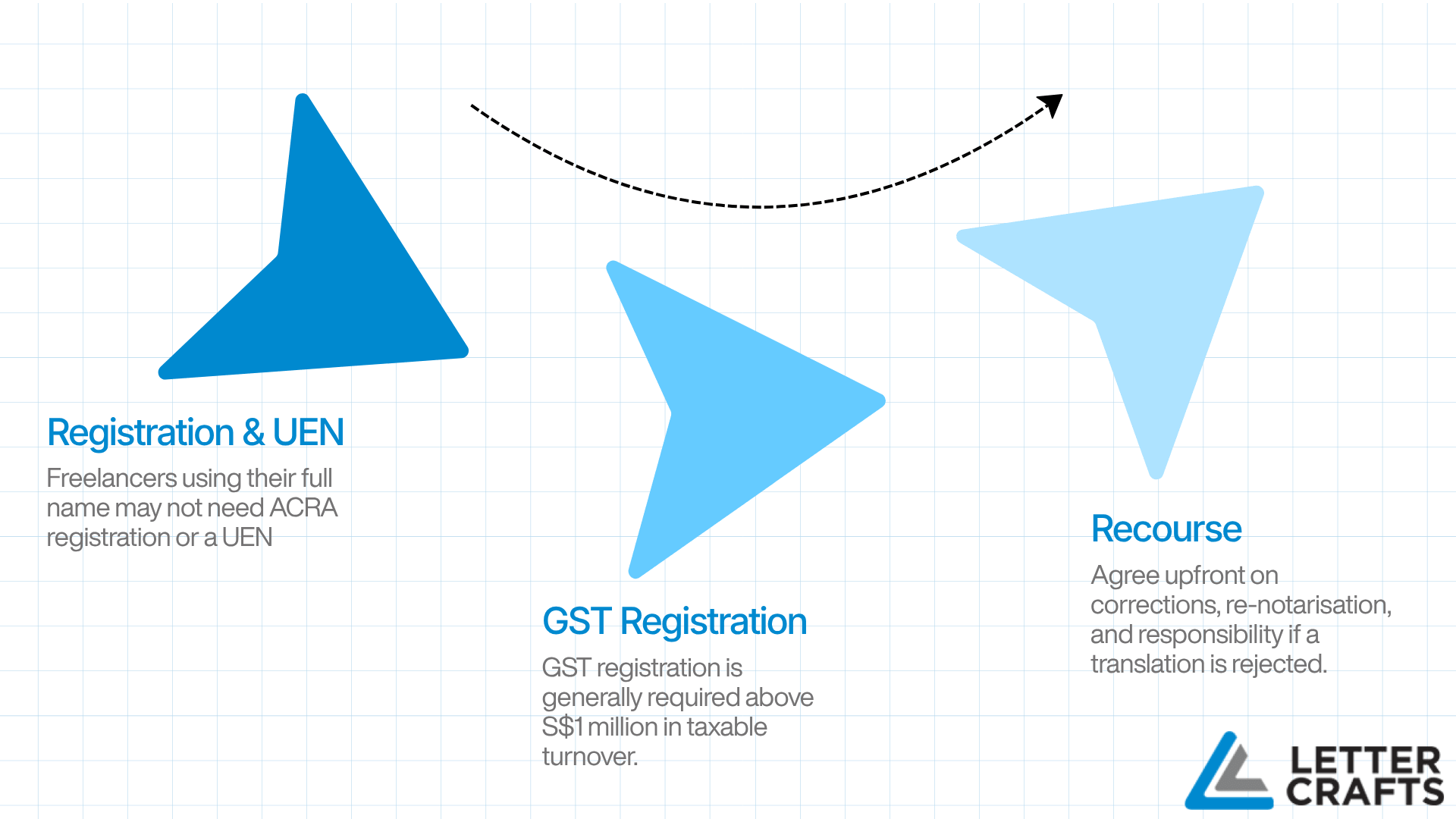
Two Singapore rules explain why freelancer paperwork often looks different from an agency's.
Business Registration and the UEN
Under the Business Names Registration Act, an individual carrying on business under only their own full name is not required to register with the Accounting and Corporate Regulatory Authority (ACRA). A freelancer without a Unique Entity Number (UEN) may be operating perfectly lawfully. It simply gives your finance or procurement team less to verify.
GST Registration
The Inland Revenue Authority of Singapore (IRAS) makes GST registration compulsory only when taxable turnover exceeds S$1 million. Most freelancers and many small agencies sit below that threshold, so whether a quote includes GST tells you little about a provider's size or legitimacy.
Recourse When Something Goes Wrong
With any provider, agree in writing before work starts: what happens if ICA, MOM, or a counterparty queries the translation, whether corrections are free, and who pays for re-notarisation if an error is found after the notarial certificate has been issued. In an informal freelance arrangement, those terms usually do not exist unless you create them. LetterCrafts outlines the knock-on effects of what happens when a translation is rejected by ICA or MOM.
Freelancer or Agency? A Decision Table for Singapore
Find the row closest to your situation. If it spans two rows, follow the stricter one.
| Your situation | Better fit | Confirm before you commit |
|---|---|---|
| Permanent residence, citizenship, or long-term pass documents for ICA | An agency that coordinates notarisation and SAL authentication, or a freelancer if you will manage those steps yourself | Which ICA route the translation will use, and who books the notary |
| One supporting document for an Employment Pass application | Either, provided the translation is professional and certified | The translation will be merged with the original as one file, and names match the passport |
| Several documents for one family's application | Agency | One team applies one spelling of every name across all documents |
| Evidence or other documents for a Singapore court | The court translation service (Chinese, Malay or Tamil into English, 4+ weeks' notice) or a private provider whose named translator will stand behind the work | The form in which your lawyer needs the translation verified |
| Commercial contract or confidential business document | An agency with a written NDA and data-handling policy, or a vetted legal-specialist freelancer under a signed NDA | Where files are stored and whether data leaves Singapore |
| Marketing copy, website or social content | A specialist freelancer or an agency with transcreation capability | Samples in your sector and tone of voice |
| 10,000+ words with repeated content | An agency with translation memory and published volume pricing | How repetitions are charged |
| Rare language pair | A specialist freelancer, unless an agency confirms coverage | Whether a second linguist can revise the work |
| Internal reference only | A freelancer, or machine translation for a rough gist | That it will never be submitted anywhere |
| Tight deadline across multiple documents | Agency | Whether the urgent timeline includes certification and notarisation |
Three Questions That Settle Most Cases
- Will anyone outside your organisation rely on this translation? If not, a competent freelancer is usually enough
- After the translation is written, who handles revision, certification, notarisation and consistency? If the answer is "me", put a value on your time before comparing quotes.
- What does it cost you if the translation is wrong or late? If the answer is a delayed pass, a rejected application, or a disputed contract clause, pay for the process, not just the words.
What to Ask a Freelancer or Translation Agency Before You Pay
Questions to Ask Any Provider
- Who signs the certification, by name, and in what capacity?
- Is the revision done by someone other than the translator?
- Will stamps, seals and handwritten notes be translated?
- Who arranges notarisation and SAL authentication, and is that in the quote?
- What happens if ICA, MOM, or the counterparty queries the translation?
- Where are my files stored, who can see them, and when are they deleted?
- Can you invoice under a registered business name?
- If you claim ISO 17100, is that certification or registration, and which body issued it?
The Red Flag That Applies to Both
Be wary of any provider, freelancer, or agency that calls itself "ICA-approved". ICA says it https://ask.gov.sg/ica/questions/clqety23o002t3k36sgka69f8does not endorse any private translation companies or entities, so the label promises something no one can offer.
For a document-by-document check before you submit, use LetterCrafts' certified translation checklist for Singapore submissions, and see why Singapore authorities reject translations for the most common failure points.
Where LetterCrafts Fits
LetterCrafts Translations is a Singapore-registered translation company (UEN 201728634E) based at Suntec Tower Three. It sits on the agency side of this decision, built around certified translation for government submissions, legal and business translation, and bulk projects.
In practice, that means:
- A three-stage workflow on every certified translation: Translation, independent editing and proofreading, with the certificate of accuracy signed by the named translator.
- The acceptance chain is handled: For ICA and other notarised submissions, LetterCrafts coordinates the Singapore notary public and SAL authentication, or delivers a certified translation ready for you to take through those steps yourself. Its ICA translation and notarisation guide and MOM Employment Pass translation guide explain each route.
- Confidentiality by default: Confidentiality agreements for everyone handling files, no public AI platforms for personal documents, and deletion after delivery unless you ask otherwise.
- Transparent pricing: Certified translation from S$38 per page, standard delivery in 24 to 36 hours, and declining per-word rates for projects above 10,000 words.
If your document is a short, informal text that no one else will rely on, a good freelancer may serve you just as well. For anything an authority or a counterparty will scrutinise, you can request a quote from LetterCrafts.