Key Takeaway
- Bahasa Indonesia translation in Singapore must match the receiving authority. ICA, MOM, ROM, and the Traffic Police each set different certification rules.
- ICA accepts embassy or notary translations, or private translations that the embassy attests, or a notary notarises. It endorses no translation company.
- Singapore notarisations need Singapore Academy of Law authentication (S$87.20). SAL also apostilles Singapore documents bound for Indonesia.
- MOM accepts a provider's translation uploaded with the original as one file, but doesn't treat a notarised translation as proof a degree is genuine.
- Indonesian isn't Malay. ROM's no-translation list includes Malay, not Indonesian, and look-alike words such as pejabat change legal meaning.
- Many Indonesian civil records carry QR-code e-signatures on plain paper. Titles can appear on ID cards but not on birth deeds.
- Contracts with Indonesian parties should be bilingual with a governing-language clause. Imported food needs Indonesian halal certification from 18 October 2026.
Most Indonesian translations that fail in Singapore aren't badly translated. They're translated to the wrong standard. Common examples:
- The translation was certified when ICA wanted it notarised.
- It was notarised when MOM actually needed a qualification verification report.
- A Malay linguist read pejabat as "office" when the Jakarta document meant "government official".
This guide starts from the person who will read your document and works backwards. It covers three situations:
- Indonesian records used in Singapore.
- Singapore documents going to Indonesia.
- The contracts, labels and content Singapore businesses need for the Indonesian market.
Quick answer: Indonesian documents used in Singapore need a complete English translation, in the form the receiving agency accepts.
- ICA: usually a certified translation, notarised by a Singapore notary public and authenticated by the Singapore Academy of Law (SAL).
- MOM: a translation from a translation service provider, uploaded together with the original as one file. This applies to work passes and Dependant's Passes.
- ROM and the Traffic Police: a certified translation.
- Documents going to Indonesia: Indonesian rules apply. That often means an apostille, and sometimes a translation by an Indonesian sworn translator.
Why Indonesian Documents Are So Common In Singapore
Documents move between the two countries every day, in both directions:
- Visitors: Indonesia sent 2.4 million visitors to Singapore in 2025, second only to Mainland China (Singapore Tourism Board).
- Investment: Singapore was Indonesia's largest source of foreign direct investment in 2025, at US$17.4 billion, or 30.9% of the total (Indonesia's Ministry of Investment and Downstream Industry/BKPM).
- Households: MOM counted 323,800 migrant domestic workers in June 2026. MOM publishes its domestic-worker safety agreement in Bahasa Indonesia as well as English.
None of this gives Indonesian official status in Singapore. Singapore's Constitution names Malay, English, Mandarin and Tamil as the official languages, with Malay as the national language.
To a Singapore agency, an Indonesian birth certificate is a foreign-language document like any other. It needs an English translation, and the agency decides what kind.
Which Indonesian Translation Do You Need? Start With Who Will Read It
Three questions decide the format, the certification, and often the choice of translator.
1. Which way is the document travelling?
- Indonesian records coming into Singapore are translated into English.
- Singapore documents going to Indonesia, and contracts or content for Indonesians, are translated into Indonesian. Indonesian offices then set the rules.
2. Who will read it?
Each Singapore agency words its rule differently. The table below summarises them.
3. What proof must travel with it?
The options are:
- a translator's certificate
- a notarial certificate with SAL authentication
- an apostille
- a translator's affidavit
- an Indonesian sworn translation
Each one adds cost and days. Order only what the reader will ask for.
| Who receives it | What the published rule says | Usual route for Indonesian documents |
|---|---|---|
| ICA (PR, citizenship, LTVP and other immigration applications) | Original plus an official translation. This can come from the issuing country's embassy or a notary public, or be a private translation that the embassy attests to or a notary notarises (ICA) | Certified translation, then Singapore notary public, then SAL authentication |
| MOM (work passes, Dependant's Pass) | Original and English translation uploaded together as one file. A translation service provider may translate it (EP, DP) | Certified translation. Notarisation is not part of the stated rule |
| ROM (civil marriage) | Documents not in English, Mandarin, Malay or Tamil must be translated into English by a certified translator (ROM) | Certified translation |
| Traffic Police (licence conversion) | Official translation by a Singapore-registered translation company if the licence isn't in English (SPF) | Certified translation from a registered Singapore company |
| Singapore courts | Proceedings are conducted in English (Judiciary). The Supreme Court's in-house service translates only Chinese, Malay and Tamil (Judiciary) | Private translation, generally verified by the translator's affidavit |
| Indonesian offices (receiving Singapore documents) | Varies by office. Some expect a sworn translator | SAL apostille on the Singapore document. Confirm the translation format with the office first |
Why A Malay Translator Isn't Enough For Indonesian Documents
Indonesian and Malay share a root, and speakers can largely understand each other. That's exactly why they get confused. Two Singapore rules show why the difference matters on paper:
- ROM: ROM's list of languages that don't need translation covers English, Mandarin, Malay, and Tamil. Indonesian isn't on it. One Singapore consular page groups "Malay/Bahasa Indonesia" together, but ROM's own guidance does not. Plan on a certified translation unless ROM tells you otherwise.
- Courts: The Supreme Court's in-house translation service covers Chinese, Malay and Tamil only. An Indonesian exhibit needs a private translator.
The bigger risk is meaning. The two languages developed separately for decades, and some identical-looking words now mean different things:
| Word | In Bahasa Indonesia | In Malay (Malaysia/Singapore) |
|---|---|---|
| pejabat | a government official | an office |
| pengacara | a lawyer or advocate | a master of ceremonies |
| polisi | police | policy |
| polis | an insurance policy | police |
| kereta | a carriage (kereta api: train) | a car |
A Malay-trained linguist can turn an Indonesian deed into fluent English and still get the official, the lawyer, or the insurance policy wrong.
Practical advice: For Indonesian source documents, ask for two things:
- a translator whose working language is Indonesian
- a reviewer who also reads Indonesian
LetterCrafts runs Indonesian translation and Malay translation as separate services.
Common Indonesian Documents And What Their Translations Must Get Right
| Indonesian document | What it is | Typical Singapore use | What the translation must get right |
|---|---|---|---|
| Akta Kelahiran | Civil birth certificate from the civil registry (Dukcapil) | PR, citizenship, Dependant's Pass, school registration | Registry office, deed number, parents' names. Not the hospital's Surat Keterangan Lahir |
| Kartu Keluarga (KK) | Family card listing every household member | Proving family relationships | Every row and column, including relationship status and each member's NIK |
| Surat keterangan belum menikah | Single-status letter, usually from the kelurahan or village office | Proving single status before marriage | Issuing office, date and signatory |
| Buku Nikah / Kutipan Akta Perkawinan | Marriage record. Muslim marriages are registered at the religious affairs office (KUA); others at the civil registry | Spouse-based LTVP, PR and Dependant's Pass | Issuing body and register numbers, exactly as printed |
| Akta Cerai / Akta Perceraian | Divorce certificate. Religious Court (Pengadilan Agama) for Muslims. For others, registered after a District Court (Pengadilan Negeri) decision | Remarriage, marital-status evidence | Court name and case number must match the decree |
| Ijazah, Transkrip Nilai, SKPI | Degree certificate, transcript, diploma supplement | Work passes, university admission, PR | Keep the IPK on its 4-point scale. Render titles like S.H. or S.Kom. with their English meaning |
| SKCK | Police certificate from the Indonesian National Police | Pass and residency applications, when requested (guide) | Validity date and issuing unit |
| SIM | Indonesian driving licence | Traffic Police conversion | Explain classes such as SIM A and SIM C. Don't substitute Singapore classes |
Three changes in Indonesian records that trip up translations
1. QR codes instead of wet stamps
Dukcapil explains that the QR code on its digital records replaces the wet signature and stamp once printed on security paper. Anyone can check authenticity by scanning the code.A birth certificate or KK on plain white A4 paper is therefore not a photocopy. The translation should record the QR code and electronic signature in brackets, the same way it would describe a seal.
2. The two-word name rule
Since April 2022, Permendagri 73 of 2022 has required names on new population records to have at least two words and no more than 60 characters. Records issued earlier remain valid.
Indonesia's civil registration chief also described the two-word requirement as a recommendation applicants can decline. Single legal names are still common, particularly on older records.
3. Titles on some documents but not others
The same regulation allows abbreviated education and religious titles on the KK and e-KTP. It prohibits them on civil registration deeds such as the Akta Kelahiran.
So "H. Budi Santoso, S.E." on a family card and "Budi Santoso" on a birth certificate can be the same man.
Practical advice: A good translation reproduces each document exactly as issued. It doesn't tidy names so they match. Explain any differences separately. MOM, for example, asks for an explanation letter and supporting documents when a passport name differs from other documents.
Names are also where AI tools go wrong most often (here's why).
Two smaller details
- NIK: The 16-digit national identity number should be identical wherever it appears.
- Number format: Indonesian uses a dot for thousands and a comma for decimals. Rp 1.500.000 is one and a half million rupiah, and an IPK of 3,45 is 3.45 on a 4-point scale. Keep the original figure and add the English-format equivalent where it helps.
How To Translate An Indonesian Document For ICA
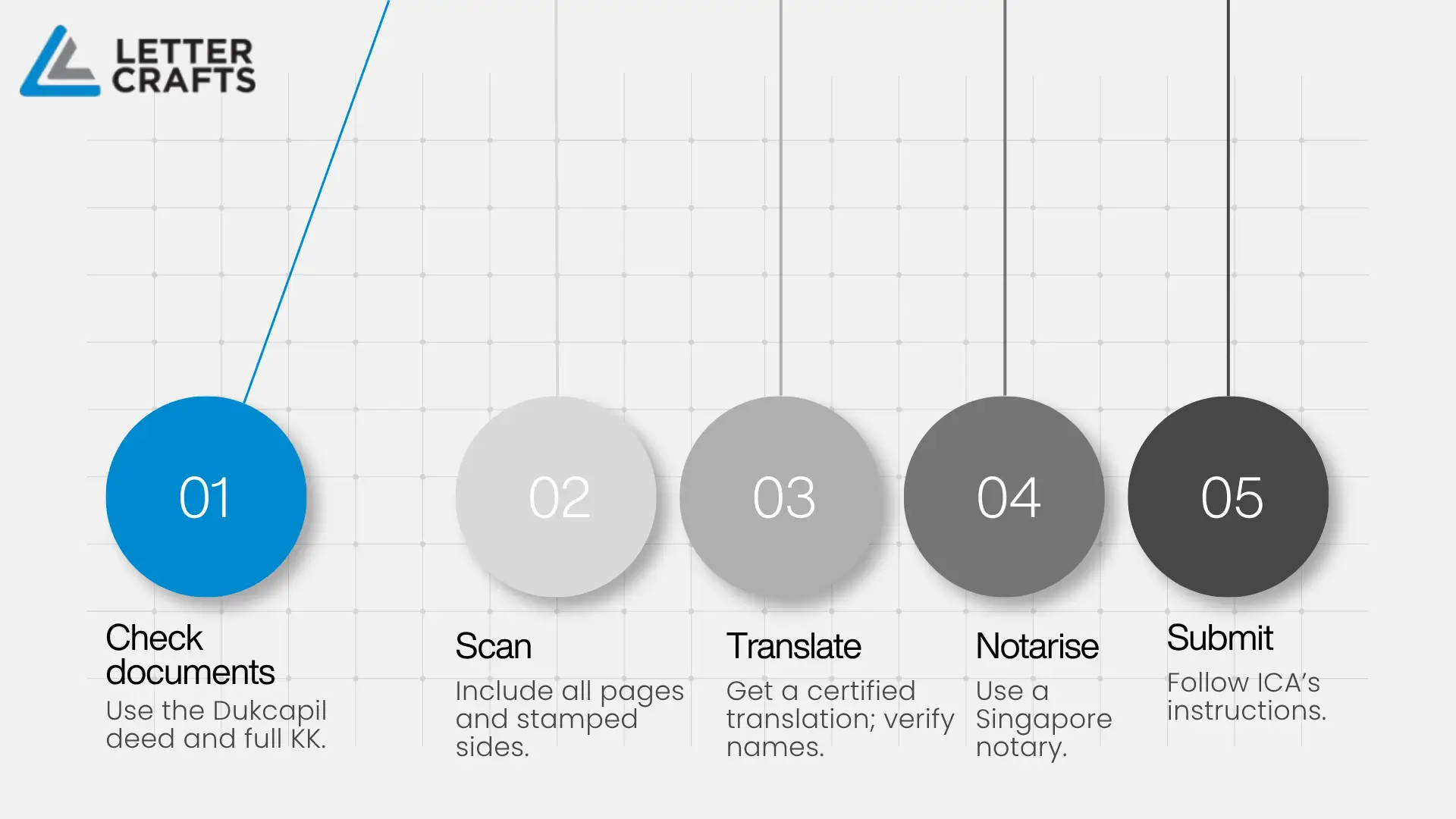
The rule: ICA asks for original documents plus official English translations for anything not in English. It accepts three routes:
- a translation from the issuing country's embassy
- a translation produced by a notary public in Singapore or the issuing country
- a private translation that the embassy attests or a notary public notarises
ICA states it does not endorse any private translation company.
In Singapore, notarisation always includes a second step. Under Rule 8(3)(c) of the Notaries Public Rules, a notarial certificate is invalid until SAL authenticates it. This has applied since 1 October 2019. SAL's fee is S$87.20 including GST, paid through the notary.
Practical advice: For most applicants, the workable route is a private translation notarised in Singapore:
- Check you hold the right document: Use the Dukcapil deed, not a hospital letter, and the full KK, not an extract.
- Scan every page in colour, including any reverse side with stamps or endorsements.
- Commission a certified translation and check the draft against your passport before it's finalised.
- Have it notarised by a Singapore notary public, which triggers SAL authentication.
- Submit the original and the translation as ICA's e-service instructs.
For document-specific details, see LetterCrafts' guides to ICA translation and notarisation, birth certificates, marriage certificates and divorce decrees.
Indonesian Documents For Mom: Work Passes And Dependant's Passes
The rule for translation: For Employment Pass and Dependant's Pass applications, MOM asks for the original non-English document and its English translation uploaded together as one file. It says a translation service provider can do the translation. Notarisation isn't part of the stated rule.
The rule for qualifications: MOM needs separate proof that a qualification is genuine. It accepts proof from:
- a listed background screening company
- an English-language government or institutional portal MOM can check
- a professional body
MOM will not accept:
- education certificates themselves
- documents certified by a notary public
- self-translated screenshots from verification portals
A notarised translation of an ijazah proves nothing about its authenticity. Plan the verification step separately. See LetterCrafts' Employment Pass and S Pass guides.
Bringing family: For a Dependant's Pass, MOM asks for:
- a copy of the marriage certificate for a spouse
- the official birth certificate stating the parents' names for each child
For Indonesian families, that usually means translating the Buku Nikah or Akta Perkawinan, and each child's Akta Kelahiran.
Marrying An Indonesian National In Singapore: ROM First, Then ICA
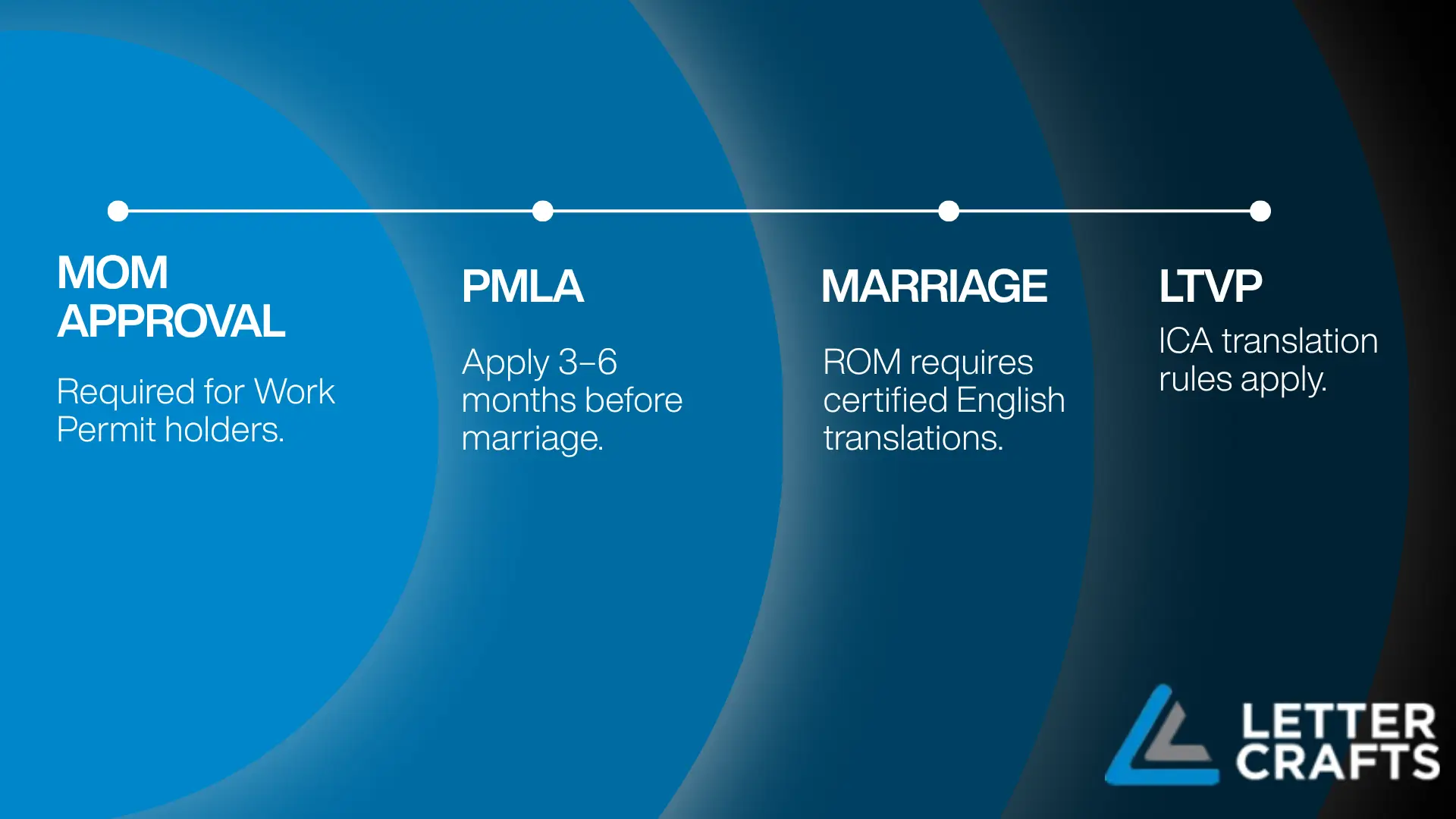
Marrying in Singapore and then applying for the spouse's long-term stay involves several agencies, in this order:
- Work Permit holders need MOM approval first: Current and former Work Permit holders, including domestic workers, must get the Controller of Work Passes' approval before marrying a Singapore citizen or PR. This applies regardless of the type of marriage (ICA).
- Consider the Pre-Marriage LTVP Assessment (PMLA): ICA encourages Singapore citizens to apply three to six months before registering the marriage. It's free and processed within a month (ICA). Couples who complete it get LTVP applications processed in about six weeks.
-
Register the marriage:
- Civil marriages at ROM need at least one non-Muslim partner. ROM requires certified English translations of Indonesian documents.
- If both partners are Muslim, the marriage goes through the Registry of Muslim Marriages instead.
- Apply for the LTVP: From this point, ICA's translation standard applies to the Indonesian documents.
Practical advice: If the same Indonesian documents will go to ROM and then to ICA, consider commissioning ICA's standard (notarised and SAL-authenticated) from the start. A notarised translation still carries the translator's certification, so you avoid translating the same birth or divorce record twice.
Converting An Indonesian Driving Licence (SIM) In Singapore
The rule: According to the Singapore Police Force, you must convert a foreign licence to keep driving in Singapore if you are:
- a new citizen or PR (you can drive on your foreign licence for three months after getting your new status)
- a foreigner living in Singapore for more than 12 months
- a Work Permit or S Pass holder employed as a driver
For conversion, the Traffic Police asks for an official translation by a Singapore-registered translation company if the licence isn't in English. You also need to pass the Basic Theory Test.
Short-term residents from ASEAN countries don't need an International Driving Permit. See LetterCrafts' driving licence translation guide.
Employing An Indonesian Domestic Worker: What To Translate
The rule: MOM requires a safety agreement between employer and worker, arranged by the employment agency. The copy she signs is in her native language, and MOM publishes a Bahasa Indonesia version. MOM encourages, but doesn't require, a written employment contract.
Practical advice: If your contract, house rules or care instructions for a child or elderly parent exist only in English, get them translated into Indonesian. Then both sides are agreeing to the same terms. This is a plain translation job and doesn't need certification.
Sending Singapore Documents To Indonesia: Apostille And Sworn Translation
Legalisation: Both countries belong to the Apostille Convention: Singapore since 16 September 2021, and Indonesia since 4 June 2022.
- For Singapore public documents and notarised documents going to Indonesia, an SAL apostille now replaces the older chain of embassy legalisation.
- Indonesia excluded documents from its prosecutor's office (Allen & Gledhill).
- The same arrangement works in reverse. If a Singapore body asks for an apostille on an Indonesian public document, Indonesia's designated authority issues it.
For how these layers fit together, see certified translation vs notarisation vs apostille.
Translation: Some Indonesian offices, courts, and notaries expect a penerjemah tersumpah. This is a sworn translator appointed through Indonesia's law ministry to translate official documents such as birth and marriage certificates (Kemenkum).
Practical advice: Before you order anything, ask the receiving office three questions:
- Will it accept an apostilled English document as it is?
- Does it need an Indonesian translation?
- Who is allowed to produce that translation?
If a sworn translation is mandatory, a Singapore-certified translation won't replace it.
Bahasa Indonesia Translation For Singapore Businesses
Do contracts with Indonesian companies have to be in Bahasa Indonesia?
Short answer: Yes, Indonesian law requires an Indonesian version when an Indonesian party is involved. Courts have applied that rule inconsistently, so a bilingual contract is the safe choice.
The rule:
- Article 31 of Law No. 24 of 2009 requires Bahasa Indonesia in memoranda of understanding and agreements involving Indonesian state bodies, Indonesian private institutions, or Indonesian individuals.
- Agreements with a foreign party are also written in that party's language or English.
- Article 26 of Presidential Regulation 63 of 2019 restates this. If the versions are interpreted differently, the language the parties agreed on in the contract governs.
How courts have applied it:
- In 2015, Indonesia's Supreme Court nullified agreements with Indonesian parties that had been signed only in English.
- Supreme Court Circular Letter 3 of 2023 later said a missing Indonesian version cannot by itself justify cancelling a contract, unless it resulted from bad faith.
- Indonesian lawyers note that circulars don't bind every court, and the Supreme Court hasn't always followed its own (Walalangi & Partners).
Practical advice:
- Draft the English and Indonesian versions together, with matching clause numbers and defined terms.
- Include a governing-language clause.
- Use a translator who knows Indonesian civil-law terms, such as wanprestasi (breach of contract), PT (limited liability company), and akta notaris (notarial deed).
- Have Indonesian counsel review the final Indonesian text.
This is general information, not legal advice. See legal translation and power of attorney translation.
Indonesian company records and deeds
Singapore parents of Indonesian subsidiaries regularly need Indonesian corporate papers in English, including:
- deeds of establishment and amendment (akta pendirian, akta perubahan)
- shareholder resolutions
- tax filings
- financial statements.
Singapore records such as ACRA business profiles and board resolutions may need to travel the other way, into Indonesian. Ask any provider for NDAs and a stated retention period. See business translation.
Product labels and halal certification for Indonesia
Labels: Imported processed food for retail sale must carry an Indonesian-language label under BPOM Regulation 31 of 2018. The US Department of Agriculture's 2026 Indonesia import report summarises the requirement.
Halal: Government Regulation 42 of 2024 set 17 October 2026 as the latest date for imported food and beverages to comply. BPJPH, Indonesia's halal authority, says mandatory certification applies from 18 October 2026, covering imported products and categories beyond food and drink.
The deadline has moved up. Indonesia delayed the original October 2024 date.
Certification itself runs through BPJPH-recognised bodies and your Indonesian importer. Translation supports it through:
- ingredient specifications
- supplier declarations
- process documents
- the Indonesian label itself
Websites, marketing and customer support in Indonesian
- Register. Anda is the polite "you." Kamu reads as casual and suits some consumer brands. Choose one and use it everywhere, including chat scripts and email templates.
- Vocabulary. Use Indonesian words, not Malaysian ones: mobil, not kereta, for car; kantor, not pejabat, for office.
- Formats. Show prices in rupiah (Rp) with dot separators, and write dates as day-month-year.
- Search. Research keywords in Indonesian from scratch. Literal translations of English keywords often miss how Indonesians actually search.
See transcreation vs. translation.
Healthcare and patient documents
Singapore clinics and hospitals treat Indonesian patients, and translation runs both ways:
- Doctors and insurers need Indonesian medical reports, lab results and referral letters in English.
- Patients need consent forms and discharge instructions in Indonesian.
Medical terms leave no room for approximation. Use a medical translator and an independent reviewer. See medical translation.
Disputes and court filings in Singapore
Singapore court proceedings are conducted in English. Indonesian exhibits fall outside the Supreme Court's in-house translation languages, so they go to a private translator. That translation is generally verified by the translator's affidavit (SingaporeLegalAdvice.com). Your lawyer will confirm the format.
LetterCrafts can arrange affidavit signing and translator court attendance, subject to prior confirmation.
Can You Use Google Translate Or Ai For Indonesian Documents?
Use it to understand an email or get the gist of a document. Don't submit its output to an agency, court, or counterparty.
Raw machine output has no accountable author. There's no translator to sign a certificate, no one for a notary to verify, and no one to swear an affidavit. ISO 17100, the international standard for translation services, places raw machine output plus post-editing outside its scope.
See whether AI can replace certified translation in Singapore?
How Much Does Indonesian Translation Cost In Singapore?
What drives the price:
- The document: a one-page Akta Kelahiran is a different job from a 40-page shareholders' agreement.
- The certification level: each added layer costs more.
- Delivery: email, post, or courier.
SAL's authentication fee is the only fixed government fee in the chain. Notary charges and translation fees vary, so compare quotes line by line.
LetterCrafts' listed prices, as a reference point:
- Indonesian birth certificates and school diplomas: from S$40
- Certified translations generally: from S$38 per page, with no additional GST
- Notarisation of a translation: from S$215
- Notarisation with SAL authentication: one to two working days
Contracts and technical files need a written timeline agreed at the quote stage. See translation pricing in Singapore.
What To Send Your Translator
These five things cut most delays before they start:
- Clear colour scans of every page, front and back, including backs that carry only a stamp.
- Your passport bio page, so names are spelled exactly as ICA and MOM will see them.
- The receiving agency and application type, for example, "ICA PR" or "MOM Dependent's Pass." This decides the certification level.
- Any name-difference evidence, such as a deed poll or documents showing titles or spellings that vary.
- Your deadline, and whether you need hard copies.
For a fuller pre-submission list, see the certified translation checklist for Singapore submissions.
Six Mistakes That Get Indonesian Translations Rejected
- Translating the wrong document: A hospital birth letter or an old photocopy goes in instead of the Dukcapil deed or its QR-coded version.
- Harmonising names: The translator changes a name to match the passport, or drops titles so documents agree. Translate each document as issued and explain differences separately.
- Leaving things out: Every stamp, QR code, handwritten note, reverse-side endorsement, and KK row belongs in the translation.
- Using a Malay linguist for Indonesian: The English reads fluently but gets official and legal terms wrong.
- Converting figures: The translator recalculates an IPK or rupiah amount instead of keeping the original and clarifying the format.
- Guessing the certification level: Notarising for MOM wastes money. Sending ICA a translation without notarisation and SAL authentication risks rejection.
More fixes: why Singapore authorities reject translations.
How LetterCrafts Handles Indonesian Translation
LetterCrafts is a Singapore-registered translation company (UEN 201728634E) covering more than 80 languages. Its Indonesian service runs separately from Malay. For an Indonesian job, expect the following:
- Scans or photos are enough to start. Originals are needed only if a lawyer must certify the originals themselves.
- A quote in about 30 minutes. The request form asks whether you need notarisation and SAL authentication, and how you want delivery.
- Draft approval before anything is stamped. You can check names, NIK, and dates against your passport.
- A signed, stamped certificate of translation on LetterCrafts letterhead, with the layout mirroring your original (samples).
- Notarisation and SAL authentication in one to two working days when ICA or another recipient needs them.
- Affidavit signing and court attendance for litigation, subject to prior confirmation.
- Confidentiality. Translators work under NDAs and Singapore's data protection law. Documents are kept for no more than three months and deleted on request once the job is complete.
-
Delivery options:
- free SingPost hard copy (three to five days)
- courier for S$25 (next day)
- collection from the notary's office at The Adelphi, by appointment
What LetterCrafts won't claim:
- ICA endorses no private translation company, so no provider can promise ICA pre-approval.
- A Singapore certified translation isn't an Indonesian sworn translation. If your document is going to an Indonesian office that insists on a penerjemah tersumpah, say so at the quote stage so the right route can be confirmed.
Ringkasan Untuk Pembaca Indonesia (Summary for Indonesian Readers)
Dokumen berbahasa Indonesia untuk instansi Singapura perlu diterjemahkan secara lengkap ke dalam bahasa Inggris. Bentuknya tergantung instansi penerima:
- ICA menerima terjemahan dari kedutaan, dari notaris publik, atau terjemahan swasta yang disahkan oleh kedutaan atau dinotariskan. Di Singapura, notarisasi selalu disertai autentikasi oleh Singapore Academy of Law (SAL).
- MOM, termasuk untuk Dependant's Pass, menerima terjemahan dari penyedia jasa terjemahan. Terjemahan diunggah bersama dokumen aslinya dalam satu file.
Pastikan ejaan nama sama persis dengan paspor, dan jangan menambahkan nama keluarga yang tidak ada di dokumen.
Untuk dokumen Singapura yang akan dipakai di Indonesia, tanyakan dulu kepada instansi penerima apakah diperlukan apostille dan terjemahan oleh penerjemah tersumpah.
LetterCrafts dapat mulai bekerja dari hasil pindaian atau foto dokumen Anda.
The Bottom Line
The approach is the same whether you're a family applying for PR or a company signing a joint venture:
- Find out who will read the document.
- Give them the certification they ask for, and no more.
- Use a translator who works in Indonesian, not Malay.
Most rejections trace back to skipping one of those steps. If you have an Indonesian document and a deadline, send LetterCrafts a scan and say where it's going. The right route follows from there.